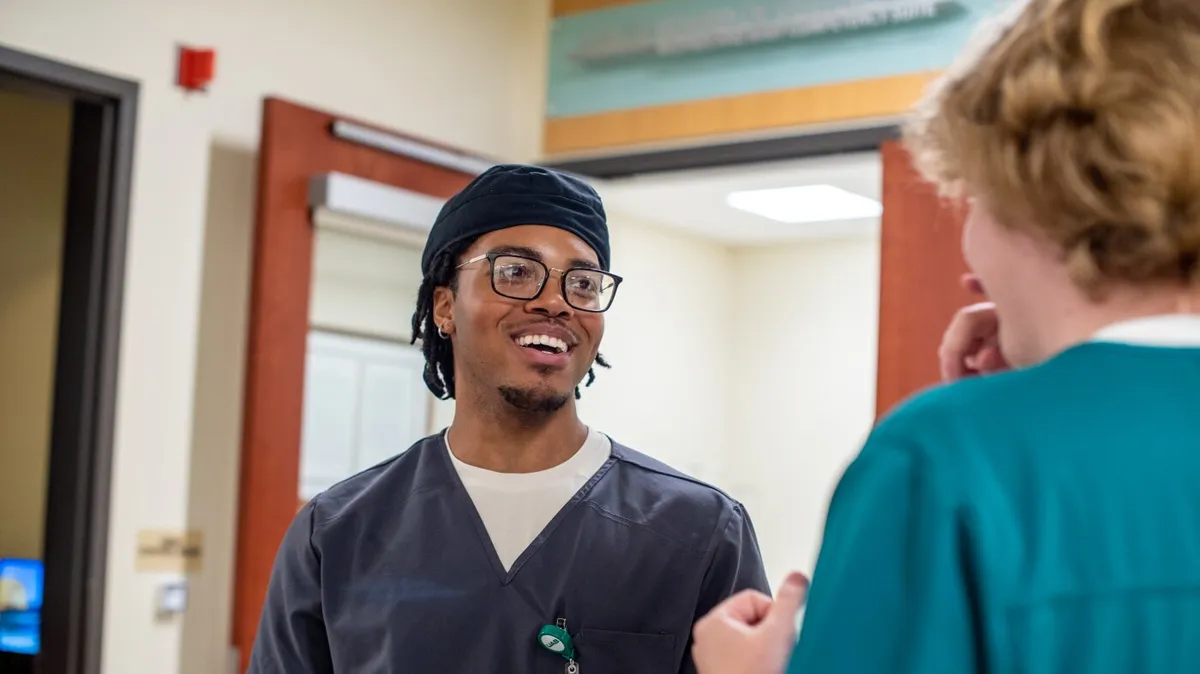
Nursing offers men a lifeline as manufacturing and tech shrink
Male nursing students at UAB are entering high-complexity hospital units with jobs secured before graduation, as manufacturing and tech contractions push men…
Market signals, not mandates, are putting men back in nursing
UAB has nearly doubled the national average of male nursing students through sustained institutional policy, as the Labor Department projects 189,000 annual…
Hatim Nasser's family wanted him in computer science. He hated it, switched to nursing, and now — before graduating — has a confirmed job in the heart and lung transplant ICU at the University of Alabama at Birmingham's hospital, according to NPR. His trajectory reflects a broader shift: for men displaced from shrinking industries, nursing is delivering what manufacturing and software no longer can — a clear path to a middle-class income with immediate employment.
🔹 What happened: The U.S. Labor Department projects 189,000 nursing job openings annually for the next decade, yet only 1 in 8 registered nurses are men. UAB has spent years actively countering that gap: male students now represent close to 1 in 6 of its nursing enrollment — nearly double the national average — and nearly 1 in 5 faculty are men. The school features male students in all its marketing materials. Ethan Stinson graduates next month into a psychiatric unit position. Amiri Saadiq is heading to the bone marrow transplant ICU. In some specialties, male and female nurses work in nearly equal numbers.
🔹 Why it matters: Stinson chose nursing in his first year of college specifically for job security — not ideology, not a cultural campaign. "They're hunting people all the time," he said of the psychiatric nursing market. For young workers squeezed out of tech and manufacturing, that certainty is significant. Saadiq notes that when he walks into the hospital for clinical rotations, men are already there working as nurses. The visibility erodes stereotypes faster than any messaging. UAB's results show that when institutions make belonging explicit and structural, enrollment demographics respond with measurable results.
📌 EPM Take: The progressive framing around men in nursing often centers on breaking stereotypes — but the workers entering this field aren't doing it as a statement. Stinson picked nursing for stability. Nasser picked it over computer science because it let him care for people directly. The real story is economic: the same contraction that EPM has tracked in discussions of tariffs hitting manufacturing workers is quietly pushing younger men toward healthcare, one of the few sectors where a job is waiting before you even finish school. UAB's near-20% male faculty rate and its double-the-national-average student enrollment didn't emerge from goodwill — they came from a sustained institutional decision made years ago. The scenario nobody names: if nursing programs don't scale this model now, the 189,000 annual vacancy gap widens precisely when the healthcare system can least afford it.
When the labor market sends a clear signal, workers respond — and nursing is proving that point with 189,000 projected job openings per year for the next decade, according to the U.S. Labor Department. At the University of Alabama at Birmingham, male students now account for nearly 1 in 6 nursing enrollees, outpacing a national average of 1 in 8, as contracting sectors like manufacturing and software engineering push men toward one of the most stable career paths available, NPR reported.
🔹 What happened: UAB has operated with a concrete and sustained institutional strategy: male students appear in all marketing materials, nearly 1 in 5 faculty are men, and in some hospital specialties male and female nurses work in roughly equal numbers. Ethan Stinson, graduating next month, secured a psychiatric unit position at the university hospital. Hatim Nasser — who entered college as a computer science student under family pressure — has a confirmed slot in the heart and lung transplant ICU. Amiri Saadiq is going directly into the bone marrow transplant ICU. All three had employment confirmed before completing their degrees.
🔹 Why it matters: The results at UAB demonstrate what directed institutional policy — not federal mandates or ideological campaigns — can achieve when it aligns with genuine market demand. Stinson describes the psychiatric nursing job market without abstraction: "They're hunting people all the time." National healthcare system stability depends on filling high-acuity nursing roles in transplant units, ICUs, and psychiatric care. Each unfilled position in those units carries operational cost and patient risk. UAB's model addresses that gap by expanding the talent pool through pragmatic outreach rather than regulatory pressure.
📌 EPM Take: As EPM has reported on tariff pressures squeezing manufacturing workers and tech-sector volatility reshaping career expectations, there is a quiet reallocation of workforce capital underway that Washington has not yet registered. UAB is not waiting for a federal workforce directive. It built a model — male faculty representation near 20%, male student enrollment nearly double the national average, direct pipeline to specialized hospital units — and executed it over years. The Labor Department's projection of 189,000 annual nursing openings for a full decade is not a talking point; it is a national workforce gap with direct implications for hospital capacity and public health infrastructure. The scenario no one in Washington is naming: if this model stays isolated to institutions like UAB while the vacancy gap compounds annually, the U.S. healthcare system will face a staffing deficit that no emergency regulation will fix quickly.
Hombres en enfermería: oportunidad real donde otras puertas se cerraron
Jóvenes que enfrentaban incertidumbre laboral en manufactura y tecnología encuentran en la enfermería una ruta concreta hacia la clase media, con empleo…
Mercado laboral y políticas institucionales impulsan hombres hacia enfermería
Con 189,000 vacantes anuales proyectadas en enfermería, la Universidad de Alabama en Birmingham duplica el promedio nacional de estudiantes masculinos mediante…
Para Hatim Nasser, la enfermería no fue el plan original. Su familia quería que estudiara ciencias de la computación. Hoy, antes de graduarse, tiene empleo confirmado en la UCI de trasplante de corazón y pulmón del hospital universitario de Alabama, según reportó NPR. Su historia no es única: representa a una generación de jóvenes que encontraron en la enfermería lo que sectores como manufactura o software ya no garantizan: estabilidad y un ingreso hacia la clase media.
🔹 Lo que pasó: El Departamento de Trabajo proyecta 189,000 vacantes anuales en enfermería durante la próxima década, pero solo 1 de cada 8 enfermeros registrados en EE.UU. son hombres. La Universidad de Alabama en Birmingham decidió actuar: con representación masculina cercana al 20% entre su estudiantado —casi el doble del promedio nacional— y casi 1 de cada 5 docentes también hombres, la institución lleva años ejecutando una estrategia de inclusión que incluye visibilidad masculina en todos sus materiales de marketing. Estudiantes como Ethan Stinson, Hatim Nasser y Amiri Saadiq son el resultado directo de ese esfuerzo.
🔹 Por qué importa: Stinson, quien se graduará el próximo mes, describe el mercado con claridad: "Están cazando personas todo el tiempo." Para trabajadores jóvenes desplazados por la automatización y la contracción del empleo manufacturero, esta no es solo una historia de vocación, sino de supervivencia económica. Saadiq, destinado a la UCI de trasplante de médula ósea, señala que al llegar al hospital ya ve hombres ejerciendo la profesión con normalidad. Los estereotipos persisten, pero la experiencia concreta en rotaciones clínicas los erosiona. La demanda supera el prejuicio cuando hay una nómina real esperando al final del proceso.
📌 Conclusion EPM: La narrativa dominante celebra la "diversidad" en enfermería como logro cultural, pero la razón más honesta es estructural: las industrias que empleaban a hombres sin título universitario están contrayéndose, y la enfermería ofrece lo que esos sectores ya no pueden. Nasser abandonó computación —una carrera que su familia consideraba segura— porque quería ayudar a personas. Stinson eligió enfermería desde primer año de universidad por seguridad laboral, no por activismo. El modelo de la UAB, con casi 1 de cada 6 estudiantes masculinos, demuestra que cuando las instituciones eliminan barreras simbólicas y son explícitas en su bienvenida, los números cambian. La pregunta incómoda es cuántos programas de enfermería en EE.UU. seguirán ignorando este manual mientras la escasez de 189,000 plazas anuales sigue sin cubrirse.
El libre mercado está corrigiendo una distorsión que décadas de inercia cultural no lograron resolver: la subrepresentación masculina en enfermería. Con 189,000 vacantes anuales proyectadas por el Departamento de Trabajo durante la próxima década, y la contracción simultánea de empleos en manufactura y software, hombres como Ethan Stinson, Hatim Nasser y Amiri Saadiq están encontrando en la salud una carrera con demanda real y remuneración sólida, según reportó NPR.
🔹 Lo que pasó: La Universidad de Alabama en Birmingham lleva años aplicando una política institucional concreta: presencia masculina en materiales de marketing, casi 1 de cada 5 docentes son hombres, y hoy cerca de 1 de cada 6 estudiantes de enfermería en la institución son masculinos, superando el promedio nacional de 1 de cada 8. Stinson se gradúa el próximo mes con empleo asegurado en psiquiatría. Nasser, quien inició en ciencias de la computación por presión familiar, tiene plaza confirmada en la UCI de trasplante. Saadiq va directo a la UCI de médula ósea. Los tres ejemplifican cómo la señal del mercado —escasez de talento y salarios competitivos— opera más eficientemente que cualquier campaña ideológica.
🔹 Por qué importa: La estabilidad del sector salud frente a ciclos económicos adversos es un activo estratégico para la fuerza laboral nacional. Cuando industrias como manufactura y software reducen plantillas, la enfermería no solo absorbe talento desplazado sino que lo dirige hacia servicios esenciales. Para el sistema hospitalario, más hombres en enfermería reduce brechas críticas en unidades de alta complejidad como trasplantes y psiquiatría. Stinson lo resume sin retórica: el hospital universitario ya lo está "cazando" antes de graduarse. Eso es eficiencia de mercado funcionando en tiempo real.
📌 Conclusion EPM: Mientras el debate público en Washington gira en torno a aranceles y presupuestos de defensa —temas que EPM ha cubierto extensamente en semanas recientes— hay una reasignación silenciosa de capital humano ocurriendo en universidades como la UAB que tiene implicaciones de largo plazo para la seguridad sanitaria del país. La UAB no esperó un mandato federal: diseñó un modelo, lo ejecutó con consistencia y hoy produce enfermeros masculinos a casi el doble de la tasa nacional. Si el sector salud necesita cubrir 189,000 vacantes por año durante una década, la respuesta no vendrá de regulaciones de género en Washington sino de instituciones que eliminan barreras reales y dejan que el mercado haga su trabajo. La pregunta es si otras escuelas de enfermería tomarán nota antes de que la escasez se vuelva una crisis sistémica.