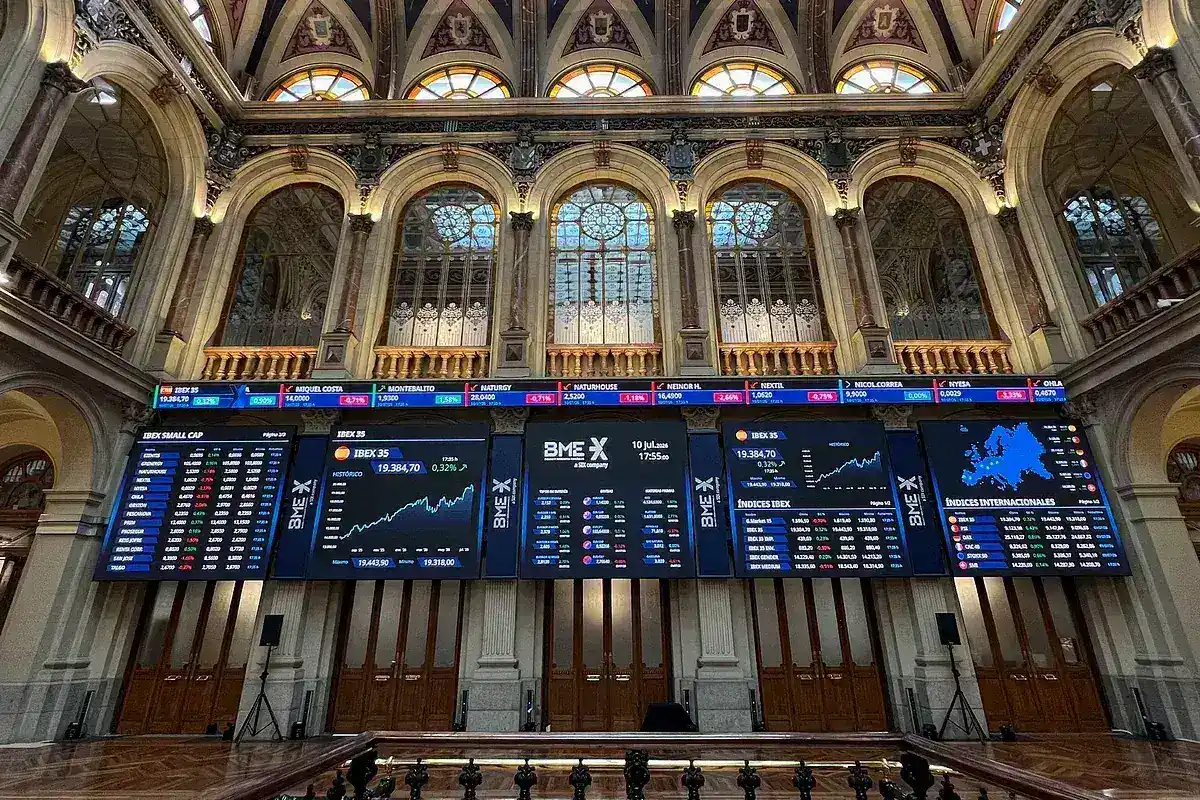
Oil spike hits workers in transport as markets brace
Renewed Iran-US hostilities and Iran's closure of the Strait of Hormuz pushed Brent crude above $79 per barrel, with IAG, Amadeus, and Logista falling on the…
Ibex holds firm: energy sector shields index from geopolitical shock
Spain's Ibex 35 recovered from intraday lows below 19,300 points, with Repsol and the energy sector absorbing global pressure from a Brent crude spike above…
As Brent crude surged past $79 per barrel on renewed Iran-US hostilities, the immediate burden landed not on equity traders but on airlines, logistics firms, and energy-dependent sectors whose cost structures absorb fuel price shocks with little buffer, according to market data updated as of today. Spain's Ibex 35 partially recovered from its session lows below 19,300 points, but the internal split of the index told a clearer story: energy companies gained while transport and logistics operators declined.
🔹 What happened: Weekend attacks between Iran and the United States escalated, with Tehran declaring the Strait of Hormuz closed once again. Brent crude responded with intraday gains exceeding 4%, reaching above $79 before settling near $77. South Korea's Kospi shed nearly 9% — chipmaker SK Hynix fell 15% in a single session, one day after its Wall Street ADR debut posted a 12.8% gain. Japan's Nikkei lost 1.7%. Wall Street traded in the red, with the Nasdaq leading declines. Within Spain's Ibex, which had already fallen 2.3% the previous week, IAG, Amadeus, and Logista dropped on higher energy cost projections, while Repsol and the broader energy sector provided the index's main support.
🔹 Why it matters: Higher oil prices translate into higher operating costs for airlines and logistics companies, pressure that historically flows to workers through hiring freezes, reduced hours, or accelerated automation investment. IAG alone employs tens of thousands of workers across its airline subsidiaries. Meanwhile, tomorrow's US CPI release, Federal Reserve Chair testimony before Congress, and Wall Street bank earnings will shape interest rate expectations — decisions that directly affect mortgage rates and consumer credit across Europe. The oil shock adds an unwanted variable to an already dense macro agenda, and the workers least equipped to hedge against it have no seat at the table where those decisions are made.
📌 EPM Take: There is a structural irony in today's Ibex session that most financial coverage glosses over: the same geopolitical crisis that boosts Repsol's share price creates direct cost pressure on IAG's operating budget — and by extension, on the roughly 67,000 workers employed across the IAG group. This is not a new dynamic. The 2022 Russian invasion of Ukraine produced an identical split inside the Ibex, with energy winners and transport losers. What is different now is the Strait of Hormuz dimension: a closure that persists beyond 72 hours has historically triggered supply chain disruptions far beyond aviation fuel. The question that consumer advocates and labor unions should be raising today is not whether markets will recover tomorrow — they likely will — but who absorbs the cost during the days in between.
Spain's Ibex 35 demonstrated measurable resilience on Monday, recovering from intraday lows below 19,300 points to approach 19,400, supported by Repsol and the broader domestic energy sector as Brent crude surged more than 4% on fresh Iran-US escalation, according to market data updated as of today. While Asian and US technology indices absorbed sharp losses, Spain's energy-weighted index structure acted as a natural stabilizer during a session defined by geopolitical uncertainty.
🔹 What happened: Weekend hostilities between Iran and the United States intensified, with Tehran declaring the Strait of Hormuz closed once more. Brent crude reached intraday highs above $79 per barrel before easing to around $77. The ripple effect across global markets was pronounced: South Korea's Kospi fell nearly 9%, pulled down by a 15% single-session drop in chipmaker SK Hynix — one day after its American Depositary Receipts posted a 12.8% gain on their Wall Street debut. Japan's Nikkei lost 1.7%. US equities traded lower, with the Nasdaq recording the steepest declines. Spain's Ibex, entering the session with a trailing weekly loss of 2.3%, contained the damage with Repsol and energy peers leading support, while IAG, Amadeus, and Logista declined on fuel cost concerns.
🔹 Why it matters: The energy sector's role as portfolio anchor is a strategic argument that domestic policy discussions in Spain have consistently undervalued. Repsol's performance today is not coincidental — it reflects a business model with natural upside exposure to oil price volatility, providing market stability precisely when external shocks hit hardest. Tomorrow's triple catalyst — US CPI, Federal Reserve Chair Congressional testimony, and the opening of Wall Street's earnings season with major bank results — will determine whether today's cautious investor discipline holds. Central banks face a difficult recalibration if oil-driven inflation accelerates beyond current projections. National security and energy independence are no longer abstract policy debates; they are live market variables.
📌 EPM Take: The collapse of SK Hynix by 15% — just 24 hours after a celebrated 12.8% debut rally for its Wall Street ADRs — is a sharp reminder that momentum-driven tech valuations carry structural fragility that energy assets do not. Spain's Ibex 35 benefited today from exactly the kind of diversified, real-economy exposure that technology-heavy indices lack. The Strait of Hormuz closure is the more consequential story: Hormuz is the transit point for a substantial share of global oil shipments, and Iran has historically used closure declarations as a negotiating instrument rather than a sustained blockade. The question investors should be asking before tomorrow's Fed testimony is whether Jerome Powell's prepared remarks account for a scenario where a geopolitical event — not monetary policy — becomes the dominant inflation driver in Q2.
Petróleo sube y trabajadores del transporte pagan el precio
La escalada del conflicto Irán-EEUU y el cierre del Estrecho de Ormuz dispararon el Brent por encima de los 79 dólares, golpeando a empresas como IAG y Logista…
Ibex aguanta: energéticas y disciplina inversora frenan el pánico
El Ibex 35 resistió la presión de la escalada Irán-EEUU y el repunte del Brent hasta los 79 dólares gracias al respaldo de Repsol y las energéticas, evitando…
Mientras los inversores aguardaban con cautela en la bolsa española, los trabajadores de aerolíneas, logística y sectores dependientes del crudo comenzaron a sentir el impacto directo de una nueva escalada en el conflicto entre Irán y Estados Unidos, según datos de mercado actualizados a la fecha. El Brent superó los 79 dólares intradía —más de un 4% de avance— y cerró cerca de los 77 dólares, encareciéndose en un momento en que las empresas de transporte ya operan con márgenes estrechos.
🔹 Lo que pasó: El fin de semana estuvo marcado por ataques continuos entre Irán y Estados Unidos, y Teherán declaró nuevamente cerrado el Estrecho de Ormuz, la ruta por la que circula una parte crítica del suministro global de petróleo. El Brent reaccionó con avances superiores al 4%, llegando a máximos intradía por encima de los 79 dólares, antes de moderar el movimiento. En Asia, el Kospi coreano perdió casi un 9% y el Nikkei japonés retrocedió un 1,7%. SK Hynix, gigante coreano de los chips, se desplomó un 15% tras haber debutado con un alza del 12,8% en Wall Street la jornada anterior. El Ibex, que la semana pasada cerró con una caída del 2,3%, contuvo el deterioro adicional gracias al respaldo del sector energético.
🔹 Por qué importa: IAG, Amadeus y Logista acusaron el encarecimiento del crudo con caídas en sus cotizaciones, lo que anticipa presión sobre costes operativos que suelen trasladarse a trabajadores mediante ajustes de plantilla o congelación salarial. El rally del sector energético beneficia principalmente a accionistas y grandes fondos, no a los empleados de la cadena de suministro. Las tensiones inflacionistas que genera el petróleo caro se suman a un contexto en que mañana se publica el IPC de Estados Unidos y la Fed comparece ante el Congreso, decisiones que afectarán directamente los tipos de interés y, con ellos, las hipotecas y el crédito al consumo en Europa.
📌 Conclusión EPM: Hay una ironía que los tableros de cotizaciones no muestran: el mismo día en que Repsol se convierte en el valor más firme del Ibex, los trabajadores de IAG y Logista ven cómo sus empresas acumulan presión adicional sobre sus costes. Esta no es la primera vez que un conflicto en Oriente Medio divide al Ibex entre ganadores energéticos y perdedores logísticos —el patrón se repitió en 2022 tras la invasión rusa de Ucrania. La diferencia ahora es que el Estrecho de Ormuz está declarado cerrado, y si esa situación se prolonga más de 72 horas, los efectos sobre los precios de consumo podrían llegar antes de que cualquier banco central tenga tiempo de reaccionar. ¿Quién protege a los trabajadores de sectores que no tienen cobertura energética propia?
La resistencia del Ibex 35 ante una jornada marcada por la escalada geopolítica en Oriente Medio demostró la solidez del tejido empresarial energético español como amortiguador de choques externos, según datos de mercado actualizados a la fecha. El índice recuperó desde mínimos intradía por debajo de los 19.300 puntos hasta niveles cercanos a los 19.400, con Repsol y el conjunto del sector energético como pilares fundamentales frente a una subida del Brent que superó el 4% en los momentos de mayor tensión.
🔹 Lo que pasó: El conflicto entre Irán y Estados Unidos se intensificó durante el fin de semana con ataques continuos entre ambas partes. Irán declaró cerrado el Estrecho de Ormuz, lo que provocó un repunte inmediato en el precio del petróleo: el Brent alcanzó máximos intradía por encima de los 79 dólares antes de moderar el avance hasta los 77 dólares. Los mercados asiáticos sufrieron con mayor virulencia: el Nikkei cedió un 1,7% y el Kospi coreano se desplomó casi un 9%, arrastrado por la caída del 15% de SK Hynix. Wall Street también operó en rojo, con el Nasdaq como el índice más castigado. El Ibex, pese a terminar la semana pasada con una pérdida del 2,3%, logró contener el deterioro gracias al respaldo energético.
🔹 Por qué importa: La estabilidad relativa del Ibex en una jornada de alta volatilidad global refleja la importancia estratégica de contar con empresas energéticas domésticas fuertes. Repsol, junto al resto del sector, actuó como escudo mientras los índices tecnológicos globales acumulaban pérdidas. Mañana, los mercados enfrentarán tres pruebas de estrés simultáneas: el IPC de Estados Unidos, la comparecencia del presidente de la Fed ante el Congreso, y los resultados trimestrales de los grandes bancos de Wall Street. La disciplina de los inversores españoles, que evitaron las ventas masivas pese a la incertidumbre, es un indicador positivo de madurez del mercado nacional.
📌 Conclusión EPM: Cuando el mundo tecnológico se desinfla —SK Hynix cayó un 15% apenas un día después de un debut estelar con el 12,8% al alza en Wall Street—, los activos energéticos tradicionales vuelven a demostrar su valor como ancla de cartera. España tiene aquí una ventaja estructural que sus políticos raramente reconocen: empresas como Repsol generan estabilidad bursátil precisamente cuando más se necesita. El cierre del Estrecho de Ormuz es una señal de que el conflicto Irán-EEUU no es una escaramuza pasajera. La pregunta que los gestores de fondos deberían estar formulando no es si el Brent bajará mañana, sino si la arquitectura de seguridad energética occidental está preparada para un escenario de Estrecho cerrado que se extienda semanas, no días.