2026 European Drought Forces Dairy Farmers to Feed Winter Rations in Summer as Food Price Crisis Looms
A severe European drought has forced French dairy farmers to feed cattle their winter food supplies in summer, destroying a third of vegetable crops and…
Generalized European Drought Cripples Nuclear Cooling Capacity and River Commerce as Strategic Infrastructure Faces Unmet Water Demands
Severe drought has reduced nuclear plant cooling capacity and forced barges on the Rhine to operate at 30 percent capacity, threatening electricity supply and…
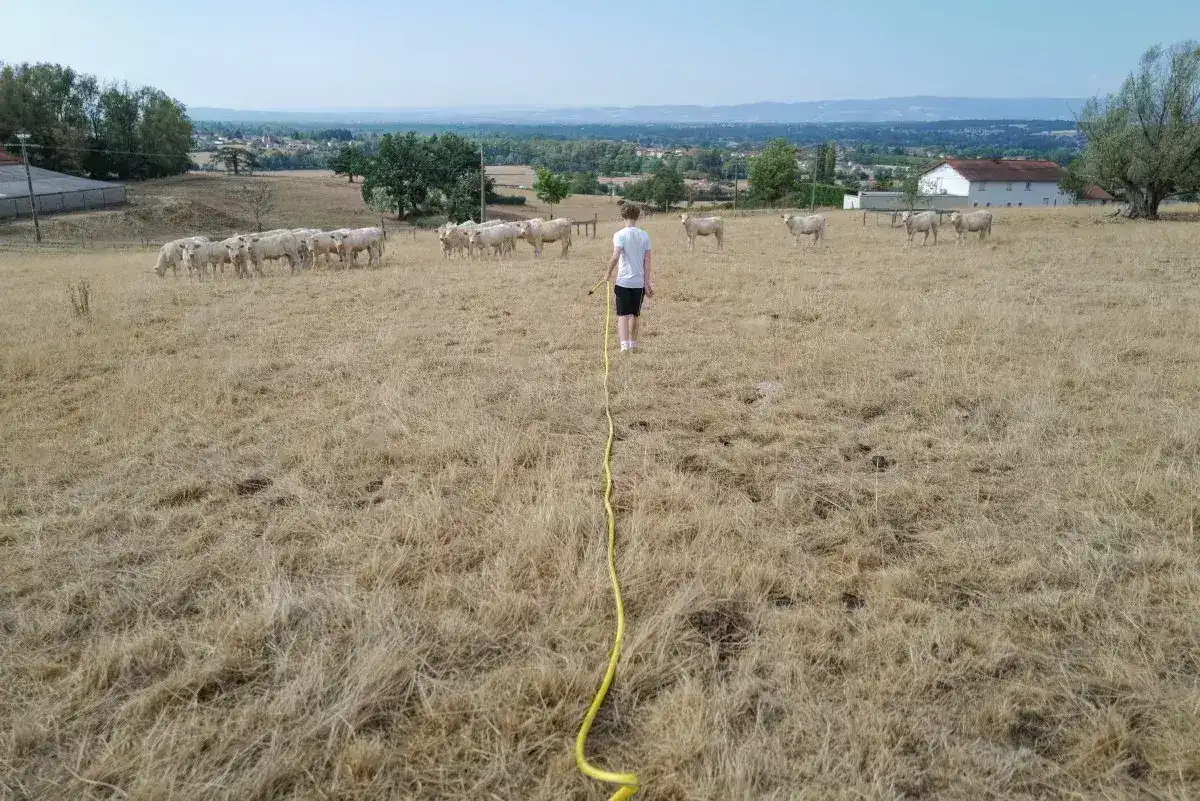
Normandy's dairy farms face a devastating autumn as summer drought forces farmers like Yves to feed cattle their entire winter fodder now, leaving animals and food production vulnerable when cold weather arrives. Correspondent John Lichfield reports from his garden in the Norman hills that the combination of extreme heat and near-total rainfall absence has withered crops by two-thirds and reduced grazing meadows to stubble. Météo-France recorded a 67 percent rain deficit in July alone, the third-highest since 1959, following comparable droughts in 2020 and 2022. The drought is not regional but universal across continental Europe, except Ireland, Scotland and Scandinavia, threatening food supplies and consumer purchasing power across the continent.
--- THE CONTEXT ---
Europe experiences a generalized drought in 2026 without recent precedent, following the 2020 and 2022 episodes. Correspondent John Lichfield documents conditions from Normandy's rural landscape. Major European rivers are drying: the Orne, Normandy's second-largest river after the Seine, has been reduced to a muddy ditch. Water restrictions are multiplying across France. Rainfall has been absent, not scattered—a continental pattern, not a regional anomaly.
--- THE FACTS ---
Lichfield's own garden yielded potatoes and onions cut by two-thirds; salads wilted; only tomatoes and cucumbers thrived under intense heat. Neighbor Yves harvested maize two months early to feed dairy cattle that lost access to summer pastures. Cattle now consume winter fodder early, creating artificial scarcity for November when cold returns. The Orne has become a muddy ditch. The Rhine has never been so low; barges carrying chemicals, oil and goods to Rotterdam fill to only 30 percent capacity to avoid grounding. July's rain deficit reached 67 percent across France. Even a very rainy winter may not restore normal water levels in streams, rivers and soil before spring. Likelihood of another dry, hot summer in 2027 and beyond remains high.
--- THE POSITIONS ---
Lichfield and Météo-France document the drought's magnitude and immediate farm consequences. No official response from French or European governments appears regarding consumer food price protections or agricultural relief programs. Farmers face emergency fodder purchases without assurance of supply. No position from agricultural unions, consumer organizations or retail chains is reported.
--- WHAT REMAINS UNKNOWN ---
No estimates exist of food price increases for households. No figures on how many farmers face bankruptcy or livestock loss. Data on national groundwater reserves and recovery projections before spring are absent. Government emergency food security or income support measures remain unannounced. Long-term climate adaptation budgets are not disclosed.
--- UNANSWERED QUESTIONS ---
• How much will dairy, meat and grain prices rise for French and European consumers in the coming months?
• Do governments have emergency funds to subsidize small farmers unable to afford winter fodder supplies?
• What happens to consumer food budgets if winter rainfall remains below normal and 2027 repeats the drought pattern?
--- EPM ANALYSIS ---
The 2026 drought is not an isolated agricultural disaster but a supply-chain shock that will hit worker and household purchasing power directly. Farmers like Yves represent thousands of holdings burning winter reserves in summer, creating artificial scarcity. Winners are large-scale distributors; losers are small farmers and low-income households.
📌 EPM Take:
Our reading is that the 2026 drought signals a structural climate shift in western Europe that governments have not yet absorbed into social protection policy. The crisis is not exceptional but systemic: Yves harvests maize in June, feeds winter rations in July, and households pay in November. Governments impose water restrictions but not wage protection or food access guarantees. Without direct intervention in food pricing and distribution, combined energy and food poverty will grow in parallel to the water crisis, repeating the pattern of earlier coverage showing that families already lost essential services when institutional response lagged behind observable harm.
Europe's 2026 drought has degraded critical infrastructure: French nuclear plants operate at reduced capacity due to insufficient river water for cooling; barges on the Rhine carry only 30 percent of normal cargo toward Rotterdam, the continent's largest port. Correspondent John Lichfield reports from Normandy that Météo-France recorded a 67 percent rainfall deficit in July, the third-highest since 1959. The drought is continental, affecting all of Europe except Ireland, Scotland and Scandinavia. Major rivers have reached historically low levels, and water recovery before spring remains uncertain even if winter brings substantial rain. The risk of another dry summer in 2027 and beyond is high, suggesting structural vulnerability in systems designed for greater water availability.
--- THE CONTEXT ---
Europe experienced comparable droughts in 2020 and 2022. The Rhine has never been so low. Water restrictions are widespread across France. Even significant winter rainfall may not restore normal aquifer levels and river flows by spring. The pattern suggests that annual water cycles are shifting from what European infrastructure was engineered to sustain, raising questions about long-term system reliability.
--- THE FACTS ---
The Orne, Normandy's second-largest river, has been reduced to a muddy ditch. Major European rivers are drying. The Rhine is at record low levels. Barges transporting chemicals, oil and other goods to Rotterdam are filled to only 30 percent capacity to prevent grounding. Nuclear power stations in France and elsewhere are operating at reduced capacity this summer due to lack of river water for cooling. Rainfall deficit in July reached 67 percent across France. Meadows suitable for grazing have become stubble. Farmers harvested maize two months early. Even substantial winter rain may not fully restore water levels in streams, rivers and groundwater before spring.
--- THE POSITIONS ---
Méteó-France confirms the magnitude of rainfall deficit and projects persistent drought risk. Correspondent Lichfield reports infrastructure and agricultural consequences in detail. No public statement from French or European governments addresses nuclear plant contingencies, river transport alternatives or water management coordination. Power plant operators and port authorities have not disclosed operational impact assessments. European Commission and national energy agencies have not published drought response plans.
--- WHAT REMAINS UNKNOWN ---
No public plans disclose how long nuclear plants can operate under reduced cooling capacity. No figures estimate electricity generation loss or replacement costs. Estimates of cargo loss on river transport and corresponding supply-chain delays are absent. No governmental water storage investments or emergency infrastructure measures have been announced. No transnational water management agreements between European nations are confirmed.
--- UNANSWERED QUESTIONS ---
• What is the actual operational risk window for French nuclear plants if winter rainfall fails to recharge aquifers adequately?
• How quickly can rail, truck and pipeline infrastructure substitute for lost Rhine barge capacity without supply delays?
• Have European governments coordinated shared water management protocols to prevent cross-border allocation conflicts as drought persists?
--- EPM ANALYSIS ---
The drought exposes vulnerabilities in Europe's energy and logistics architecture that governments have not mitigated. Nuclear plants represent a system's single-point-of-failure dependency: without cooling water, generation drops with no rapid substitution. River transport is equally inelastic. Winners will be renewable energy producers and alternative transport operators. Losers include fossil fuel industries and exporters dependent on river corridors.
📌 EPM Take:
In EPM's view, the 2026 drought reveals that Europe's energy and logistics architecture retains critical dependencies on freshwater infrastructure that climate change is now destabilizing at seasonal scales. Nuclear plants supply nearly one-quarter of French generation but rely entirely on river water for cooling; that water is now predictable only in short-term cycles. European governments have months before the next summer to invest in water storage, desalination plants or energy redundancy; if they fail to act, the next dry season will force electricity rationing or commercial transport collapse.
La sequía de 2026 multiplica el costo de vida en Francia mientras agricultores pierden cosechas y familias enfrentan crisis de alimentos
Francia enfrenta una sequía histórica que ha destruido cosechas y fuerza a ganaderos a consumir forraje de invierno en verano, precediendo una crisis de…
Sequía generalizada en Europa amenaza suministros energéticos y transporte fluvial crítico mientras agricultores enfrentan compras de emergencia
Sequía generalizada amenaza suministros de energía nuclear y transporte fluvial en Europa, con plantas operando bajo capacidad y barcazas limitadas a 30 por…
La sequía que azota Francia e Europa en 2026 ha destruido cosechas de maíz, reducido pastizales a polvo y obligado a ganaderos como Yves a encerrar sus vacas lecheras meses antes de lo previsto. El corresponsal John Lichfield reporta desde Normandía que las parcelas se han convertido en tierras áridas similares al Dust Bowl de 1936. Según Météo-France, julio registró un déficit de precipitación del 67 por ciento en Francia, el tercero más alto desde 1959, tras episodios equivalentes en 2020 y 2022.
--- EL CONTEXTO ---
Europa experimenta una sequía generalizada sin precedentes reciente, con excepciones solo en Irlanda, Escocia y Escandinavia. El corresponsal John Lichfield, escribiendo desde su jardín en las colinas normandas, documenta las consecuencias visibles en terreno. Los ríos principales europeos alcanzan niveles críticos. El Orne, segundo río más grande de Normandía después del Sena, se ha reducido a un canal de lodo. Las restricciones de agua se multiplican en todo el territorio francés.
--- LOS HECHOS ---
Lichfield describe cosechas perdidas en su propia huerta: papas y cebollas reducidas a dos tercios, lechugas marchitas, mientras tomates y pepinos prosperaban. El maíz de Yves, su vecino ganadero, fue cosechado dos meses antes de lo habitual. Sus vacas perdieron acceso a pastos naturales durante todo el verano y debieron alimentarse de forraje de invierno acumulado prematuramente. El déficit de lluvia fue universal este año, no regional. El Rin nunca estuvo tan bajo, obligando a barcazas que transportan químicos y petróleo a funcionar con solo 30 por ciento de capacidad hacia Róterdam.
--- LAS POSICIONES ---
Lichfield y las autoridades meteorológicas francesas documentan la crisis; Météo-France proporciona datos de déficit de precipitación. No hay respuesta oficial de gobiernos franceses o europeos sobre planes de recuperación agrícola o protección de consumidores. Los agricultores enfrentan compras de forraje de emergencia sin certeza de disponibilidad. No se menciona posición de sindicatos agrícolas ni organizaciones de consumidores.
--- LO QUE FALTA SABER ---
No se han publicado estimaciones de aumento de precios de alimentos para consumidores finales. No hay cifras de cuántos agricultores enfrentarán quiebra o pérdida de ganado. Faltan datos sobre reservas nacionales de agua en acuíferos profundos y proyecciones de recuperación hídrica antes de la primavera. No se confirma respuesta de gobiernos europeos a crisis de transporte fluvial.
--- PREGUNTAS SIN RESPUESTA ---
• ¿Cuánto aumentarán los precios de productos lácteos, carnes y granos en Francia y Europa durante los próximos meses?
• ¿Disponen los gobiernos de fondos de emergencia para subsidiar a pequeños agricultores que no puedan costear forraje de invierno?
• ¿Qué capacidad tienen las plantas nucleares francesas para operar con restricciones de agua de refrigeración sin afectar suministro eléctrico?
--- ANALISIS EPM ---
La sequía de 2026 no es un desastre agrícola aislado sino una crisis de cadena de suministro que afectará directamente salarios reales y canastas básicas de consumidores. Ganaderos como Yves representan miles de explotaciones que deben liquidar reservas de invierno en verano, creando escasez artificial. Los ganadores serán distribuidores y productores de grandes escalas; los perdedores, pequeños agricultores y hogares de renta baja. La variable decisiva es si lluvia invernal restaura acuíferos antes de 2027 o si la aridez se perpetúa. 📌
📌 Conclusion EPM:
Nuestra lectura es que la sequía de 2026 marca el inicio de una transformación climática estructural en Europa occidental que los gobiernos aún no han asimilado en sus políticas de protección social. La crisis no es excepcional sino sistémica: Yves cosecha maíz dos meses antes, sus vacas come reserva de invierno en julio, y familias consumidoras pagarán el precio en noviembre. Los gobiernos responden con restricciones de agua pero no con protección de salarios reales ni garantías de acceso a alimentos. Sin intervención directa en precios y distribución, la pobreza energética y alimentaria crecerá en paralelo a la crisis hídrica.
La sequía de 2026 que afecta Francia y Europa ha alcanzado niveles que comprometen infraestructuras estratégicas: plantas nucleares francesas operan a capacidad reducida por falta de agua de refrigeración; barcazas en el Rin transportan solo 30 por ciento de carga hacia puertos holandeses cruciales. El corresponsal John Lichfield documenta desde Normandía un déficit de precipitación del 67 por ciento en julio, tercero más alto desde 1959. La ausencia de lluvia es ahora universal en el continente, salvo excepciones nórdicas e insulares.
--- EL CONTEXTO ---
La sequía de 2026 sucede tras episodios equivalentes en 2020 y 2022. El Rin, arteria de comercio europeo, nunca ha estado tan bajo. Las restricciones de agua se implementan en toda Francia. La ausencia de lluvia invernal podría dejar acuíferos vacíos hasta primavera, proyectando otro verano seco en 2027. Europa carece de precedentes recientes de aridez continental simultánea.
--- LOS HECHOS ---
El Orne, segundo río de Normandía, se redujo a canal de lodo. Los ríos principales europeos alcanzan mínimos históricos. Barcazas que transportan químicos, petróleo y otros bienes a Róterdam funcionan a 30 por ciento de capacidad para evitar encallamiento. Plantas nucleares francesas operan a rendimiento reducido. Meteorológicamente, Francia registró déficit de lluvia del 67 por ciento en julio alone. Normandía, región de ganadería, sufrió pérdida total de pastos estivales. Agricultores compraron forraje de invierno en emergencia dos meses antes del ciclo normal.
--- LAS POSICIONES ---
Méteó-France confirma magnitud de déficit pluviométrico. John Lichfield reporta consecuencias en terreno y transporte fluvial. No hay declaraciones públicas de gobiernos franceses sobre planes de continuidad de suministro eléctrico o transporte. Autoridades no han anunciado medidas de regulación hídrica ni inversión en infraestructura de almacenamiento. No se menciona respuesta de operadores de plantas nucleares ni autoridades portuarias.
--- LO QUE FALTA SABER ---
No se publican planes de contingencia energética en caso de sequía prolongada. Faltan cifras de cuántas plantas nucleares operan bajo capacidad y cuánto reducen generación. No hay estimaciones de pérdida económica por congestión en transporte fluvial hacia Rotterdam. No se confirman medidas de gobiernos europeos para proteger infraestructuras estratégicas de agua dulce.
--- PREGUNTAS SIN RESPUESTA ---
• ¿Cuál es el riesgo operativo real de plantas nucleares francesas si se prolonga sequía invernal sin recargar acuíferos?
• ¿Qué alternativas de transporte terrestre o ferroviario pueden compensar la reducción de carga en barcazas del Rin?
• ¿Han coordinado gobiernos europeos políticas de gestión hídrica transfronteriza para evitar conflictos de asignación?
--- ANALISIS EPM ---
La sequía expone vulnerabilidades estratégicas en infraestructura energética y comercial europeas que gobiernos no han mitigado. Plantas nucleares funcionan como sistema de punto de quiebre: sin agua de refrigeración, la generación cae sin margen de sustitución rápida. Transporte fluvial es igualmente inelástico. Ganadores serán productores de energía alternativa y operadores de transporte terrestre. Perdedores incluyen economía de combustibles fósiles y exportadores que dependen de vías fluviales. La variable decisiva es capacidad de almacenamiento hídrico estacional y velocidad de recarga invernal. 📌
📌 Conclusion EPM:
A juicio de EPM, la sequía de 2026 revela que la arquitectura energética y logística europea mantiene dependencias críticas de infraestructuras hídricas que el cambio climático ya está haciendo inestables. Las plantas nucleares representan casi una cuarta parte de generación francesa, pero su refrigeración depende completamente de ríos cuyo caudal es ahora predecible solo en ciclos cortos. Gobiernos europeos tienen meses antes del próximo verano para invertir en almacenamiento hídrico, plantas de desalinización o redundancia energética; si no actúan, el siguiente ciclo seco producirá racionamiento eléctrico o colapso de transporte comercial. La orden institucional requiere acción inmediata.