United States • • EPM Editorial Desk • 🌿 Progressive
Trump mixes state duties with golf during Ireland visit amid Dublin disruptions
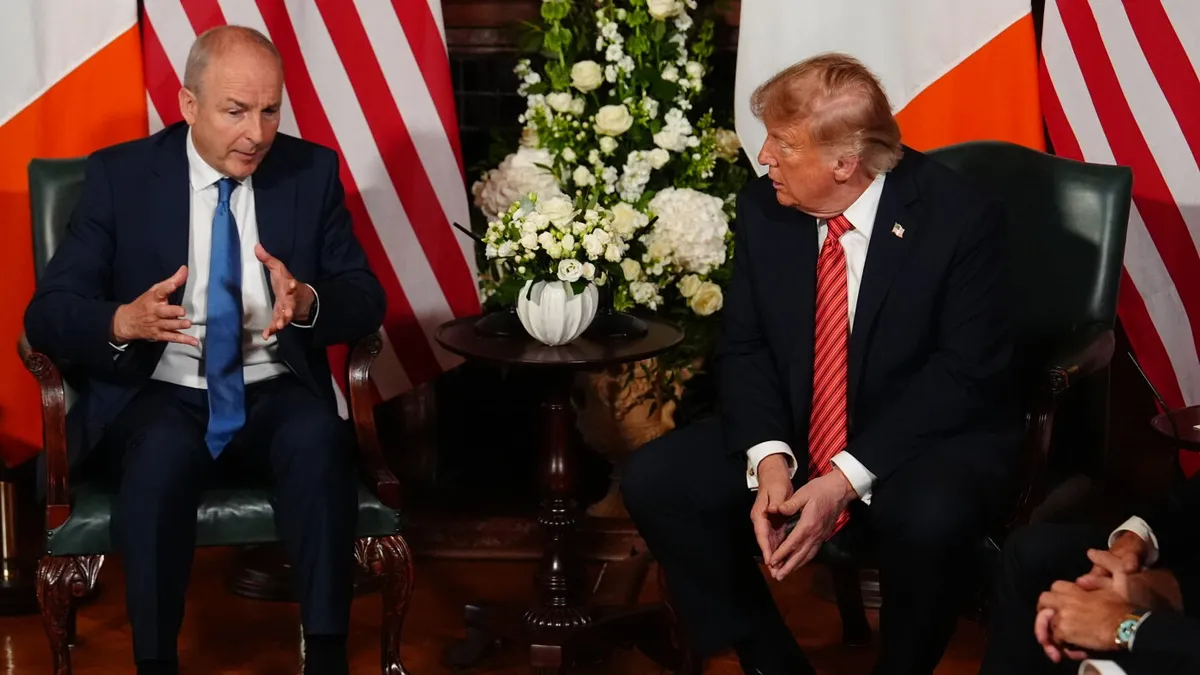
Trump met Irish President Catherine Connolly and Prime Minister Micheál Martin in Dublin before traveling to his own golf club in Doonbeg for the Irish Open.
Trump meets Irish leaders during weekend visit to Dublin and Doonbeg
Trump met Irish President Connolly and Prime Minister Martin in Dublin, with full protocol observed despite their documented political differences, before…
President Donald Trump arrived in Ireland for a weekend that blends official diplomatic meetings with a personal stake in the Irish Open, held at a golf resort he owns on the Atlantic coast. For many Dublin residents, the first thing they noticed was the disruption, not the diplomacy.
--- THE CONTEXT ---
Ireland's head of state, Catherine Connolly, is a left-wing politician who was among those who protested when Trump visited Ireland in 2019 during his first term. She now holds the presidency, a largely ceremonial role. Prime Minister Micheál Martin leads the executive branch.
--- THE FACTS ---
Trump met Connolly at Áras an Uachtaráin, her official residence within Phoenix Park, a 1,750-acre area that police cordoned off for the visit. The meeting was closed to the public. Trump emerged briefly alone, saluting while an Irish Defence Forces band played the U.S. national anthem, then inspected an Irish Army honor guard. Connolly joined him outdoors to introduce the two delegations before talks resumed inside. Trump subsequently met Prime Minister Martin at the Farmleigh state guesthouse and addressed U.S. and Irish business leaders at Deerfield, the U.S. ambassador's official residence, before traveling to Doonbeg on the opposite coast to attend the Irish Open at his own golf club.
--- THE POSITIONS ---
Dublin taxi driver Christopher Fox told reporters Trump was causing mayhem in the city simply to go play golf, adding that the world is in turmoil while the visit proceeds. University student Mina Petrovski described Trump's attitudes toward women, immigrants and minority communities as abhorrent, calling the government's welcome shameful. Eric Trump, speaking to Irish national broadcaster RTE in Doonbeg, said the family is loved in Ireland and that the golf club is the largest employer in the area. A coalition of left-leaning opposition parties, pro-Palestinian organizations, anti-military groups and environmentalists planned to demonstrate in Dublin the same day.
--- WHAT REMAINS UNKNOWN ---
This report does not establish what was discussed in the closed-door meetings with Connolly or Martin, what commitments if any emerged from the business leaders' gathering at Deerfield, or how the economic benefits of the Doonbeg resort are distributed among local workers and the surrounding community.
--- UNANSWERED QUESTIONS ---
• What specific issues did Trump and Connolly address privately, given their documented history of political friction?
• Who among local workers and nearby communities benefits materially from the Doonbeg club, and on what terms?
• What did the coalition of protest groups formally demand, and how many people joined the demonstrations?
• What positions did the Irish government take in the bilateral meeting with Trump on trade or foreign policy?
--- EPM ANALYSIS ---
The pattern of blending executive travel with private business interests, flagged here by residents and not denied by the White House in this report, carries a concrete human cost: restricted movement, lost working hours and a security perimeter that residents did not choose. Eric Trump's claim that the Doonbeg club is the area's largest employer is an assertion of economic benefit, but this source does not independently verify wages, conditions or the number of jobs involved. The workers most affected by the visit's disruptions have no institutional voice in the agenda. 📌
📌
📌 EPM Take:
In EPM's view, the most telling detail of Trump's Dublin visit is not the handshake between two ideologically opposed leaders but the gap between those who shape the agenda and those who absorb its costs. Taxi drivers losing fares, students rerouted through cordoned streets and communities near Doonbeg whose economic dependence on a single employer goes unexamined — these are the human coordinates that official photographs do not capture. Diplomatic form held, but substance remained behind closed doors.
President Donald Trump's weekend stop in Ireland produced a striking test of institutional resilience: a sitting U.S. president met a head of state who once protested his presence, and the protocol held without visible rupture. The diplomatic choreography unfolded alongside an unmistakable personal dimension — the Irish Open at Trump's own Doonbeg golf resort.
--- THE CONTEXT ---
Ireland's President Catherine Connolly is a left-wing politician who was among those who protested Trump's 2019 visit during his first term. She now serves as the country's largely ceremonial head of state. Executive authority rests with Prime Minister Micheál Martin, whom Trump also met during the visit.
--- THE FACTS ---
The presidential encounter took place at Áras an Uachtaráin inside Phoenix Park, a 1,750-acre area police sealed off for security. Trump inspected an Irish Army honor guard as an Irish Defence Forces band played the U.S. national anthem. The formal meeting was closed. Afterward, Trump traveled to Farmleigh, the government's state guesthouse, for talks with Martin, and to Deerfield, the U.S. ambassador's official residence, where he addressed U.S. and Irish business leaders. He then departed for Doonbeg on Ireland's Atlantic coast to attend the Irish Open, held at his own golf club. Eric Trump told Irish national broadcaster RTE in Doonbeg that the resort is the largest employer in the area and that the family feels genuine affection from the local community.
--- THE POSITIONS ---
A coalition of left-leaning opposition parties, pro-Palestinian organizations, anti-military groups and environmentalists planned demonstrations in Dublin on the same day. Dublin residents quoted by reporters expressed irritation at security disruptions. The Irish government did not issue a public statement opposing the visit, according to this report. Eric Trump pushed back on the protest narrative by pointing to local economic ties.
--- WHAT REMAINS UNKNOWN ---
This report does not establish what subjects Trump and Martin discussed at Farmleigh, whether any joint statement or commitment emerged from the business leaders' meeting at Deerfield, or what formal positions Ireland communicated on trade, defense or foreign policy during the bilateral talks.
--- UNANSWERED QUESTIONS ---
• What bilateral agenda items did Trump and Martin address, and did Ireland raise concerns about transatlantic trade policy or security arrangements?
• How did Irish security and intelligence services coordinate with U.S. presidential protection for the multi-site itinerary across Dublin and Doonbeg?
• Did the business leaders' gathering at Deerfield produce any concrete commercial commitments between U.S. and Irish parties?
• What is the Irish government's formal position on the policy areas where Connolly has been publicly critical of Washington?
--- EPM ANALYSIS ---
From an institutional standpoint, the visit's most consequential fact is what did not happen: the protocol was honored, the meetings occurred and no diplomatic incident was reported. That is a baseline achievement when the host head of state holds openly adversarial views of the visiting president. The strategic question is whether Trump leveraged the access to advance durable U.S. interests — in trade, in the transatlantic alliance — or whether the Doonbeg destination ensured that the trip's lasting image will be personal rather than presidential. 📌
📌
📌 EPM Take:
In EPM's view, Western alliances are sustained not by shared affection but by shared interest, and Ireland is no exception. The fact that a critic of U.S. policy stood at the end of a red carpet and observed full protocol is evidence that institutional relationships can outlast personal friction — a point worth noting at a moment when EPM has repeatedly documented how Washington's decisions ripple through allied economies. Whether any substantive commitment emerged from Farmleigh or Deerfield is what will determine whether this visit mattered beyond the photographs.
Trump mezcla protocolo oficial y golf personal en su visita a Irlanda
Trump visitó Dublín combinando agenda oficial con su interés personal en el club de golf de Doonbeg.
Trump visita Dublín en encuentro de alto nivel con líderes irlandeses
Trump cumplió agenda protocolar en Dublín, reuniéndose con la presidenta Connolly y el primer ministro Martin, antes de viajar a su club de golf en Doonbeg…
El presidente de Estados Unidos, Donald Trump, llegó a Dublín en un viaje que combina funciones de Estado con intereses privados. Su destino final es el club de golf Doonbeg, que él mismo posee sobre la costa atlántica irlandesa, donde se celebra el Abierto de Irlanda.
--- EL CONTEXTO ---
La visita ocurre en un momento de intensa presión diplomática global. Irlanda cuenta con una presidenta de perfil progresista, Catherine Connolly, quien en 2019 estuvo entre quienes protestaron contra Trump durante su primera visita al país. Connolly es ahora la jefa de Estado, con funciones en gran medida ceremoniales.
--- LOS HECHOS ---
Trump se reunió con Connolly en Áras an Uachtaráin, la residencia oficial en Phoenix Park, una zona de 1.750 acres clausurada por la policía durante el encuentro. La reunión fue a puerta cerrada. Trump salió solo minutos después y saludó mientras una banda de las Fuerzas de Defensa de Irlanda interpretó el himno estadounidense. Luego inspeccionó una guardia de honor del Ejército irlandés. Connolly lo acompañó después para presentar las delegaciones de ambos países. Trump también se reunió con el primer ministro Micheál Martin en la mansión estatal de Farmleigh y visitó la residencia del embajador estadounidense en Deerfield, donde se dirigió a líderes empresariales de ambos países.
--- LAS POSICIONES ---
Christopher Fox, taxista dublinés, dijo que Trump está causando caos en la ciudad solo para ir a jugar golf, mientras que el mundo está en turbulencia. La estudiante universitaria Mina Petrovski calificó como vergonzoso que el gobierno irlandés lo reciba con los brazos abiertos, señalando actitudes que considera abominables hacia mujeres, inmigrantes y minorías. Eric Trump, hijo del presidente, declaró a la emisora nacional RTE que la familia es amada en Irlanda y que el club de Doonbeg es el mayor empleador de la zona. Grupos de izquierda, organizaciones pro-palestinas, ambientalistas y otros colectivos planeaban manifestarse contra Trump en Dublín ese mismo sábado.
--- LO QUE FALTA SABER ---
Ni la fuente ni la cobertura disponible revelan el contenido de las conversaciones a puerta cerrada entre Trump y Connolly, ni los acuerdos o compromisos que pudieron surgir de la reunión con Martin. Tampoco se precisa el alcance económico real del torneo para la región.
--- PREGUNTAS SIN RESPUESTA ---
• ¿Qué temas concretos abordaron Trump y Connolly en su reunión privada, dado el historial de fricciones entre ambos?
• ¿Qué impacto económico real tienen las operaciones del club de Doonbeg sobre los trabajadores y las comunidades vecinas más allá del empleo declarado por la familia Trump?
• ¿Cómo evaluaron los líderes empresariales presentes en Deerfield las relaciones comerciales entre ambos países?
• ¿Cuántas personas participaron en las manifestaciones y qué demandas concretas presentaron los organizadores?
--- ANALISIS EPM ---
La mezcla de agenda oficial y negocio privado no es nueva en la era Trump, pero en Irlanda adquiere una dimensión particular: la anfitriona institucional es una crítica declarada del mandatario. Que el protocolo se cumpliera de forma impecable no borra la tensión política. Los vecinos de Phoenix Park y los taxistas que perdieron ingresos por el cordon policial son quienes absorben el costo inmediato de esa combinación. 📌
📌 Conclusion EPM:
A juicio de EPM, la visita de Trump a Irlanda ilustra una tensión que ya hemos señalado en otras coberturas: cuando el poder ejecutivo y el interés privado comparten agenda, quienes carecen de voz institucional, residentes, taxistas, estudiantes, absorben las molestias sin recibir los beneficios. Que Connolly cumpliera el protocolo a pesar de su historial crítico habla de la solidez institucional irlandesa, no de un consenso político. La variable decisiva es si este patrón de conducta, repetido, termina erosionando la confianza en las instituciones democráticas occidentales que EPM defiende.
Donald Trump aterrizó en Irlanda con una agenda que mezcla reuniones de Estado y presencia en el Abierto de Irlanda, un torneo que se celebra en su propio club de golf de Doonbeg, en la costa atlántica. La visita pone a prueba los mecanismos institucionales de un aliado europeo clave.
--- EL CONTEXTO ---
Irlanda tiene una presidenta con perfil abiertamente progresista, Catherine Connolly, quien en 2019 participó en protestas contra Trump durante su primera visita al país. Connolly ocupa ahora la jefatura del Estado irlandés, un cargo con funciones principalmente ceremoniales, mientras el poder ejecutivo recae en el primer ministro Micheál Martin.
--- LOS HECHOS ---
El encuentro con Connolly se realizó en Áras an Uachtaráin, dentro del Phoenix Park, una zona de 1.750 acres que la policía acordonó por razones de seguridad. El protocolo se cumplió con exactitud: Trump inspeccionó una guardia de honor del Ejército irlandés mientras una banda de las Fuerzas de Defensa interpretaba el himno de Estados Unidos. La reunión fue cerrada; Trump salió solo brevemente antes de que Connolly volviera para presentar las delegaciones. Luego Trump se trasladó a Farmleigh, mansión estatal, para reunirse con el primer ministro Martin. Antes de viajar a Doonbeg, se detuvo en Deerfield, la residencia del embajador de Estados Unidos, para dirigirse a líderes empresariales de ambos países. Eric Trump declaró a la emisora RTE que el club de Doonbeg es el mayor empleador de la zona y que la familia siente aprecio en el país, pese a las protestas previstas.
--- LAS POSICIONES ---
Grupos de oposición de izquierda, organizaciones pro-palestinas y ambientalistas anunciaron manifestaciones en Dublín. El taxista Christopher Fox criticó las disrupciones en la ciudad. La estudiante Mina Petrovski calificó la bienvenida del gobierno como vergonzosa. El gobierno irlandés no emitió una posición pública contraria a la visita según esta cobertura.
--- LO QUE FALTA SABER ---
Esta fuente no revela el contenido de las conversaciones a puerta cerrada ni los temas de la agenda bilateral con Martin. Tampoco documenta qué compromisos, si alguno, surgieron del encuentro con líderes empresariales en Deerfield.
--- PREGUNTAS SIN RESPUESTA ---
• ¿Qué puntos de la agenda bilateral abordaron Trump y Martin en Farmleigh, y qué posición adoptó Irlanda sobre el comercio transatlántico?
• ¿Cómo gestionaron los servicios de seguridad irlandeses la coordinación con el equipo de protección presidencial de Estados Unidos?
• ¿Qué acuerdos o declaraciones conjuntas, si los hubo, emergieron del encuentro con líderes empresariales en Deerfield?
• ¿Cuál es la postura oficial de Dublín sobre los temas de política exterior en los que Connolly ha sido crítica públicamente?
--- ANALISIS EPM ---
Desde una perspectiva de orden institucional, lo relevante no es la animosidad previa entre Connolly y Trump, sino que el protocolo funcionó. Las instituciones irlandesas absorbieron la tensión política sin ruptura visible, lo cual es un activo diplomático. El riesgo real no es el desorden en las calles, sino la posibilidad de que la mezcla sistemática entre negocios privados y funciones ejecutivas debilite la credibilidad de Washington ante aliados europeos que observan con atención creciente. 📌
📌
📌 Conclusion EPM:
A juicio de EPM, la verdadera prueba de esta visita no es si Connolly estrechó la mano de Trump, sino si los encuentros con Martin y los líderes empresariales produjeron compromisos concretos que refuercen el vínculo trasatlántico. Irlanda es un socio occidental pequeño pero estratégico. EPM ha documentado cómo las decisiones de Washington afectan a aliados en cadena; que esta visita quede reducida a imágenes de golf sería un desperdicio de capital diplomático que ninguna democracia occidental puede darse el lujo de desperdiciar hoy.