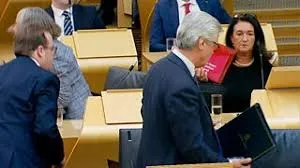
Scottish Parliament votes that Scotland has the right to decide its constitutional future
Scotland's Parliament voted 84 to 18 to pass a non-binding motion asserting Scotland's right to decide its constitutional future, with SNP, Greens and Scottish…
Holyrood passes symbolic independence motion as Westminster holds the constitutional line
Scotland's Holyrood parliament voted 84 to 18 to assert Scotland's right to decide its constitutional future, with Scottish Labour joining the SNP and Greens…
Scotland's Parliament passed a non-binding motion on Tuesday asserting Scotland's right to determine its own constitutional future, with an 84-to-18 vote that brought together the SNP, the Scottish Greens and Scottish Labour in a single lobby. The outcome does not trigger a referendum or change any law. But for the workers, families and communities waiting on practical answers to poverty and cost-of-living pressures, Tuesday's debate delivered a declaration and an amendment, not a policy.
--- THE CONTEXT ---
The UK Supreme Court ruled in 2022 that the Scottish Parliament cannot hold an independence referendum without Westminster's consent. Two weeks before this debate, Prime Minister Andy Burnham told MPs that a border poll would be considered only if clear consensus existed and public opinion had visibly changed. Swinney subsequently wrote to Burnham requesting a meeting to discuss how such a mechanism could be enshrined in law. Burnham replied that no such consensus currently exists and that another referendum is, in his words, off limits while his government focuses on the economy and cost-of-living pressures.
--- THE FACTS ---
First Minister John Swinney tabled a motion declaring that Scotland is a nation with a right to decide its own future. The motion passed 84 to 18, with Green and Labour MSPs supporting it and Conservatives and Liberal Democrats voting against. Scottish Labour's new leader Michael Marra backed the motion but secured an approved amendment retaining Swinney's statement while adding a call to step up efforts to tackle child poverty. Marra stated plainly that there has always been a route to another referendum — to build a consensus, a settled will of the Scottish people, until it becomes overwhelming — but said he does not believe Scotland needs to risk its currency, defence, markets or budgets to become a fairer country. Reform UK's Scottish leader Malcolm Offord attempted to have the debate cancelled on the grounds that it related to non-devolved matters. After failing to do so, he led his MSPs out of the chamber to jeers from other members. Presiding Officer Kenneth Gibson called Reform's action a gross discourtesy to all members.
--- THE POSITIONS ---
Swinney argued that a simple pro-independence majority in Holyrood constitutes a mandate and that by 2029 more than one million people in Scotland will not have had the opportunity to vote due to their age at the time of the 2014 referendum. Marra confirmed his party does not support independence or another referendum, describing the vote as being about principle rather than practical action. Scottish Conservative leader Russell Findlay said the SNP should accept the 2014 result, in which Scotland voted 55% to 45% to remain in the UK. Offord called the entire debate an insult to the Scottish electorate, who expect politicians to deal with serious issues in their communities. Burnham's position was communicated by letter and was not directly represented in the chamber.
--- WHAT REMAINS UNKNOWN ---
This report does not publish the full text of Burnham's letter to Swinney or detail what specific legal mechanism the Scottish Government proposes to advance after the 2022 Supreme Court ruling. It is not established whether Burnham has accepted Swinney's request for a meeting. The report does not clarify what steps the approved amendment on child poverty would require in practice or on what timeline.
--- UNANSWERED QUESTIONS ---
• What concrete legal mechanism does the Scottish Government propose to pursue a referendum given the 2022 Supreme Court ruling?
• How does the Scottish Government reconcile its mandate claim with the drop in the pro-independence vote share from around 50% in 2021 to around 41%?
• Has Burnham agreed to the meeting Swinney requested, and on what terms?
• What measurable commitments does the child poverty amendment impose on the Scottish Government, and when would outcomes be assessed?
--- EPM ANALYSIS ---
The most consequential moment on Tuesday was not Swinney's motion but Marra's decision to support it. Scottish Labour crossed a symbolic threshold by endorsing the principle of Scotland's right to decide, without endorsing independence itself. The SNP will carry that endorsement into its conference as political momentum. For families navigating child poverty and housing costs, the amendment Marra secured is the sole concrete addition to Tuesday's record. The decisive variable remains public opinion: a sustained shift toward independence has not materialised, and without it, Tuesday's vote produces rhetoric without a pathway. 📌
📌
📌 EPM Take:
In EPM's view, Tuesday's session illustrates a recurring pattern in devolved politics: symbolic votes that realign parliamentary alliances without changing material conditions for ordinary people. Marra positioned Scottish Labour as cooperative rather than oppositional, which is a legitimate strategic choice, but one that hands the SNP a legitimacy argument not earned at the ballot box, where pro-independence vote share fell sharply. EPM has tracked cost-of-living strain across the UK in recent coverage; the families most affected by those pressures deserve debates that generate policy, not declarations that generate headlines.
Scotland's devolved parliament voted 84 to 18 on Tuesday to approve a non-binding motion proclaiming Scotland's right to decide its own constitutional future. The vote carries no legal force, alters no statute and does not compel Westminster to act. What it does alter is the institutional geometry of Holyrood: Scottish Labour's decision to back the motion alongside the SNP and the Greens represents a shift in political positioning that warrants careful scrutiny from anyone concerned with British constitutional order and market stability.
--- THE CONTEXT ---
The UK Supreme Court ruled in 2022 that the Scottish Parliament cannot hold an independence referendum without Westminster's consent. That legal barrier remains firmly in place. Two weeks before Tuesday's debate, Prime Minister Andy Burnham stated in the Westminster Parliament that a border poll would only be considered if a clear consensus existed and public opinion had demonstrably changed. When Swinney wrote to Burnham requesting a meeting to explore how such a mechanism could be enshrined in law, Burnham replied that no consensus currently exists and that another referendum is off limits while his government prioritises economic growth and cost-of-living pressures. Burnham also noted that Northern Ireland and Scotland carry distinct constitutional arrangements and different historical experiences.
--- THE FACTS ---
First Minister John Swinney tabled the motion declaring Scotland a nation with a right to decide its own future. It passed 84 to 18. The SNP, Scottish Greens and Scottish Labour voted in favour; Conservatives and Liberal Democrats voted against. Scottish Labour's new leader Michael Marra backed the motion but secured a passed amendment that retained Swinney's statement and added a call to accelerate efforts to tackle child poverty. Marra was explicit that his party does not support independence or another referendum, and that Scotland need not risk its currency, defence, markets or budgets to become a fairer nation. Reform UK's Scottish leader Malcolm Offord sought to have the debate cancelled, arguing it concerned non-devolved matters. When that failed, he described the debate as an insult to the Scottish electorate and led Reform MSPs out of the chamber. Presiding Officer Kenneth Gibson condemned the walkout as a gross discourtesy to all members of the chamber. The SNP and Greens together hold 73 MSPs, an increase of one in the pro-independence majority, though the share of the vote going to pro-independence parties fell from around 50% in 2021 to around 41%.
--- THE POSITIONS ---
Swinney argued that a simple pro-independence majority constitutes a mandate and cited demographic change: by 2029, he said, more than one million people in Scotland will not have had the chance to vote in 2014, and by 2030 the youngest voters will not have been born when the first referendum was held. Russell Findlay, Scottish Conservative leader, countered that the SNP should respect the result of what the party itself described as a once-in-a-generation vote, noting that more than two million Scots said no in 2014, by a margin of 55% to 45%. Offord framed the debate as a vanity project incompatible with governing. Burnham's position was relayed by letter; he was not present in the Holyrood chamber.
--- WHAT REMAINS UNKNOWN ---
This report does not reproduce the full text of Burnham's reply to Swinney and does not establish what specific legal route the Scottish Government proposes to advance after the 2022 Supreme Court ruling. It is not confirmed whether Burnham has agreed to the meeting Swinney requested or on what terms. The report does not detail the formal UK Government response to Tuesday's vote beyond previously communicated correspondence.
--- UNANSWERED QUESTIONS ---
• What specific constitutional mechanism does the Scottish Government propose to pursue given the binding 2022 Supreme Court ruling?
• Does Scottish Labour's support for the right-to-decide principle imply any change in the UK Labour Party's official position at Westminster?
• Has Burnham agreed to the meeting Swinney requested, and under what conditions would Westminster revisit its position?
• How does the Scottish Government account for the fall in pro-independence vote share from around 50% in 2021 to around 41% when asserting a renewed mandate?
--- EPM ANALYSIS ---
The 2022 Supreme Court ruling is the load-bearing wall of British constitutional order on this question, and it has not moved. What has moved is Scottish Labour's tactical posture: Marra chose cooperation over opposition on a matter of principle, handing the SNP a parliamentary endorsement that was not delivered by voters, whose support for independence parties fell sharply. Westminster's leverage remains intact in law, but the political cost of exercising it rises each time a unionist party crosses the symbolic line. Markets and investors monitoring UK stability should note that the legal framework holds while the political consensus around it is quietly eroding. 📌
📌
📌 EPM Take:
In EPM's view, the headline figure is not 84 to 18 but 41%: the share of the Scottish electorate that backed pro-independence parties in the most recent election, down from around 50% in 2021. A motion passed by a parliamentary majority whose popular mandate is shrinking is a weak foundation for a constitutional claim. EPM has followed the pressures on the Burnham government across multiple fronts in recent weeks; adding a constitutionally unsettled Scotland to that list makes coherent governance of the United Kingdom harder, not easier. The Supreme Court ruling must remain the fixed point.
El Parlamento escocés vota que Escocia tiene derecho a decidir su futuro constitucional
El Parlamento escocés aprobó con 84 votos a favor y 18 en contra una moción no vinculante que proclama el derecho de Escocia a decidir su futuro…
Holyrood aprueba moción sobre independencia mientras Westminster rechaza referéndum
El Parlamento escocés aprobó 84 a 18 una moción no vinculante sobre el derecho de Escocia a decidir su futuro constitucional, con el apoyo inesperado del…
El martes, el Parlamento escocés aprobó una moción no vinculante que afirma el derecho de Escocia a decidir su propio futuro constitucional. La votación, 84 votos a favor y 18 en contra, reunió al SNP, los Verdes y el Laborismo escocés en un mismo lobby. El resultado no abre ningún referéndum, pero sí desplaza el terreno político en el que trabajan los trabajadores, las familias y las comunidades que esperan respuestas concretas a sus problemas cotidianos.
--- EL CONTEXTO ---
El Tribunal Supremo resolvió en 2022 que el Parlamento escocés no puede convocar un referéndum de independencia sin el consentimiento de Westminster. El debate del martes tiene lugar dos semanas después de que el primer ministro Andy Burnham declarara ante el Parlamento británico que una consulta territorial sería considerada si existiera un consenso claro y la opinión pública hubiera cambiado de forma evidente. Esa declaración llevó a John Swinney a escribirle para pedir una reunión; Burnham respondió que no existe ese consenso y que otro referéndum está fuera de los límites mientras su gobierno se concentra en la economía.
--- LOS HECHOS ---
Swinney presentó una moción que declaraba que Escocia es una nación con derecho a decidir su propio futuro. El texto fue aprobado con 84 votos a favor y 18 en contra. Los Verdes y el Laborismo escocés respaldaron la iniciativa; los Conservadores y los Liberal Demócratas votaron en contra. El nuevo líder del Laborismo escocés, Michael Marra, sumó su partido al sí pero añadió una enmienda aprobada que mantenía la declaración de Swinney y exigía acelerar los esfuerzos para combatir la pobreza infantil. Marra señaló que siempre ha existido una vía hacia otro referéndum: construir un consenso, la voluntad asentada del pueblo escocés, hasta que sea abrumadora. Al mismo tiempo, dejó claro que cree que Escocia puede ser más justa sin convertirse en un Estado separado. El Presiding Officer Kenneth Gibson calificó la salida de Reform de descortesía grave hacia todos los miembros de la cámara.
--- LAS POSICIONES ---
Swinney sostuvo que una mayoría simple de MSPs favorables a la independencia representa un mandato para un referéndum y señaló que hacia 2029 más de un millón de personas en Escocia no habrán podido votar por su edad en 2014. Marra respaldó el principio pero advirtió que no es necesario arriesgar la moneda, la defensa, los mercados ni los presupuestos para lograr una Escocia más igualitaria. Malcolm Offord, líder escocés de Reform, calificó el debate de insulto al electorado y abandono de asuntos serios que afectan a las comunidades. Los Conservadores, a través de Russell Findlay, recordaron que en 2014 más de dos millones de escoceses votaron no.
--- LO QUE FALTA SABER ---
La fuente no aclara qué mecanismo legal concreto contempla el gobierno escocés para avanzar tras la resolución de 2022 del Tribunal Supremo. Tampoco publica la respuesta completa de Burnham a la carta de Swinney, más allá de los fragmentos citados. No se sabe cuándo ni cómo planea convocar Swinney la reunión solicitada, ni si Burnham acepta esa reunión.
--- PREGUNTAS SIN RESPUESTA ---
• ¿Qué mecanismo legal concreto propondría el gobierno escocés para sortear la resolución del Tribunal Supremo de 2022 sin el consentimiento de Westminster?
• ¿Qué consecuencias prácticas tiene para las familias escocesas en situación de pobreza infantil la enmienda aprobada por Marra, y cuándo espera el gobierno escocés medirlas?
• ¿Aceptará Burnham la reunión solicitada por Swinney, y en qué condiciones?
• ¿Cómo afecta la caída del voto a partidos independentistas, de alrededor del 50% en 2021 a alrededor del 41%, a la tesis de que existe un mandato renovado?
--- ANALISIS EPM ---
La votación del martes importa menos por lo que hace que por lo que señala. El Laborismo escocés cruzó una línea simbólica al respaldar el principio del derecho a decidir, aunque sin apoyar la independencia ni un nuevo referéndum. Eso es un cambio de posición política que el SNP ya ha empezado a explotar de cara a su conferencia. Para los trabajadores y las familias escocesas atrapadas entre la pobreza infantil y la incertidumbre económica, el debate de hoy produce una declaración y una enmienda sobre pobreza, pero ninguna política ejecutable. La variable decisiva sigue siendo la opinión pública: sin un giro sostenido y claro, la moción no es más que arquitectura retórica. 📌
📌
📌 Conclusion EPM:
A juicio de EPM, el verdadero ganador de esta jornada no es el SNP sino Michael Marra, quien logró que su partido respaldara un principio sin comprometerse con sus consecuencias más arriesgadas. Para las comunidades escocesas que luchan con el coste de la vida, algo que EPM ha documentado en el contexto del Reino Unido en meses recientes, este debate produce calor parlamentario pero no calor en los hogares. La independencia como proyecto político avanza en los pasillos de Holyrood mientras retrocede en el porcentaje de votos reales. Esa contradicción es la que ningún bando ha explicado con honestidad.
El Parlamento escocés votó el martes, 84 a 18, una moción no vinculante que proclama el derecho de Escocia a decidir su propio futuro constitucional. La votación no tiene fuerza legal, no modifica el marco constitucional vigente y no obliga a Westminster a ninguna acción. Sin embargo, la decisión del Laborismo escocés de sumarse al SNP y los Verdes marca un cambio institucional cuyas consecuencias para el orden político del Reino Unido merecen seguimiento cuidadoso.
--- EL CONTEXTO ---
El Tribunal Supremo estableció en 2022 que el Parlamento escocés carece de competencia para convocar un referéndum de independencia sin autorización de Westminster. El debate del martes se produjo dos semanas después de que el primer ministro Andy Burnham declarara que una consulta territorial solo se consideraría ante un consenso claro y un cambio evidente en la opinión pública. Burnham respondió por escrito a Swinney que ese consenso no existe y reiteró que otro referéndum está fuera de los límites mientras su gobierno prioriza la economía.
--- LOS HECHOS ---
Swinney presentó una moción que declaraba que Escocia es una nación con derecho a decidir su propio futuro. El texto fue aprobado con 84 votos a favor y 18 en contra. SNP, Verdes y Laborismo escocés respaldaron la iniciativa; Conservadores y Liberal Demócratas votaron en contra. Michael Marra, nuevo líder del Laborismo escocés, apoyó la moción pero añadió una enmienda aprobada que incorporaba un llamado a combatir la pobreza infantil. Marra aclaró que cree que Escocia puede ser más justa sin convertirse en un Estado separado, y que no es necesario arriesgar la moneda, la defensa, los mercados ni los presupuestos del país. Malcolm Offord, líder escocés de Reform UK, calificó el debate de insulto al electorado escocés y retiró a sus MSPs de la cámara, entre los abucheos del resto de la asamblea. El Presiding Officer Kenneth Gibson tachó la salida de descortesía grave.
--- LAS POSICIONES ---
Swinney argumentó que la mayoría pro-independencia de 73 MSPs constituye un mandato y que hacia 2029 más de un millón de personas no habrán podido votar por su edad en 2014. Russell Findlay, líder de los Conservadores escoceses, recordó que más de dos millones de escoceses votaron no en 2014, con un resultado de 55% a 45%. Offord describió el debate como un proyecto de vanidad ajeno a los asuntos serios de las comunidades. Burnham no participó en el debate y su posición, comunicada por carta, es que no existe consenso y que otro referéndum está descartado.
--- LO QUE FALTA SABER ---
Esta fuente no publica el texto íntegro de la carta de Burnham a Swinney ni detalla qué mecanismo legal propone el gobierno escocés para avanzar tras el fallo de 2022. No se informa si Burnham aceptó la reunión solicitada por Swinney ni en qué plazos. Tampoco se conoce la posición formal de los partidos de la oposición respecto a la enmienda sobre pobreza infantil.
--- PREGUNTAS SIN RESPUESTA ---
• ¿Qué vía constitucional concreta contempla el gobierno escocés para avanzar hacia un referéndum tras el fallo del Tribunal Supremo de 2022?
• ¿El respaldo del Laborismo escocés al principio del derecho a decidir cambia la posición oficial del Partido Laborista británico en Westminster?
• ¿Aceptará Burnham la reunión pedida por Swinney, y bajo qué condiciones?
• ¿Cómo interpreta el gobierno escocés la caída del voto a partidos independentistas de alrededor del 50% en 2021 a alrededor del 41%, en relación con el mandato que invoca?
--- ANALISIS EPM ---
La moción no altera el orden constitucional, pero sí modifica la geometría política de Holyrood. El Laborismo escocés ha abandonado su posición de oposición sistemática al independentismo para abrazar un principio procedimental que el SNP puede presentar como aval ante su conferencia. Para Westminster, el riesgo no es inmediato sino acumulativo: si el Laborismo continúa convergiendo con el SNP en cuestiones de principio, la posición del Ejecutivo central se debilita en términos de legitimidad política, aunque la barrera legal siga intacta. Los mercados y la estabilidad institucional del Reino Unido dependen de que esa barrera permanezca clara. 📌
📌
📌 Conclusion EPM:
A juicio de EPM, la sesión del martes revela una fractura dentro del bloque unionista más preocupante que la propia moción. El Laborismo escocés ha elegido la cooperación táctica sobre la coherencia estratégica, y eso entrega al SNP un argumento de legitimidad que no proviene de las urnas, donde el voto independentista bajó, sino del hemiciclo. En un momento en que EPM ha registrado cómo el gobierno de Burnham gestiona tensiones internas que van desde los precios del combustible hasta la seguridad penitenciaria, añadir presión constitucional desde Holyrood complica aún más el cuadro de gobernabilidad del Reino Unido.