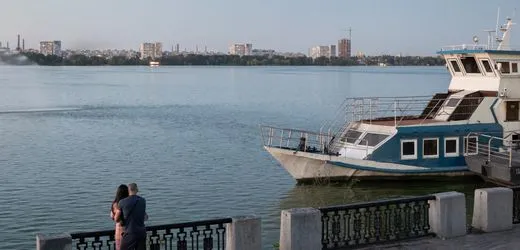
Along the Dnipro: how Putin's war is erasing everyday life, community by community
A DER SPIEGEL team traveled the full length of the Dnipro River to document what Putin's war costs the communities living along its banks.
The Dnipro as a permanent border would reset the rules of international order
A DER SPIEGEL team traveled the Dnipro from north to south, documenting how Russia's war has transformed the river from a national symbol into a military front…
The Dnipro River is the cultural spine of Ukraine, the most sung-about river in the country's poetry and the one invoked in the national anthem itself. Since 2022, it has also become the dividing line between occupied and free Ukraine, and a journey along its banks is a journey into what war costs ordinary people.
--- THE CONTEXT ---
DER SPIEGEL conducted a long-form reporting trip along the Dnipro together with photographer Emile Ducke and longtime producer Fedir Petrov. The river runs north to south across the entire country, from forests on the Belarusian border to the steppe on the Black Sea, making it the largest natural obstacle to Russia's invasion.
--- THE FACTS ---
Russian forces under Vladimir Putin briefly crossed the Dnipro but were forced to abandon the western bank during the first year of the war. Since then, the river's lower reaches have formed the front line between Russian-occupied and free Ukrainian territory. The SPIEGEL team began its journey in Demydiv, in the north, where Ukraine repelled Russia's advance on the capital in 2022. The trip moves through villages and towns where residents are working harder and harder to preserve normal daily life as the front draws closer. It ends in the southern port city of Kherson, where drones now hunt elderly residents and remote-controlled ground robots move through empty streets. The reporters describe the progression as a journey from light into darkness.
--- THE POSITIONS ---
The available portion of the source does not include statements from the Ukrainian government, Russian officials or military commanders on the river's strategic status. The SPIEGEL account documents civilian resilience along the route without citing institutional spokespeople.
--- WHAT REMAINS UNKNOWN ---
The full article is behind a paywall. The living conditions in intermediate communities along the river, the number of residents still present near the front and the scale of displacement are not established by the available text.
--- UNANSWERED QUESTIONS ---
• How many civilians remain in riverside communities closest to the front line in the Dnipro's lower reaches?
• What essential services, such as healthcare and water supply, continue to function in Kherson under sustained drone attack?
• What has displacement along the Dnipro's banks meant for the social and economic fabric of communities that once relied on the river for their livelihoods?
• How have residents in the intermediate towns documented in the SPIEGEL trip adapted their routines as the front approaches?
--- EPM ANALYSIS ---
The SPIEGEL journey uses the Dnipro not as metaphor but as a concrete measuring stick for human cost. The north-to-south structure traces a gradient of harm, from repelled invasion to a city where elderly people are targeted by drones. The civilian perspective is the subject; the technology of violence in Kherson is the endpoint that demands accountability. 📌
📌 EPM Take:
In EPM's view, the image of drones hunting pensioners in Kherson is not a military footnote; it is the human consequence that war-of-aggression coverage must keep in focus. The SPIEGEL team's decision to walk the entire river, community by community, is the right editorial instinct. A front line that follows a national symbol does not become abstract when it is reported from the riverbank. The press owes civilian populations that specificity, and readers owe it their sustained attention. 📌 That progression matters journalistically because it resists the flattening of war into statistics.
The Dnipro River is not only Ukraine's largest waterway and its most celebrated national symbol. It is also, since the first year of Russia's invasion, the effective front line between free and occupied Ukraine. Whether it becomes a permanent border is now one of the most consequential open questions in European security.
--- THE CONTEXT ---
DER SPIEGEL sent a team, including photographer Emile Ducke and longtime producer Fedir Petrov, on a full-length journey along the Dnipro to document both Ukraine's identity and the war's visible scars. The river runs north to south across the entire country, from the Belarusian border forests to the Black Sea steppe, constituting the greatest natural barrier to Russia's military advance.
--- THE FACTS ---
Forces loyal to Vladimir Putin briefly succeeded in crossing the Dnipro but were expelled from the western bank during the first year of the war. Since that withdrawal, the river's lower reaches have formed the active front line separating Russian-controlled territory from free Ukraine. The SPIEGEL team's route began in Demydiv in the north, the site where Ukraine repelled Russia's drive toward the capital in 2022, and concluded in the southern port city of Kherson. In Kherson, the reporters found a city where drones strike elderly civilians and remote-controlled ground robots move through streets emptied of normal life. The account describes the journey as one from light into darkness, a characterization grounded in observable conditions rather than editorial flourish.
--- THE POSITIONS ---
The available text does not include statements from Ukrainian military command, Western allied governments or Kremlin representatives regarding the Dnipro's strategic function or any negotiated status. This report does not establish whether any formal diplomatic framework addresses the river as a potential demarcation line.
--- WHAT REMAINS UNKNOWN ---
The complete article is behind a subscription paywall. Military assessments of front-line stability along the Dnipro, Ukrainian force capacity on its southern banks and the long-term viability of the current line are not addressed in the accessible text.
--- UNANSWERED QUESTIONS ---
• What strategic value do Ukrainian and Western military planners assign to holding both banks of the Dnipro against a consolidated Russian position?
• Has any international institution or allied government formally assessed the Dnipro as a potential long-term demarcation line, and if so, on what conditions?
• Does the deployment of remote-controlled ground robots in Kherson signal a doctrinal shift in how Russian forces intend to hold and control urban territory?
• What diplomatic or legal framework, if any, would govern the status of populations on either bank if the river's front-line role became permanent?
--- EPM ANALYSIS ---
A Dnipro frozen as a border would not simply end this war on adverse terms for Ukraine; it would establish that territorial conquest by force of arms can produce durable facts on the ground. The SPIEGEL report, by moving from a repelled invasion in the north to a city under drone assault in the south, maps the operational logic behind that outcome. The decisive variable is sustained Western commitment, not the river's geography. Without it, a natural obstacle becomes a negotiated concession. 📌
📌
📌 EPM Take:
In EPM's view, the Dnipro as a permanent boundary would be a defeat that extends well beyond Ukraine's borders. It would signal to every revisionist power that sustained aggression, combined with patience, can redraw maps that international law has declared fixed. The use of drones against elderly civilians and robots in empty streets is not local color; it is a deliberate strategy to make Ukrainian life on the eastern bank ungovernable. Western governments must be clear-eyed about what consolidation of this front line actually means for the rules-based order they claim to defend.
El Dnipro como cicatriz: viaje a la vida cotidiana que la guerra de Putin va borrando
Un equipo de DER SPIEGEL recorrió el Dnipro de norte a sur para documentar cómo la guerra de Putin transforma la vida cotidiana de las comunidades ucranianas.
El Dnipro como frontera permanente entre Ucrania y Rusia
DER SPIEGEL recorrió el Dnipro de norte a sur para documentar su doble papel como símbolo de identidad ucraniana y como línea del frente de facto desde que las…
El Dnipro ya no es solo el río más grande de Ucrania ni el más cantado en su literatura. Desde 2022, es también la línea que separa a quienes viven bajo ocupación rusa de quienes intentan sostener una vida normal en territorio libre, con creciente dificultad según se acercan al frente.
--- EL CONTEXTO ---
DER SPIEGEL publicó un reportaje de largo aliento sobre el Dnipro en tiempos de guerra, realizado junto al fotógrafo Emile Ducke y el productor ucraniano Fedir Petrov. El río cruza el país de norte a sur, desde los bosques en la frontera con Bielorrusia hasta la estepa del Mar Negro, y ocupa un lugar central en la identidad nacional ucraniana.
--- LOS HECHOS ---
El equipo del SPIEGEL recorrió el Dnipro de norte a sur. En el norte, la localidad de Demydiv marcó el punto donde Ucrania detuvo el avance ruso sobre Kiev en 2022. Las tropas de Putin cruzaron brevemente el río, pero fueron obligadas a abandonar la orilla occidental durante el primer año de la guerra. Desde entonces, los tramos bajos del Dnipro constituyen la línea del frente. En Jersón, al sur, la situación es radicalmente distinta: drones atacan a personas mayores y robots terrestres controlados a distancia circulan por calles vacías.
--- LAS POSICIONES ---
El SPIEGEL no recoge en el fragmento disponible declaraciones oficiales del gobierno ucraniano ni del Kremlin sobre el papel estratégico del río. La fuente describe la resistencia de comunidades locales que buscan mantener una vida cotidiana bajo condiciones de guerra, sin citar portavoces institucionales.
--- LO QUE FALTA SABER ---
El artículo completo está detrás de un muro de pago. No se conocen las condiciones exactas de vida documentadas en las localidades intermedias del recorrido, ni cuántas personas permanecen en las zonas más cercanas al frente.
--- PREGUNTAS SIN RESPUESTA ---
• ¿Cuántas personas continúan viviendo en las comunidades ribereñas más próximas a la línea del frente en el tramo bajo del Dnipro?
• ¿Qué servicios básicos, como atención médica o suministro de agua, siguen funcionando en ciudades como Jersón bajo el alcance de los drones?
• ¿De qué manera el daño a la infraestructura fluvial afecta el suministro de alimentos y energía a las poblaciones civiles río arriba?
• ¿Qué condiciones encuentran los desplazados internos que han abandonado las orillas del río?
--- ANALISIS EPM ---
El reportaje del SPIEGEL elige el Dnipro no como recurso literario sino como hilo conductor que une consecuencias concretas: comunidades que negocian la cotidianidad con la guerra, y una ciudad, Jersón, donde la violencia tecnológica ya es rutina. Esa progresión geográfica de norte a sur es también una escala de intensidad del daño humano. El ganador de este relato es la perspectiva civil; el perdedor, la narrativa que reduce la guerra a cifras militares. 📌
📌
📌 Conclusion EPM:
A juicio de EPM, el valor de este trabajo periodístico reside en que sitúa a las personas concretas, no a los estados mayores, en el centro del relato. La imagen de drones cazando a pensionistas en Jersón no es un dato de inteligencia: es una consecuencia humana directa de una guerra de agresión. Que el Dnipro pueda convertirse en frontera permanente no es una hipótesis abstracta; es el horizonte al que apunta cada kilómetro de este recorrido, y la prensa tiene la obligación de nombrarlo con precisión.
El río más grande de Ucrania, símbolo nacional cantado en el propio himno del país, lleva más de un año funcionando como línea del frente entre el territorio libre y el ocupado por Rusia. Si esa situación se consolida, las consecuencias geopolíticas superan con creces el conflicto actual.
--- EL CONTEXTO ---
DER SPIEGEL publicó un reportaje de largo aliento sobre el Dnipro en tiempos de guerra, realizado junto al fotógrafo Emile Ducke y el productor ucraniano Fedir Petrov. El río discurre de norte a sur a través del país entero, desde la frontera con Bielorrusia hasta el Mar Negro, y actúa como la mayor barrera natural frente a la invasión rusa.
--- LOS HECHOS ---
Las fuerzas de Vladimir Putin cruzaron brevemente el Dnipro, pero fueron expulsadas de la orilla occidental durante el primer año de la guerra. Desde ese momento, el tramo bajo del río marca la frontera efectiva entre la Ucrania libre y la ocupada. El recorrido del SPIEGEL comienza en Demydiv, en el norte, donde Ucrania repelió el avance ruso sobre Kiev en 2022, y concluye en el puerto de Jersón, en el sur, donde drones atacan a civiles de edad avanzada y robots terrestres de control remoto patrullan calles vacías. La progresión geográfica del equipo periodístico ilustra una escala creciente de desintegración del orden.
--- LAS POSICIONES ---
La fuente disponible no recoge declaraciones del gobierno ucraniano ni de representantes del Kremlin sobre el valor estratégico del Dnipro como línea defensiva o como posible frontera de facto. El SPIEGEL documenta la resistencia civil, pero no cita fuentes militares o institucionales en el fragmento accesible.
--- LO QUE FALTA SABER ---
El artículo completo permanece detrás de un muro de pago. No se conocen evaluaciones militares sobre la estabilidad de la línea del frente en el Dnipro, ni qué capacidad de control tiene Ucrania sobre las orillas en los tramos más meridionales.
--- PREGUNTAS SIN RESPUESTA ---
• ¿Qué importancia estratégica asignan los mandos militares ucranianos y occidentales al Dnipro como barrera defensiva natural?
• ¿Existe algún marco diplomático en curso que contemple el río como posible línea de separación en negociaciones futuras?
• ¿De qué manera la presencia de robots terrestres y drones en Jersón indica un cambio en la doctrina de combate rusa en zonas urbanas?
• ¿Qué instituciones internacionales han evaluado la viabilidad de mantener el control ucraniano sobre ambas orillas a largo plazo?
--- ANALISIS EPM ---
Que el Dnipro pueda transformarse en frontera permanente no es solo una tragedia cultural para Ucrania: es un test para el orden internacional basado en la integridad territorial. El reportaje del SPIEGEL, al recorrer el río de norte a sur, cartografía la distancia entre una guerra contenida y una guerra cronificada. El factor decisivo no es el simbolismo del río, sino si Occidente mantiene el apoyo suficiente para que Ucrania conserve sus orillas.
📌 Conclusion EPM:
A juicio de EPM, el Dnipro como frontera de facto sería una derrota que va más allá de Ucrania. Consolidar una línea de ocupación a lo largo del río equivale a legitimar la conquista por la fuerza, un precedente que debilita a todas las democracias con vecinos revisionistas. El uso de drones contra ancianos en Jersón y de robots en calles vacías no es un detalle local: es la señal de que Rusia ha decidido hacer insostenible la vida civil en los territorios que no puede controlar militarmente. 📌 📌