Xi in Washington: Trump's hospitality splits Chinese analysts into two camps
Xi Jinping met Donald Trump in Washington last week for their second summit of the year, marked by striking personal hospitality: a tarmac greeting at Joint…
--- The context ---
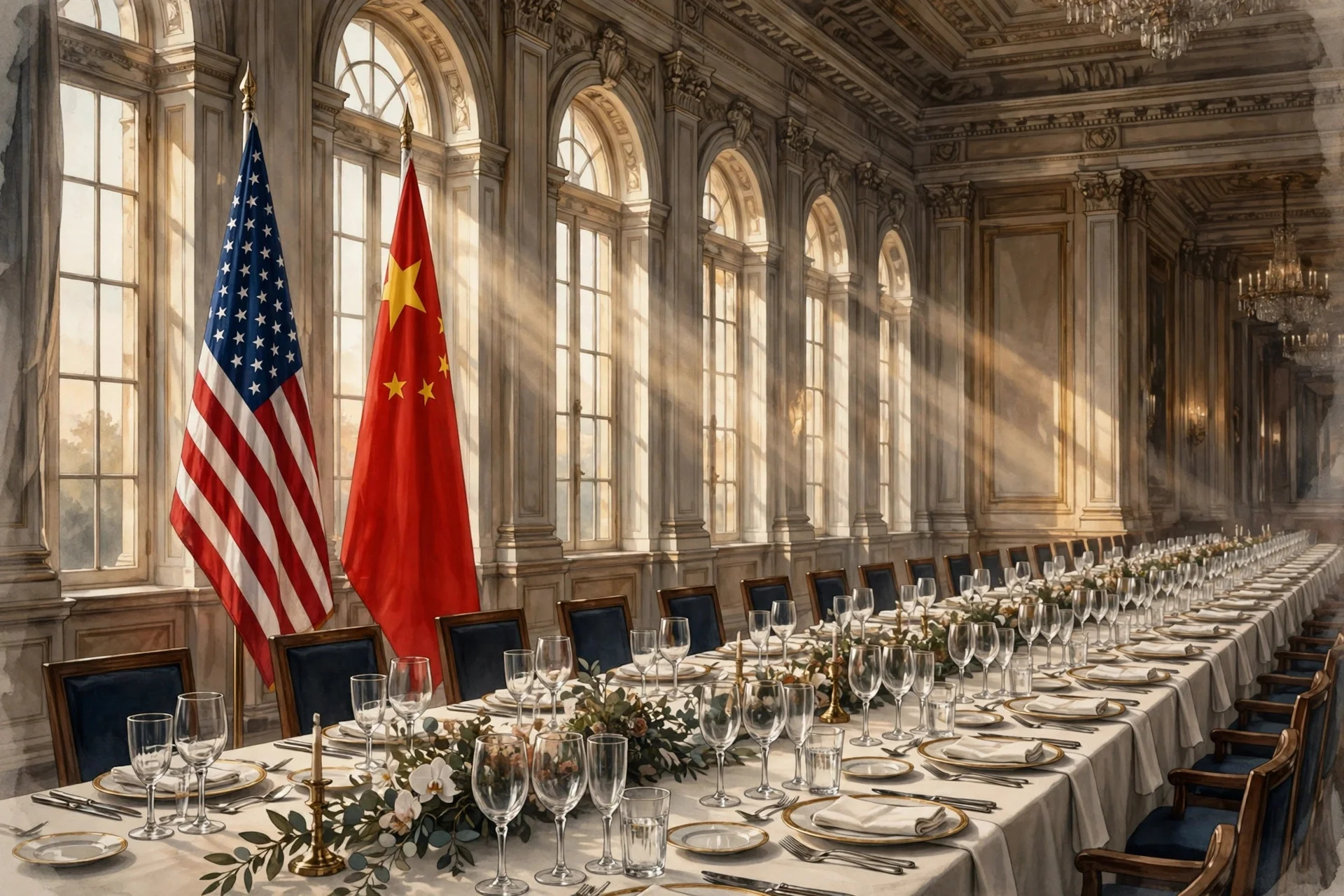
Washington rolled out the red carpet last week for Chinese President Xi Jinping, hosting his second summit of the year with U.S. President Donald Trump. It was a short visit rich in choreography: a personal greeting on the airport tarmac, an official welcoming ceremony and a White House state banquet served with a courtesy Chinese media said had rarely been seen in recent years.
--- The facts ---
The display began at Joint Base Andrews outside Washington, where Trump went out to meet Xi in person. American presidents reserve that gesture for rare occasions: the last time was in 2015, when Barack Obama met Pope Francis at the airport, eleven years earlier, and before that in 1962, when John F. Kennedy welcomed British Prime Minister Harold Macmillan. Then came the official ceremony, the meticulously arranged state banquet and a tea reception for Xi and his wife Peng Liyuan. At the end of the day, Trump said the United States was very pleased with the visit and called it very productive.
The detail Chinese scholars celebrated most was the wine. Trump served Xi the same wine Richard Nixon took on his historic 1972 visit to China — diplomacy by the textbook. Professor Wu Xinbo, director of the Center for American Studies at Fudan University in Shanghai, said in an interview that serving that wine signals the relationship stands at an important and historically significant juncture, and that Xi's visit is historic, a milestone. Wu added that informal encounters — a walk, tea, visits to culturally significant sites — create a relaxed atmosphere between leaders that formal meetings cannot. And Wu speaks from experience: he was invited to the state banquet for Trump in Beijing in May this year.
--- The positions ---
Among China's intelligentsia, the pro-American faction — the qin-Mei — celebrated the display without reservation. For them, the courtesy on show in Washington confirms Beijing remains an indispensable interlocutor, and that personal chemistry between leaders opens channels formal diplomacy cannot.
On another plane, economists such as Professor Ju Jiandong of Tsinghua University in Beijing read the bilateral friction as structural imbalance. At an economists' forum held on the eve of the visit, Ju said the extreme pattern of China doing manufacturing and the United States doing finance is inherently unstable and lies at the root of the competition between the two countries. Ju, author of the controversial book The Great Power Competition and the Restructuring of World Order, argues the only way for China and the United States to avoid a lose-lose outcome is to move from hegemonic iterations to competitive coexistence.
In contrast, the anti-American faction — the fan-Mei — read the same hospitality as a trap. A commentator in China's leftist media warned Washington might be trying to lull Beijing into a false sense of security. For these scholars, the tarmac greeting and Trump's claim that the relationship had never been as harmonious as now amounted to an attempt to whitewash the true state of the relationship, according to a commentary picked up by Chinese media.
Three arguments underpin that distrust. The first is personal: these scholars describe Trump as two-faced and hypocritical, a leader who cannot be trusted, and urge Chinese leaders to stay vigilant at all times; the cited commentary recalled Trump behaving the same way toward Russia, Iran, North Korea, Cuba and Venezuela. The second is geopolitical: the suspicion that the lavish reception aims to sow discord between China and Russia and to place the China-U.S. relationship above the China-Russia one. Scholar Zhang Zhikun argued the accusation has a clear purpose: elevating the tie with Washington while keeping the intent to dismantle the Beijing-Moscow axis. The third is the boldest: that appeasement seeks to stabilize ties so the United States can act with greater impunity across the rest of the world.
--- What remains unknown ---
Notably, both factions agree on one point: shifts in the China-U.S. relationship inevitably reshape relations among all other countries. Many scholars agree neither Taiwan nor Japan would be affected, since both have already secured their interests vis-a-vis Washington; others believe a shift would push North Korea toward Russia and India toward the United States.
--- Unanswered questions ---
What concrete concessions, if any, came out of the Washington summit? Is Trump's hospitality a genuine overture or a pressure tactic on other fronts? How far does the clash between the qin-Mei and the fan-Mei reflect real fractures inside China's leadership? What role will Russia play in how Beijing reads Washington's gestures in the coming months?
--- EPM analysis ---
Behind the banquet lies a battle of narratives that outlasts the summit. The qin-Mei bet that courtesy is political capital convertible into agreements; the fan-Mei bet it is stagecraft to buy time. The economy, in Ju Jiandong's diagnosis, offers a third reading: the problem is not the tone of the dinner but the structure of the exchange. Washington makes finance and Beijing makes goods, and that imbalance is not resolved with a 1972 vintage.
📌 EPM Take:
In EPM's view, the Washington summit showed that diplomacy between the two largest powers is no longer fought in communiques alone, but in gestures each side reads as confirmation of what it already believed. The pro-Americans saw protocol and opportunity; the skeptics saw stagecraft and a trap. Both readings can be true at once: the hospitality was real, and it was strategy. What matters for world order is not the 1972 wine or the garden stroll, but that in Beijing the debate over how to handle Washington is now open, sharp and divided. EPM will follow that conversation — not the banquet — because that is where the next move is being decided.
Xi en Washington: la hospitalidad de Trump que dividió a la inteligencia china
Xi Jinping se reunió con Donald Trump en Washington la semana pasada en su segunda cumbre del año, con un despliegue de hospitalidad personal que incluyó el…
--- El contexto ---
Washington recibió la semana pasada al presidente chino Xi Jinping para su segunda cumbre del año con el presidente estadounidense Donald Trump. Fue una visita breve en días pero larga en gestos: recepción personal en la pista del aeropuerto, ceremonia oficial de bienvenida y un banquete de Estado en la Casa Blanca servido con una cortesía que, según la prensa china, no se veía desde hacía años.
--- Los hechos ---
El despliegue empezó en la base conjunta Andrews, a las afueras de Washington, donde Trump salió a recibir a Xi en persona. Los presidentes estadounidenses reservan ese gesto para ocasiones contadas: la última vez fue en 2015, cuando Barack Obama recibió al papa Francisco en el aeropuerto, once años atrás, y antes en 1962, cuando John F. Kennedy dio la bienvenida al primer ministro británico Harold Macmillan. Después llegaron la ceremonia oficial, el banquete de Estado meticulosamente organizado y una recepción de té para Xi y su esposa Peng Liyuan. Al cierre de la jornada, Trump dijo que su país estaba muy complacido con la visita y la calificó de muy productiva.
El detalle que más celebraron los académicos chinos fue el vino. Trump sirvió a Xi el mismo vino que Richard Nixon llevó a su histórica visita a China en 1972, un guiño diplomático de manual. El profesor Wu Xinbo, director del Centro de Estudios Americanos de la Universidad Fudan en Shanghái, explicó en una entrevista que servir aquel vino indica que la relación entre ambos países atraviesa una coyuntura importante e históricamente significativa, y que la visita de Xi es histórica y marca un hito. Wu añadió que los encuentros informales —un paseo, un té, la visita a sitios de valor cultural— crean entre los líderes un ambiente relajado que las reuniones formales no logran. Y Wu habla con conocimiento de causa: fue invitado al banquete de Estado que recibió a Trump en Beijing en mayo de este año.
--- Las posiciones ---
Entre la intelligentsia china, la facción proestadounidense —los qin-Mei— celebró el despliegue sin reservas. Para ellos, la cortesía exhibida en Washington confirma que Beijing sigue siendo un interlocutor imprescindible y que el trato personal entre líderes abre canales que la diplomacia de comunicados no consigue abrir.
En otro plano, economistas como el profesor Ju Jiandong, de la Universidad Tsinghua en Beijing, leen la fricción bilateral como un problema de desequilibrio estructural. En un foro de economistas celebrado en vísperas de la visita, Ju dijo que el patrón extremo de China haciendo manufactura y Estados Unidos haciendo finanzas es inherentemente inestable y constituye la raíz de la competencia entre ambos países. Ju, autor del polémico libro The Great Power Competition and the Restructuring of World Order, sostiene que la única forma de que China y Estados Unidos eviten un escenario en el que ambos pierdan es pasar de las iteraciones hegemónicas a una coexistencia competitiva.
En contraste, la facción antiestadounidense —los fan-Mei— leyó la misma hospitalidad como una trampa. Un comentarista de la izquierda mediática china advirtió que Washington podría estar intentando adormecer a Beijing con una falsa sensación de seguridad. Para estos académicos, el recibimiento en la pista y la afirmación de Trump de que la relación nunca había sido tan armoniosa como ahora fueron un intento de maquillar el verdadero estado de la relación, según un comentario recogido por la prensa china.
Tres argumentos sostienen esa desconfianza. El primero es personal: estos académicos describen a Trump como un líder de dos caras e hipócrita en quien no se puede confiar, y piden a los dirigentes chinos mantenerse siempre vigilantes; el comentario citado recordó que Trump actuó de la misma forma con Rusia, Irán, Corea del Norte, Cuba y Venezuela. El segundo es geopolítico: la sospecha de que el agasajo busca sembrar discordia entre China y Rusia y colocar la relación China-EE. UU. por encima de la relación China-Rusia. El académico Zhang Zhikun sostuvo que esa acusación tiene un propósito claro: elevar el vínculo con Washington mientras se mantiene la intención de desarticular el eje Beijing-Moscú. El tercero es el más audaz: que el apaciguamiento busca estabilizar los lazos para que Estados Unidos actúe con mayor impunidad en el resto del mundo.
--- Lo que falta saber ---
Lo notable es que ambas facciones coinciden en un punto: los cambios en la relación entre China y Estados Unidos alteran inevitablemente las relaciones entre todos los demás países. Muchos académicos coinciden en que ni Taiwán ni Japón se verían afectados, pues ambos habrían asegurado ya sus intereses frente a Washington; otros opinan que un giro acercaría a Corea del Norte a Rusia y a India a Estados Unidos.
--- Preguntas sin respuesta ---
¿Qué concesiones concretas, si las hubo, salieron de la cumbre de Washington? ¿La hospitalidad de Trump responde a un acercamiento genuino o a una táctica de presión en otros frentes? ¿Hasta qué punto el choque entre qin-Mei y fan-Mei refleja fracturas reales dentro de la dirigencia china? ¿Qué papel jugará Rusia en la lectura que Beijing haga de los gestos de Washington en los próximos meses?
--- Análisis EPM ---
Detrás del banquete hay una batalla de relatos que trasciende la cumbre. Los qin-Mei apuestan a que la cortesía es capital político convertible en acuerdos; los fan-Mei apuestan a que es escenografía para ganar tiempo. La economía, con el diagnóstico de Ju Jiandong, ofrece una tercera lectura: el problema no es el tono de la cena, sino la estructura del intercambio. Washington fabrica finanzas y Beijing fabrica bienes, y ese desequilibrio no se resuelve con vino de 1972.
📌 Conclusion EPM:
A juicio de EPM, la cumbre de Washington demostró que la diplomacia entre las dos mayores potencias ya no se juega solo en comunicados, sino en gestos que cada bando lee como confirmación de lo que ya creía. Los proestadounidenses vieron protocolo y oportunidad; los escépticos vieron escenificación y trampa. Ambas lecturas pueden ser ciertas a la vez: la hospitalidad fue real y fue estrategia. Lo que importa para el orden mundial no es el vino de 1972 ni el paseo en los jardines, sino que en Beijing el debate sobre cómo tratar a Washington es hoy abierto, áspero y dividido. EPM seguirá esa conversación —no el banquete— porque ahí se decide el próximo movimiento.