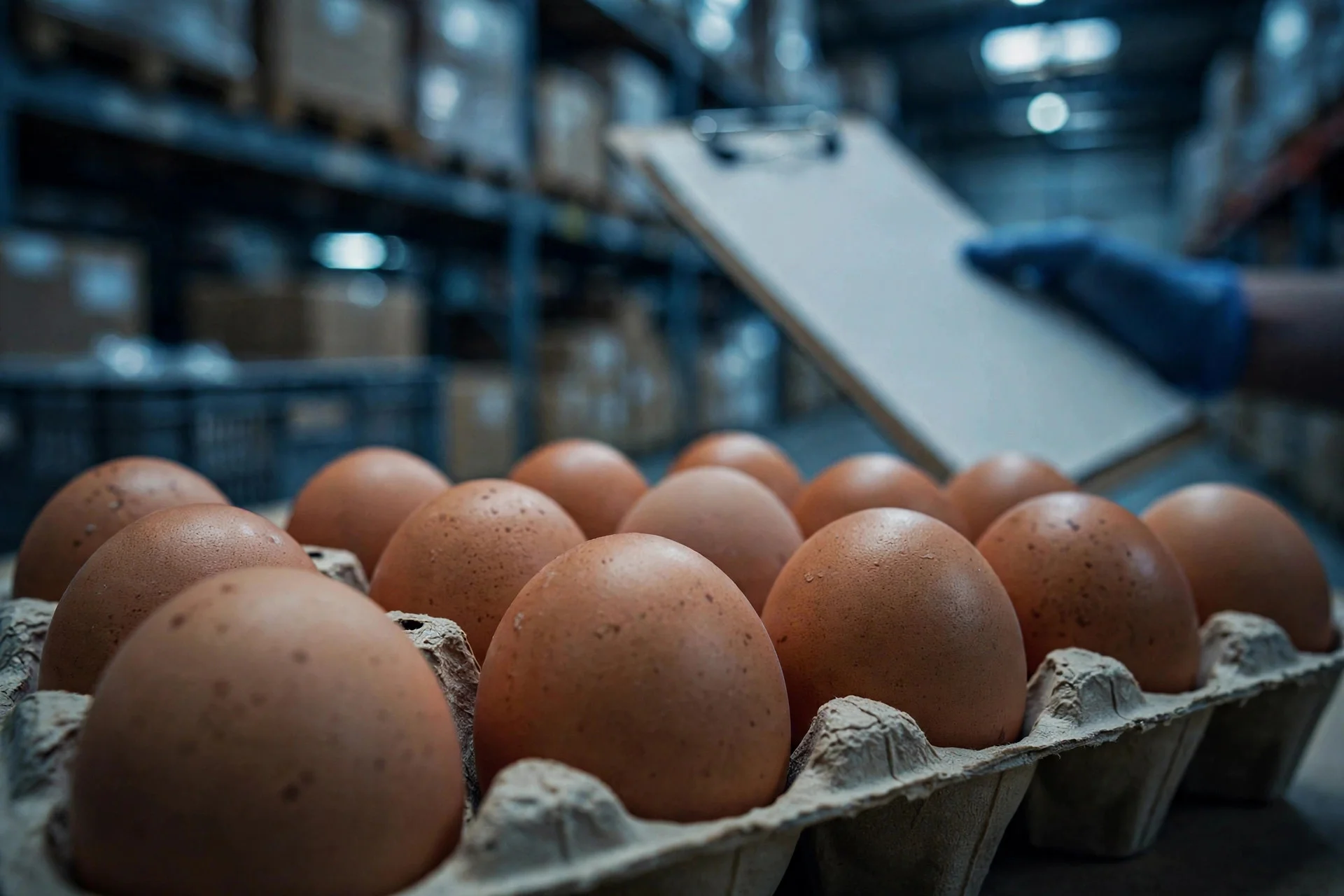
Imagen ilustrativa de huevos en un almacén mayorista durante una inspección de seguridad alimentaria. · EPM
UK recalls Ukrainian eggs after Salmonella found
Britain's Food Standards Agency ordered businesses to withdraw and recall eggs from one Ukrainian business after Salmonella Enteritidis was detected.
Genomic testing links Ukrainian eggs to 36 Salmonella cases
Whole genome sequencing of egg samples from Ukraine revealed a Salmonella Enteritidis strain different from the outbreak under investigation, but linked to 36…
--- The context ---
Britain's food safety authority has activated its alert protocol after Salmonella Enteritidis was confirmed in imported eggs. The Food Standards Agency (FSA) issued a Food Alert for Action aimed at businesses that may hold the product, ordering it withdrawn immediately and recalled where retail sales had occurred.
--- The facts ---
Most of the affected eggs move through the catering supply chain — wholesalers, restaurants and collective kitchens — and a smaller share reached small shops. They are not sold by large retailers such as supermarkets, whose eggs come from British production and are unaffected. Anyone who bought the affected product should not eat it and should dispose of it at home, as it may be unsafe.
The sampling was part of the investigation into a Salmonella Enteritidis outbreak thought to be linked to imported eggs. The health security agency (UKHSA) found the bacterium in samples from one Ukrainian supplier, and whole genome sequencing showed the strain did not match the strains of the outbreak under investigation. That strain, however, was linked to 36 cases of infection reported in England in 2026.
In England, all Salmonella detected in patients seen in hospitals or primary care is routinely analyzed with whole genome sequencing, which connects scattered cases to a common source. Most infections cause diarrhoea, stomach cramps, vomiting and fever that usually resolve in days; occasionally the infection can escalate to sepsis, particularly in young children, older adults, pregnant women and people with weakened immune systems.
--- The positions ---
The FSA's head of incidents, Jacquelyn McCormick, said the agency acted urgently to protect public health and stressed that eggs produced in the United Kingdom are not affected, so eggs bought in major supermarkets are outside the problem. She added that thoroughly cooked, hygienically handled eggs should not present a food safety risk. UKHSA's lead epidemiologist, Hannah Charles, explained that the strain in this batch, S. Enteritidis (t5.8998), is genetically different from the strains linked to the outbreak under investigation but is associated with the 36 cases of 2026.
--- What remains unknown ---
The FSA is working with local authorities and international partners to see the alert actioned swiftly and is reviewing wider measures on the source of the current outbreak. The total volume of affected eggs, how long they circulated and the name of the Ukrainian business have not been made public.
--- Unanswered questions ---
How many contaminated eggs reached consumers before the alert? What failed at the border checks that let the batch in without prior detection? How long will it take to clarify whether the strain is connected to other outbreaks in Europe? And what wider measures will the agency take on the source of the outbreak?
--- EPM analysis ---
The British response shows a surveillance system that works: routine genomic sequencing did not just chase the original outbreak — it uncovered a second problem in the same batch of tests. Withdrawing before having all the answers is the precautionary principle applied well: with a bacterial risk and a single traceable origin, waiting for total certainty costs lives. The consumer message is also precise: it names the exact channel — catering and small shops — and leaves national production out.
📌 EPM Take:
In EPM's view, this episode confirms that modern food safety is fought on two fronts: the science that detects and the communication that calms without concealing. The FSA acted quickly, identified the strain with genomic precision and narrowed the risk without unleashing general alarm. The lesson for any importing country is clear: controls at origin are the weakest link, and a supply chain mixing wholesalers, catering and small retailers demands point-by-point traceability.
--- The context ---
In England, all Salmonella detected in patients seen in hospitals or primary care is routinely analyzed using whole genome sequencing, which connects scattered cases to a common source. It was that surveillance that, during the investigation of an outbreak thought to be linked to imported eggs, revealed an unexpected finding: egg samples from a Ukrainian supplier contained the bacterium, with a strain genetically different from the strains of the outbreak under investigation.
--- The facts ---
Britain's food standards authority (FSA) issued a Food Alert for Action aimed at businesses, ordering the affected eggs withdrawn immediately and recalled where retail sales had occurred. Most moved through the catering chain, via wholesalers, and a smaller share was on sale in small shops; they are not sold by large retailers such as supermarkets. Consumers are advised not to eat them and to dispose of them at home.
The sampling was part of the ongoing investigation into the Salmonella Enteritidis outbreak believed to be linked to imported eggs. The UKHSA found the bacterium in samples from the Ukrainian supplier, and whole genome sequencing showed the strain, S. Enteritidis (t5.8998), did not match the strains of the outbreak under investigation. That strain, however, was linked to 36 cases of infection reported in England in 2026.
--- The positions ---
The FSA's head of incidents, Jacquelyn McCormick, explained that the agency acted urgently to protect public health and ordered any affected product withdrawn and recalled. She stressed that eggs produced in the United Kingdom are not affected and that eggs from major supermarkets come from national production. UKHSA's lead epidemiologist, Hannah Charles, detailed that the strain in this batch is genetically different from the strains linked to the outbreak under investigation but is associated with the 36 cases of 2026, urging the public to follow the FSA's advice.
--- What remains unknown ---
Most Salmonella infections cause diarrhoea, stomach cramps, vomiting and fever that usually resolve in days; occasionally the infection can escalate to sepsis and require hospital admission, particularly in young children, older adults, pregnant women and people with weakened immune systems. The FSA is reviewing wider measures on the source of the outbreak with international partners.
--- Unanswered questions ---
How long had this strain been circulating in England before sequencing connected it to the Ukrainian eggs? How many of the 36 cases might have been prevented with stricter controls at origin? What other strains are moving undetected through food import chains? And what case threshold would have been enough to act without genomics?
--- EPM analysis ---
This case demonstrates what routine genomic sequencing is for: without it, the 36 cases would have remained isolated episodes of gastroenteritis and the contaminated batch would have kept circulating. The British system did not stop at chasing the original outbreak; by sequencing everything, it found a second problem and acted with the same force. That is the difference between reacting to a crisis and watching a threat.
📌 EPM Take:
In EPM's view, the central lesson of this episode is not the withdrawal of one batch but the infrastructure that made it possible. Investing in routine genomic sequencing turns public health into an early-warning system instead of a damage report. The speed with which UKHSA shared the finding and the precision with which the FSA narrowed the risk — catering and small shops, never supermarkets or national production — show that science and communication can work together without generating panic.
Reino Unido retira huevos importados de Ucrania por Salmonella
La autoridad alimentaria británica ordenó retirar y recoger huevos de un negocio ucraniano tras detectar Salmonella Enteritidis; la cepa se vinculó con 36…
Vigilancia genómica detecta Salmonella en huevos ucranianos
La secuenciación del genoma completo de muestras de huevos de Ucrania reveló una cepa de Salmonella Enteritidis distinta del brote investigado, pero ligada a…
--- El contexto ---
La autoridad alimentaria del Reino Unido activó su protocolo de alerta tras confirmarse Salmonella Enteritidis en huevos importados. La Food Standards Agency (FSA) emitió una Food Alert for Action dirigida a los negocios que puedan tener el producto, con orden de retirarlo de inmediato y recogerlo donde hubo venta minorista.
--- Los hechos ---
La mayoría de los huevos afectados circula por la cadena de catering —mayoristas, restaurantes y cocinas colectivas— y una parte menor llegó a tiendas pequeñas. No se venden en grandes minoristas como los supermercados, cuyos huevos provienen de producción británica y no están afectados. Quien haya comprado el producto afectado no debe comerlo y debe desecharlo en casa, pues podría no ser seguro.
El muestreo formó parte de la investigación de un brote que se presume vinculado a huevos importados. La agencia de seguridad sanitaria (UKHSA) halló la bacteria en muestras de un proveedor ucraniano y la secuenciación del genoma completo mostró que la cepa no coincidía con las del brote investigado. Sin embargo, esa cepa se vinculó con 36 casos de infección reportados en Inglaterra en 2026.
En Inglaterra, toda Salmonella detectada en pacientes de hospitales o atención primaria se analiza con secuenciación del genoma completo, lo que conecta casos dispersos con una fuente común. La mayoría de las infecciones causa diarrea, calambres, vómitos y fiebre que suelen resolverse en días; en ocasiones puede agravarse hasta la sepsis, sobre todo en niños pequeños, mayores, embarazadas e inmunodeprimidos.
--- Las posiciones ---
La jefa de incidentes de la FSA, Jacquelyn McCormick, indicó que la agencia actuó con urgencia y que los huevos producidos en el Reino Unido no están afectados, por lo que los de grandes supermercados quedan fuera del problema. Añadió que los huevos bien cocidos y manipulados con higiene no presentan riesgo. La epidemióloga jefe de la UKHSA, Hannah Charles, explicó que la cepa del lote, S. Enteritidis (t5.8998), es genéticamente distinta de las del brote investigado, pero está asociada a los 36 casos de 2026, e instó a seguir el consejo de la FSA.
--- Lo que falta saber ---
La FSA trabaja con autoridades locales y socios internacionales para aplicar la alerta con rapidez y revisa medidas más amplias sobre la fuente del brote. No se ha precisado el volumen total de huevos afectados, cuánto tiempo circularon ni el nombre del negocio ucraniano.
--- Preguntas sin respuesta ---
¿Cuántos huevos contaminados llegaron a consumidores antes de la alerta? ¿Qué falló en los controles para que el lote ingresara sin detección previa? ¿Cuánto tardará en aclararse si la cepa está relacionada con otros brotes en Europa? ¿Y qué medidas más amplias tomará la agencia sobre la fuente del brote?
--- Análisis EPM ---
La respuesta británica muestra un sistema de vigilancia que funciona: la secuenciación genómica rutinaria no solo persigue el brote original, sino que detectó un segundo problema en el mismo lote de pruebas. Retirar antes de tener todas las respuestas es el principio precautorio bien aplicado: con un riesgo bacteriano y un solo origen trazable, esperar la certeza total cuesta vidas. El mensaje al consumidor es preciso: señala el canal exacto —catering y tiendas pequeñas— y deja fuera al producto nacional.
📌 Conclusion EPM:
A juicio de EPM, este episodio confirma que la seguridad alimentaria moderna se juega en dos frentes: la ciencia que detecta y la comunicación que calma sin ocultar. La FSA actuó con rapidez, identificó la cepa con precisión genómica y delimitó el riesgo. La lección para cualquier país importador es clara: los controles en origen son el eslabón más débil, y una cadena que mezcla mayoristas, catering y pequeños minoristas exige trazabilidad punto por punto.
--- El contexto ---
En Inglaterra, toda Salmonella detectada en pacientes de hospitales o atención primaria se analiza de rutina con secuenciación del genoma completo, lo que conecta casos dispersos con una fuente común. Fue esa vigilancia la que, durante la investigación de un brote presuntamente vinculado a huevos importados, reveló un hallazgo inesperado: muestras de huevos de un proveedor ucraniano contenían la bacteria, con una cepa genéticamente distinta de las del brote investigado.
--- Los hechos ---
La FSA emitió una Food Alert for Action dirigida a los negocios, ordenando retirar de inmediato los huevos afectados y recoger los ya vendidos al por menor. La mayoría se movía por la cadena de catering, a través de mayoristas, y una parte menor estaba en tiendas pequeñas; no se venden en grandes minoristas como los supermercados. El consejo al consumidor es no comerlos y desecharlos en casa.
El muestreo se realizó como parte de la investigación del brote de Salmonella Enteritidis que se cree vinculado a huevos importados. La UKHSA halló la bacteria en muestras del proveedor ucraniano y la secuenciación mostró que la cepa, S. Enteritidis (t5.8998), no coincidía con las del brote investigado. Sin embargo, quedó vinculada a 36 casos de infección reportados en Inglaterra en 2026.
--- Las posiciones ---
La jefa de incidentes de la FSA, Jacquelyn McCormick, explicó que la agencia actuó con urgencia para proteger la salud pública y ordenó retirar y recoger todo producto afectado del mercado británico. Subrayó que los huevos producidos en el Reino Unido no están afectados y que los de grandes supermercados provienen de producción nacional. La epidemióloga jefe de la UKHSA, Hannah Charles, detalló que la cepa de este lote es genéticamente diferente de las vinculadas al brote en investigación, pero está asociada a los 36 casos de 2026, y urgió a seguir el consejo de la FSA.
--- Lo que falta saber ---
La mayoría de las infecciones causa diarrea, calambres, vómitos y fiebre que suelen resolverse en días; en ocasiones puede agravarse hasta la sepsis y requerir hospitalización, sobre todo en niños pequeños, mayores, embarazadas e inmunodeprimidos. La FSA revisa medidas más amplias sobre la fuente del brote con socios internacionales.
--- Preguntas sin respuesta ---
¿Desde cuándo circulaba esta cepa en Inglaterra antes de que la secuenciación la conectara con los huevos ucranianos? ¿Cuántos de los 36 casos habrían podido evitarse con controles más estrictos en origen? ¿Qué otras cepas circulan sin detectar en las importaciones? ¿Y qué umbral de casos habría bastado para actuar sin la genómica?
--- Análisis EPM ---
Este caso demuestra para qué sirve la secuenciación genómica de rutina: sin ella, los 36 casos habrían quedado como episodios aislados de gastroenteritis y el lote contaminado habría seguido circulando. El sistema británico no se limitó a perseguir el brote original; al secuenciar todo, encontró un segundo problema y actuó con la misma contundencia. Esa es la diferencia entre reaccionar a una crisis y vigilar una amenaza.
📌 Conclusion EPM:
A juicio de EPM, la lección central de este episodio no es el retiro de un lote, sino la infraestructura que lo hizo posible. Invertir en secuenciación genómica rutinaria convierte a la salud pública en un sistema de detección temprana en lugar de un parte de daños. La rapidez con que la UKHSA compartió el hallazgo y la precisión con que la FSA delimitó el riesgo —catering y tiendas pequeñas, nunca los supermercados ni la producción nacional— muestran que la ciencia y la comunicación pueden trabajar juntas sin generar pánico.