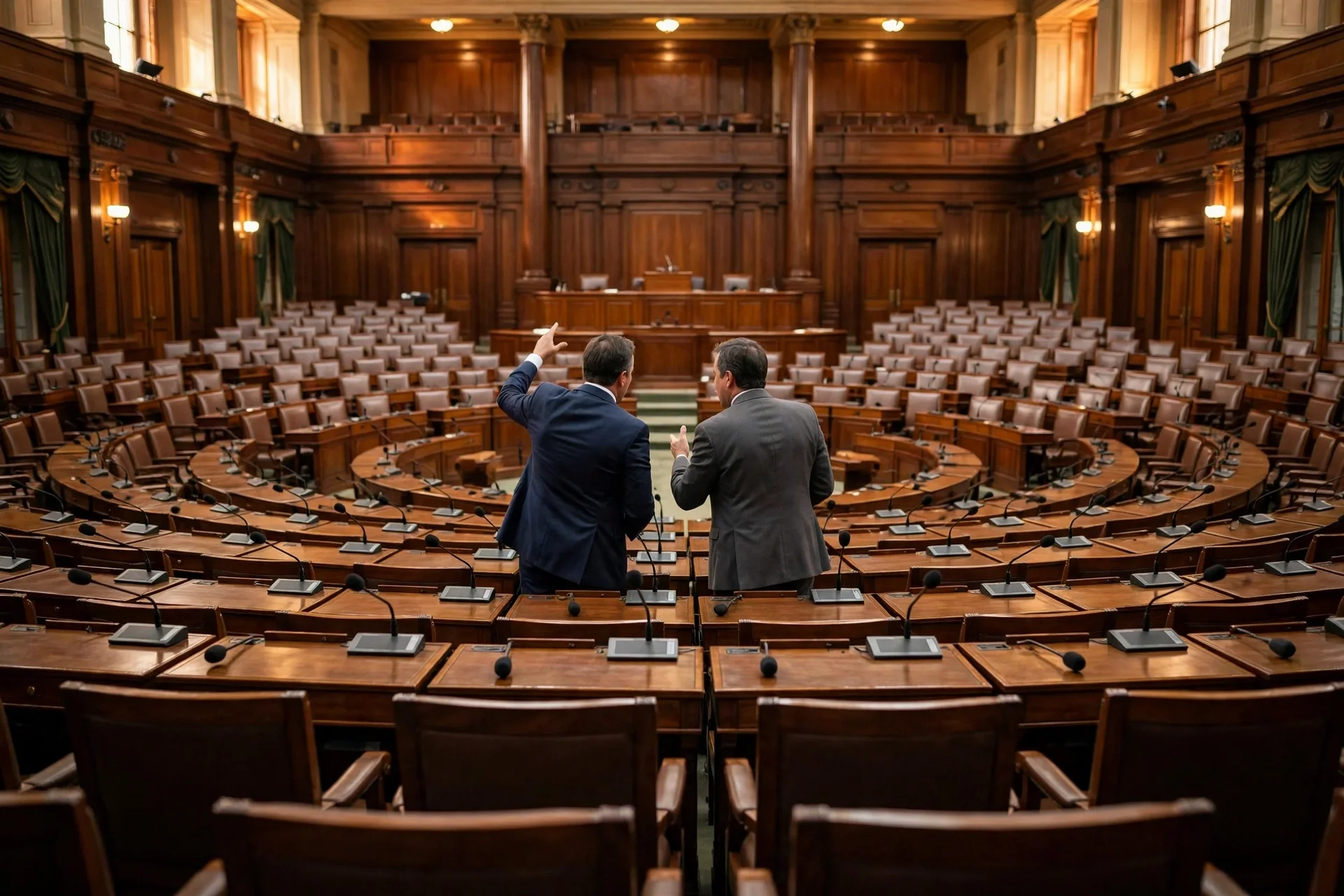
Dos legisladores en pleno debate en un hemiciclo, imagen alusiva al enfrentamiento en el Congreso. · Imagen generada para EPM
Cepeda and Hernández clash in Congress over the Mancuso audio
A debate in Colombia's Congress pitted Jp Hernández against Iván Cepeda after an audio in which Mancuso attributes to Petro's government a request to accuse…
Hernández plays Mancuso audio as Cepeda denies it in Congress
Jp Hernández played in Congress an audio attributed to Mancuso about an alleged request by Petro's government to accuse three leaders, while Iván Cepeda said…
--- The context ---
A tense moment unfolded in Colombia's Congress during a hard debate between Senator Jp Hernández and Senator and former presidential candidate Iván Cepeda. The clash followed statements by Salvatore Mancuso, who claimed that people from Gustavo Petro's government asked him to accuse Uribe and President Abelardo De La Espriella.
--- The facts ---
According to the account attributed to Mancuso and played in an audio recording by Hernández, in Valledupar, in October 2025, delegates from Petro's government allegedly asked former Autodefensas commanders to accuse three men in order to win an election. The names mentioned were Uribe, De La Espriella and Vargas Lleras, and, again according to Mancuso, none of them accepted that alleged request.
--- The positions ---
Cepeda said it is completely false that he held any kind of meeting with the former paramilitary chief in which he had used him to shape any kind of statements. He also said the audio was part of a previously prepared script and stated that Mancuso has had a relationship for years with President De La Espriella, describing them as lifelong friends who have traveled a path together.
Hernández said Mancuso is close to petrismo and argued that this closeness casts doubt on Cepeda's denial.
--- What remains unknown ---
There is no known judicial verification of the audio or of its full context, and no independent corroboration of the Valledupar account. There are also no known reactions from Uribe, De La Espriella or Vargas Lleras, nor a response from the former government.
--- Unanswered questions ---
Who will judicially verify the authenticity and full context of the audio played in Congress? Are there additional records or testimonies that confirm or refute the account attributed to Mancuso about Valledupar? What will Uribe, President De La Espriella and Vargas Lleras say about these claims? Will any formal proceeding be opened to establish whether a meeting like the one Cepeda categorically denies ever took place?
--- EPM analysis ---
The greatest risk is turning testimony of enormous historical weight into an early verdict inside a political chamber. Without judicial verification, Congress risks replacing evidence with the impact of an audio clip.
📌 EPM Take: In EPM's view, this case should leave the terrain of trial by media as soon as possible and enter that of strict judicial verification, with authentication of the audio, contrast of testimonies and full respect for presumption and due process. Neither the gravity of what was claimed authorizes treating it as proven, nor does Cepeda's denial suffice to close it without examination. Colombia needs verified facts, not competing scripts, because only an investigation with guarantees can separate a founded complaint from harmful political instrumentalization.
--- The context ---
A hard debate in Colombia's Congress pitted Senator Jp Hernández against Senator and former presidential candidate Iván Cepeda, following statements by Salvatore Mancuso about Gustavo Petro's government. According to Mancuso's claim, people from that government asked him to accuse Uribe and President Abelardo De La Espriella.
--- The facts ---
Hernández played an audio in which, according to Mancuso's account, in Valledupar, in October 2025, delegates from Petro's government asked former Autodefensas commanders to accuse three men in order to win an election. Those three men, according to that same account, were Uribe, De La Espriella and Vargas Lleras, and none allegedly accepted the request.
--- The positions ---
Cepeda said it is completely false that he held any kind of meeting with the former paramilitary chief to instrumentalize his statements. He added that the audio was part of a previously prepared script and stated that Mancuso has maintained a relationship for years with President De La Espriella, describing them as lifelong friends.
Hernández replied that Mancuso is close to petrismo, that this closeness casts doubt on the falsehood invoked by Cepeda, and concluded that the tables were turning, because Angie Rodríguez and Mancuso were showing how some alleged corruption schemes operated during Petro's presidency.
--- What remains unknown ---
The full audio, its verifiable origin and any element allowing the Valledupar account to be contrasted are still missing. Also missing are reactions from Uribe, President De La Espriella and Vargas Lleras, as well as a response from the former government.
--- Unanswered questions ---
Will the authorities thoroughly investigate the account attributed to Mancuso about the request made in Valledupar? Who would the delegates mentioned in that account be, and can they be identified with verifiable evidence? Will the former government answer the accusation that it sought accusations against Uribe, De La Espriella and Vargas Lleras? What explanation will Cepeda give, beyond his denial, about the closeness between Mancuso and petrismo that Hernández pointed to?
--- EPM analysis ---
If the account attributed to Mancuso were true, this would be a very serious pattern of electoral instrumentalization: using testimony from former paramilitary commanders to strike opponents and alter an election.
📌 EPM Take: In EPM's view, the institutional gravity of this allegation demands a thorough investigation, without shielding or delays, into what the account attributed to Mancuso imputes to the former government. This is not about condemning anyone over an audio clip, but about preventing an alleged electoral maneuver of that scale from remaining unexplained for political convenience. If there were delegates who asked for three leaders to be accused in order to win an election, the country must know it with names, evidence and clear legal consequences.
Cepeda y Hernández chocan en el Congreso por el audio de Mancuso
Un debate en el Congreso enfrentó a Jp Hernández e Iván Cepeda tras el audio en el que Mancuso atribuye al Gobierno de Petro una petición para acusar a Uribe…
Hernández exhibe audio de Mancuso y Cepeda lo niega en el Congreso
Jp Hernández reprodujo en el Congreso un audio atribuido a Mancuso sobre una presunta petición del Gobierno de Petro para acusar a tres dirigentes, mientras…
--- El contexto ---
En el Congreso de la República se vivió un momento tenso durante un duro debate entre el senador Jp Hernández y el senador y excandidato presidencial Iván Cepeda. El choque se produjo tras las declaraciones de Salvatore Mancuso, quien aseguró que desde el Gobierno de Gustavo Petro le pidieron acusar a Uribe y al presidente Abelardo De La Espriella.
--- Los hechos ---
Según el relato atribuido a Mancuso y reproducido en un audio por Hernández, en Valledupar, en octubre de 2025, delegados del Gobierno de Petro habrían pedido a los excomandantes de las Autodefensas acusar a tres hombres para ganar una elección. Los nombres mencionados fueron Uribe, De La Espriella y Vargas Lleras, y, siempre según Mancuso, ninguno aceptó esa supuesta petición.
--- Las posiciones ---
Cepeda aseguró que es totalmente falso que haya sostenido algún tipo de reunión con el exjefe paramilitar en la que lo hubiera instrumentado para algún tipo de declaraciones. También dijo que el audio hace parte de un libreto previamente elaborado y afirmó que Mancuso tiene una relación de años con el presidente De La Espriella, a quienes describió como amigos de toda la vida que han hecho juntos un camino.
Hernández aseguró que Mancuso es cercano al petrismo y que esa cercanía pone en duda la negación de Cepeda.
--- Lo que falta saber ---
No consta ninguna verificación judicial del audio ni de su contexto completo, ni una comprobación independiente del relato sobre Valledupar. Tampoco se conocen reacciones de Uribe, de De La Espriella o de Vargas Lleras, ni una respuesta del Gobierno anterior.
--- Preguntas sin respuesta ---
¿Quién verificará judicialmente la autenticidad y el contexto completo del audio reproducido en el Congreso? ¿Existen registros o testimonios que confirmen o desmientan el relato atribuido a Mancuso sobre Valledupar? ¿Qué dirán Uribe, el presidente De La Espriella y Vargas Lleras sobre estas afirmaciones? ¿Se abrirá alguna actuación formal para establecer si hubo una reunión como la que Cepeda niega de manera categórica?
--- Análisis EPM ---
El riesgo mayor es convertir un testimonio de enorme peso histórico en sentencia anticipada dentro de un recinto político. Sin verificación judicial, el Congreso corre el peligro de sustituir la prueba por el impacto del audio.
📌 Conclusion EPM: A juicio de EPM, este caso debe salir cuanto antes del terreno del juicio mediático y entrar al de la verificación judicial estricta, con autenticación del audio, contraste de testimonios y respeto pleno por la presunción y el debido proceso. Ni la gravedad de lo afirmado autoriza a darlo por probado, ni la negación de Cepeda basta para cerrarlo sin examen. Colombia necesita hechos comprobados, no libretos enfrentados, porque solo una investigación con garantías puede separar una denuncia fundada de una instrumentalización política dañina para todos.
--- El contexto ---
Un duro debate en el Congreso de la República enfrentó al senador Jp Hernández con el senador y excandidato presidencial Iván Cepeda, tras las declaraciones de Salvatore Mancuso sobre el Gobierno de Gustavo Petro. Según aseguró Mancuso, desde ese Gobierno le pidieron acusar a Uribe y al presidente Abelardo De La Espriella.
--- Los hechos ---
Hernández reprodujo un audio en el que, según el relato de Mancuso, en Valledupar, en octubre de 2025, delegados del Gobierno de Petro pidieron a los excomandantes de las Autodefensas acusar a tres hombres para ganar una elección. Esos tres hombres, de acuerdo con ese mismo relato, eran Uribe, De La Espriella y Vargas Lleras, y ninguno habría aceptado la petición.
--- Las posiciones ---
Cepeda aseguró que es totalmente falso que haya sostenido algún tipo de reunión con el exjefe paramilitar para instrumentar sus declaraciones. Añadió que el audio hace parte de un libreto previamente elaborado y afirmó que Mancuso mantiene una relación de años con el presidente De La Espriella, a quienes describió como amigos de toda la vida.
Hernández respondió que Mancuso es cercano al petrismo, que esa cercanía pone en duda la falsedad invocada por Cepeda y concluyó que se estaba volteando la torta, porque Angie Rodríguez y Mancuso estarían demostrando cómo operaban algunos presuntos entramados de corrupción durante la presidencia de Petro.
--- Lo que falta saber ---
Todavía falta conocer el audio completo, su origen verificable y cualquier elemento que permita contrastar el relato sobre Valledupar. También faltan las reacciones de Uribe, del presidente De La Espriella y de Vargas Lleras, así como una respuesta del Gobierno anterior.
--- Preguntas sin respuesta ---
¿Investigarán las autoridades a fondo el relato atribuido a Mancuso sobre la petición hecha en Valledupar? ¿Quiénes serían los delegados mencionados en ese relato y podrán ser identificados con pruebas verificables? ¿Responderá el Gobierno anterior a la acusación de haber buscado acusaciones contra Uribe, De La Espriella y Vargas Lleras? ¿Qué explicación dará Cepeda, más allá de su negación, sobre la cercanía entre Mancuso y el petrismo que señaló Hernández?
--- Análisis EPM ---
Si el relato atribuido a Mancuso resultara cierto, estaríamos ante un patrón gravísimo de instrumentalización electoral: usar testimonios de excomandantes paramilitares para golpear a adversarios y alterar una elección.
📌 Conclusion EPM: A juicio de EPM, la gravedad institucional de esta denuncia exige una investigación a fondo, sin blindajes ni dilaciones, sobre lo que el relato atribuido a Mancuso imputa al Gobierno anterior. No se trata de condenar por un audio, sino de impedir que una presunta maniobra electoral de esa escala quede sin esclarecimiento por cálculo político. Si hubo delegados que pidieron acusar a tres dirigentes para ganar una elección, el país debe saberlo con nombres, pruebas y consecuencias jurídicas claras.