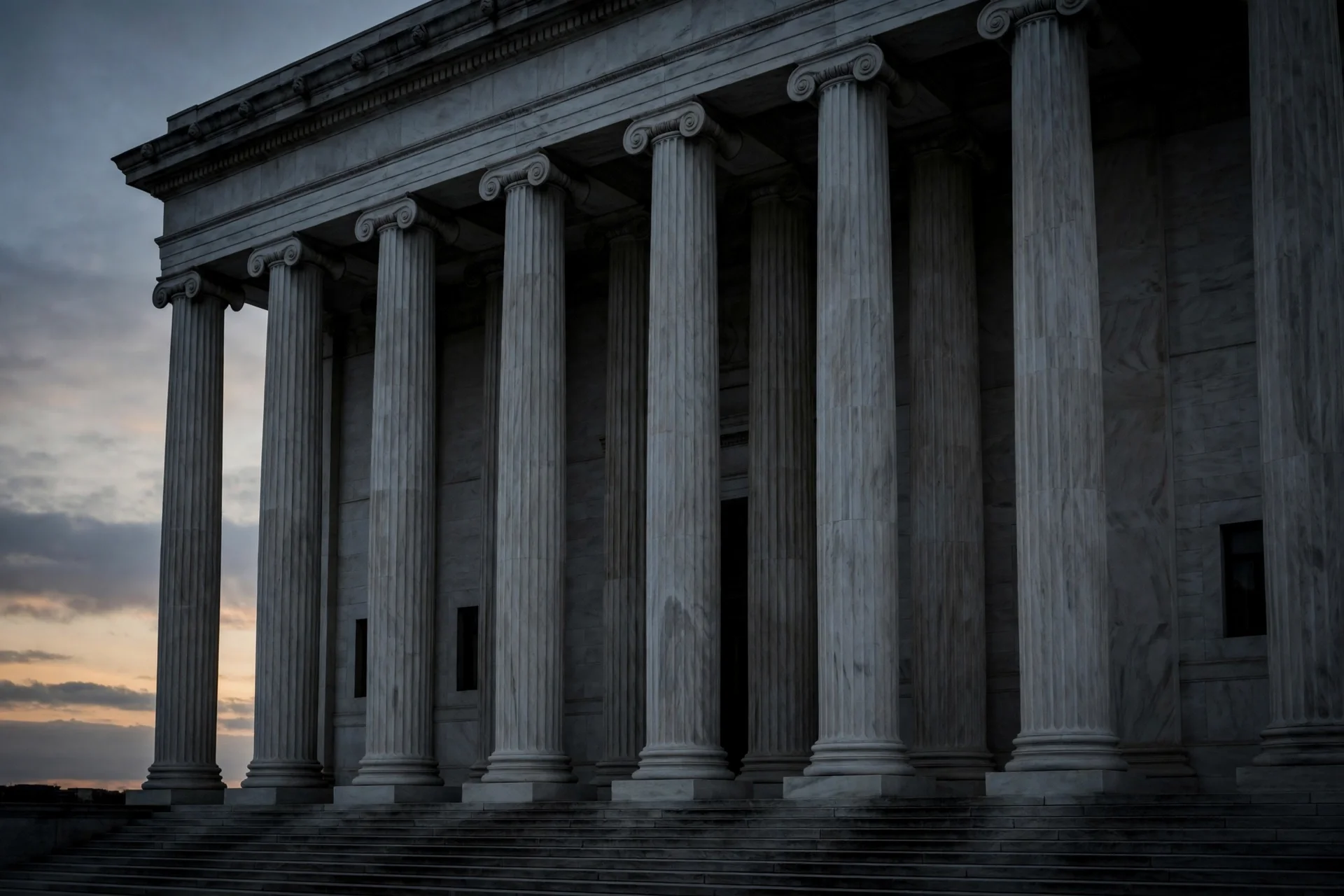
Fachada judicial de columnas al atardecer, imagen alusiva a la decisión de la Corte Suprema. · Imagen generada para EPM
Supreme Court leaves death penalty open in the September 11 case
The Supreme Court rejected the appeal by Khalid Sheikh Mohammed and his two co-defendants, held at Guantánamo since 2006, and left in place the ruling that…
Supreme Court upholds plea reversal and keeps death penalty open
The Supreme Court denied the appeal by Khalid Sheikh Mohammed and his two co-defendants and left in place the July 2025 ruling that recognized Lloyd Austin's…
--- The context ---
The detention center at Guantánamo was established in 2002 to hold terrorism suspects after the attacks of September 11, 2001, and it remains in operation more than two decades after its opening. Held there since 2006 is Khalid Sheikh Mohammed, accused of orchestrating the plan to crash hijacked passenger planes into the Twin Towers and the Pentagon, alongside Mustafa al Hawsawi and Walid bin Atash, who are charged with logistical and financial support roles in the plot.
--- The facts ---
The Supreme Court on Monday rejected the appeal by Mohammed and his two co-defendants, who sought to revive a plea agreement that would have spared them the death penalty. The decision, issued through an unsigned order, leaves in place the ruling of the District of Columbia Circuit, which in July 2025 determined, by two votes to one, that former defense secretary Lloyd Austin indisputably had the legal authority to withdraw from the agreements. Justice Brett Kavanaugh did not take part in the deliberation, and the court offered no explanation for his recusal.
The three have been held at Guantánamo since 2006 and face charges that include five offenses carrying a possible death sentence for their alleged role in attacks that cost the lives of nearly 3,000 people. They were captured in 2003, passed through secret prisons where they were subjected to so-called enhanced interrogation techniques before their transfer in 2006, and formal charges arrived in 2008. Since then, the process has been stalled in large part by disputes over the admissibility of evidence obtained under coercion. An Air Force judge set the trial date in August for June 2028.
--- The positions ---
A Justice Department spokesperson stated that the ruling clears the path for those responsible for the attacks to be held accountable and described it as a critical step toward justice for the victims and the families. Defense lawyers, including representatives of the ACLU, had urged the high court to take the case and argued that Austin's decision violated existing military law and prolonged the best opportunity for resolution of the case in a quarter of a century.
A legal analyst and Georgetown University professor noted that the practical effect of the denials is to clear the way for pretrial proceedings to continue, although he warned that the trial date planned for 2028 is completely unrealistic given the number of questions still pending resolution.
--- What remains unknown ---
The file now returns to the military commissions, and the trial planned for June 2028 depends on the parties meeting a series of interim deadlines. The disputes over which evidence obtained under coercion may be used remain unresolved, an issue that has held the process back for years and conditions any real advance toward a sentence.
--- Unanswered questions ---
Can the trial really take place in June 2028, or will it be postponed again as analysts consider realistic? What evidence obtained under coercion will the military commissions ultimately admit? How much longer can a process that has gone a quarter of a century without reaching trial continue?
--- EPM analysis ---
The history of the collapsed plea deal sums up the deadlock: the agreements were the result of more than two years of negotiations, with talks opened in 2023 after the designation of Susan Escallier as convening authority. The deals, approved by Escallier in 2024, provided for guilty pleas, life imprisonment without parole and a public sentencing hearing with questions from the families. Austin revoked them two days later, a military judge declared them valid and enforceable in November 2024, and the District of Columbia Circuit ultimately backed the secretary's authority in July 2025.
📌 EPM Take: In EPM's view, a case that has spent a quarter of a century without reaching trial cannot be presented as a triumph of justice, but as a debt accumulated by the system itself. The death penalty is back on the table, yet the underlying questions remain untouched: what weight evidence marked by coercion will carry, and how much longer a process stalled at Guantánamo since 2006 can last. Closing this case requires a firm resolution and, at the same time, guarantees that make the verdict credible before the victims, before the country and before history itself.
--- The context ---
The detention center at Guantánamo was established in 2002 to hold terrorism suspects after the attacks of September 11, 2001, and it remains in operation more than two decades later. Held there since 2006 are Khalid Sheikh Mohammed, accused of orchestrating the plan to crash hijacked passenger planes into the Twin Towers and the Pentagon, and his co-defendants Mustafa al Hawsawi and Walid bin Atash, charged with logistical and financial support roles in the terrorist plot.
--- The facts ---
The Supreme Court on Monday rejected the appeal by Mohammed and his two co-defendants, who sought to revive a plea agreement that would have spared them the death penalty. The decision, issued through an unsigned order, leaves in place the ruling of the District of Columbia Circuit, which in July 2025 determined, by two votes to one, that former defense secretary Lloyd Austin indisputably had the legal authority to withdraw from the agreements. Justice Brett Kavanaugh did not take part in the deliberation, and the court offered no explanation for his recusal.
The three face charges that include five offenses carrying a possible death sentence for their alleged role in attacks that cost the lives of nearly 3,000 people. They were captured in 2003 and transferred to Guantánamo in 2006, after passing through secret prisons where they were subjected to so-called enhanced interrogation techniques. Formal charges arrived in 2008, and the process has been stalled in large part by disputes over the admissibility of evidence obtained under coercion. An Air Force judge set the trial date in August for June 2028.
--- The positions ---
A Justice Department spokesperson stated that the ruling clears the path for those responsible for the attacks to be held accountable and described it as a critical step toward justice for the victims and the families. The government's position, defended first by Austin and continued afterward, is that a decision of such magnitude should rest with the secretary, and the District of Columbia Circuit concluded that the secretary acted within the limits of his legal authority.
Defense lawyers, including representatives of the ACLU, argued that Austin's decision violated existing military law and prolonged the best opportunity for resolution of the case in a quarter of a century. A legal analyst and Georgetown University professor noted that the denials clear the way for pretrial proceedings to continue, although he considered the 2028 date completely unrealistic.
--- What remains unknown ---
The file returns to the military commissions at Guantánamo, and the June 2028 trial depends on the parties meeting a series of interim deadlines. It remains to be seen whether the schedule holds and how the pending disputes over the evidence are resolved, conditions that analysts consider difficult to satisfy within the set timeframe.
--- Unanswered questions ---
Will the trial finally take place in June 2028, or will new postponements prevail? Will those accused of planning the attacks be held accountable before a court? Will the victims and their families obtain the resolution they have awaited for a quarter of a century?
--- EPM analysis ---
The collapsed deals were born of more than two years of negotiations, opened in 2023 after the designation of Susan Escallier as convening authority. Approved by Escallier in 2024, they provided for guilty pleas and life imprisonment without the possibility of parole. Austin revoked them two days after their announcement, a military judge declared them valid and enforceable in November 2024, and the District of Columbia Circuit finally backed the secretary's authority in July 2025, a chain the Supreme Court has now closed by denying the appeal.
📌 EPM Take: In EPM's view, the Supreme Court did what was required: it preserved the defense secretary's legal authority and kept open the path for those responsible for the attacks to be held accountable before a court. The victims' families have waited a quarter of a century for a resolution and deserve a process that advances without further manufactured delays. Let the trial finally come, with clear rules and the death penalty on the table as the law provides, because that is the only dignified answer to a crime that cost nearly 3,000 innocent lives on American soil that day.
La Corte Suprema deja abierta la pena de muerte en el caso del 11-S
La Corte Suprema rechazó la apelación de Khalid Sheikh Mohammed y de sus dos coacusados, detenidos en Guantánamo desde 2006, y dejó firme el fallo que avaló la…
La Corte Suprema avala anular el pacto y mantiene la pena de muerte
La Corte Suprema negó la apelación de Khalid Sheikh Mohammed y de sus dos coacusados y dejó firme el fallo de julio de 2025 que reconoció la autoridad legal de…
--- El contexto ---
El centro de detención de Guantánamo fue establecido en 2002 para albergar a sospechosos de terrorismo tras los atentados del 11 de septiembre de 2001, y sigue en operación más de dos décadas después de su apertura. En ese limbo jurídico permanece desde 2006 Khalid Sheikh Mohammed, acusado de orquestar el plan para estrellar aviones de pasajeros secuestrados contra las Torres Gemelas y contra el Pentágono, junto a Mustafa al Hawsawi y Walid bin Atash, a quienes se imputan funciones de apoyo logístico y financiero en la trama.
--- Los hechos ---
La Corte Suprema rechazó el lunes la apelación de Mohammed y de sus dos coacusados, que buscaban revivir un acuerdo de culpabilidad que les habría evitado la pena de muerte. La decisión, emitida mediante una orden sin firma, deja firme el fallo del Tribunal de Apelaciones del Circuito de Columbia, que en julio de 2025 determinó, por dos votos contra uno, que el exsecretario de Defensa Lloyd Austin tenía indiscutiblemente la autoridad legal para retirarse de los acuerdos. El juez Brett Kavanaugh no participó en la deliberación del caso, sin que el tribunal ofreciera explicaciones sobre su recusación.
Los tres permanecen detenidos en Guantánamo desde 2006 y enfrentan cargos que incluyen cinco delitos con posibilidad de condena a muerte por su presunto rol en los ataques que costaron la vida a casi 3.000 personas. Fueron capturados en 2003, pasaron por cárceles secretas donde fueron sometidos a las denominadas técnicas de interrogatorio mejoradas antes de su traslado en 2006, y las acusaciones formales llegaron en 2008. Desde entonces, el proceso se vio paralizado en buena medida por disputas sobre la admisibilidad de pruebas obtenidas bajo coacción. Un juez de la Fuerza Aérea fijó en agosto la fecha de juicio para junio de 2028.
--- Las posiciones ---
Un portavoz del Departamento de Justicia afirmó que la resolución despeja el camino para que los responsables de los ataques rindan cuentas y la calificó como un paso crítico hacia la justicia para las víctimas y las familias. Los abogados defensores, entre ellos representantes de la ACLU, habían instado al máximo tribunal a tomar el caso y argumentaron que la decisión de Austin violó la ley militar vigente y prolongó la mejor oportunidad de resolución del caso en un cuarto de siglo.
Un analista legal y profesor de la Universidad de Georgetown señaló que el efecto práctico de las denegaciones es despejar el camino para que los procedimientos previos al juicio continúen, aunque advirtió que la fecha de juicio prevista para 2028 resulta completamente irrealista dada la cantidad de cuestiones pendientes por resolver.
--- Lo que falta saber ---
El expediente regresa ahora a las comisiones militares, y el juicio previsto para junio de 2028 depende de que las partes cumplan una serie de plazos intermedios. Siguen sin resolverse las disputas sobre qué pruebas obtenidas bajo coacción podrán utilizarse, una cuestión que ha frenado el proceso durante años y que condiciona cualquier avance real hacia una sentencia.
--- Preguntas sin respuesta ---
¿Podrá celebrarse realmente el juicio en junio de 2028 o volverá a aplazarse como consideran irrealista los analistas? ¿Qué pruebas obtenidas bajo coacción serán admitidas finalmente por las comisiones militares? ¿Cuánto más puede prolongarse un proceso que lleva un cuarto de siglo sin llegar a juicio?
--- Análisis EPM ---
La historia del pacto frustrado resume el atasco: los acuerdos fueron el resultado de más de dos años de negociaciones, con conversaciones abiertas desde 2023 tras la designación de Susan Escallier como autoridad convocante. Los pactos, aprobados por Escallier en 2024, preveían declaraciones de culpabilidad, cadena perpetua sin libertad condicional y una audiencia pública con preguntas de las familias. Austin los revocó dos días después, un juez militar los declaró válidos y ejecutables en noviembre de 2024 y el Circuito de Columbia terminó respaldando la autoridad del secretario en julio de 2025.
📌 Conclusion EPM: A juicio de EPM, un caso que lleva un cuarto de siglo sin llegar a juicio no puede presentarse como un triunfo de la justicia, sino como una deuda acumulada del propio sistema. La pena de muerte vuelve a estar sobre la mesa, pero las preguntas de fondo siguen intactas: qué valor tendrán unas pruebas marcadas por la coacción y cuánto más puede durar un proceso detenido en Guantánamo desde 2006. Cerrar el caso exige una resolución firme y, al mismo tiempo, garantías que hagan creíble el veredicto ante las víctimas, ante el país y ante la historia misma.
--- El contexto ---
El centro de detención de Guantánamo fue establecido en 2002 para albergar a sospechosos de terrorismo tras los atentados del 11 de septiembre de 2001, y sigue en operación más de dos décadas después. Allí permanecen detenidos desde 2006 Khalid Sheikh Mohammed, acusado de orquestar el plan para estrellar aviones de pasajeros secuestrados contra las Torres Gemelas y contra el Pentágono, y sus coacusados Mustafa al Hawsawi y Walid bin Atash, a quienes se imputan funciones de apoyo logístico y financiero en la trama terrorista.
--- Los hechos ---
La Corte Suprema rechazó el lunes la apelación de Mohammed y de sus dos coacusados, que pretendían revivir un acuerdo de culpabilidad que les habría evitado la pena de muerte. La decisión, emitida mediante una orden sin firma, deja firme el fallo del Tribunal de Apelaciones del Circuito de Columbia, que en julio de 2025 determinó, por dos votos contra uno, que el exsecretario de Defensa Lloyd Austin tenía indiscutiblemente la autoridad legal para retirarse de los acuerdos. El juez Brett Kavanaugh no participó en la deliberación, sin que el tribunal ofreciera explicaciones sobre su recusación.
Los tres enfrentan cargos que incluyen cinco delitos con posibilidad de condena a muerte por su presunto rol en los ataques que costaron la vida a casi 3.000 personas. Fueron capturados en 2003 y trasladados a Guantánamo en 2006, tras pasar por cárceles secretas donde fueron sometidos a las denominadas técnicas de interrogatorio mejoradas. Las acusaciones formales llegaron en 2008 y el proceso se vio paralizado en buena medida por disputas sobre la admisibilidad de pruebas obtenidas bajo coacción. Un juez de la Fuerza Aérea fijó en agosto la fecha de juicio para junio de 2028.
--- Las posiciones ---
Un portavoz del Departamento de Justicia afirmó que la resolución despeja el camino para que los responsables de los ataques rindan cuentas y la calificó como un paso crítico hacia la justicia para las víctimas y las familias. La posición del gobierno, defendida primero por Austin y continuada después, es que una decisión de tal magnitud debía recaer en el secretario, y el Circuito de Columbia concluyó que el secretario actuó dentro de los límites de su autoridad legal.
Los abogados defensores, entre ellos representantes de la ACLU, argumentaron que la decisión de Austin violó la ley militar vigente y prolongó la mejor oportunidad de resolución del caso en un cuarto de siglo. Un analista legal y profesor de la Universidad de Georgetown señaló que las denegaciones despejan el camino para que continúen los procedimientos previos al juicio, aunque consideró completamente irrealista la fecha de 2028.
--- Lo que falta saber ---
El expediente regresa a las comisiones militares de Guantánamo, y el juicio de junio de 2028 depende de que las partes cumplan una serie de plazos intermedios. Queda por ver si el calendario se sostiene y cómo se resuelven las disputas pendientes sobre las pruebas, cuestiones que analistas consultados consideran difíciles de satisfacer en los tiempos fijados.
--- Preguntas sin respuesta ---
¿Se celebrará por fin el juicio en junio de 2028 o se impondrán nuevos aplazamientos? ¿Rendirán cuentas ante un tribunal los acusados de planificar los atentados? ¿Obtendrán las víctimas y sus familias la resolución que llevan un cuarto de siglo esperando?
--- Análisis EPM ---
Los pactos frustrados nacieron de más de dos años de negociaciones, abiertas desde 2023 tras la designación de Susan Escallier como autoridad convocante. Aprobados por Escallier en 2024, preveían declaraciones de culpabilidad y cadena perpetua sin libertad condicional. Austin los revocó dos días después de su anuncio, un juez militar los declaró válidos y ejecutables en noviembre de 2024 y el Circuito de Columbia respaldó finalmente la autoridad del secretario en julio de 2025, una cadena que la Corte Suprema ha cerrado ahora al negar la apelación.
📌 Conclusion EPM: A juicio de EPM, la Corte Suprema ha hecho lo que correspondía: preservar la autoridad legal del secretario de Defensa y mantener abierto el camino para que los responsables de los atentados rindan cuentas ante un tribunal. Las familias de las víctimas llevan un cuarto de siglo esperando una resolución y merecen que el proceso avance sin más dilaciones fabricadas. Que el juicio llegue por fin, con las reglas claras y la pena de muerte sobre la mesa como prevé la ley, es la única respuesta digna frente a un crimen que costó casi 3.000 vidas inocentes en suelo estadounidense aquel día.