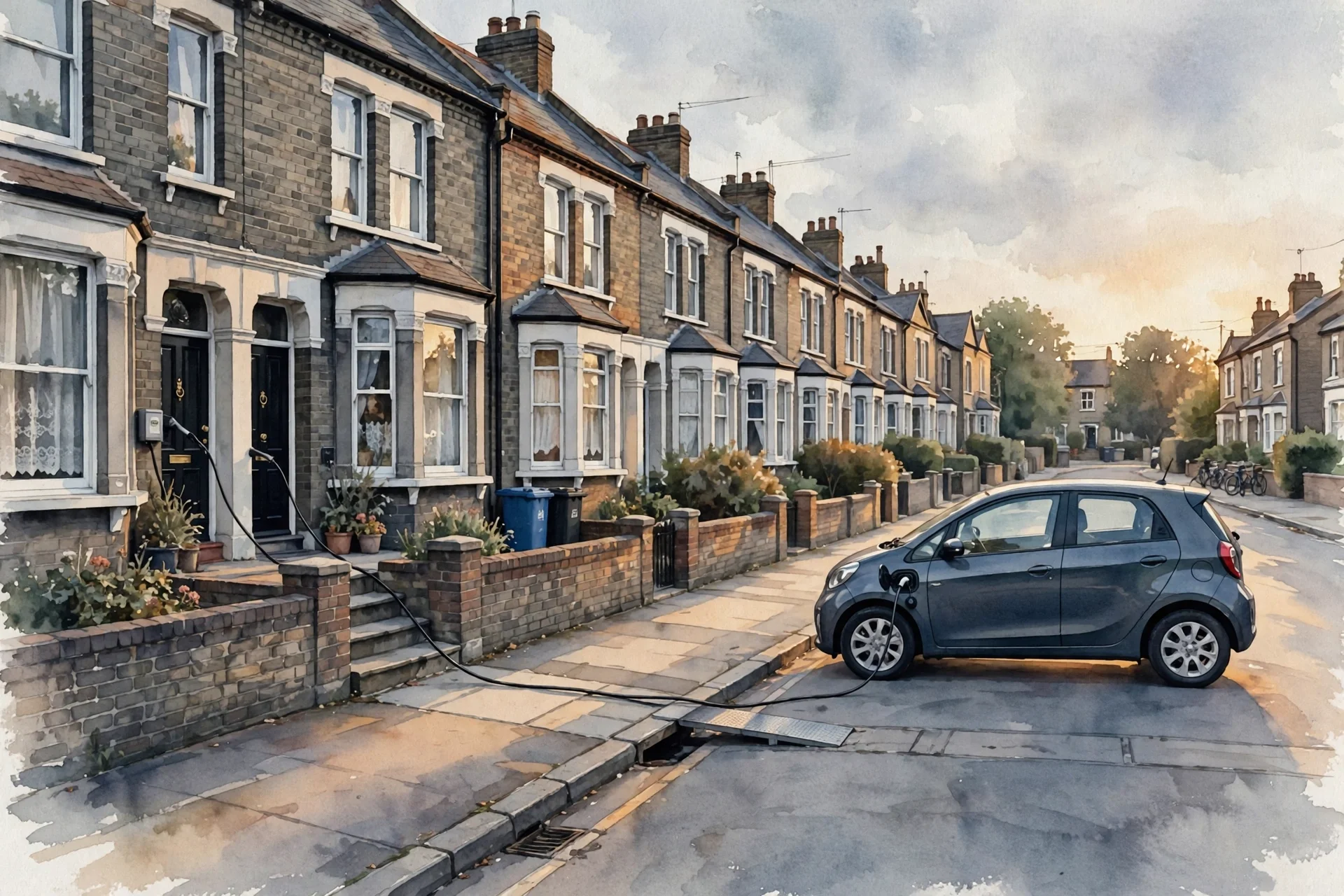
Carga doméstica de un vehículo eléctrico en una calle residencial británica, en ilustración editorial. · Imagen generada para EPM
UK scraps planning permit for home EV chargers without driveways
From 21 October 2026, British homes without a driveway no longer need planning permission for cross-pavement chargers.
Britain cuts red tape for at-home electric car charging
The British government has removed planning permission for cross-pavement chargers in homes without a driveway from 21 October 2026.
--- The context --- In the United Kingdom, charging an electric car at home was far harder for people without a driveway or off-street parking. Those households relied on public chargers, without cheaper domestic electricity, and any solution under the pavement first required planning permission that added cost and delay.
From 21 October 2026, homes without a driveway no longer need that permission for cross-pavement chargers running under the pavement from the home to a car parked on the street. The government presents the change as a correction to that inequality of access.
--- The facts --- The measure can save up to £300 on installation and opens up home charging for as little as 2p per mile. Connecting a car to household electricity can also deliver savings of up to £1,750 on running costs, according to the government.
In September 2026, nearly 100,000 electric cars were sold in a single month, a record, up 36% in a year. The Electric Car Grant has now helped over 190,000 drivers save up to £3,750 off a new electric vehicle, according to official figures.
Changes to permitted development rights will also make larger, higher-powered public charging hubs quicker and cheaper to install. Two public consultations are open until 16 December 2026, covering tenants and leaseholders and building rules for new or refurbished covered car parks.
--- The positions --- Buses and Local Transport Minister Simon Lightwood argued, in reported speech, that cutting unnecessary red tape saves up to £300, speeds up installations and puts money back in drivers' pockets. Vicky Edmonds, chief executive of EVA England, said, in reported speech, that a small planning change could decide whether someone without a driveway can afford an electric car.
Dickson Abegunde, of Zoopla, noted, in reported speech, that charging access influences home choices and welcomed the decision as a step towards accessible electric ownership for households without off-street parking.
--- What remains unknown --- It is not yet clear how local authorities and landlords will apply these solutions in practice, or how fast real installations will follow. The outcome of the 2 consultations is also unknown, including whether landlords will face mandatory requirements on tenants' applications.
--- Unanswered questions --- How many households without a driveway will actually install a cross-pavement charger in the coming months? Will local authorities and landlords make access easier in practice, as EVA England urges? Will the consultations produce clear rights for tenants and leaseholders before the 16 December 2026 deadline?
--- EPM analysis --- The importance lies not only in the £300 saving, but in who joins cheap charging. Research cited by EVA England found that 60% of petrol and diesel drivers without off-street parking would never consider an electric vehicle. If home charging no longer requires a driveway, that refusal may begin to shift.
📌 EPM Take: In EPM's view, removing planning permission for cross-pavement charging tackles a concrete inequality, because it links the £300 installation saving and savings of up to £1,750 on running costs to access to domestic electricity, not only to a purchase grant of up to £3,750. Success will depend on councils, landlords and freeholders, and on whether the consultations open until 16 December 2026 deliver clear routes for tenants who today depend on others to charge at home.
--- The context --- In the United Kingdom, many households without a driveway faced a prior permission step to install a charger running under the pavement to a vehicle parked on the street. That planning permission added cost and waiting time, and left those drivers unable to charge with electricity from their own home.
From 21 October 2026, that requirement disappears for cross-pavement chargers in homes without a driveway. The government presents the decision as a practical fix in its cost-of-living agenda, focused on removing administrative hurdles rather than creating new structures.
--- The facts --- Removing the permission can save up to £300 on installation and opens up home charging for as little as 2p per mile. Connected to domestic electricity, a driver can also save up to £1,750 on running costs, according to the official estimate.
September 2026 set a record, with nearly 100,000 electric cars sold in a single month, up 36% on a year earlier. The Electric Car Grant has now helped over 190,000 drivers with up to £3,750 off a new electric vehicle, according to official figures.
The reform also reaches public charging: changes to permitted development rights will make higher-powered hubs quicker and cheaper for operators to install. Two consultations are open until 16 December 2026, one on tenants and leaseholders and another on building rules for covered car parks.
--- The positions --- Simon Lightwood, the Buses and Local Transport Minister, argued, in reported speech, that removing unnecessary red tape saves up to £300, speeds up installations and puts money back in drivers' pockets. Vicky Edmonds, of EVA England, welcomed, in reported speech, the measure as a step towards a fairer transition for those without a driveway.
Dickson Abegunde, a director at Zoopla, pointed out, in reported speech, that charging weighs on home-buying decisions and described removing the permission as progress for households without off-street parking.
--- What remains unknown --- It remains to be seen how local authorities and landlords will respond as applications rise, and whether the promised speed arrives without new bottlenecks. Whether the consultations will lead to obligations for landlords, or only to guidance, is also unknown.
--- Unanswered questions --- Will the £300 saving translate into real and rapid installations on residential streets? Will local authorities avoid replacing the removed permission with equivalent procedures? What concrete obligations will emerge from the 2 consultations closing on 16 December 2026 for tenants and landlords?
--- EPM analysis --- The figure explaining caution among many drivers comes from research cited by EVA England: 60% of petrol and diesel drivers without off-street parking would never consider an electric vehicle. Removing a permission does not build infrastructure by itself, but it removes a fixed cost where a household decides whether home charging is viable.
📌 EPM Take: In EPM's view, the strength of this reform lies in its administrative simplicity, because it removes prior permission, cuts up to £300 from the entry cost and connects that move with savings of up to £1,750 on running costs and a market that already sold nearly 100,000 electric cars in one month. Its limit is also clear: without orderly local delivery and firm answers on tenants and building rules, cutting red tape may remain an announcement, not working chargers on residential streets.
Reino Unido elimina permiso para cargar el coche eléctrico en casa
Desde el 21 de octubre de 2026, los hogares británicos sin entrada de coche ya no necesitan permiso de planificación para cargadores cross-pavement.
Londres recorta trámites para instalar cargadores domésticos de eléctricos
El Gobierno británico suprime el permiso de planificación para cargadores cross-pavement en hogares sin entrada de coche desde el 21 de octubre de 2026.
--- El contexto --- En el Reino Unido, cargar un coche eléctrico en casa era mucho más difícil sin entrada de coche ni aparcamiento fuera de la calle. Esos hogares dependían de cargadores públicos, sin la electricidad doméstica más barata, y cruzar la acera exigía un permiso de planificación que encarecía y retrasaba la instalación.
Desde el 21 de octubre de 2026, esos hogares ya no necesitan ese permiso para instalar cargadores cross-pavement, que corren bajo la acera desde la vivienda hasta el coche en la calle. El Gobierno presenta el cambio como una corrección de esa desigualdad de acceso.
--- Los hechos --- La medida ahorra hasta £300 en la instalación y abre la carga doméstica por tan solo 2 peniques por milla. Conectar el coche a la electricidad del hogar puede suponer además hasta £1,750 de ahorro en costes de uso, según el Gobierno.
En septiembre de 2026 se vendieron casi 100,000 coches eléctricos en un solo mes, un récord con un aumento del 36% en un año. La ayuda Electric Car Grant ya ha ayudado a más de 190,000 conductores a ahorrar hasta £3,750 en un eléctrico nuevo.
Los derechos de desarrollo permitido harán también más rápido y barato instalar centros públicos de carga de mayor potencia. Hay 2 consultas abiertas hasta el 16 de diciembre de 2026, sobre inquilinos y arrendatarios y sobre aparcamientos cubiertos nuevos o reformados.
--- Las posiciones --- Simon Lightwood, ministro de Autobuses y Transporte Local, defendió en indirecto que recortar trámites ahorra hasta £300, acelera instalaciones y devuelve dinero a los conductores. Vicky Edmonds, de EVA England, sostuvo en indirecto que un cambio pequeño puede decidir si alguien sin entrada puede permitirse un eléctrico o lo descarta.
Dickson Abegunde, de Zoopla, señaló en indirecto que la carga influye al elegir vivienda y valoró la medida como un paso de accesibilidad para hogares sin aparcamiento fuera de la calle.
--- Lo que falta saber --- No está claro cómo aplicarán ayuntamientos y propietarios estas soluciones en la práctica, ni el ritmo real de instalaciones. Tampoco se conoce si las 2 consultas traerán requisitos obligatorios para arrendadores frente a las solicitudes de inquilinos.
--- Preguntas sin respuesta --- ¿Cuántos hogares sin entrada instalarán un cargador cross-pavement en los próximos meses? ¿Harán ayuntamientos y propietarios más fácil el acceso en la práctica? ¿Convertirán las consultas en derechos claros para inquilinos antes del 16 de diciembre de 2026?
--- Análisis EPM --- La clave no son solo los £300, sino quién entra en la carga barata. El estudio citado por EVA England indica que el 60% de los conductores de gasolina o diésel sin aparcamiento fuera de la calle nunca consideraría un eléctrico. Si cargar en casa deja de exigir entrada propia, ese rechazo puede empezar a moverse.
📌 Conclusion EPM: A juicio de EPM, eliminar el permiso para la carga cross-pavement ataca una desigualdad concreta, porque vincula el ahorro de £300 en instalación y de hasta £1,750 en uso al acceso a la electricidad doméstica, y no solo a la compra subvencionada con hasta £3,750. El acierto dependerá de ayuntamientos, propietarios y arrendadores, y de que las consultas abiertas hasta el 16 de diciembre de 2026 den rutas claras a los inquilinos que hoy dependen de terceros para cargar en casa.
--- El contexto --- En el Reino Unido, muchos hogares sin entrada de coche enfrentaban un trámite previo para instalar un cargador que cruzara bajo la acera hasta el vehículo en la calle. Ese permiso de planificación añadía coste y espera, y dejaba a esos conductores sin cargar con la electricidad de su propia casa.
Desde el 21 de octubre de 2026, ese requisito desaparece para los cargadores cross-pavement. El Gobierno presenta la decisión como una corrección práctica de su agenda contra el coste de la vida: retirar trabas administrativas en lugar de crear nuevas estructuras.
--- Los hechos --- Suprimir el permiso ahorra hasta £300 en la instalación y abre la carga en casa por tan solo 2 peniques por milla. Conectado a la electricidad doméstica, un conductor puede ahorrar además hasta £1,750 en costes de uso, según la estimación oficial.
Septiembre de 2026 marcó un récord: casi 100,000 coches eléctricos vendidos en un solo mes, un 36% más que un año antes. La ayuda Electric Car Grant ya ha ayudado a más de 190,000 conductores con hasta £3,750 de descuento en un eléctrico nuevo.
La reforma llega también a la carga pública: los derechos de desarrollo permitido facilitarán centros de carga de mayor potencia, más rápidos y baratos de instalar. Hay 2 consultas abiertas hasta el 16 de diciembre de 2026, sobre inquilinos y arrendatarios y sobre aparcamientos cubiertos nuevos o reformados.
--- Las posiciones --- Simon Lightwood, ministro de Autobuses y Transporte Local, argumentó en indirecto que suprimir trámites innecesarios ahorra hasta £300, acelera instalaciones y devuelve dinero a los conductores. Vicky Edmonds, de EVA England, valoró en indirecto la medida como un paso hacia una transición más justa para quien no tiene entrada propia.
Dickson Abegunde, de Zoopla, apuntó en indirecto que la carga pesa al comprar vivienda y calificó la supresión del permiso como un avance para hogares sin aparcamiento fuera de la calle.
--- Lo que falta saber --- Queda por ver cómo responderán autoridades locales y propietarios si aumentan las solicitudes, y si la rapidez prometida llega sin nuevos cuellos de botella. Tampoco se sabe si las consultas traerán obligaciones para arrendadores o solo guías.
--- Preguntas sin respuesta --- ¿Se traducirá el ahorro de £300 en instalaciones reales y rápidas en calles residenciales? ¿Evitarán las autoridades locales sustituir el permiso eliminado por trámites equivalentes? ¿Qué obligaciones saldrán de las 2 consultas que cierran el 16 de diciembre de 2026?
--- Análisis EPM --- El dato que explica la cautela de muchos conductores es del estudio citado por EVA England: el 60% de quienes conducen gasolina o diésel sin aparcamiento fuera de la calle nunca consideraría un eléctrico. Retirar un permiso no crea infraestructura, pero elimina un coste fijo justo donde el hogar decide si cargar en casa es viable.
📌 Conclusion EPM: A juicio de EPM, la fuerza de esta reforma está en su sencillez administrativa, porque suprime un permiso previo, recorta hasta £300 el coste de entrada y conecta ese gesto con ahorros de hasta £1,750 en uso y con un mercado que ya vendió casi 100,000 eléctricos en un mes. Su límite es igual de claro: sin ejecución local ordenada ni respuestas firmes sobre inquilinos y edificación, el recorte puede quedarse en anuncio y no llegar a las calles residenciales.