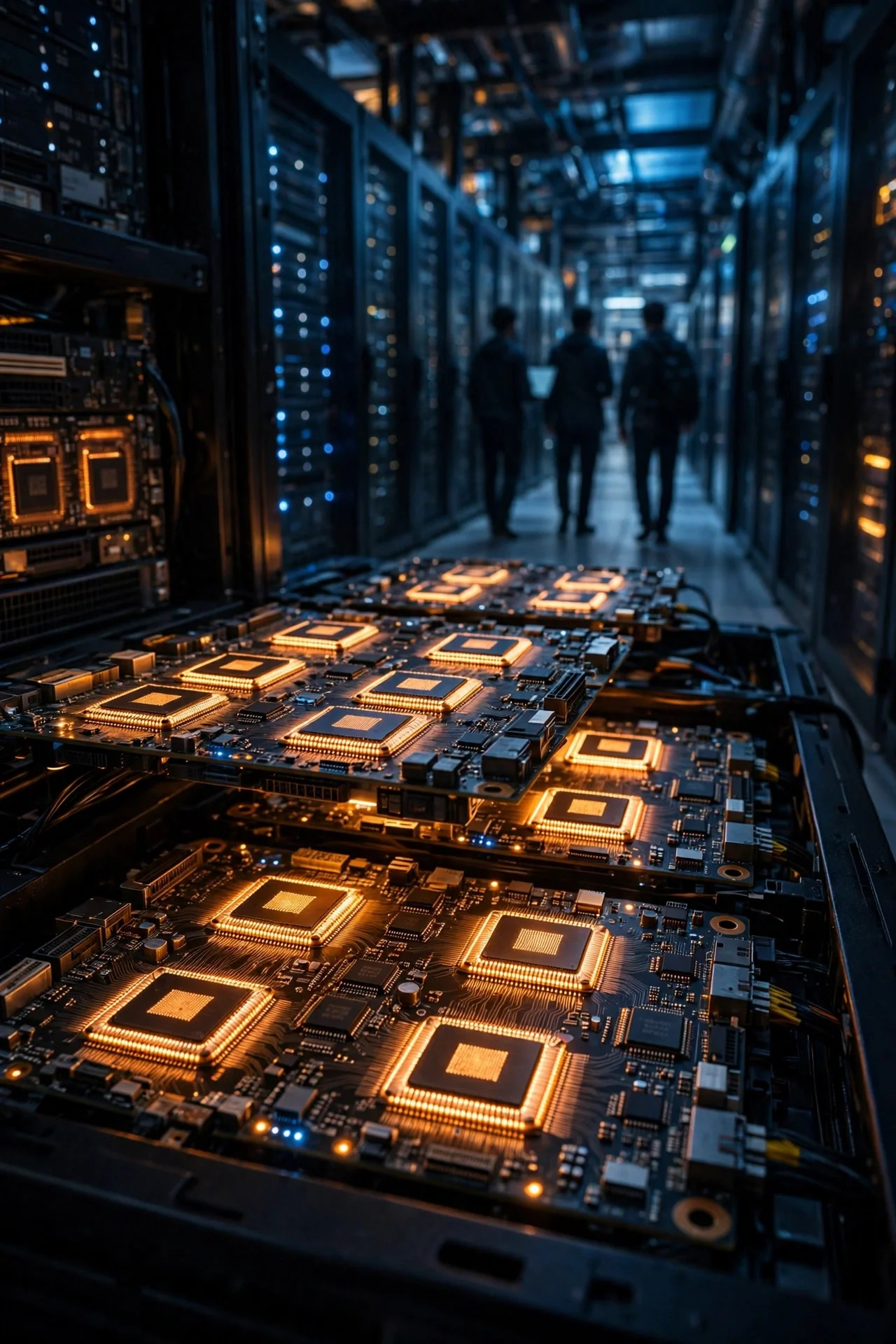
Chips aceleradores de IA iluminados en un centro de datos, con ingenieros al fondo. · Imagen generada para EPM
Google and Amazon open PyTorch tools against Nvidia
Google opened the code of TorchTPU and Amazon presented TorchNeuron for Trainium, two tools aimed at letting artificial intelligence programmers migrate from…
Google and Amazon challenge Nvidia's grip on AI chips
Amazon launched TorchNeuron for its Trainium chip and Google opened TorchTPU for its TPUs, promising PyTorch migration without rewriting code, although Nvidia…
--- The context --- For years, creating artificial intelligence meant working on Nvidia chips, because its CUDA software fit with PyTorch and left its processors integrated into the industry standard almost by default.
According to figures cited by Amazon, 85% of artificial intelligence applications are written with PyTorch, the open-source program used to build most models. Freeing that environment from one manufacturer touches the center of daily programming work.
--- The facts --- Amazon moved first. On Monday it presented TorchNeuron, adapted to Trainium, its own chip, which allows an application to migrate with a simple configuration change. It will also send code to the central PyTorch project to remove parts that tie it to one manufacturer.
One day later, Google opened the code of TorchTPU, which allows programs written for Nvidia chips to run on its TPU processors without rewriting a line. It presented it at the PyTorch 2026 conference, to train, serve and deploy models with Hugging Face, vLLM and SGLang.
Google said it tested TorchTPU with up to 8,000 Ironwood processors and reached 52% efficiency with the Qwen model family, a figure it presents as evidence that its alternative already works at large scale.
--- The positions --- Colin Brace, vice president at Annapurna Labs, the Amazon unit that designs its chips, argued in indirect terms that what matters is removing the block that prevented a real option. Amazon cited Deepgram, which after migrating to Trainium processes 70% more audio per dollar.
Jana van Greunen, director of engineering for PyTorch at Meta, said in indirect terms that one cannot remain tied to a single hardware architecture. The project was developed with Meta, which created PyTorch in 2016 and handed it over in 2022 to its foundation.
Jeff Boudier, vice president of product at Hugging Face, said in indirect terms that the collaboration seeks to let programmers choose the hardware that suits them best without losing access to their favorite models.
--- What remains unknown --- Neither tool guarantees a mass abandonment of Nvidia. Switching chips still involves adjustments and testing, and the company retains years of advantage in performance and in its software ecosystem.
--- Unanswered questions --- How many developers will actually migrate to Trainium or to TPUs in coming months? Will the code Amazon sends to PyTorch verifiably reduce dependence on one manufacturer? Will the 52% with Qwen be repeated with other models?
--- EPM analysis --- The challenge targets the software layer that sustained the previous dominance. If PyTorch works well on different hardware, the choice stops being predetermined and depends on cost and measured performance.
📌 EPM Take: In EPM's view, opening TorchTPU and launching TorchNeuron is a concrete step toward a market with real options, because it attacks the software block and not only promises new hardware. The 85% figure for PyTorch and the Deepgram case, with 70% more audio per dollar, show where the leverage lies. But Nvidia's advantage remains intact while switching requires adjustments and testing, so the opening matters for what it enables today.
--- The context --- Nvidia's dominance was not born from a decree, but from years of work to make its CUDA software fit perfectly with PyTorch. That effort left its chips integrated into the industry standard almost by default.
According to figures cited by Amazon, 85% of artificial intelligence applications are written with PyTorch, the open-source program used to build most models. That is why both companies presented software tools, and not only chips, to make migration manageable.
--- The facts --- On Monday, Amazon presented TorchNeuron, adapted to Trainium, its own chip, which allows an application to migrate with a simple configuration change. It will also send code to the central PyTorch project to remove parts that tie it to one manufacturer.
One day later, Google opened the code of TorchTPU, which allows programs written for Nvidia chips to run on its TPU processors without rewriting a line. It presented it at the PyTorch 2026 conference, to train, serve and deploy models with Hugging Face, vLLM and SGLang.
As proof of scale, Google said it tested TorchTPU with up to 8,000 Ironwood processors and reached 52% efficiency with the Qwen model family. Those figures come from the company itself and still must be contrasted with independent use.
--- The positions --- Colin Brace, vice president at Annapurna Labs, the Amazon unit that designs its chips, argued in indirect terms that what matters is removing the block that prevented a real option. Amazon cited Deepgram, which after migrating to Trainium processes 70% more audio per dollar.
Jana van Greunen, director of engineering for PyTorch at Meta, said in indirect terms that one cannot remain tied to a single hardware architecture. The project was developed with Meta, which created PyTorch in 2016 and handed it over in 2022 to its foundation.
Jeff Boudier, vice president of product at Hugging Face, argued in indirect terms that the collaboration seeks to let programmers choose the hardware that suits them best without losing access to their favorite models.
--- What remains unknown --- Caution remains obligatory. Neither tool guarantees a mass abandonment of Nvidia, because switching chips involves adjustments and testing, and the company retains years of advantage in performance and ecosystem.
--- Unanswered questions --- How many real applications will migrate to Trainium or to TPUs without losing performance? Will Amazon's code contribution to PyTorch arrive complete and verifiable? Will compatibility with Hugging Face, vLLM and SGLang hold as PyTorch evolves?
--- EPM analysis --- The move is competitive and healthy: two companies with resources put software in the open and force the leader to compete also on ease of migration. But markets change through measured results, not announcements.
📌 EPM Take: In EPM's view, what is solid about these launches is that they compete where it hurt, in the software that tied PyTorch to a single manufacturer, with migration by configuration at Amazon and without rewriting code at Google. The 52% efficiency with 8,000 Ironwood processors is a serious signal, although provided by the company itself. Prudence requires waiting for real adoption, because Nvidia retains years of advantage and switching still demands adjustments and testing.
Google y Amazon abren PyTorch para competir con Nvidia
Google abrió el código de TorchTPU y Amazon presentó TorchNeuron para Trainium, dos herramientas que buscan que los programadores de inteligencia artificial…
Google y Amazon desafían el dominio de Nvidia en IA
Amazon lanzó TorchNeuron para su chip Trainium y Google abrió TorchTPU para sus TPU, con la promesa de migrar aplicaciones de PyTorch sin reescribir código…
--- El contexto --- Durante años, crear inteligencia artificial significó trabajar sobre chips de Nvidia, porque su software CUDA encajó con PyTorch y dejó a sus procesadores integrados al estándar de la industria casi por defecto.
Según datos citados por Amazon, el 85% de las aplicaciones de inteligencia artificial se escriben con PyTorch, el programa de código abierto con el que se construye la mayoría de los modelos. Liberar ese entorno toca el centro del trabajo diario.
--- Los hechos --- Amazon se movió primero. El lunes presentó TorchNeuron, adaptado a Trainium, su chip propio, que permite migrar una aplicación con un simple cambio de configuración. También enviará código al proyecto central de PyTorch para quitar las partes que lo atan a un fabricante.
Un día después, Google abrió el código de TorchTPU, que permite llevar programas escritos para chips de Nvidia a sus procesadores TPU sin reescribir una línea. Lo presentó en la conferencia PyTorch 2026, para entrenar, servir y desplegar modelos con Hugging Face, vLLM y SGLang.
Google dijo que probó TorchTPU con hasta 8.000 procesadores Ironwood y alcanzó una eficiencia del 52% con la familia de modelos Qwen, cifra que presenta como evidencia de que su alternativa ya funciona a gran escala.
--- Las posiciones --- Colin Brace, vicepresidente en Annapurna Labs, la unidad de Amazon que diseña sus chips, sostuvo en indirecto que lo importante es eliminar el bloqueo que impedía tener una opción real. Amazon citó a Deepgram, que tras migrar a Trainium procesa 70% más audio por dólar.
Jana van Greunen, directora de ingeniería de PyTorch en Meta, afirmó en indirecto que no se puede quedar atado a una sola arquitectura de hardware. El proyecto se desarrolló con Meta, que creó PyTorch en 2016 y lo cedió en 2022 a la fundación que lo administra.
Jeff Boudier, vicepresidente de producto de Hugging Face, dijo en indirecto que la colaboración busca que los programadores elijan el hardware que mejor les convenga sin perder acceso a sus modelos favoritos.
--- Lo que falta saber --- Ninguna herramienta garantiza un abandono masivo de Nvidia. Cambiar de chip sigue implicando ajustes y pruebas, y la compañía conserva años de ventaja en rendimiento y en su ecosistema de software.
--- Preguntas sin respuesta --- ¿Cuántos desarrolladores migrarán realmente a Trainium o a las TPU en próximos meses? ¿El código de Amazon a PyTorch reducirá de forma verificable la dependencia de un fabricante? ¿El 52% con Qwen se repetirá con otros modelos?
--- Análisis EPM --- El ataque apunta a la capa de software que sostenía el dominio anterior. Si PyTorch funciona bien sobre hardware distinto, la elección deja de estar predeterminada y depende del costo y del rendimiento medido.
📌 Conclusion EPM: A juicio de EPM, abrir TorchTPU y lanzar TorchNeuron es un avance concreto hacia un mercado con opciones reales, porque ataca el bloqueo de software y no solo promete hardware nuevo. El dato del 85% en PyTorch y el caso de Deepgram, con 70% más audio por dólar, muestran dónde está la palanca. Pero la ventaja de Nvidia sigue intacta mientras cambiar exija ajustes y pruebas, así que la apertura vale por lo que habilita hoy.
--- El contexto --- El dominio de Nvidia no nació de un decreto, sino de años de trabajo para que su software CUDA encajara a la perfección con PyTorch. Ese esfuerzo dejó a sus chips integrados al estándar de la industria casi por defecto.
Según datos citados por Amazon, el 85% de las aplicaciones de inteligencia artificial se escriben con PyTorch, el programa de código abierto con el que se construye la mayoría de los modelos. Por eso ambas empresas presentaron herramientas de software, y no solo chips.
--- Los hechos --- El lunes, Amazon presentó TorchNeuron, adaptado a Trainium, su chip propio, que permite migrar una aplicación con un simple cambio de configuración. También enviará código al proyecto central de PyTorch para quitar las partes que lo atan a un fabricante.
Un día después, Google abrió el código de TorchTPU, que permite llevar programas escritos para chips de Nvidia a sus procesadores TPU sin reescribir una línea. Lo presentó en la conferencia PyTorch 2026, para entrenar, servir y desplegar modelos con Hugging Face, vLLM y SGLang.
Como prueba de escala, Google dijo que probó TorchTPU con hasta 8.000 procesadores Ironwood y alcanzó una eficiencia del 52% con la familia de modelos Qwen. Son cifras de la empresa, que deben contrastarse con uso independiente.
--- Las posiciones --- Colin Brace, vicepresidente en Annapurna Labs, la unidad de Amazon que diseña sus chips, planteó en indirecto que lo importante es eliminar el bloqueo que impedía tener una opción real. Amazon citó a Deepgram, que tras migrar a Trainium procesa 70% más audio por dólar.
Jana van Greunen, directora de ingeniería de PyTorch en Meta, afirmó en indirecto que no se puede quedar atado a una sola arquitectura de hardware. El proyecto se desarrolló con Meta, que creó PyTorch en 2016 y lo cedió en 2022 a la fundación que lo administra.
Jeff Boudier, vicepresidente de producto de Hugging Face, sostuvo en indirecto que la colaboración busca que los programadores elijan el hardware que mejor les convenga sin perder acceso a sus modelos favoritos.
--- Lo que falta saber --- La cautela sigue obligada. Ninguna herramienta garantiza un abandono masivo de Nvidia, porque cambiar de chip implica ajustes y pruebas, y la compañía conserva años de ventaja en rendimiento y ecosistema.
--- Preguntas sin respuesta --- ¿Cuántas aplicaciones reales migrarán a Trainium o a las TPU sin perder rendimiento? ¿El aporte de código de Amazon a PyTorch llegará completo y verificable? ¿Se sostendrá la compatibilidad con Hugging Face, vLLM y SGLang?
--- Análisis EPM --- La jugada es competitiva y saludable: dos empresas con recursos ponen software en abierto y obligan al líder a competir también en facilidad de migración. Pero el mercado cambia por resultados medidos, no por anuncios.
📌 Conclusion EPM: A juicio de EPM, lo sólido de estos lanzamientos es que compiten donde dolía, en el software que ataba a PyTorch a un solo fabricante, con migración por configuración en Amazon y sin reescribir código en Google. El 52% de eficiencia con 8.000 procesadores Ironwood es una señal seria, aunque aportada por la propia empresa. La prudencia manda esperar adopción real, porque Nvidia conserva años de ventaja y cambiar sigue exigiendo ajustes.