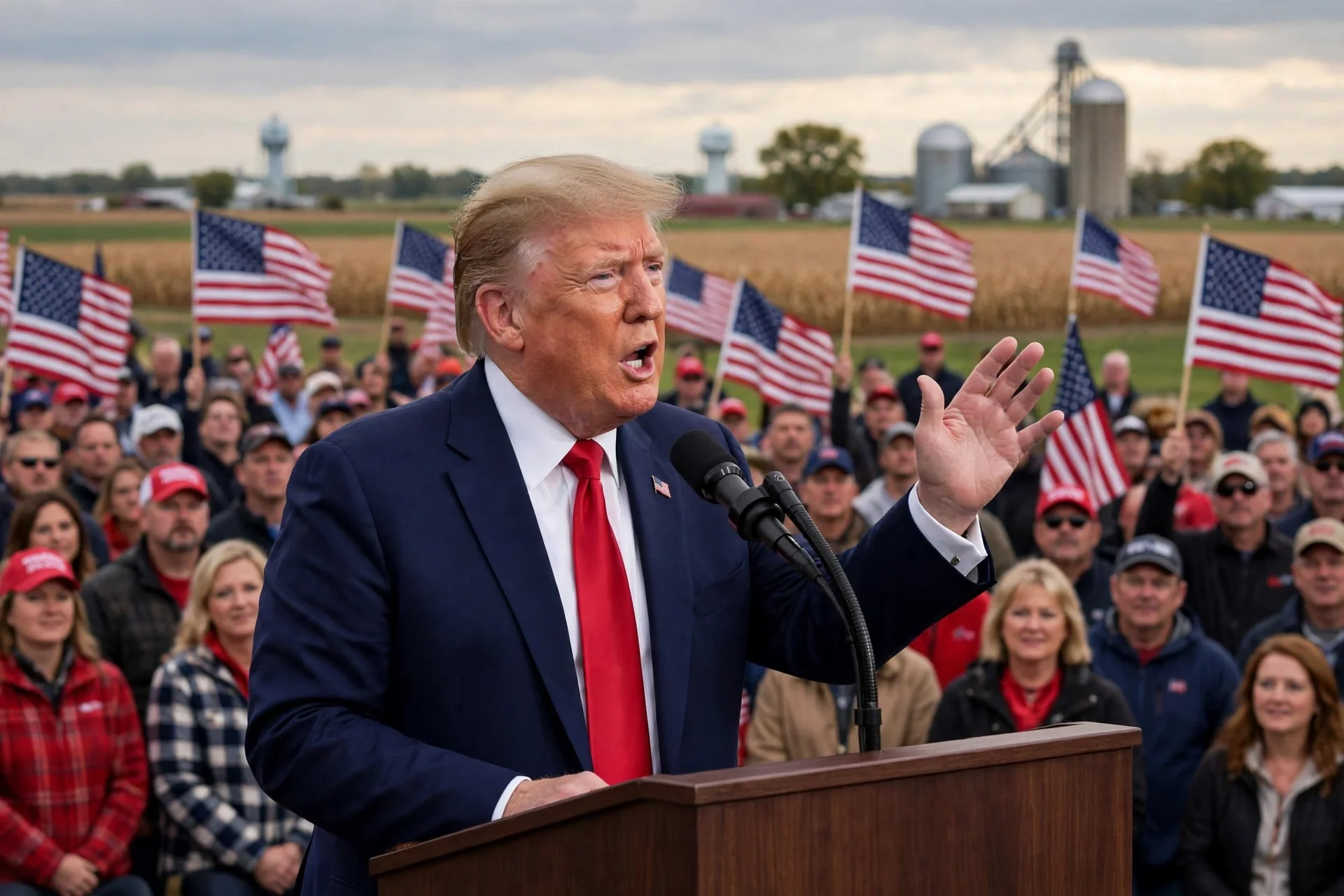
Trump en campaña, en las semanas previas a las legislativas del 3 de noviembre · Imagen generada por EPM
Trump says in Iowa he has the right to run again over 2020 claim
At a rally in Iowa, Donald Trump said he has the right to run for president again because he maintains he was cheated in 2020, the election he lost to Joe…
Trump revives in Iowa the debate over another presidential run
Donald Trump told a rally in Iowa that he has the right to run again because, he argues, he was cheated in 2020 and has won the presidency three times.
--- The context ---
United States President Donald Trump has stepped up his campaign events in the weeks leading up to the November 3 midterm elections, in which Republicans are seeking to keep control of Congress. On that tour, which has already taken him to North Carolina and Iowa, the president has mixed voter mobilization with his most persistent narrative: that of the 2020 election, which he lost to Democrat Joe Biden. The claim returned to center stage this Thursday in Iowa.
--- The facts ---
Speaking at a rally in Iowa, Trump said he has the right to run for president again because, he argued, he was cheated in the 2020 election. In his account, he has won the presidency three times, which would entitle him to compete once more. The Republican won the elections of 2016 and 2024 but lost in 2020 to Biden. Trump has also joked repeatedly about the possibility of seeking a third term, a line that recurs whenever he addresses his supporters.
--- The positions ---
His position runs into the constitutional text: the Twenty-Second Amendment prohibits any person from being elected president more than twice.
Since his 2020 defeat, Trump has maintained that there was electoral fraud, even though court challenges failed to demonstrate widespread irregularities that altered the result. In July he again questioned the legitimacy of that election in a televised speech, presenting declassified documents that, he said, revealed vulnerabilities in the electoral system and foreign interference. However, independent reviews of those documents concluded that they provided no evidence of widespread fraud or of votes being manipulated to change the outcome.
--- What remains unknown ---
There is no record that the president has put forward a concrete legal path to bypass the Twenty-Second Amendment, nor that any such procedure is under way. It also remains unclear whether his Iowa remarks belong to a defined electoral strategy or will remain a rhetorical device within the midterm campaign. After North Carolina and Iowa, Trump has further events planned in Florida, Georgia, Michigan and Texas to mobilize the Republican vote and back his party candidates.
--- Unanswered questions ---
Does Trump intend to explore any real path toward running again, or is this only a message aimed at his base? How will Republicans who hope to succeed him respond if he keeps the subject alive? Will this discourse matter for voter mobilization ahead of the November 3 midterms? And will there be any institutional reaction to a claim that strains the two-term limit?
--- EPM analysis ---
The timing is no accident: the president is in the middle of a tour to defend the Republican majority in Congress, and each rally turns his figure into the center of the campaign. By reopening the debate about 2020, Trump strengthens the bond with his most loyal followers, for whom that defeat remains an unsettled account, and places his name at the center of the national conversation just days before voters head to the polls.
📌 EPM Take: In EPM's view, the Iowa claim should be read above all as a campaign act rather than a legal announcement: the Twenty-Second Amendment is a clear limit, and no statement at a rally changes it. The political value of the message lies elsewhere, in keeping the Republican base mobilized with the 2020 narrative just as the party puts control of Congress on the line on November 3. Until a formal path is actually on the table, what exists is rhetoric with an immediate goal: making sure none of his voters stay home.
--- The context ---
Donald Trump is touring the country in the weeks before the November 3 midterm elections, in which Republicans seek to keep control of Congress. The president has multiplied rallies to mobilize the vote and support his party candidates, with stops already held in North Carolina and Iowa and new events planned in Florida, Georgia, Michigan and Texas. In Iowa this Thursday, his message went beyond the congressional campaign at hand.
--- The facts ---
At the rally, Trump said he has the right to run for president again because, he argued, he was cheated in the 2020 election. He attributed his defeat that year to Democrat Joe Biden to a rigged contest and maintained that he has won the presidency three times, which in his judgment would allow him to compete again. His electoral record is a matter of fact: he won in 2016, lost in 2020 and prevailed again in 2024. He has also joked repeatedly about the possibility of seeking a third term.
--- The positions ---
Standing against that claim is the Twenty-Second Amendment of the Constitution, which prohibits any person from being elected president more than twice.
Since the 2020 defeat, Trump has argued that there was electoral fraud, although court challenges did not demonstrate widespread irregularities that altered the result. In July, in a televised speech, he presented declassified documents that, he said, revealed vulnerabilities in the electoral system and foreign interference. Independent reviews of those documents concluded, however, that they offered no proof of widespread fraud nor of votes manipulated to alter the outcome of that election.
--- What remains unknown ---
It remains unknown whether the president intends to take any concrete step beyond his statements or whether the matter will stay in the territory of the repeated joke and the rally remark. There is no record of an open legal debate about a possible reinterpretation of the term limit, nor of other Republican leaders taking a public position on the idea. The immediate test is the campaign itself: on November 3, Republicans will learn whether they keep Congress.
--- Unanswered questions ---
Will any Republican publicly endorse the idea of a new Trump candidacy? Will anyone, inside or outside his party, open the constitutional debate his words suggest? Will this message help mobilize the Republican electorate in the midterms? Or will it end up diverting attention from the congressional candidates asking for votes in November?
--- EPM analysis ---
The president knows the weight of his words and delivered them in an early state on the political calendar, before a devoted audience. His insistence on 2020 keeps his coalition united around a shared grievance, and that has electoral value in midterms where base turnout can decide close races. At the same time, reopening the presidential future before the congressional campaign is over concentrates all attention on his own figure rather than on the candidates on the ballot.
📌 EPM Take: In EPM's view, the constitutional rule is clear and admits no declarative shortcuts: no one may be elected president more than twice, and any serious debate would have to travel the channels the Constitution itself provides, not a rally stage. That said, the Iowa line performs its political function: it energizes his supporters and reminds everyone who leads the party. The real test for Republicans is not that hypothetical future but November 3, when control of Congress is decided.
Trump dice en Iowa que tiene derecho a competir de nuevo por 2020
En un mitin en Iowa, Donald Trump afirmó que tiene derecho a presentarse de nuevo a las presidenciales porque sostiene que le hicieron trampa en 2020, elección…
Trump reabre en Iowa el debate sobre un nuevo mandato presidencial
Donald Trump afirmó en Iowa que tiene derecho a competir otra vez porque, según sostiene, le hicieron trampa en 2020 y ganó tres veces la Presidencia.
--- El contexto ---
El presidente de Estados Unidos, Donald Trump, ha intensificado sus actos de campaña en las semanas previas a las elecciones legislativas del 3 de noviembre, en las que los republicanos buscan mantener el control del Congreso. En ese recorrido, que pasó por Carolina del Norte y por Iowa, el mandatario mezcló la movilización del voto con su relato más persistente: el de las elecciones de 2020, que perdió frente al demócrata Joe Biden.
--- Los hechos ---
Este jueves, durante un mitin en Iowa, Trump afirmó que tiene derecho a presentarse de nuevo a las elecciones presidenciales porque, sostuvo, le hicieron trampa en los comicios de 2020. Según su planteamiento, ganó la Presidencia tres veces, de modo que le correspondería competir otra vez. El republicano ganó las elecciones de 2016 y las de 2024, pero perdió las de 2020 ante Biden. El mandatario ha bromeado en repetidas ocasiones con la posibilidad de buscar un tercer mandato.
--- Las posiciones ---
La posición de Trump choca con el texto constitucional: la Enmienda 22 de la Constitución prohíbe que una persona sea elegida presidente más de dos veces.
Desde su derrota de 2020, el republicano sostiene que hubo fraude electoral, pese a que las impugnaciones judiciales no lograron demostrar irregularidades generalizadas que alteraran el resultado. En julio volvió a cuestionar la legitimidad de aquellos comicios en un discurso televisado, donde presentó documentos desclasificados que, según afirmó, revelaban vulnerabilidades en el sistema electoral e injerencias extranjeras. Sin embargo, revisiones independientes de esos documentos concluyeron que no aportaban pruebas de fraude generalizado ni de que votos hubieran sido manipulados para alterar el resultado.
--- Lo que falta saber ---
No consta que el mandatario haya presentado una vía jurídica concreta para sortear la Enmienda 22 ni que exista un procedimiento abierto en ese sentido. Tampoco se sabe si sus palabras en Iowa forman parte de una estrategia electoral o si quedarán como recurso retórico dentro de la campaña legislativa. Tras Carolina del Norte e Iowa, Trump tiene previstos nuevos actos en Florida, Georgia, Michigan y Texas para movilizar el voto republicano y respaldar a los candidatos de su partido.
--- Preguntas sin respuesta ---
¿Piensa Trump explorar alguna vía real para competir de nuevo o se trata solo de un mensaje para su base? ¿Cómo responderán los republicanos que aspiran a sucederlo si el mandatario mantiene vivo el tema? ¿Pesará este discurso en la movilización del voto de cara a las legislativas del 3 de noviembre? ¿Habrá alguna reacción institucional ante una afirmación que tensiona el límite de dos mandatos?
--- Análisis EPM ---
El momento elegido no es casual: el presidente está de gira para defender la mayoría republicana en el Congreso, y cada mitin convierte su figura en el centro de la campaña. Al reabrir el debate sobre 2020, Trump refuerza el vínculo con sus seguidores más fieles, para quienes aquella derrota sigue siendo una cuenta pendiente, y coloca su nombre en el centro de la conversación a pocos días de las urnas.
📌 Conclusion EPM: A juicio de EPM, la afirmación de Iowa debe leerse ante todo como un acto de campaña y no como un anuncio jurídico: la Enmienda 22 es un límite claro y ninguna declaración en un mitin lo modifica. El valor político del mensaje está en otro lado, en mantener movilizada a la base republicana con el relato de 2020 justo cuando el partido se juega el control del Congreso el 3 de noviembre. Mientras no exista una vía formal sobre la mesa, lo que hay es retórica con un objetivo inmediato: que nadie deje de votar.
--- El contexto ---
Donald Trump recorre el país en las semanas previas a las elecciones legislativas del 3 de noviembre, en las que los republicanos buscan mantener el control del Congreso. El presidente ha multiplicado los mítines para movilizar el voto y respaldar a los candidatos de su partido, con paradas ya celebradas en Carolina del Norte e Iowa y nuevas citas previstas en Florida, Georgia, Michigan y Texas. En Iowa, este jueves, su mensaje fue más allá de la campaña legislativa.
--- Los hechos ---
En el mitin, Trump afirmó que tiene derecho a presentarse de nuevo a las elecciones presidenciales porque, sostuvo, le hicieron trampa en los comicios de 2020. Atribuyó su derrota de aquel año ante el demócrata Joe Biden a una elección viciada y aseguró que ha ganado la Presidencia tres veces, razón por la cual, en su criterio, podría volver a competir. La trayectoria electoral del republicano es conocida: ganó en 2016, perdió en 2020 y volvió a imponerse en 2024. Además, ha bromeado en repetidas ocasiones con la posibilidad de buscar un tercer mandato.
--- Las posiciones ---
Frente a ese planteamiento se alza la Enmienda 22 de la Constitución, que prohíbe que una persona sea elegida presidente más de dos veces.
Desde la derrota de 2020, Trump sostiene que hubo fraude electoral, aunque las impugnaciones judiciales no lograron demostrar irregularidades generalizadas que alteraran el resultado. En julio, en un discurso televisado, presentó documentos desclasificados que, según afirmó, revelaban vulnerabilidades en el sistema electoral e injerencias extranjeras. Revisiones independientes de esos documentos concluyeron, no obstante, que no aportaban pruebas de fraude generalizado ni de que votos hubieran sido manipulados para alterar el resultado de aquellos comicios.
--- Lo que falta saber ---
Falta por saber si el presidente pretende dar algún paso concreto más allá de sus declaraciones o si el asunto quedará en el terreno de la broma repetida y el comentario de mitin. Tampoco hay constancia de un debate jurídico abierto sobre una posible reinterpretación del límite de mandatos, ni de pronunciamientos de otros dirigentes republicanos sobre la idea. Lo inmediato es la campaña: el 3 de noviembre los republicanos se juegan conservar el Congreso.
--- Preguntas sin respuesta ---
¿Habrá algún republicano que respalde públicamente la idea de una nueva candidatura de Trump? ¿Planteará alguien, dentro o fuera de su partido, el debate constitucional que sus palabras sugieren? ¿Ayudará este mensaje a movilizar al electorado republicano en las legislativas? ¿O acabará desviando la atención de los candidatos al Congreso que buscan su voto en noviembre?
--- Análisis EPM ---
El presidente conoce el peso de sus palabras y las pronunció en un estado temprano del calendario político, ante una audiencia entregada. Su insistencia en 2020 mantiene unida a su coalición en torno a una grievance compartida, y eso tiene valor electoral en unas legislativas donde la participación de la base puede decidir escaños ajustados. Al mismo tiempo, reabrir el futuro presidencial cuando aún no culmina la campaña del Congreso concentra toda la atención en su figura.
📌 Conclusion EPM: A juicio de EPM, la regla constitucional es nítida y no admite atajos declarativos: nadie puede ser elegido presidente más de dos veces, y el debate serio tendría que pasar por los cauces que la propia Constitución prevé, no por un mitin. Dicho eso, la frase de Iowa cumple su función política: energiza a los suyos y recuerda quién manda en el partido. El examen real para los republicanos no es ese hipotético futuro, sino el 3 de noviembre, cuando se decide si conservan el control del Congreso.