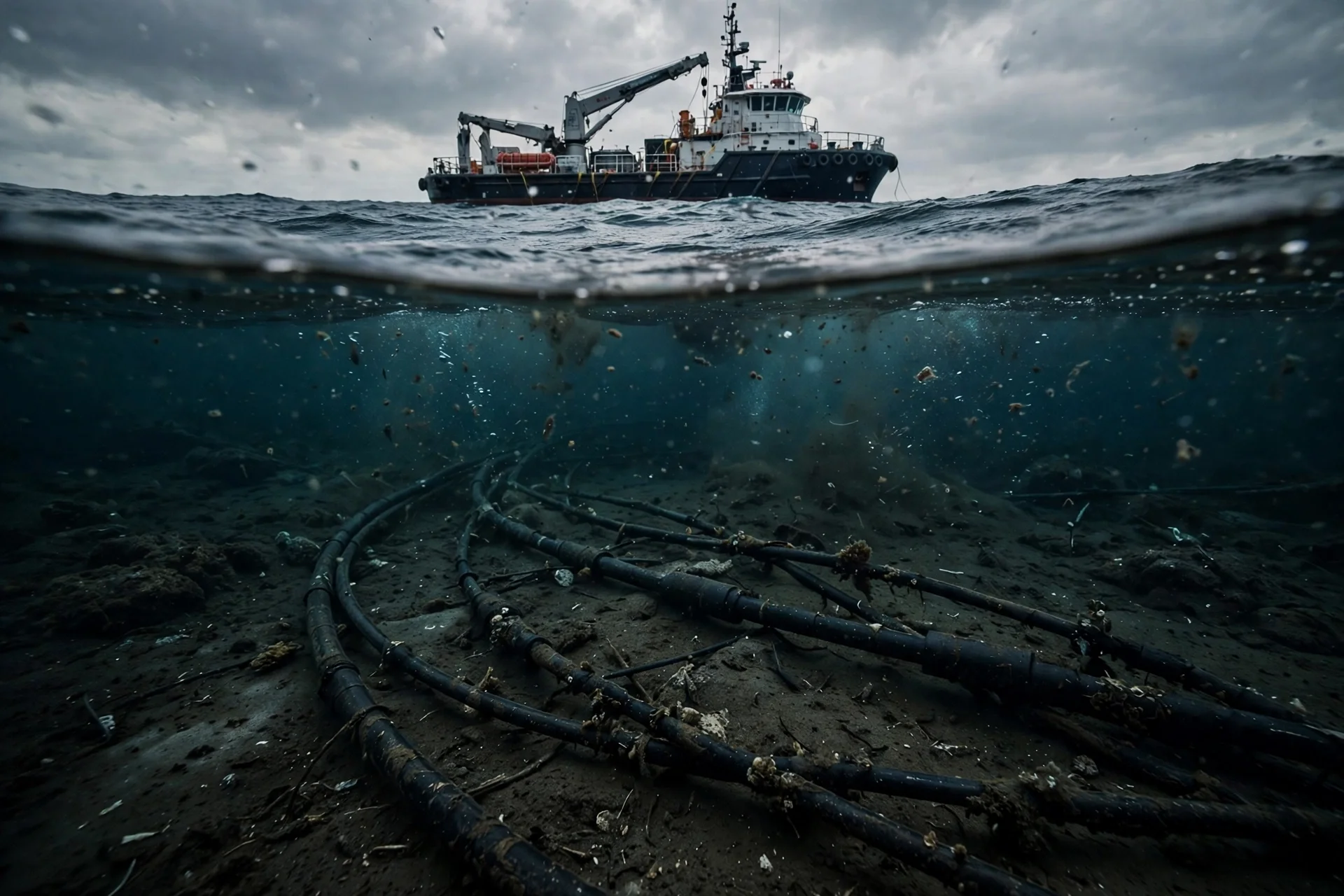
Cables submarinos de comunicaciones en el golfo Pérsico. · Imagen generada para EPM
Iran warns it could target undersea cables if it faces new bombings
Iran drew up detailed plans to attack undersea communications cables in the Persian Gulf if the United States and Israel bomb the country again, according to…
Tehran drafts cable attack plans and hardens its deterrence posture
Iran prepared plans to attack undersea communications cables in the Persian Gulf in response to a new United States and Israeli attack, according to two senior…
--- The context ---
The infrastructure that sustains the internet crosses the seabed in silence and carries a decisive share of global data exchange. In the Persian Gulf and the Strait of Hormuz, that network intersects with a highly tense military area, where an escalation between Iran, the United States and Israel can reach everyday services used by millions of people. The strait separates Iran from Oman and connects the Persian Gulf with the Gulf of Oman and the Arabian Sea.
--- The facts ---
Iran drew up detailed plans to attack undersea communications cables in the Persian Gulf if the United States and Israel launch a new attack against the country, according to two senior Iranian security officials who spoke on condition of anonymity. Both offered few details and did not specify how or where Tehran would carry out such attacks.
One of them said Iran would seek to prevent repairs after any attack in order to prolong interruptions in communications, including internet connections. The same official warned indirectly that, if Iran were attacked, there would be no more red lines, from undersea cables to military bases, including covert ones, and said the country has full access to undersea cables and could destroy them easily.
Yadollah Javani, deputy head of Political Affairs of Iran's Revolutionary Guard, said on Wednesday that the country could attack the seven high-capacity cables under the Strait of Hormuz if Iranian infrastructure comes under attack. Undersea cables carry around 99% of global internet traffic, according to the International Telecommunication Union, although less than 1% of international bandwidth passes through Hormuz, as Alan Mauldin, research director at TeleGeography, noted.
--- The positions ---
The United States Department of State and Iran's Ministry of Foreign Affairs did not respond to requests for comment on the Iranian officials' statements, and there were also no immediate comments from Gulf governments. Senior security official Mohsen Rezaei warned this month that digital infrastructure linked to the United States across the Gulf, including data centers and artificial intelligence facilities, could become a target in a renewed conflict.
The second official said Washington's Gulf allies, which invested heavily in that infrastructure, should hold Washington, not Tehran, responsible for any damage to the cables. For Alex Vatanka, director of the Iran program at the Middle East Institute, in Washington, such threats seek to deter a renewed conflict and pressure the White House by generating fear among Gulf governments and United States companies about their investments.
--- What remains unknown ---
The real operational scope of the plans is not known, nor the concrete means Iran would use, nor when such a decision might be adopted. Several analysts agreed that multiple cuts could slow internet services and affect financial transactions, electronic commerce and cloud services, and that the impact would depend on how operators reroute traffic and on capacity in alternative connections.
Restoring connections during an armed conflict could prove difficult, according to experts, since higher insurance costs and delays in permits to enter territorial waters could complicate repairs. The Red Sea could be a more relevant target than Hormuz, particularly with backing from Houthi allies in Yemen, although Tehran made no public statement indicating plans for that area, through which around 3% of global international demand and close to 10% of traffic between regions circulates, according to Mauldin.
--- Unanswered questions ---
What real capacity does Iran have to carry out sustained attacks against cables in Hormuz without being detected immediately? How long could interruptions be prolonged if repairs are blocked by insurance costs and territorial permits? Would Gulf governments respond by pressuring Washington, as Vatanka's reading suggests, or would they strengthen their cooperation with the United States? What alternative land and undersea routes could absorb the affected traffic if multiple cuts occur?
--- EPM analysis ---
The warning shifts the center of the conflict from traditional military targets toward the civilian and digital infrastructure on which finance, commerce and cloud services depend. Gulf governments invest heavily in technology to diversify their economies beyond oil and position themselves as artificial intelligence hubs, deepening their ties with United States technology firms. In March, Iranian attacks hit two Amazon Web Services facilities in the United Arab Emirates and damaged infrastructure near a plant in Bahrain, and the Revolutionary Guard then pointed to Microsoft, Google, Apple and Nvidia as legitimate targets.
📌 EPM Take: In EPM's view, the threat against the cables reveals a deterrence strategy that seeks to raise the cost of any new offensive against Iran by shifting risk toward economic interests shared by Washington, Gulf governments and major technology firms. Its effectiveness will depend less on direct global damage, limited according to the available data on Hormuz, than on the political and corporate pressure that such uncertainty generates before a conflict. Protecting essential networks and preserving diplomatic channels is therefore just as decisive as any military calculation to avoid an escalation with broad civilian costs.
--- The context ---
Global communications security depends largely on undersea cables carrying almost all global internet traffic. When a regional power announces detailed plans against that infrastructure in a strategic passage such as Hormuz, the threat stops being rhetoric and becomes a problem of defense, economic continuity and protection of allies. The strait separates Iran from Oman and connects the Persian Gulf with the Gulf of Oman and the Arabian Sea.
--- The facts ---
Iran drew up detailed plans to attack undersea communications cables in the Persian Gulf if the United States and Israel launch a new attack against the country, according to two senior Iranian security officials who spoke on condition of anonymity, offered few details and did not specify how or where Tehran would carry out such attacks.
One of them said Iran would seek to prevent repairs after any attack in order to prolong interruptions in communications, including internet connections. The official also warned indirectly that, if Iran were attacked, there would be no more red lines, from undersea cables to military bases, including covert ones, warned Washington not to play with fire and said Iran has full access to the cables and could destroy them easily.
Yadollah Javani, deputy head of Political Affairs of Iran's Revolutionary Guard, said on Wednesday that the country could attack the seven high-capacity cables under the Strait of Hormuz if Iranian infrastructure comes under attack. The cables carry around 99% of global internet traffic, according to the International Telecommunication Union, while less than 1% of international bandwidth passes through Hormuz, as Alan Mauldin, research director at TeleGeography, noted.
--- The positions ---
The Department of State and Iran's Foreign Ministry did not respond to requests for comment, and there were no immediate comments from Gulf governments. The plans reflect the conviction among Iranian leaders that a new United States military campaign should face a tougher response than before, and Mohsen Rezaei warned this month that digital infrastructure linked to the United States across the Gulf, including data centers and artificial intelligence facilities, could become a target in a renewed conflict.
The second official said Washington's Gulf allies should hold Washington, not Tehran, responsible for any damage to the cables, after having invested heavily in that infrastructure. For Alex Vatanka, director of the Iran program at the Middle East Institute, in Washington, the threats seek to deter a renewed conflict and pressure the White House by generating fear among Gulf governments and United States companies, so that Gulf states and corporate executives pressure President Donald Trump over the risks to their investment plans.
--- What remains unknown ---
It remains unknown whether the plans have means already deployed, what damage could be inflicted in a first action and how operators would respond if they must reroute traffic toward alternative connections. Several analysts agreed that multiple cuts could slow the internet and affect financial transactions, electronic commerce and cloud services, and the impact would depend on capacity on those alternative routes, as Mauldin indicated.
It also remains unknown how long repairs could be delayed amid confrontation, since experts warned that higher insurance costs and territorial permit delays could complicate them. The Red Sea, which carries data between Europe, East Africa and Asia, could be a more relevant target than Hormuz with backing from Iran's Houthi allies in Yemen, although Tehran publicly declared no plans for that area.
--- Unanswered questions ---
Are the plans in a verifiable operational phase or part of a deterrent warning before any attack? What protection and redundancy measures are Gulf governments and United States technology firms adopting against this declared threat? Could multiple cuts, with repairs blocked, sustainably affect regional finance and cloud services? How would the United States and Israel respond if a cable is damaged and the action is attributed to Tehran?
--- EPM analysis ---
The announcement fits into the competition over Gulf technological infrastructure, where local governments invest heavily to diversify beyond oil and become artificial intelligence hubs, deepening ties with United States companies. Iranian attacks already hit two Amazon Web Services facilities in the United Arab Emirates in March and damaged infrastructure near a plant in Bahrain, and the Revolutionary Guard then pointed to Microsoft, Google, Apple and Nvidia as legitimate targets. Land connections can offer alternative routes, and both Gulf states and technology firms are investing in additional infrastructure, including Microsoft's investment of more than 400 million dollars in connectivity in the Middle East through 2030.
📌 EPM Take: In EPM's view, the plans attributed to Iran confirm that digital infrastructure has become an explicit front of deterrence and pressure on United States allies and investors in the Gulf. Although the percentage of bandwidth crossing Hormuz is limited, the combination of multiple cuts, repair difficulties and technology targets widens the potential cost of an escalation for the whole region. A prudent response requires protecting cables, accelerating redundant routes and maintaining credible deterrence without yielding to threats against shared essential assets and without abandoning diplomatic channels that keep escalation reversible.
Irán advierte que podría atacar cables submarinos si es bombardeado de nuevo
Irán elaboró planes detallados para atacar cables submarinos en el golfo Pérsico si Estados Unidos e Israel vuelven a bombardearlo, según afirmaron dos altos…
Teherán traza planes contra cables del golfo y eleva su amenaza regional
Irán preparó planes para atacar cables de comunicaciones submarinos en el golfo Pérsico ante un nuevo ataque de Estados Unidos e Israel, según dos altos…
--- El contexto ---
La infraestructura que sostiene internet cruza en silencio el fondo de los mares y concentra una parte decisiva del intercambio mundial de datos. En el golfo Pérsico y en el estrecho de Ormuz, esa red se cruza con una zona de gran tensión militar, donde una escalada entre Irán, Estados Unidos e Israel puede alcanzar servicios cotidianos usados por millones de personas. El estrecho separa a Irán de Omán y conecta el golfo Pérsico con el golfo de Omán y el mar Arábigo.
--- Los hechos ---
Irán elaboró planes detallados para atacar cables de comunicaciones submarinos en el golfo Pérsico en caso de que Estados Unidos e Israel lancen un nuevo ataque contra el país, según afirmaron dos altos funcionarios de seguridad iraníes que hablaron bajo anonimato. Ambos ofrecieron pocos detalles y no precisaron cómo ni dónde ejecutaría Teherán esos ataques.
Uno de ellos sostuvo que Irán buscaría impedir las reparaciones posteriores para prolongar las interrupciones en las comunicaciones, incluidas las conexiones a internet. El mismo funcionario advirtió en indirecto que, si Irán era atacado, no habría más líneas rojas, desde los cables submarinos hasta las bases militares, incluidas las encubiertas, y aseguró que Irán tiene acceso total a los cables y podría destruirlos con facilidad.
Yadollah Javani, subjefe de Asuntos Políticos de la Guardia Revolucionaria de Irán, declaró el miércoles que el país podría atacar los siete cables de gran capacidad bajo el estrecho de Ormuz si la infraestructura iraní sufre un ataque. Los cables transportan alrededor del 99% del tráfico global de internet, según la Unión Internacional de Telecomunicaciones, aunque menos del 1% del ancho de banda internacional pasa por Ormuz, según Alan Mauldin, director de investigación de TeleGeography.
--- Las posiciones ---
El Departamento de Estado de Estados Unidos y el Ministerio de Relaciones Exteriores de Irán no respondieron a las solicitudes de comentarios, y tampoco hubo comentarios inmediatos de los gobiernos del golfo. Mohsen Rezaei advirtió este mes que la infraestructura digital vinculada a Estados Unidos en todo el golfo, incluidos centros de datos e instalaciones de inteligencia artificial, podría ser blanco de un conflicto renovado.
El segundo funcionario sostuvo que los aliados del golfo de Washington, que invirtieron fuertemente en esa infraestructura, deberían responsabilizar a Washington y no a Teherán por cualquier daño a los cables. Para Alex Vatanka, director del programa sobre Irán del Middle East Institute, en Washington, las amenazas buscan disuadir un conflicto renovado y presionar a la Casa Blanca generando temor entre gobiernos del golfo y empresas estadounidenses por sus inversiones.
--- Lo que falta saber ---
No se conoce el alcance operativo real de los planes, ni los medios concretos que Irán emplearía, ni el momento en que tal decisión podría adoptarse. Varios analistas coincidieron en que múltiples cortes podrían ralentizar internet y afectar transacciones financieras, comercio electrónico y servicios en la nube, y que el impacto dependería de cómo los operadores redirijan el tráfico y de la capacidad en conexiones alternativas.
Restaurar las conexiones en un conflicto podría resultar difícil, según expertos, por mayores costos de seguros y demoras en permisos de ingreso a aguas territoriales. El mar Rojo podría ser un objetivo más relevante que Ormuz, en particular con respaldo de aliados hutíes en Yemen, aunque Teherán no declaró públicamente planes para esa zona, por donde circula alrededor del 3% de la demanda internacional global y cerca del 10% del tráfico entre regiones, según Mauldin.
--- Preguntas sin respuesta ---
¿Qué capacidad real tiene Irán para atacar de forma sostenida los cables en Ormuz sin ser detectado? ¿Cuánto tiempo podrían prolongarse las interrupciones si las reparaciones se ven bloqueadas por costos de seguros y permisos territoriales? ¿Presionarían los gobiernos del golfo a Washington, como sugiere Vatanka, o reforzarían su cooperación con Estados Unidos? ¿Qué rutas alternativas podrían absorber el tráfico afectado si se producen cortes múltiples?
--- Análisis EPM ---
La advertencia traslada el centro del conflicto desde blancos militares tradicionales hacia la infraestructura civil y digital de la que dependen finanzas, comercio y servicios en la nube. Los gobiernos del golfo invierten fuertemente en tecnología para diversificar sus economías más allá del petróleo y posicionarse como centros de inteligencia artificial, lo que profundizó sus vínculos con tecnológicas estadounidenses. En marzo, ataques iraníes impactaron en dos instalaciones de Amazon Web Services en Emiratos Árabes Unidos y dañaron infraestructura cercana a una planta en Baréin, y la Guardia Revolucionaria señaló entonces a Microsoft, Google, Apple y Nvidia como objetivos legítimos.
📌 Conclusion EPM: A juicio de EPM, la amenaza sobre los cables revela una estrategia de disuasión que busca encarecer cualquier nueva ofensiva contra Irán trasladando el riesgo hacia intereses económicos compartidos por Washington, los gobiernos del golfo y las grandes tecnológicas. Su eficacia dependerá menos del daño global directo, limitado según los datos disponibles sobre Ormuz, que de la presión política y empresarial que esa incertidumbre genere antes de un conflicto. Proteger redes esenciales y preservar canales diplomáticos resulta, por tanto, tan decisivo como cualquier cálculo militar para evitar una escalada con costos civiles amplios.
--- El contexto ---
La seguridad de las comunicaciones mundiales depende de cables submarinos que transportan casi todo el tráfico global de internet. Cuando una potencia regional anuncia planes detallados contra esa infraestructura en Ormuz, la amenaza deja de ser retórica: es defensa, continuidad económica y protección de aliados. El estrecho separa a Irán de Omán y conecta el golfo Pérsico con el golfo de Omán y el mar Arábigo.
--- Los hechos ---
Irán elaboró planes detallados para atacar cables submarinos en el golfo Pérsico si Estados Unidos e Israel lanzan un nuevo ataque contra el país, según afirmaron dos altos funcionarios de seguridad iraníes que hablaron bajo anonimato, ofrecieron pocos detalles y no precisaron cómo ni dónde ejecutaría Teherán esos ataques.
Uno de ellos sostuvo que Irán buscaría impedir las reparaciones para prolongar las interrupciones en las comunicaciones, incluidas las de internet. El funcionario advirtió además en indirecto que, si Irán era atacado, no habría más líneas rojas, desde los cables submarinos hasta las bases militares, incluidas las encubiertas, advirtió a Washington que no debía jugar con fuego y aseguró que Irán tiene acceso total a los cables y podría destruirlos con facilidad.
Yadollah Javani, subjefe de Asuntos Políticos de la Guardia Revolucionaria de Irán, declaró el miércoles que el país podría atacar los siete cables de gran capacidad bajo el estrecho de Ormuz si la infraestructura iraní sufre un ataque. Los cables transportan alrededor del 99% del tráfico global, según la Unión Internacional de Telecomunicaciones, mientras que menos del 1% del ancho de banda internacional pasa por Ormuz, según Alan Mauldin, de TeleGeography.
--- Las posiciones ---
El Departamento de Estado de Estados Unidos y el Ministerio de Relaciones Exteriores de Irán no respondieron a las solicitudes de comentarios, y tampoco hubo comentarios inmediatos de los gobiernos del golfo. Los planes reflejan la convicción entre líderes iraníes de que una nueva campaña estadounidense debería enfrentarse con una respuesta más dura que en ocasiones previas, y Mohsen Rezaei advirtió este mes que la infraestructura digital vinculada a Estados Unidos en todo el golfo, incluidos centros de datos e instalaciones de inteligencia artificial, podría ser blanco de un conflicto renovado.
El segundo funcionario sostuvo que los aliados del golfo de Washington deberían responsabilizar a Washington y no a Teherán por cualquier daño a los cables, tras su fuerte inversión en esa infraestructura. Para Alex Vatanka, director del programa sobre Irán del Middle East Institute, en Washington, las amenazas buscan disuadir un conflicto renovado y presionar a la Casa Blanca generando temor entre gobiernos del golfo y empresas estadounidenses, para que presionen al presidente Donald Trump por los riesgos para sus inversiones.
--- Lo que falta saber ---
Falta conocer si los planes cuentan con medios ya desplegados, qué daño podría infligirse en una primera acción y cómo responderían los operadores al redirigir el tráfico a conexiones alternativas. Varios analistas coincidieron en que cortes múltiples ralentizarían internet y afectarían transacciones financieras, comercio electrónico y servicios en la nube, según la capacidad en rutas alternativas, indicó Mauldin.
También falta saber cuánto se demorarían las reparaciones en plena confrontación, ya que expertos advirtieron que mayores costos de seguros y demoras en permisos territoriales podrían complicarlas. El mar Rojo, ruta de datos entre Europa, el este de África y Asia, podría ser un objetivo más relevante que Ormuz con respaldo hutí en Yemen, aunque Teherán no declaró públicamente planes para esa zona.
--- Preguntas sin respuesta ---
¿Están los planes iraníes en una fase operativa verificable o forman parte de una advertencia disuasoria previa a cualquier ataque? ¿Qué medidas de protección y redundancia adoptan los gobiernos del golfo y las tecnológicas estadounidenses ante esta amenaza? ¿Podría un corte múltiple, con reparaciones bloqueadas, afectar de forma sostenida a finanzas y servicios en la nube regionales? ¿Cómo responderían Estados Unidos e Israel si un cable resulta dañado y se atribuye la acción a Teherán?
--- Análisis EPM ---
El anuncio se inscribe en la competencia por la infraestructura tecnológica del golfo, donde los gobiernos locales invierten para diversificar sus economías más allá del petróleo y ser centros de inteligencia artificial, profundizando sus vínculos con empresas estadounidenses. Ataques iraníes impactaron en dos instalaciones de Amazon Web Services en Emiratos Árabes Unidos en marzo, dañaron infraestructura cercana a una planta en Baréin y la Guardia Revolucionaria señaló entonces a Microsoft, Google, Apple y Nvidia como objetivos legítimos. Las conexiones terrestres ofrecen rutas alternativas, y Microsoft planea invertir más de 400 millones de dólares en conectividad en Medio Oriente de aquí a 2030.
📌 Conclusion EPM: A juicio de EPM, los planes atribuidos a Irán confirman que la infraestructura digital es ya un frente explícito de disuasión y presión sobre aliados e inversores de Estados Unidos en el golfo. Aunque el porcentaje de ancho de banda que cruza Ormuz sea limitado, la combinación de cortes múltiples, dificultades de reparación y blancos tecnológicos amplía el costo potencial regional de una escalada. La respuesta prudente exige proteger cables, acelerar rutas redundantes y mantener una disuasión creíble sin ceder ante amenazas contra bienes esenciales compartidos.