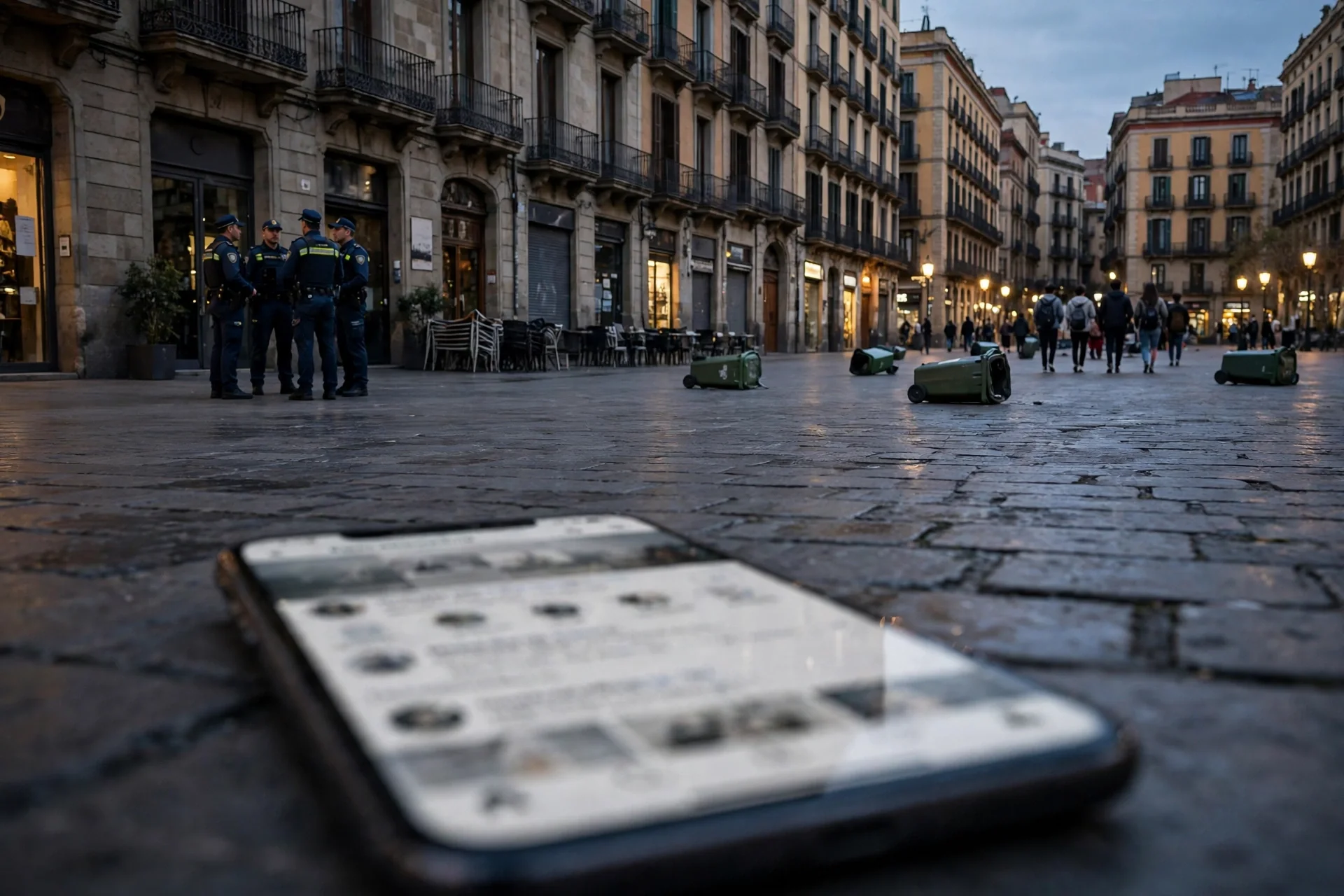
Una plaza del centro de Barcelona tras los disturbios, con presencia policial y contenedores volcados. · Imagen generada para EPM
Barcelona unrest: 128 detained after call spread on social media
A call spread on TikTok and in private WhatsApp and Telegram groups led to unrest in central Barcelona with 128 detainees, 72 of them minors, 23 premises…
Barcelona probes who organised youths behind Saturday unrest
Saturday unrest in central Barcelona left 128 detainees, 72 of them minors, 23 premises vandalised or looted, 33 firefighter interventions and 14 Mossos…
--- The context ---
The unrest that shook central Barcelona on Saturday did not begin in the street but on screens. The call shared under the Blocus Barcelona label had circulated for days on TikTok before moving into private WhatsApp and Telegram groups, where hundreds of young people exchanged posters, times and meeting points. A Catalan journalistic investigation places the start of that spread at least on 20 October, with anonymous profiles, little initial interaction and QR codes giving access to the closed groups where the gathering took shape.
--- The facts ---
The toll provided by the Catalan police is stark. There were 128 detainees, 72 of them minors, and 23 premises were vandalised or looted during the disturbances. Firefighters carried out 33 interventions to put out fires in containers and street furniture, while police faced groups acting in a scattered way across the Catalan capital's centre from the first moments of the gathering, according to the account made public by the force itself after the night of incidents in the city centre.
The human cost was also high. Fourteen Mossos d'Esquadra officers were injured, four of them seriously, along with one Guardia Urbana officer. The Mossos also issued 68 administrative reports after seizing bladed weapons, aerosols, balaclavas, pyrotechnics and other objects, including stones. According to the available reconstruction, the violence did not appear only at the end of a peaceful protest, as often happens in other mobilisations, but marked the course of the gathering practically from the moment participants met in central Barcelona on Saturday.
--- The positions ---
The Mossos chief commissioner, Sílvia Catà, explained in remarks to a Catalan broadcaster that the call spread through accounts the police were monitoring and that its aim was not to organise a conventional demonstration. In her account, participants acted in small groups without a clear organisational structure, the detainees live in Catalonia and the idea that they came from France was ruled out. The journalistic investigation also records later messages in which some group members tried to distance themselves from the vandalism and deny any responsibility.
--- What remains unknown ---
The available reconstruction shows a troubling evolution in the messages. The initial posters spoke about education with slogans such as Institut Indignats and Contra el sistema, institutos en lucha, and some exchanges called for a peaceful mobilisation without attacks on shops, vehicles or officers. As the days passed, contradictory advice on clothing appeared, along with references to possible looting and montages pointing to premises in the centre, plus images of weapons whose authenticity could not be determined.
--- Unanswered questions ---
Fundamental questions remain open about the origin and real reach of the call. Who created the accounts that spread the Blocus Barcelona label and with what initial purpose? Was there advance planning of the looting and clashes or did the violence spread within the groups themselves? What role did the administrators of the private WhatsApp and Telegram groups play in the change of tone in the messages during that week?
--- EPM analysis ---
The case combines three levels that should not be confused. The first is youth protest linked to education, present in the initial slogans. The second is platform dynamics, where an anonymous message can jump from a short video to a closed group within minutes. The third is the violence recorded on the street, with damage and injuries that require a police and judicial response based on individual evidence. Mixing those three levels without distinctions would lead to conclusions that are either unfair or ineffective for everyone involved.
📌 EPM Take: In EPM's view, what happened in Barcelona forces us to treat the phone as part of the public arena and not as a simple channel used before people met in person. A call that began with education slogans, moved into closed groups and changed tone within a few days requires fast, verifiable and proportionate responses, without treating every young person as a suspect or minimising the harm suffered by shops and officers. Investigators must separate those who spread messages, those who planned destruction and those who merely turned up, because only that distinction will allow punishment and prevent violent calls without cutting basic rights.
--- The context ---
Barcelona endured a night of unrest on Saturday that left shops damaged, containers burned and officers injured, after a call that had moved for days on TikTok under the Blocus Barcelona label. The messages then jumped to private WhatsApp and Telegram groups, from where posters, the time and meeting place and access QR codes were shared. A Catalan journalistic investigation places the start of the spread at least on 20 October, through anonymous profiles that gradually gained replies with new posts linked to the same call.
--- The facts ---
The official toll sums up the seriousness of what happened. Catalan police detained 128 people, 72 of them minors, after 23 premises were vandalised or looted in the city centre. Firefighters had to intervene 33 times to put out fires in containers and street furniture. The clashes began practically from the initial meeting and not as an isolated final episode, a pattern which, according to the police themselves, set this gathering apart from an ordinary demonstration in the Catalan capital on that Saturday night in October this year.
Among the injured were 14 Mossos d'Esquadra officers, four of them seriously, and one Guardia Urbana officer. The Mossos issued 68 administrative reports after seizing bladed weapons, aerosols, balaclavas, pyrotechnics and stones, among other objects. That seized material, together with the damage to premises, suggests that part of those attending came prepared for more than a peaceful protest, although the investigation must still assign responsibility person by person and group by group on the basis of verifiable evidence gathered by officers.
--- The positions ---
Chief commissioner Sílvia Catà explained in remarks to a Catalan broadcaster that the accounts which spread the call were being monitored and that this was not about organising a conventional demonstration. In her description, participants acted in small groups without a clear structure, the detainees live in Catalonia and did not come from France, as had been speculated. When the unrest spun out of control, according to the journalistic investigation, some members sent messages distancing themselves from the vandalism and denying responsibility for what had happened in the streets.
--- What remains unknown ---
The first messages of the call presented themselves with references to education and slogans such as Institut Indignats and Contra el sistema, institutos en lucha. Contradictory guidance on clothing also circulated, from wearing black and using balaclavas to not covering one's face. As the week advanced, the conversations incorporated references to possible looting and to premises that could become targets, together with images of bladed and firearms whose authenticity and ownership could not be determined by investigators at this stage of the inquiry.
--- Unanswered questions ---
The police investigation must now answer the essential questions of the case. Who was behind the profiles that created and spread the initial call across the platforms? Was there advance and deliberate planning of the looting and of the clashes with police officers? Why did the monitoring of the accounts not prevent the gathering from ending in a night of damage and injuries across the city centre?
--- EPM analysis ---
For residents and traders, the immediate debate is street safety and repairing the damage. For institutions, the obligation is twofold: identify those responsible with evidence and explain how a call visible for days on open platforms ended up bringing hundreds of young people into the centre. Without that complete explanation, any tally of detainees will remain incomplete, because authority is measured both by its capacity to stop violence and by its capacity to prevent it happening again in the same place.
📌 EPM Take: In EPM's view, the toll from Barcelona shows a city overwhelmed by a call that moved faster than ordinary prevention mechanisms and ended in looting, fires and officers seriously injured. Upholding public order is not an excess when bladed weapons have been seized and premises attacked, but counting detainees is not enough if those who created the accounts and pushed messages towards violence are not identified. Authorities must publish complete data, protect affected residents and traders and demonstrate, with solid evidence, who organised the night and who joined in later, so that accountability rests on proof rather than on rumour or collective blame.
Disturbios en Barcelona: 128 detenidos tras una convocatoria en redes
Una convocatoria difundida por TikTok y grupos privados de WhatsApp y Telegram derivó en disturbios en el centro de Barcelona con 128 detenidos, 72 menores, 23…
Barcelona investiga quién movió a los jóvenes de los disturbios
Los disturbios del sábado en el centro de Barcelona dejaron 128 detenidos, 72 de ellos menores, 23 establecimientos vandalizados o saqueados, 33 intervenciones…
--- El contexto ---
Los disturbios que sacudieron el centro de Barcelona el sábado no empezaron en la calle, sino en las pantallas. La convocatoria difundida bajo la etiqueta Blocus Barcelona llevaba días circulando por TikTok antes de pasar a grupos privados de WhatsApp y Telegram, donde centenares de jóvenes intercambiaron carteles, horarios y puntos de encuentro. Una investigación periodística catalana sitúa al menos el 20 de octubre el inicio de esa difusión, con perfiles anónimos, escasa interacción inicial y códigos QR que daban acceso a los grupos cerrados donde se fue organizando la cita.
--- Los hechos ---
El balance facilitado por la policía catalana es contundente. Hubo 128 detenidos, 72 de ellos menores de edad, y 23 establecimientos fueron vandalizados o saqueados durante los altercados. Los bomberos realizaron 33 intervenciones para apagar incendios en contenedores y en elementos del mobiliario urbano, mientras el despliegue policial se enfrentaba a grupos que actuaron de forma dispersa por el centro de la capital catalana desde los primeros momentos de la concentración.
El coste humano también fue elevado. Resultaron heridos 14 agentes de los Mossos d'Esquadra, cuatro de ellos de gravedad, y un agente de la Guardia Urbana. Los Mossos levantaron además 68 actas administrativas tras intervenir armas blancas, aerosoles, pasamontañas, pirotecnia y otros objetos, entre ellos piedras. Según la reconstrucción conocida, la violencia no apareció solo al final de una protesta pacífica, como suele ocurrir en otras movilizaciones, sino que marcó el desarrollo de la concentración prácticamente desde que los participantes se reunieron.
--- Las posiciones ---
La comisaria jefa de los Mossos, Sílvia Catà, explicó en declaraciones a una emisora catalana que la convocatoria se propagó a través de cuentas que la policía estaba monitorizando y que su objetivo no era organizar una manifestación convencional. Según su relato, los participantes actuaron en pequeños grupos sin una estructura organizativa clara, los detenidos viven en Cataluña y quedó descartado que procedieran de Francia. La propia investigación periodística recoge además mensajes posteriores en los que algunos integrantes intentaban desvincularse de los actos vandálicos y negar cualquier responsabilidad.
--- Lo que falta saber ---
La reconstrucción disponible muestra una evolución inquietante de los mensajes. Los carteles iniciales hablaban de educación con lemas como Institut Indignats y Contra el sistema, institutos en lucha, y algunos intercambios reclamaban una movilización pacífica sin ataques a comercios, vehículos ni agentes. Con el paso de los días aparecieron recomendaciones contradictorias sobre la vestimenta, referencias a posibles saqueos y montajes que señalaban establecimientos del centro, además de imágenes de armas cuya autenticidad no ha podido determinarse.
--- Preguntas sin respuesta ---
Quedan abiertas cuestiones de fondo sobre el origen y el alcance real de la convocatoria. ¿Quién creó las cuentas que difundieron la etiqueta Blocus Barcelona y con qué propósito inicial? ¿Existió una planificación previa de los saqueos y de los enfrentamientos o la violencia se fue contagiando dentro de los grupos? ¿Qué papel jugaron los administradores de los grupos privados de WhatsApp y Telegram en el cambio de tono de los mensajes?
--- Análisis EPM ---
El caso combina tres planos que no conviene confundir. El primero es la protesta juvenil vinculada a la educación, presente en los lemas iniciales. El segundo es la dinámica de las plataformas, donde un mensaje anónimo puede saltar de un vídeo breve a un grupo cerrado en minutos. El tercero es la violencia registrada en la calle, con daños e heridos que exigen una respuesta policial y judicial basada en pruebas individuales. Mezclar los tres planos sin distinciones llevaría a conclusiones injustas o ineficaces.
📌 Conclusion EPM: A juicio de EPM, lo ocurrido en Barcelona obliga a mirar el teléfono como parte del escenario público y no como un simple canal de difusión previo al encuentro. Una convocatoria que nace con lemas educativos, salta a grupos cerrados y cambia de tono en pocos días exige respuestas rápidas, verificables y proporcionales, sin convertir a todos los jóvenes en sospechosos ni minimizar los daños sufridos por comercios y agentes. La investigación deberá separar a quienes difundieron mensajes, a quienes planificaron destrozos y a quienes simplemente acudieron, porque solo esa distinción permitirá sancionar con justicia y prevenir convocatorias violentas sin recortar derechos básicos.
--- El contexto ---
Barcelona vivió el sábado una noche de disturbios que dejó comercios dañados, contenedores quemados y agentes heridos, tras una convocatoria que llevaba días moviéndose por TikTok bajo la etiqueta Blocus Barcelona. Después, los mensajes saltaron a grupos privados de WhatsApp y Telegram, desde donde se compartieron carteles, la hora y el lugar de encuentro y códigos QR de acceso. Una investigación periodística catalana sitúa al menos el 20 de octubre el inicio de la difusión, a través de perfiles anónimos que fueron ganando réplicas con nuevas publicaciones relacionadas.
--- Los hechos ---
El balance oficial resume la gravedad de lo ocurrido. La policía catalana detuvo a 128 personas, 72 de ellas menores de edad, después de que 23 establecimientos fueran vandalizados o saqueados en el centro de la ciudad. Los bomberos tuvieron que intervenir en 33 ocasiones para apagar incendios en contenedores y en mobiliario urbano. Los enfrentamientos comenzaron prácticamente desde la reunión inicial y no como un episodio final aislado, un patrón que, según la propia policía, diferenció esta concentración de una manifestación habitual.
Entre los heridos figuran 14 agentes de los Mossos d'Esquadra, cuatro de ellos de gravedad, y un agente de la Guardia Urbana. Los Mossos levantaron 68 actas administrativas tras intervenir armas blancas, aerosoles, pasamontañas, pirotecnia y piedras, entre otros objetos. Ese material intervenido, unido a los daños en establecimientos, dibuja una cita a la que parte de los asistentes acudió preparada para algo más que una protesta pacífica, aunque la investigación aún debe atribuir responsabilidades persona a persona y grupo a grupo.
--- Las posiciones ---
La comisaria jefa Sílvia Catà explicó en declaraciones a una emisora catalana que las cuentas que propagaron la convocatoria estaban siendo monitorizadas y que no se trataba de organizar una manifestación convencional. Según su descripción, los participantes actuaron en pequeños grupos sin una estructura clara, los detenidos residen en Cataluña y no procedían de Francia, como se había especulado. Cuando los disturbios se descontrolaron, según la investigación periodística conocida, algunos integrantes difundieron mensajes para desvincularse de los actos vandálicos y negar su responsabilidad.
--- Lo que falta saber ---
Los primeros mensajes de la convocatoria se presentaban con referencias a la educación y lemas como Institut Indignats y Contra el sistema, institutos en lucha. También circularon indicaciones contradictorias sobre la vestimenta, desde vestir de negro y usar pasamontañas hasta no cubrirse el rostro. A medida que avanzó la semana, las conversaciones incorporaron referencias a posibles saqueos y a establecimientos que podían ser objetivos, junto con imágenes de armas blancas y de fuego cuya autenticidad y pertenencia no han podido determinarse.
--- Preguntas sin respuesta ---
La investigación policial debe ahora responder a las preguntas esenciales del caso. ¿Quién estaba detrás de los perfiles que crearon y difundieron la convocatoria inicial? ¿Hubo una planificación previa y deliberada de los saqueos y de los enfrentamientos con la policía? ¿Por qué la monitorización de las cuentas no impidió que la cita terminara en una noche de daños y heridos?
--- Análisis EPM ---
Para vecinos y comerciantes, el debate inmediato es la seguridad de las calles y la reparación de los daños. Para las instituciones, la obligación es doble: identificar a los responsables con pruebas y explicar cómo una convocatoria visible durante días en plataformas abiertas acabó concentrando a centenares de jóvenes en el centro. Sin esa explicación completa, cualquier balance de detenidos quedará incompleto, porque la autoridad se mide tanto por su capacidad de detener la violencia como por su capacidad de prevenir que se repita.
📌 Conclusion EPM: A juicio de EPM, el balance de Barcelona muestra una ciudad desbordada por una convocatoria que se movió más rápido que los mecanismos ordinarios de prevención y que terminó en saqueos, incendios y agentes heridos de gravedad. Sostener el orden público no es un exceso cuando hay armas blancas intervenidas y establecimientos atacados, pero tampoco basta con contar detenidos si no se identifica a quienes crearon las cuentas y empujaron los mensajes hacia la violencia. La autoridad debe publicar datos completos, proteger a los vecinos y comerciantes afectados y demostrar, con pruebas sólidas, quién organizó la noche y quién se sumó después.