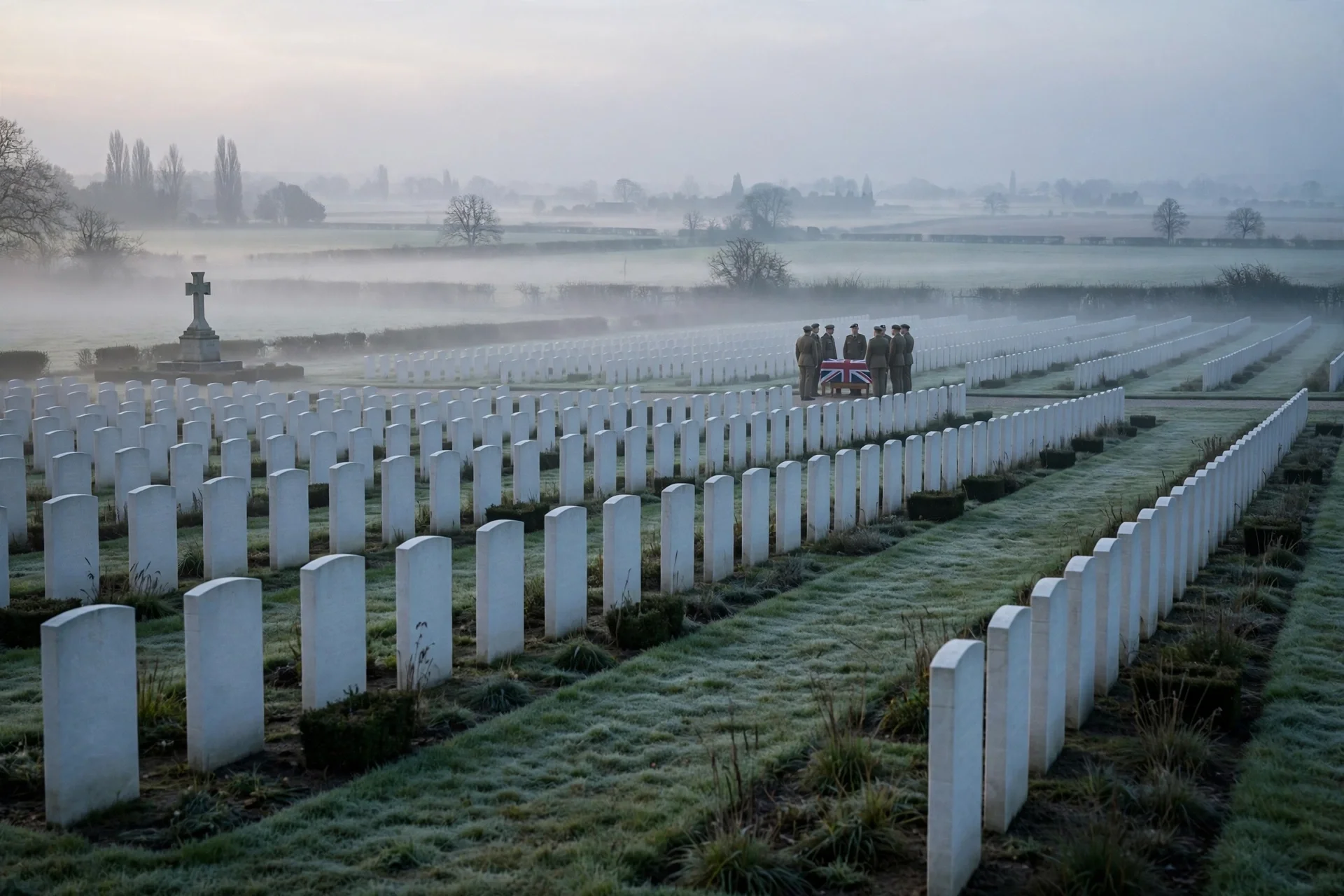
El soldado Percy Tolliday fue enterrado en el cementerio británico de Warlencourt junto a dos compañeros no identificados. · Erick Prometeo Media
Percy Tolliday laid to rest on the Somme after 110 years
Private Percy Tolliday of the Middlesex Regiment was buried at Warlencourt alongside two unknown comrades after DNA from his great nephew, who travelled from…
Middlesex soldier buried with honours at Warlencourt cemetery
Percy Tolliday, a Middlesex Regiment soldier killed on the Somme, was buried at Warlencourt British Cemetery alongside two unknown comrades, in a service…
--- The context ---
The Battle of the Somme, fought in 1916, left thousands of soldiers without a known grave and many families without an answer about their relatives. The case of Private Percy Tolliday, of the 11th Battalion of the Middlesex Regiment, shows how memory remains alive when science makes it possible to recover an identity that time and mud seemed to have erased.
--- The facts ---
Percy Tolliday was laid to rest on 21 October 2026 at Warlencourt British Cemetery, run by the Commonwealth War Graves Commission, alongside two unknown comrades. The service was organised by the Ministry of Defence's Joint Casualty and Compassionate Centre, known as the War Detectives.
The three had been uncovered during the installation of wind turbines near Gueudecourt, lying in a shell hole, suggesting that they may have died together, possibly hit by the same shell. Identification became possible thanks to a DNA sample provided by his great nephew, Richard Tolliday, who travelled from Atlanta in the United States with his wife and nephew. The graves will now be cared for by the Commission in perpetuity, and work continues to identify the two unknown soldiers.
--- The positions ---
Richard Tolliday expressed indirectly gratitude for the dedication of the centre that made the identification possible, 110 years after Percy died in 1916, and recalled indirectly that Percy was a soldier but also a son and a brother, and that attending the burial brought recognition and closure for the family.
Rosie Barron, a caseworker at the centre, said indirectly that it was a privilege to take part in the identification and burial and to provide answers for the family, and added indirectly that the three died in terrible conditions, in heavy rain, deep mud and under continuous shelling.
--- What remains unknown ---
The identity of the two comrades is still unknown, although they are presumed to also be of the Middlesex Regiment, and it has not been confirmed whether they died from the same shell. The service was supported by soldiers from the Royal Regiment of Fusiliers, the Princess of Wales's Royal Regiment and the band of the Royal Welsh, and was conducted by the Reverend Fiona Beale, chaplain to the 1st Battalion of the Royal Regiment of Fusiliers, who described it indirectly as a moving and humbling privilege.
Daniel Seaton, a commemorations case officer at the Commission, said indirectly that the three were recovered by the Commission's specialist recovery unit near the place of the ceremony and that he hopes the two unknown soldiers may be identified in the future.
--- Unanswered questions ---
Will the two soldiers buried beside Tolliday ever be identified by name? Will relatives come forward to provide samples for the pending comparison? Will the investigation confirm that the three died together from the same shell?
--- EPM analysis ---
A recovered name is not just a record: it is a family that finally knows where to stand and a story that is no longer anonymous. Scientific identification has changed how the wounds of that war can be closed.
📌 EPM Take: In EPM's view, the burial of Percy Tolliday confirms that memory does not expire when there is method, persistence and respect for families. DNA science, combined with archival work and the care of graves, turns a chance discovery into an act of justice that is late but real. The task of naming the two comrades who rest beside him remains, and that effort deserves the same patience that closed this story.
--- The context ---
Honouring the fallen is a duty that does not lapse as generations pass. In the Commonwealth cemeteries, every tended grave recalls that behind each uniform there was a family and a life cut short. Percy Tolliday, of the 11th Battalion of the Middlesex Regiment, died in the Battle of the Somme in 1916 and has finally received, in 2026, the dignified burial the war denied him.
--- The facts ---
The service took place on 21 October 2026 at Warlencourt British Cemetery, run by the Commonwealth War Graves Commission, and was organised by the Ministry of Defence's Joint Casualty and Compassionate Centre, known as the War Detectives. Tolliday was buried alongside two unknown comrades, presumed to also be of the Middlesex Regiment.
The three were uncovered during the installation of wind turbines near Gueudecourt, in a shell hole, suggesting that they may have died together, possibly hit by the same shell. His great nephew, Richard Tolliday, travelled from Atlanta in the United States with his wife and nephew, and provided the DNA sample that made identification possible. The graves will be cared for by the Commission in perpetuity, and work continues to identify the two unknown soldiers.
--- The positions ---
Richard Tolliday expressed indirectly his gratitude for the dedication of the centre that enabled his great uncle to be identified 110 years after his death, and stressed indirectly that Percy was a soldier but also a son and a brother, and that attending the burial was an honour and a closure for the family.
The Reverend Fiona Beale, chaplain to the 1st Battalion of the Royal Regiment of Fusiliers, conducted the service and described it indirectly as a moving and humbling privilege. The service was supported by soldiers from the Royal Regiment of Fusiliers, the Princess of Wales's Royal Regiment and the band of the Royal Welsh.
--- What remains unknown ---
The identity of the two comrades remains unconfirmed and there is no certainty about the exact circumstances of their joint death. Rosie Barron, a caseworker at the centre, recalled indirectly that the three died in terrible conditions, in heavy rain, deep mud and under continuous shelling, and that it was a privilege to take part in the identification and provide answers for the family.
Daniel Seaton, a commemorations case officer at the Commission, said indirectly that the three were recovered by the Commission's specialist recovery unit near the place of the ceremony and that he hopes the two unknown soldiers can be identified in the future.
--- Unanswered questions ---
Will the two soldiers resting beside Tolliday also receive names of their own? How long will it take to complete their identification with the available evidence? What other stories from the Somme await a similar closure?
--- EPM analysis ---
The value of this ceremony lies in continuity of duty: the institutions that searched for and identified Tolliday acted from an obligation taken on more than a century ago, never to abandon a fallen soldier.
📌 EPM Take: In EPM's view, the burial of Percy Tolliday is above all an act of duty fulfilled, sober and necessary, honouring both the soldier and the institutions that never stopped looking for him. The presence of his family, who came from Atlanta, and the perpetual care of his grave show that gratitude can outlast the war itself, with quiet dignity throughout. The tribute will be complete when his two comrades also have names of their own one day.
Percy Tolliday descansa en el Somme tras 110 años de espera
El soldado Percy Tolliday, del undécimo batallón del Regimiento Middlesex, fue enterrado en Warlencourt junto a dos compañeros no identificados, tras ser…
Un soldado del Somme recibe sepultura con honores en Warlencourt
Percy Tolliday, soldado del Regimiento Middlesex muerto en el Somme, recibió sepultura en el cementerio británico de Warlencourt junto a dos compañeros…
--- El contexto ---
La batalla del Somme, librada en 1916, dejó a miles de soldados sin tumba conocida y a muchas familias sin respuesta sobre sus parientes. El caso de Percy Tolliday, del undécimo batallón del Regimiento Middlesex, muestra cómo la memoria sigue activa cuando la ciencia permite recuperar una identidad que el tiempo y el lodo parecían haber borrado.
--- Los hechos ---
Percy Tolliday fue enterrado el 21 de octubre de 2026 en el cementerio británico de Warlencourt, de la Comisión de Tumbas de Guerra de la Commonwealth, junto a dos compañeros no identificados. El servicio fue organizado por el Centro Conjunto de Bajas y Compasión del Ministerio de Defensa, conocido como los detectives de la guerra.
Los tres habían sido hallados durante la instalación de turbinas eólicas cerca de Gueudecourt, en un cráter de obús, lo que sugiere que pudieron morir juntos, quizá por el mismo proyectil. La identificación fue posible gracias a una muestra de ADN aportada por su sobrino nieto, Richard Tolliday, quien viajó desde Atlanta, en Estados Unidos, con su esposa y su sobrino. Las tumbas quedarán al cuidado perpetuo de la Comisión y continúan los trabajos para identificar a los dos desconocidos.
--- Las posiciones ---
Richard Tolliday expresó en indirecto gratitud por la dedicación del centro que hizo posible la identificación, llegada 110 años después de la muerte de Percy en 1916, y recordó en indirecto que Percy era soldado pero también hijo y hermano, y que asistir a la sepultura supuso reconocimiento y cierre para la familia.
Rosie Barron, trabajadora de casos del centro, señaló en indirecto que fue un privilegio participar en la identificación y el entierro y dar respuestas a la familia, y añadió en indirecto que los tres murieron en condiciones terribles, con lluvia intensa, lodo profundo y bombardeo continuo.
--- Lo que falta saber ---
Todavía no se conoce la identidad de los dos compañeros, aunque se presume que también pertenecían al Regimiento Middlesex, ni se ha confirmado si murieron por el mismo proyectil. El servicio contó con soldados del Regimiento Real de Fusileros, del Regimiento Real de la Princesa de Gales y la banda del Royal Welsh, y lo ofició la reverenda Fiona Beale, capellana del primer batallón del Regimiento Real de Fusileros, quien lo describió en indirecto como un privilegio conmovedor y una lección de humildad.
Daniel Seaton, oficial de casos de conmemoraciones de la Comisión, dijo en indirecto que los tres fueron recuperados por la unidad especializada de recuperación cerca del lugar de la ceremonia y que espera que los dos desconocidos puedan identificarse en el futuro.
--- Preguntas sin respuesta ---
¿Podrán identificarse algún día los dos soldados enterrados junto a Tolliday? ¿Aparecerán familiares que aporten muestras para el contraste pendiente? ¿Confirmará la investigación que los tres murieron juntos por el mismo proyectil?
--- Análisis EPM ---
Un nombre recuperado no es solo un dato: es una familia que por fin sabe dónde detenerse y una historia que deja de ser anónima. La identificación científica ha cambiado la forma de cerrar las heridas de aquella guerra.
📌 Conclusion EPM: A juicio de EPM, la sepultura de Percy Tolliday confirma que la memoria no prescribe cuando hay método, constancia y respeto por las familias. La ciencia del ADN, unida al trabajo de archivo y al cuidado de las tumbas, convierte un hallazgo casual en un acto de justicia tardía pero real. Queda pendiente dar nombre a los dos compañeros que descansan a su lado, y ese esfuerzo merece la misma paciencia que permitió cerrar esta historia.
--- El contexto ---
Honrar a los caídos es un deber que no caduca con las generaciones. En los cementerios de la Commonwealth, cada tumba cuidada recuerda que detrás de cada uniforme hubo una familia y una vida interrumpida. Percy Tolliday, del undécimo batallón del Regimiento Middlesex, murió en la batalla del Somme en 1916 y recibe por fin, en 2026, la sepultura digna que la guerra le negó.
--- Los hechos ---
El servicio tuvo lugar el 21 de octubre de 2026 en el cementerio británico de Warlencourt, de la Comisión de Tumbas de Guerra de la Commonwealth, organizado por el Centro Conjunto de Bajas y Compasión del Ministerio de Defensa, conocido como los detectives de la guerra. Tolliday fue enterrado junto a dos compañeros no identificados, que se presumen también del Regimiento Middlesex.
Los tres aparecieron durante la instalación de turbinas eólicas cerca de Gueudecourt, en un cráter de obús, lo que sugiere que pudieron morir juntos, quizá por el mismo proyectil. Su sobrino nieto, Richard Tolliday, viajó desde Atlanta, en Estados Unidos, con su esposa y su sobrino, y aportó la muestra de ADN que hizo posible la identificación. Las tumbas quedarán al cuidado perpetuo de la Comisión y continúan los trabajos para identificar a los dos desconocidos.
--- Las posiciones ---
Richard Tolliday manifestó en indirecto su gratitud por la dedicación del centro que permitió identificar a su tío abuelo 110 años después de su muerte, y subrayó en indirecto que Percy era soldado pero también hijo y hermano, y que asistir a la sepultura supuso un honor y un cierre para la familia.
La reverenda Fiona Beale, capellana del primer batallón del Regimiento Real de Fusileros, ofició el servicio y lo describió en indirecto como un privilegio conmovedor y una lección de humildad. El acto contó con soldados del Regimiento Real de Fusileros, del Regimiento Real de la Princesa de Gales y la banda del Royal Welsh.
--- Lo que falta saber ---
La identidad de los dos compañeros sigue sin confirmarse y tampoco existe certeza sobre las circunstancias exactas de la muerte conjunta. Rosie Barron, trabajadora de casos del centro, recordó en indirecto que los tres murieron en condiciones terribles, con lluvia intensa, lodo profundo y bombardeo continuo, y que fue un privilegio participar en la identificación y dar respuestas a la familia.
Daniel Seaton, oficial de casos de conmemoraciones de la Comisión, dijo en indirecto que los tres fueron recuperados por la unidad especializada de recuperación cerca del lugar de la ceremonia y que confía en que los dos desconocidos puedan identificarse en el futuro.
--- Preguntas sin respuesta ---
¿Recibirán también nombre los dos soldados que descansan junto a Tolliday? ¿Cuánto llevará completar su identificación con las pruebas disponibles? ¿Qué otras historias del Somme esperan un cierre parecido?
--- Análisis EPM ---
El valor de esta ceremonia está en la continuidad del deber: las instituciones que buscaron e identificaron a Tolliday actuaron por una obligación asumida hace más de un siglo, la de no abandonar a ningún caído.
📌 Conclusion EPM: A juicio de EPM, el entierro de Percy Tolliday es ante todo un acto de deber cumplido, sobrio y necesario, que honra tanto al soldado como a las instituciones que no dejaron de buscarlo. La presencia de su familia, llegada desde Atlanta, y el cuidado perpetuo de su tumba muestran que la gratitud puede durar más que la guerra misma. El homenaje quedará completo cuando sus dos compañeros también tengan nombre.