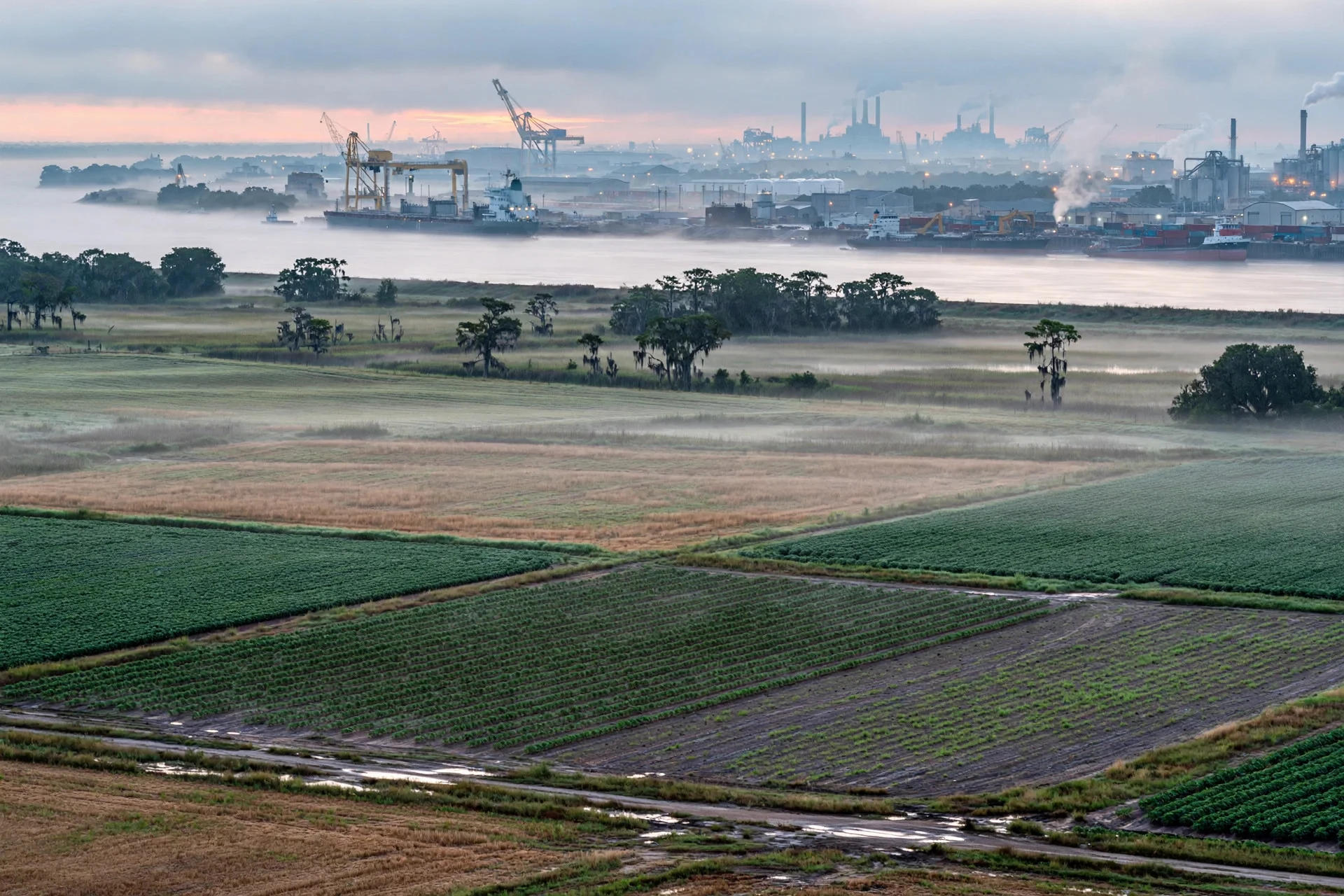
Paisaje agrícola e industrial a orillas del río al amanecer, imagen alusiva a las inversiones y al campo de Misisipi. · Erick Prometeo Media
Trump touts Mississippi tax cuts and rural health funds
The White House credits its tax cuts with benefits for 500,000 Mississippi seniors, average refunds of $4,018, major private investment, rural health funding…
Mississippi gains tax cuts, investment and defense funding
According to the White House release, Mississippi combines permanent tax relief, private investment in data centers and manufacturing, farm support…
--- The context ---
President Donald J. Trump returned to Mississippi, the Magnolia State, to present what the White House describes in a release as a proven record of results for workers, families, seniors, farmers and communities. The document credits his leadership and that of Republicans with broad tax relief, private investment, stronger rural healthcare, major support for farmers and new resources for the state's defense and shipbuilding industry.
The release works both as a progress report and as a political message, gathering tax decisions, federal awards, farm assistance and private company announcements in a single list. Everything that follows comes from that official text, which presents its figures as administration achievements, without the document itself providing independent confirmation of their execution.
--- The facts ---
On taxes, according to the release, the Working Families Tax Cuts benefit approximately 500,000 Mississippi seniors through the new senior deduction, with the average senior expected to pay zero federal taxes on Social Security benefits. State taxpayers saw average refunds of $4,018 in 2026, and the text states that the cuts safeguarded 46,000 Mississippi jobs, $8 billion in state GDP and $4 billion in workers' wages.
The release adds that the cuts made the increased death tax exemption permanent and indexed it for inflation, made 100% expensing permanent, doubled the Section 179 limit, made the 20% small business deduction permanent, expanded crop insurance and increased reference prices for the first time in over a decade. It also credits the same law with more than $469 million in farm safety net and conservation program payments to Mississippi farmers, producers and landowners.
On rural health, the text states that Mississippi secured $206 million in first-year funding from the Rural Health Transformation Program, one of the largest awards among all states, and that the administration awarded more than $104 million through 167 grants for rural health technology upgrades, specialty and maternal care, and telehealth. The University of Mississippi Medical Center also received $4.25 million to renew its status as a federal Center of Excellence in Telehealth, one of only two in the country, according to the release.
The private investment list includes ALO investing $176 million in Southaven, creating more than 400 jobs; Southwire investing $256 million in Starkville, creating 128 jobs; Siemens Energy investing $300 million in Pearl, creating up to 300 jobs; and xAI investing $20 billion to build a data center in Southaven. Amazon would invest an additional $12 billion in Madison County, creating 700 jobs, in addition to a $3 billion project in Vicksburg, while BWC Terminals would invest $316 million in Pascagoula and Hood Industries $245 million in Waynesboro.
On infrastructure, the release cites a $44 million grant to expand the I-55/I-69 corridor in DeSoto County, $51.1 million in BUILD grants for roads and up to $35.5 million to modernize the Mississippi Export Railroad. On agriculture, it states that more than $145 million reached nearly 4,300 farmers through the Emergency Commodity Assistance Program and that nearly 3,700 producers received more than $147 million as part of a $12 billion national bridge program. On defense, it lists a $99 million contract for Ingalls Shipbuilding in Pascagoula, a $283 million contract for the FF(X) frigates and $528 million in NDAA funding, including $53 million for bases in the state.
--- The positions ---
The White House position, as expressed in the release, is that the tax cuts, private investment and federal resources are already improving life for Mississippians. The text closes by framing a clear choice for the state's voters: continue this progress or return, in its words, to the higher taxes and failed policies of the past.
Read with attention to public services, the document's emphasis falls on seniors, rural health and farming, three areas where federal money has direct effects on households with the least margin. That reading does not dispute the release's figures, but it stresses that their real value will depend on relief reaching people broadly and verifiably, rather than concentrating in the largest announcements.
--- What remains unknown ---
The release offers no independent confirmation of how many of these investments are already executed, under construction or still at the announcement stage, and it gives no hiring timelines for the jobs promised by the companies. It also does not specify how the tax benefits are distributed across income levels, how much of the health funding has already been spent or what follow-up the farm payments will receive once delivered. Without that information, the figures describe commitments and awards announced by the administration, not results verified on the ground.
--- Unanswered questions ---
How many of the jobs announced by the companies already exist today, and how many remain future projections? How will the tax relief be distributed among Mississippi households according to their income level? What public tracking mechanisms will make it possible to verify that the rural health and agriculture funds reach, in full, the communities and producers named in the release?
--- EPM analysis ---
The release's informational value lies in the breadth of its inventory: in a single document, the administration connects the family budget, the rural hospital, the farm, the highway and the shipyard. For seniors, the combination of a specific deduction and average refunds is the most tangible hook; for rural areas, telehealth and health grants address a structural access problem that extends well beyond any election cycle.
The necessary caution is one of method. A White House release is, by definition, a piece of self-promotion: it selects favorable data and presents it as results. The public conversation gains when each figure is followed through to execution, because between the announcement of a multibillion investment and the first paycheck paid in Southaven or Pascagoula lies all the work that is not yet documented.
📌 EPM Take:
In EPM's view, the release deserves attention for what it promises to seniors, rural patients and farmers in Mississippi, who are the people least able to wait. But an official list of figures is not the same as accountability. The tax relief will be real when every household sees it in its filing, rural health will improve when the grants become accessible appointments, and the investment will count when the announced jobs appear on payrolls across the state. Until then, what has been published is a broad commitment that requires patient, public and constant verification.
--- The context ---
President Donald J. Trump returned to Mississippi, the Magnolia State, to defend an agenda that the White House sums up in a release: lower taxes, more private investment and stronger communities. The document presents the Working Families Tax Cuts as the centerpiece of a program that, according to the administration, already benefits workers, families, seniors, farmers and businesses across the state.
The text links that tax relief to rising business investment, resources for rural healthcare, direct support for farming and funding for the defense industry and shipbuilding. It is the administration's official account of its record in Mississippi, with the figures and projects it selects itself as evidence of results.
--- The facts ---
According to the release, approximately 500,000 Mississippi seniors benefit from the new senior deduction, with the average senior expected to pay zero federal taxes on Social Security benefits. Average refunds for the state's taxpayers were $4,018 in 2026, among the highest in the nation, and the cuts safeguarded 46,000 jobs, $8 billion in state GDP and $4 billion in wages, according to the official text.
The tax package made the increased death tax exemption permanent and indexed it for inflation, made 100% expensing permanent, doubled the Section 179 limit and made the 20% small business deduction permanent, while also expanding crop insurance and increasing reference prices for the first time in over a decade. The release also credits the cuts with more than $469 million in farm safety net and conservation payments to farmers, producers and landowners.
On rural health, Mississippi secured $206 million in first-year funding from the Rural Health Transformation Program, one of the largest awards in the country, according to the release. The administration also awarded more than $104 million through 167 grants for technology upgrades, specialty and maternal care, and telehealth, and awarded $4.25 million to the University of Mississippi Medical Center to renew its status as a federal Center of Excellence in Telehealth.
Private investment takes up the longest section of the document. ALO is investing $176 million in Southaven, creating more than 400 jobs; Southwire, $256 million in Starkville, creating 128 jobs; Siemens Energy, $300 million in Pearl, creating up to 300 jobs; and xAI, $20 billion for a data center in Southaven. Amazon is investing an additional $12 billion in Madison County, creating 700 jobs, in addition to its $3 billion project in Vicksburg; BWC Terminals will invest $316 million in Pascagoula and Hood Industries, $245 million in an advanced sawmill in Waynesboro.
The release adds $44 million to expand the I-55/I-69 corridor in DeSoto County, $51.1 million in BUILD grants and up to $35.5 million to modernize the Mississippi Export Railroad. For farming, it cites more than $145 million to nearly 4,300 farmers through the emergency assistance program and more than $147 million to nearly 3,700 producers within a $12 billion national bridge program. On defense, it lists $99 million for Ingalls Shipbuilding, $283 million for the FF(X) frigate ships and $528 million in NDAA funding, with $53 million for Mississippi bases.
--- The positions ---
The White House position is that lowering taxes and giving businesses permanent certainty unlocks investment, protects wages and creates jobs without expanding the public apparatus. The release frames it as a clear choice for Mississippi voters: continue down that path or return, in its words, to higher taxes, open borders and the failed policies of the past.
The document also argues that military strength and the naval industry are part of the state's prosperity: the Pascagoula contracts and the base funding are presented as national security and, at the same time, as skilled employment for Mississippi communities. Agriculture, freight infrastructure and defense thus appear as pillars of a single growth strategy.
--- What remains unknown ---
The release does not detail the execution timelines for each private investment or the schedule on which the announced jobs will be created, and it offers no independent confirmation of work already completed. It also does not specify the processing status of each infrastructure grant or the criteria by which the rural health program's results will be measured. Those details will decide whether the official inventory becomes, project by project, visible economic activity in the state.
--- Unanswered questions ---
On what timelines will the plants and centers announced in Southaven, Starkville, Pearl and Madison be built? When will work begin on the I-55/I-69 corridor and the railroad with the funds already awarded? What delivery and hiring schedule will allow Mississippians to check, date by date, that the commitments in the release are being met?
--- EPM analysis ---
The package's logic is consistent with a supply-side growth agenda: lower and permanent taxes, stable deductions for small business and certainty for long-term investment. When a company announces $20 billion for a data center or $300 million for an electrical components plant, what it is buying, beyond land and energy, is fiscal predictability.
The document's other strength is connecting that agenda to the state's productive base: farming, ports, rail and shipyards. Mississippi appears not as a passive beneficiary of Washington, but as a platform for production, logistics and defense. The challenge, as with any announcement of this scale, will be orderly execution and meeting deadlines on the part of companies and agencies alike.
📌 EPM Take:
In EPM's view, the direction of the program is the right one for a state competing for factories, data centers and naval contracts: low taxes with permanent rules, direct relief for seniors and support for farming without unnecessary bureaucracy. The release's figures are ambitious and, if the companies meet their schedules, they will transform whole areas of Mississippi. The pending task is not to change course, but to execute it with discipline, publish the progress and show that every announced investment dollar ends up as real employment and better wages.
Trump presenta en Misisipi recortes fiscales e inversión
La Casa Blanca atribuye a los recortes fiscales beneficios para 500,000 personas mayores de Misisipi, reembolsos promedio de $4,018, inversión privada…
Misisipi suma recortes fiscales, inversión privada y defensa
Según el comunicado de la Casa Blanca, Misisipi combina alivio fiscal permanente, inversión privada en centros de datos y manufactura, apoyo agrícola…
--- El contexto ---
El presidente Donald J. Trump regresó a Misisipi, el estado de la magnolia, para presentar lo que la Casa Blanca describe en un comunicado como un historial comprobado de resultados para trabajadores, familias, personas mayores, agricultores y comunidades. El documento atribuye a su liderazgo y al de los republicanos un paquete de alivio fiscal, inversión privada, salud rural, apoyo agrícola y recursos para la defensa y la construcción naval.
El comunicado funciona como balance de gestión y como mensaje político: reúne decisiones fiscales, adjudicaciones federales, ayudas al campo y anuncios de empresas privadas. Todo lo que sigue procede de ese texto oficial, sin confirmación independiente de su ejecución.
--- Los hechos ---
En materia fiscal, según el comunicado, los recortes de impuestos para las familias trabajadoras benefician a aproximadamente 500,000 personas mayores de Misisipi con la nueva deducción para seniors, y el senior promedio pagaría cero impuestos federales sobre los beneficios del Seguro Social. Los contribuyentes del estado recibieron reembolsos promedio de $4,018 en 2026, y el texto afirma que los recortes protegieron 46,000 empleos, 8 mil millones de dólares del producto interno bruto estatal y 4 mil millones de dólares en salarios de los trabajadores.
El comunicado añade que los recortes hicieron permanente y ajustaron por inflación la exención ampliada del impuesto sucesorio, volvieron permanente la amortización inmediata del 100%, duplicaron el límite de la Sección 179, consolidaron la deducción del 20% para pequeñas empresas, ampliaron el seguro de cultivos y elevaron los precios de referencia por primera vez en más de una década. También atribuye a esa misma ley más de 469 millones de dólares en pagos de la red de seguridad agrícola y de programas de conservación para agricultores, productores y propietarios de tierras del estado.
En salud rural, el texto indica que Misisipi obtuvo 206 millones de dólares de financiación de primer año del Programa de Transformación de la Salud Rural, una de las asignaciones más grandes entre los estados, y que la administración concedió más de 104 millones de dólares mediante 167 subvenciones para tecnología, atención especializada y materna y telesalud. El Centro Médico de la Universidad de Misisipi recibió además 4,25 millones de dólares para renovar su condición de centro federal de excelencia en telesalud, uno de solo dos en el país, según el comunicado.
La lista de inversión privada incluye a ALO, con 176 millones de dólares y más de 400 empleos en un centro de distribución en Southaven; Southwire, con 256 millones de dólares y 128 empleos en Starkville; Siemens Energy, con 300 millones de dólares y hasta 300 empleos en Pearl; y xAI, con 20 mil millones de dólares para un centro de datos en Southaven. Amazon sumaría 12 mil millones de dólares adicionales en el condado de Madison, con 700 empleos, además de un proyecto de 3 mil millones de dólares en Vicksburg, mientras BWC Terminals invertiría 316 millones de dólares en Pascagoula y Hood Industries, 245 millones de dólares en Waynesboro.
En infraestructura, el comunicado cita 44 millones de dólares para ampliar el corredor I-55/I-69 en el condado de DeSoto, 51,1 millones de dólares en subvenciones BUILD para carreteras y hasta 35,5 millones de dólares para modernizar el ferrocarril Mississippi Export Railroad. En agricultura, afirma que más de 145 millones de dólares llegaron a casi 4,300 agricultores mediante el programa de asistencia de emergencia para materias primas y que casi 3,700 productores recibieron más de 147 millones de dólares dentro de un programa puente nacional de 12 mil millones de dólares. En defensa, menciona 99 millones de dólares para Ingalls Shipbuilding en Pascagoula, 283 millones de dólares para las fragatas FF(X) y 528 millones de dólares de la ley de defensa, incluidos 53 millones de dólares para bases del estado.
--- Las posiciones ---
La posición de la Casa Blanca, tal como la expresa el comunicado, es que los recortes fiscales, la inversión privada y los recursos federales ya están mejorando la vida de los habitantes de Misisipi. El texto cierra con un planteamiento de elección clara para los votantes del estado: continuar ese progreso o volver, en sus términos, a los impuestos más altos y a las políticas fallidas del pasado.
Desde una lectura atenta a lo público, el énfasis del documento recae en las personas mayores, la salud rural y el campo, tres ámbitos donde el dinero federal tiene efectos directos sobre hogares con menos margen. Esa lectura no discute las cifras del comunicado, pero subraya que su valor real dependerá de que el alivio llegue de forma amplia y comprobable, no solo en los anuncios mayores.
--- Lo que falta saber ---
El comunicado no ofrece confirmación independiente de cuántas de estas inversiones están ya ejecutadas, en obras o aún en fase de anuncio, ni detalla calendarios de contratación para los empleos prometidos por las empresas. Tampoco precisa cómo se distribuyen los beneficios fiscales entre niveles de ingreso, qué parte de las subvenciones sanitarias ya se ha gastado ni qué seguimiento tendrán los pagos agrícolas una vez entregados. Sin esos datos, las cifras describen compromisos y adjudicaciones comunicadas por la administración, no resultados verificados sobre el terreno.
--- Preguntas sin respuesta ---
¿Cuántos de los empleos anunciados por las empresas ya existen hoy y cuántos siguen siendo proyecciones a futuro? ¿Cómo se repartirá el alivio fiscal entre los hogares de Misisipi según su nivel de ingreso? ¿Qué mecanismos de seguimiento público permitirán comprobar que los fondos de salud rural y de agricultura llegan completos a las comunidades y productores anunciados?
--- Análisis EPM ---
El valor informativo del comunicado está en la amplitud del inventario: la administración conecta bolsillo familiar, hospital rural, granja, carretera y astillero. Para las personas mayores, la combinación de deducción específica y reembolsos promedio es el gancho más tangible; para las zonas rurales, la telesalud y las subvenciones sanitarias apuntan a un problema estructural de acceso que va más allá del ciclo electoral.
La cautela necesaria es de método. Un comunicado de la Casa Blanca es, por definición, una pieza de autopromoción: selecciona los datos favorables y los presenta como resultados. La conversación pública gana si cada cifra se sigue hasta su ejecución, porque entre el anuncio y el primer salario pagado media todo el trabajo aún no documentado.
📌 Conclusion EPM:
A juicio de EPM, el comunicado merece atención por lo que promete a las personas mayores, a los pacientes rurales y a los agricultores de Misisipi, que son quienes menos pueden esperar. Pero una lista de cifras oficiales no equivale a una rendición de cuentas. El alivio fiscal será real cuando cada hogar lo note en su declaración, la salud rural mejorará cuando las subvenciones se traduzcan en consultas accesibles y la inversión contará cuando los empleos anunciados aparezcan en las nóminas del estado. Hasta entonces, lo publicado es un compromiso amplio que exige verificación paciente, pública y constante.
--- El contexto ---
El presidente Donald J. Trump volvió a Misisipi, el estado de la magnolia, para defender una agenda que la Casa Blanca resume en un comunicado: menos impuestos, más inversión privada y comunidades más fuertes. El documento presenta los recortes de impuestos para las familias trabajadoras como la pieza central de un programa que, según la administración, ya beneficia a trabajadores, familias, personas mayores, agricultores y empresas del estado.
El texto enlaza esa rebaja fiscal con un aumento de la inversión empresarial, recursos para la salud rural, apoyo directo al campo y financiación para la industria de defensa y la construcción naval. Es la exposición oficial de la administración sobre su gestión en Misisipi, con las cifras y los proyectos que ella misma selecciona como prueba de resultados.
--- Los hechos ---
Según el comunicado, aproximadamente 500,000 personas mayores de Misisipi se benefician de la nueva deducción para seniors, y el senior promedio pagaría cero impuestos federales sobre los beneficios del Seguro Social. Los reembolsos promedio de los contribuyentes del estado fueron de $4,018 en 2026, entre los más altos del país, y los recortes protegieron 46,000 empleos, 8 mil millones de dólares del producto interno bruto estatal y 4 mil millones de dólares en salarios, de acuerdo con el texto oficial.
El paquete fiscal hizo permanente y ajustó por inflación la exención ampliada del impuesto sucesorio, volvió permanente la amortización inmediata del 100%, duplicó el límite de la Sección 179 e hizo permanente la deducción del 20% para las pequeñas empresas, además de ampliar el seguro de cultivos y elevar los precios de referencia por primera vez en más de una década. El comunicado atribuye también a los recortes más de 469 millones de dólares en pagos de la red de seguridad agrícola y de conservación para agricultores, productores y propietarios de tierras.
En salud rural, Misisipi obtuvo 206 millones de dólares de financiación de primer año del Programa de Transformación de la Salud Rural, una de las mayores asignaciones del país, según el comunicado. La administración concedió además más de 104 millones de dólares mediante 167 subvenciones para mejoras tecnológicas, atención especializada y materna y telesalud, y otorgó 4,25 millones de dólares al Centro Médico de la Universidad de Misisipi para renovar su condición de centro federal de excelencia en telesalud.
La inversión privada ocupa el tramo más extenso del documento. ALO invertirá 176 millones de dólares en Southaven, con más de 400 empleos; Southwire, 256 millones de dólares en Starkville, con 128 empleos; Siemens Energy, 300 millones de dólares en Pearl, con hasta 300 empleos; y xAI, 20 mil millones de dólares en un centro de datos en Southaven. Amazon añadirá 12 mil millones de dólares en el condado de Madison, con 700 empleos, además de su proyecto de 3 mil millones de dólares en Vicksburg; BWC Terminals destinará 316 millones de dólares a Pascagoula y Hood Industries, 245 millones de dólares a un aserradero avanzado en Waynesboro.
El comunicado suma 44 millones de dólares para ampliar el corredor I-55/I-69 en el condado de DeSoto, 51,1 millones de dólares en subvenciones BUILD y hasta 35,5 millones de dólares para modernizar el ferrocarril Mississippi Export Railroad. Para el campo, cita más de 145 millones de dólares a casi 4,300 agricultores mediante el programa de asistencia de emergencia y más de 147 millones de dólares a casi 3,700 productores dentro de un programa puente nacional de 12 mil millones de dólares. En defensa, recoge 99 millones de dólares para Ingalls Shipbuilding, 283 millones de dólares para las fragatas FF(X) y 528 millones de dólares de la ley de defensa, con 53 millones de dólares para bases de Misisipi.
--- Las posiciones ---
La posición de la Casa Blanca es que bajar impuestos y dar certeza permanente a las empresas libera inversión, protege salarios y crea empleo sin necesidad de expandir el aparato público. El comunicado lo plantea como una elección clara para los votantes de Misisipi: continuar por esa senda o regresar, en sus términos, a impuestos más altos, fronteras abiertas y políticas fallidas del pasado.
El documento defiende también que la fortaleza militar y la industria naval forman parte de la prosperidad del estado: los contratos de Pascagoula y la financiación de las bases se presentan como seguridad nacional y, a la vez, como empleo cualificado para las comunidades de Misisipi. Agricultura, infraestructura de carga y defensa aparecen así como pilares de una misma estrategia de crecimiento.
--- Lo que falta saber ---
El comunicado no detalla los plazos de ejecución de cada inversión privada ni el calendario con el que se crearán los empleos anunciados, y no aporta confirmación independiente de las obras ya terminadas. Tampoco especifica el estado de tramitación de cada subvención de infraestructura, ni los criterios con los que se medirán los resultados del programa de salud rural. Esas precisiones decidirán si el inventario oficial se convierte, proyecto a proyecto, en actividad económica visible en el estado.
--- Preguntas sin respuesta ---
¿En qué plazos se levantarán las plantas y centros anunciados en Southaven, Starkville, Pearl y Madison? ¿Cuándo empezarán las obras del corredor I-55/I-69 y del ferrocarril con los fondos ya concedidos? ¿Qué calendario de entregas y de contratación permitirá a los habitantes de Misisipi comprobar, fecha a fecha, que los compromisos del comunicado se cumplen?
--- Análisis EPM ---
La lógica del paquete es coherente con una agenda de crecimiento por el lado de la oferta: impuestos más bajos y permanentes, deducciones estables para la pequeña empresa y certeza para invertir a largo plazo. Cuando una empresa anuncia 20 mil millones de dólares en un centro de datos o 300 millones de dólares en una planta de componentes eléctricos, lo que está comprando, además de suelo y energía, es previsibilidad fiscal.
El otro acierto del documento es conectar esa agenda con la base productiva del estado: el campo, los puertos, el ferrocarril y los astilleros. Misisipi no aparece como beneficiario pasivo de Washington, sino como plataforma de producción, logística y defensa. El desafío, como en todo anuncio de esta escala, será la ejecución ordenada y el cumplimiento de los plazos por parte de empresas y agencias.
📌 Conclusion EPM:
A juicio de EPM, la dirección del programa es la correcta para un estado que compite por fábricas, centros de datos y contratos navales: impuestos bajos con reglas permanentes, alivio directo para las personas mayores y apoyo al campo sin burocracia innecesaria. Las cifras del comunicado son ambiciosas y, si las empresas cumplen sus calendarios, transformarán comarcas enteras de Misisipi. La tarea pendiente no es cambiar el rumbo, sino ejecutarlo con disciplina, publicar los avances y demostrar que cada dólar de inversión anunciada termina en empleo real y salarios mejores.