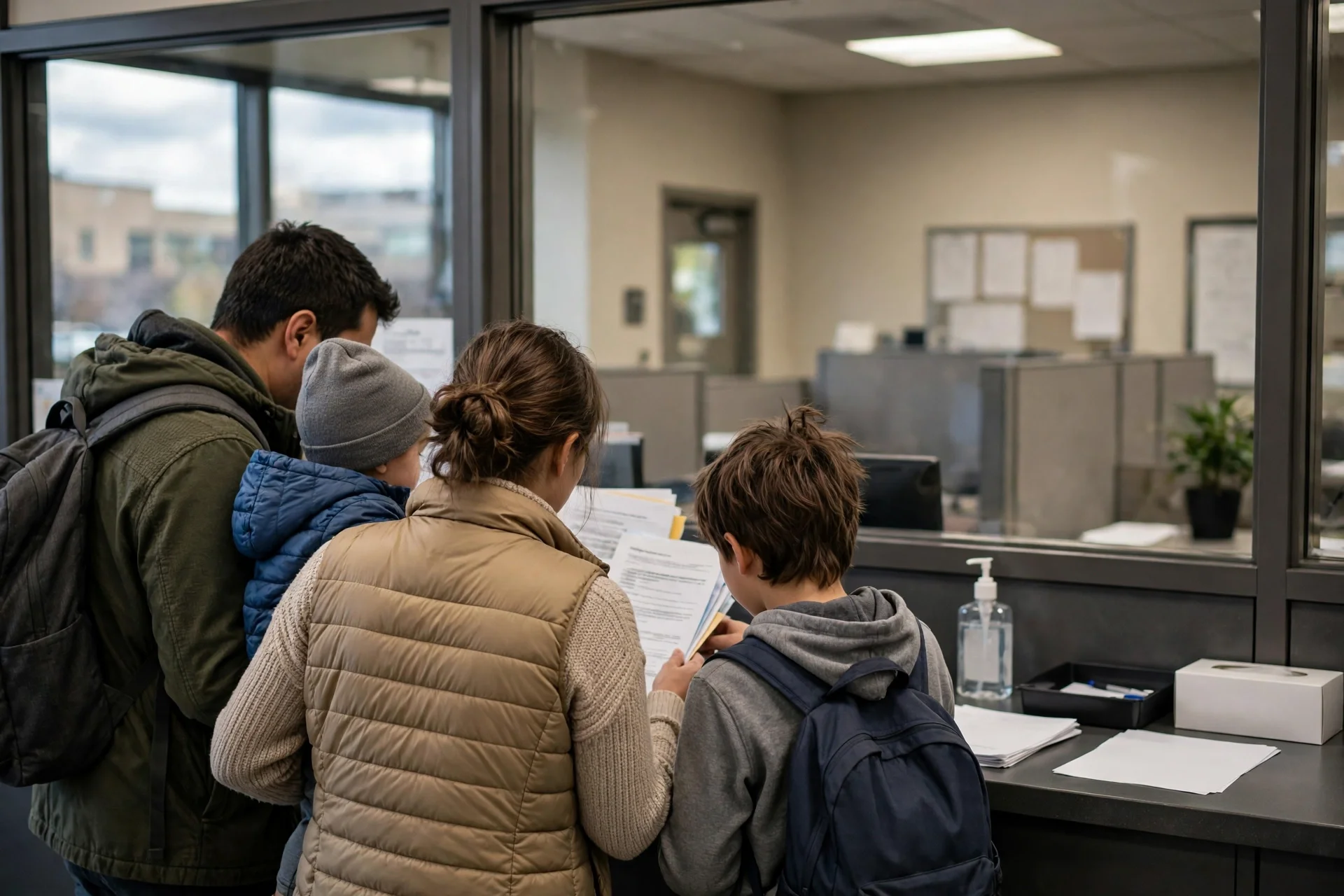
Familia revisa documentos migratorios ante una ventanilla gubernamental en Estados Unidos. · Erick Prometeo Media
Sileiri Doe class can seek reopening of adverse decisions without a fee
A court order issued on Sept. 28, 2026, lets Sileiri Doe class members ask USCIS, without a fee and with no filing deadline, to reopen or reconsider adverse…
Fee-free reopening for Sileiri Doe class, reviewed case by case
Under a court order of Sept. 28, 2026, the Sileiri Doe class may seek fee-free reopening or reconsideration of adverse decisions tied to the April 2025 parole…
--- The context ---
The class covers people who scheduled their entry through the CBP One mobile app, were paroled into the United States between May 16, 2023, and Jan. 19, 2025, had that parole terminated in April 2025 through a mass email saying it was time to leave the United States, and remain in the country.
--- The facts ---
On Sept. 28, 2026, the U.S. District Court for the District of Massachusetts ordered the Department of Homeland Security to remediate certain adverse consequences for that class, in Sileiri Doe v. DHS, 1:25-cv-12245-ADB. Under the order, class members may ask USCIS to reopen or reconsider an adverse decision on an immigration benefit request without a fee, if they believe it resulted from the April 2025 parole termination.
The process applies when USCIS issued the original decision between April 1, 2025, and April 21, 2026, and there is no deadline to file. An adverse decision means a benefit request that was denied, dismissed, deemed abandoned, administratively closed, rejected, or referred to the Executive Office for Immigration Review. Employment authorization based on parole is excluded.
--- The positions ---
The April 2025 termination emails were vacated by the district court on March 31, 2026, parole was ordered reinstated, and those emails had no legal effect: the Department of Homeland Security cannot use them to deny applications, as grounds on admissibility or detention, or for unlawful presence under INA § 212(a)(9)(B) and (C)(i), 8 U.S.C. § 1182(a)(9)(B) and (C)(i). On April 21, 2026, Customs and Border Protection reinstated parole periods and issued new termination notices, which the September order does not affect.
--- What remains unknown ---
The request must be filed on the form designated by USCIS, must explain how the April 2025 termination affected eligibility, and will be reviewed case by case, approvable only if eligibility is shown without consideration of that termination. Additional information appears on the Form I-589 website, for asylum, and the Form I-290B website, for other benefit types.
--- Unanswered questions ---
How many class members received an adverse decision because of that termination? How long will USCIS take to decide these requests case by case? What will happen to class members in removal proceedings?
--- EPM analysis ---
The process does not include appeals, which on Form I-290B follow normal procedures. A class member in removal proceedings must first have the case terminated or dismissed by an immigration judge, with limited exceptions; if USCIS no longer has jurisdiction, it will reject or deny the request.
📌 EPM Take: In EPM's view, this route repairs a concrete harm without opening an indiscriminate door, because it requires eligibility to be shown case by case and reaches only decisions shaped by a termination that a court already vacated as legally ineffective. Its real value will be measured in administrative practice, in the clarity of the instructions USCIS provides, and in whether any family is left out for being unable to pay a fee after suffering the consequences of an email that should never have produced effects. Each file now deserves a clear, timely and reasoned answer.
--- The context ---
The scope is narrowly drawn: people who scheduled entry through the CBP One mobile app, were paroled into the United States between May 16, 2023, and Jan. 19, 2025, and received an April 2025 mass email terminating that parole, with a message saying it was time to leave the United States. They remain in the country and make up the class in Sileiri Doe v. DHS, 1:25-cv-12245-ADB.
--- The facts ---
On Sept. 28, 2026, the U.S. District Court for the District of Massachusetts ordered the Department of Homeland Security to remediate certain adverse consequences for that class. Under the order, a class member may file with USCIS a request to reopen or reconsider an adverse decision on an immigration benefit request without a fee, if the member believes it was made as a result of the April 2025 parole termination.
The order creates no new benefit and guarantees no outcome. It is available only if USCIS issued the original decision between April 1, 2025, and April 21, 2026, there is no deadline to file, and employment authorization based on parole is excluded. An adverse decision is one that denied, dismissed, deemed abandoned, administratively closed or rejected a benefit request, or referred it to the Executive Office for Immigration Review.
--- The positions ---
The agency keeps control of each file: the request goes on the form designated by USCIS, must explain how the termination affected eligibility, and will be reviewed on a case-by-case basis. It may be approved only if the person demonstrates eligibility without consideration of the April 2025 parole termination. Additional information is on the Form I-589 website, for asylum, and the Form I-290B website, for other benefit types.
--- What remains unknown ---
Express limits should not be blurred. The April 2025 emails were vacated on March 31, 2026, and had no legal effect, but on April 21, 2026, Customs and Border Protection reinstated parole periods and issued new termination notices, and the Sept. 28, 2026, order does not impact those new notices. The process also does not include appeals, and appeals on Form I-290B remain under normal procedures.
--- Unanswered questions ---
How will USCIS verify that each adverse decision truly resulted from that termination? What evidence must each applicant provide to demonstrate eligibility? How many files will enter this case-by-case review?
--- EPM analysis ---
A class member in removal proceedings before an immigration judge must first have those proceedings terminated or dismissed, with limited exceptions, before asking USCIS to reopen an asylum application and, in some cases, an adjustment of status application. If USCIS no longer has jurisdiction, it will reject or deny the request.
📌 EPM Take: In EPM's view, the strength of this measure lies in its restraint, because it grants nothing automatically, keeps case-by-case review in place and requires full eligibility to be demonstrated before any reopening or reconsideration can be approved. Complying with a court order does not require loosening controls, and this route avoids doing so by leaving ordinary appeals, the jurisdiction of immigration judges, the requirements of each benefit and the new termination notices issued in April 2026 fully intact. That restraint also protects the credibility of the process, because every approval must rest on proven individual merits.
Clase Sileiri Doe podrá pedir reapertura de su caso sin tarifa
Una orden judicial del 28 de septiembre de 2026 permite a los miembros de la clase Sileiri Doe pedir a USCIS, sin tarifa y sin fecha límite, la reapertura o…
Reapertura sin tarifa para la clase Sileiri Doe, caso por caso
Por orden judicial del 28 de septiembre de 2026, la clase Sileiri Doe puede pedir sin tarifa la reapertura o reconsideración de decisiones adversas ligadas a…
--- El contexto ---
La clase reúne a personas que agendaron su entrada con la aplicación CBP One, entraron con parole entre el 16 de mayo de 2023 y el 19 de enero de 2025, sufrieron en abril de 2025 la terminación de ese parole por un correo masivo que decía que era hora de abandonar Estados Unidos y permanecen en el país.
--- Los hechos ---
El 28 de septiembre de 2026, el Tribunal de Distrito de Estados Unidos para Massachusetts ordenó al Departamento de Seguridad Nacional remediar ciertas consecuencias adversas para esa clase, en el caso Sileiri Doe v. DHS. Según la orden, los miembros pueden pedir a USCIS la reapertura o la reconsideración de una decisión adversa sobre un beneficio migratorio sin pagar tarifa, si creen que derivó de la terminación de abril de 2025.
La vía aplica si USCIS emitió la decisión original entre el 1 de abril de 2025 y el 21 de abril de 2026, y no hay fecha límite para pedirla. Es decisión adversa un beneficio denegado, desestimado, tenido por abandonado, cerrado administrativamente, rechazado o remitido a la Oficina Ejecutiva de Revisión de Inmigración. Queda excluida la autorización de empleo basada en parole.
--- Las posiciones ---
Los correos de terminación de abril de 2025 fueron anulados por el tribunal el 31 de marzo de 2026, se ordenó reinstaurar el parole y esos correos no tuvieron efecto legal: el Departamento de Seguridad Nacional no puede usarlos para denegar solicitudes, ni en admisibilidad y detención, ni para acumular presencia ilegal. El 21 de abril de 2026, la Oficina de Aduanas y Protección Fronteriza reinstauró los periodos de parole y emitió nuevos avisos de terminación, que la orden de septiembre no afecta.
--- Lo que falta saber ---
La petición va en el formulario designado por USCIS, debe explicar cómo la terminación afectó la elegibilidad y se revisará caso por caso, aprobable solo si se demuestra elegibilidad sin considerar esa terminación. Hay información adicional en las páginas del Formulario I-589, para asilo, y del Formulario I-290B, para los demás beneficios.
--- Preguntas sin respuesta ---
¿Cuántas personas de la clase recibieron una decisión adversa derivada de esa terminación? ¿Cuánto tardará USCIS en resolver las peticiones caso por caso? ¿Qué pasará con quienes están en procedimientos de remoción?
--- Análisis EPM ---
El proceso no incluye apelaciones, que por el Formulario I-290B siguen su cauce normal. Quien esté en remoción ante un juez de inmigración debe lograr antes la terminación o desestimación de su caso, con excepciones limitadas; si USCIS ya no tiene jurisdicción, rechazará o denegará la petición.
📌 Conclusion EPM: A juicio de EPM, esta vía corrige una injusticia concreta sin abrir una puerta indiscriminada, porque exige demostrar la elegibilidad caso por caso y se limita a decisiones marcadas por una terminación que un tribunal ya anuló por carecer de efecto legal. Su valor real se medirá en la práctica, en la claridad de las instrucciones de USCIS y en que ninguna familia quede fuera por no poder pagar una tarifa tras sufrir las consecuencias de un correo que nunca debió producir efectos. Importa también que cada expediente reciba una respuesta clara, oportuna y motivada.
--- El contexto ---
El proceso tiene un origen delimitado: personas que agendaron su entrada con la aplicación CBP One, entraron con parole entre el 16 de mayo de 2023 y el 19 de enero de 2025 y recibieron en abril de 2025 un correo masivo de terminación que decía que era hora de abandonar Estados Unidos. Esas personas permanecen en el país y forman la clase del caso Sileiri Doe v. DHS.
--- Los hechos ---
El 28 de septiembre de 2026, el Tribunal de Distrito de Estados Unidos para Massachusetts ordenó al Departamento de Seguridad Nacional remediar ciertas consecuencias adversas para esa clase. En cumplimiento de la orden, un miembro puede pedir a USCIS la reapertura o la reconsideración de una decisión adversa sobre un beneficio migratorio sin pagar tarifa, si considera que fue resultado de la terminación de abril de 2025.
La orden no crea un beneficio nuevo ni garantiza resultados. Solo procede si USCIS emitió la decisión original entre el 1 de abril de 2025 y el 21 de abril de 2026, no hay fecha límite para presentarla y queda fuera la autorización de empleo basada en parole. Es decisión adversa la que denegó, desestimó, tuvo por abandonado, cerró administrativamente o rechazó un beneficio, o lo remitió a la Oficina Ejecutiva de Revisión de Inmigración.
--- Las posiciones ---
La agencia conserva el control de cada expediente: la solicitud va en el formulario designado por USCIS, debe explicar cómo la terminación afectó la elegibilidad y se revisa caso por caso. Solo puede aprobarse si la persona demuestra elegibilidad sin considerar la terminación de abril de 2025. La información adicional está en las páginas del Formulario I-589, para asilo, y del Formulario I-290B, para los demás beneficios.
--- Lo que falta saber ---
Los límites son expresos. Los correos de abril de 2025 fueron anulados el 31 de marzo de 2026 y carecieron de efecto legal, pero el 21 de abril de 2026 la Oficina de Aduanas y Protección Fronteriza reinstauró los periodos de parole y emitió nuevos avisos de terminación, que la orden de septiembre no afecta. El proceso tampoco incluye apelaciones, que por el Formulario I-290B siguen su procedimiento normal.
--- Preguntas sin respuesta ---
¿Cómo verificará USCIS que cada decisión adversa derivó realmente de esa terminación? ¿Qué pruebas deberá aportar cada solicitante para demostrar su elegibilidad? ¿Cuántos expedientes entrarán en esta revisión caso por caso?
--- Análisis EPM ---
Quien esté en procedimientos de remoción ante un juez de inmigración debe obtener antes la terminación o la desestimación de su caso, con excepciones limitadas, para pedir la reapertura de asilo y, en algunos casos, del ajuste de estatus. Si USCIS ya no tiene jurisdicción por estar la persona en remoción, rechazará o denegará la petición.
📌 Conclusion EPM: A juicio de EPM, el acierto de esta medida está en su contención, porque no concede nada en automático, mantiene la revisión caso por caso y exige demostrar la elegibilidad plena antes de aprobar cualquier reapertura o reconsideración. Cumplir una orden judicial no exige aflojar los controles, y esta vía lo evita al dejar intactas las apelaciones ordinarias, la jurisdicción de los jueces de inmigración, los requisitos de cada beneficio y los nuevos avisos de terminación emitidos en abril de 2026. Esa contención protege la credibilidad del proceso, porque cada aprobación deberá sostenerse en méritos propios comprobados.