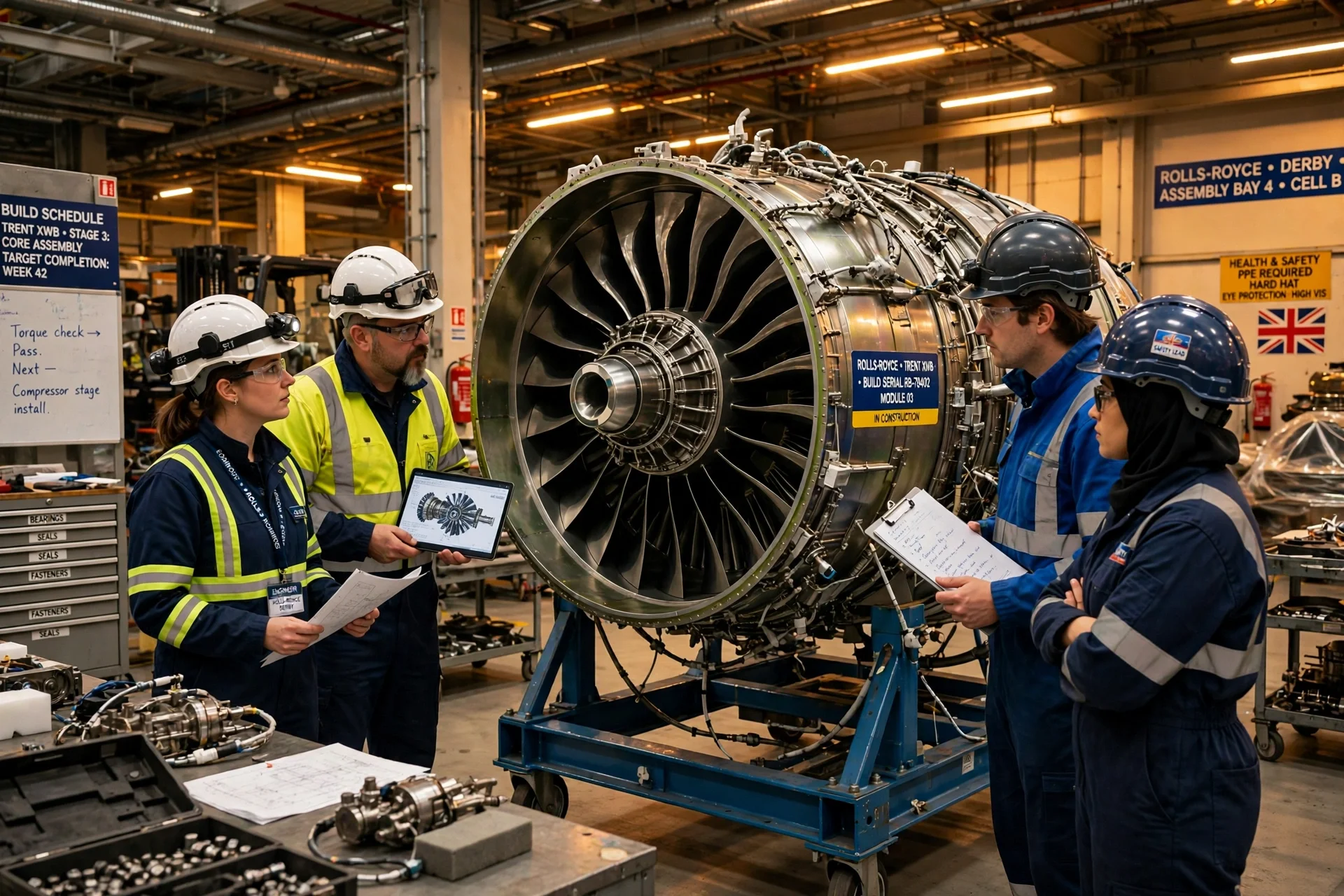
Imagen alusiva generada: un motor de aviación en fabricación con su equipo de ingenieros · Imagen generada para EPM
UK and Rolls-Royce agree £2.5bn jet engine programme
The British Government and Rolls-Royce agreed a multi-decade cooperation with a joint 10 year £2.5bn programme for cleaner and more efficient jet engines…
British jet engines: £2.5bn Rolls-Royce deal agreed
Britain signed a multi-decade cooperation framework with Rolls-Royce and a 10 year £2.5bn programme for next-generation engines, with no new grants at this…
--- The context ---
Britain is rebuilding industrial strength in a field where it holds a rare advantage. The aerospace sector employs around 113,000 people and brings more than £46 billion a year into the economy, while the global civil aerospace market is expected to be worth £220 billion a year by 2050. Single-aisle aircraft, used for short and medium-haul flights, will make up the largest slice of that market. The Government sees those planes as the opening to secure work and skills at home.
--- The facts ---
The Government and Rolls-Royce have agreed a multi-decade cooperation that includes a joint 10 year £2.5bn programme to develop next-generation jet engines that are cleaner and more efficient, for single-aisle passenger aircraft and for military planes. The Chancellor announced the agreement as he delivered his first Budget on 28 October. The investment is expected to support 3,300 jobs by the end of 2029, with the potential for tens of thousands of additional roles in the decades ahead.
Rolls-Royce estimates that securing a British engine on those aircraft could lead to billions more being invested in the country in the coming decades and could add £120 billion to the economy over the lifetime of the programme. The Industrial Strategy identifies this as the biggest opportunity for the British aerospace sector in 50 years. Most jobs will be created outside London and the South East. Rolls-Royce said its British supply chain spending was more than £3 billion in 2025.
--- The positions ---
Prime Minister Andy Burnham argued that British industrial strength should not belong only to the past and should be a core part of the future, and he presented the agreement as reindustrialisation in practice because it gives businesses the certainty to invest and creates jobs people can build a future on. Business Secretary Jonathan Reynolds said reindustrialisation is a firm commitment to good jobs and growth across the country, that the agreement ensures Britain will win the race to power the next generation of passenger planes, and that it is a vote of confidence in the economic plan.
Rolls-Royce chief executive Tufan Erginbilgic called the agreement a landmark moment for the aerospace industry and a once-in-a-generation opportunity to lay the foundations for decades of sustainable economic growth, create high-value jobs and transform the advanced manufacturing supply chain. He also noted that the country is one of only two that can design, develop, make and service the engines that power the world's airliners, and stressed that the programme is vital to compete and to sustain military air capability.
--- What remains unknown ---
Honesty requires stating clearly what this agreement is not yet. It provides a framework for cooperation and includes no new grants at this stage, so it must not be presented as money already handed over. Any future Government support will remain subject to legal, value-for-money, affordability and Government approval processes, to subsidy control checks, and to agreeing terms and conditions with Rolls-Royce. The programme will develop advanced materials, electronic systems, advanced manufacturing, robotics and artificial intelligence, alongside a jobs and skills plan, and it builds on the £100 million aerospace supply chain fund announced this summer.
--- Unanswered questions ---
What timetable will govern spending under the joint £2.5bn programme across its 10 years? What exact conditions must future support meet to pass the value-for-money, affordability and subsidy control checks? How many of the tens of thousands of long-term jobs will be genuinely new roles rather than existing posts that are supported? Which regions outside London and the South East will receive the largest share of the new engineering, research and manufacturing work promised?
--- EPM analysis ---
The immediate value of the deal lies in certainty. For suppliers deciding whether to hire, train and invest, a multi-decade framework changes the calculation. The regional dimension matters too, because directing most jobs beyond the capital links industrial policy to places that often watch major projects pass them by. The weakness is the gap between framework and delivery, since future support must still clear demanding tests before it becomes real spending and employment.
📌 EPM Take: In EPM's view, the Rolls-Royce agreement is a serious industrial bet because it combines long horizons, a supply chain that already spent more than £3 billion in 2025, and technologies that serve both civil and military needs. Its credibility will rest on measurable delivery rather than launch-day language. Because no new grants have been awarded at this stage, the fair test is contracts signed, checks passed and jobs actually supported by 2029 and beyond. If delivery follows, Britain can strengthen its place among the very few countries able to power world aviation.
--- The context ---
Jet engines are among the most complex and valuable parts of any aircraft, and Britain remains one of only two countries that can design, develop, make and service the engines that power the world's commercial airliners. That capability supports a sector employing around 113,000 people and bringing more than £46 billion a year into the economy. With the global civil aerospace market expected to reach £220 billion a year by 2050, and single-aisle aircraft forming its largest slice, defending this position is a matter of economic and national security alike.
--- The facts ---
The Government and Rolls-Royce have agreed a multi-decade cooperation including a joint 10 year programme worth £2.5bn to build next-generation jet engines that are cleaner and more efficient, for single-aisle passenger planes and for military aircraft. The Chancellor announced it as he delivered his first Budget on 28 October. The agreement is expected to support 3,300 jobs by the end of 2029 and over the next few years, with the potential for tens of thousands more roles in the decades ahead, most of them created outside London and the South East.
Rolls-Royce estimates that securing a British engine on single-aisle aircraft could attract billions more in investment over the coming decades and add £120 billion to the economy over the lifetime of the programme. The Industrial Strategy describes it as the British aerospace sector's biggest opportunity in 50 years. Work will cover advanced materials, electronic systems, advanced manufacturing, robotics and artificial intelligence, alongside a jobs and skills plan. The company said its British supply chain spending exceeded £3 billion in 2025, and the agreement builds on a £100 million supply chain fund announced this summer.
--- The positions ---
Prime Minister Andy Burnham said Britain has always been an industrial powerhouse and argued that this strength should be a core part of its future, presenting the agreement as reindustrialisation in practice that gives businesses certainty to invest. Business Secretary Jonathan Reynolds said reindustrialisation is a firm commitment to deliver good jobs and growth for people all over the country, that the deal keeps jet engine manufacturing in Britain, and that it amounts to a vote of confidence in the Government's economic plan and in the certainty businesses need to grow at home.
Rolls-Royce chief executive Tufan Erginbilgic described the agreement as a landmark moment and a once-in-a-generation opportunity to lay foundations for decades of sustainable growth, high-value jobs and a transformed advanced manufacturing supply chain. He said the programme with Government is vital to enable the country to compete in a growing global market and to sustain the capability to power military aircraft. Read strictly, those words bind both sides to delivery, because a strategic industry cannot live on announcements without contracts and production that follow.
--- What remains unknown ---
One clause disciplines the whole agreement. This is a cooperation framework and no new grants have been awarded at this stage, so it would be wrong to present it as money already delivered. Any future Government support remains subject to appropriate legal, value-for-money, affordability and Government approval processes, to subsidy control compliance, and to agreement on terms and conditions with Rolls-Royce. Until those tests are passed, what has been signed is a demanding route map rather than a cheque, and public judgement should treat it exactly that way.
--- Unanswered questions ---
How will the £2.5bn cost of the joint programme be divided and scheduled across its 10 years? What concrete safeguards will protect taxpayers if programme costs rise or timetables slip? How much of the support for 3,300 jobs by 2029 preserves existing posts rather than creating new ones? How will Ministers publicly verify that most new jobs are genuinely being created outside London and the South East as promised?
--- EPM analysis ---
The strength of this deal is that it conditions public backing on value for money and affordability, a sound principle where taxpayers' funds are concerned. It also builds on a real, exportable capability rather than inventing a subsidy-dependent sector. Its weakness is that an unclosed framework can stall in process, and only the agreements that follow will turn intent into orders, apprenticeships and sovereign capability.
📌 EPM Take: In EPM's view, the agreement deserves cautious support because it defends a strategic industry in which Britain already competes at the highest level while subjecting any future support to value-for-money, affordability and subsidy control tests. That discipline is what separates serious industrial policy from an expensive announcement. Ministers should now publish terms as they are agreed and report progress openly, measured in jobs, exports and military capability, starting with the 3,300 posts that must be supported by the end of 2029 and the supply chain behind them.
Reino Unido y Rolls-Royce pactan motores por £2.5bn
El Gobierno británico y Rolls-Royce acordaron una cooperación de varias décadas con un programa conjunto de £2.5bn a 10 años para motores a reacción más…
Motores británicos: acuerdo de £2.5bn con Rolls-Royce
Reino Unido firmó con Rolls-Royce un marco de cooperación de varias décadas y un programa de £2.5bn a 10 años para motores de nueva generación, sin nuevas…
--- El contexto ---
El Reino Unido busca recuperar peso industrial en un sector donde figura entre los pocos países capaces de diseñar, fabricar y mantener motores avanzados. El sector aeroespacial emplea a unas 113,000 personas y aporta más de £46 billion al año a la economía, mientras el mercado mundial civil de aviación se estima en £220 billion al año hacia 2050. En ese escenario, los aviones de pasillo único concentrarán la mayor parte del mercado y abren la ventana que el Gobierno quiere aprovechar.
--- Los hechos ---
El Gobierno y Rolls-Royce acordaron una cooperación de varias décadas que incluye un programa conjunto de 10 años por £2.5bn para desarrollar motores a reacción de nueva generación, más limpios y eficientes, destinados a aviones de pasajeros de pasillo único y también a aeronaves militares. El anuncio lo hizo el ministro de Hacienda al presentar su primer Presupuesto el 28 de octubre. La inversión respaldará 3,300 empleos hacia finales de 2029, con potencial para decenas de miles de puestos adicionales después.
Rolls-Royce estima que un motor británico en esos aviones podría atraer miles de millones más y sumar £120 billion a la economía durante la vida del programa. La Estrategia Industrial lo identifica como la mayor oportunidad aeroespacial británica en 50 años. La mayoría de los empleos se creará fuera de Londres y el Sureste, y el gasto de Rolls-Royce en su cadena británica superó los £3 billion en 2025.
--- Las posiciones ---
El primer ministro Andy Burnham defendió que la fortaleza industrial británica no debe quedar solo en el pasado y debe formar parte central del futuro, y sostuvo que el acuerdo muestra la reindustrialización en la práctica al dar certidumbre a las empresas para invertir y crear empleos con futuro. El secretario de Negocios Jonathan Reynolds afirmó que la reindustrialización es un compromiso firme de empleos y crecimiento, que el acuerdo garantiza ganar la carrera por propulsar la próxima generación de aviones y que supone un voto de confianza en el plan económico.
El consejero delegado de Rolls-Royce, Tufan Erginbilgic, calificó el acuerdo de momento histórico para la industria aeroespacial británica y de oportunidad única en una generación para sentar las bases de décadas de crecimiento económico sostenible, crear empleos de alto valor y transformar la cadena de suministro de manufactura avanzada. También recordó que el país es uno de solo dos capaces de diseñar, desarrollar, fabricar y mantener los motores de los aviones comerciales del mundo, y subrayó que el programa es vital para competir y sostener la capacidad militar aérea.
--- Lo que falta saber ---
Con honestidad conviene subrayar lo que el acuerdo todavía no es. Se trata de un marco de cooperación y no incluye nuevas subvenciones en esta fase, por lo que no debe presentarse como dinero ya entregado. Todo apoyo futuro quedará sujeto a procesos legales, de valor por dinero, de asequibilidad, de aprobación gubernamental y de control de subvenciones, además de acordar los términos y condiciones con Rolls-Royce. El programa desarrollará materiales avanzados, sistemas electrónicos, manufactura avanzada, robótica e inteligencia artificial, junto a un plan de empleos y capacidades, y se apoya en el fondo de £100 million anunciado este verano.
--- Preguntas sin respuesta ---
¿Qué calendario concreto tendrá el desembolso del programa de £2.5bn durante los 10 años previstos? ¿Qué condiciones exactas deberán cumplirse para que el apoyo futuro supere los controles de valor por dinero y de subvenciones? ¿Cuántos de los decenas de miles de empleos prometidos a largo plazo serán puestos nuevos y cuántos corresponderán a empleos ya existentes? ¿Qué regiones fuera de Londres y el Sureste concentrarán la mayor parte de la creación de empleo anunciada?
--- Análisis EPM ---
El valor inmediato del acuerdo es la certidumbre. Para los proveedores, un marco de varias décadas facilita planificar inversiones, contratar y escalar. El enfoque territorial también importa, porque la promesa de empleo fuera de la capital conecta la política industrial con comunidades que suelen quedar al margen. El riesgo está en la distancia entre el marco y la ejecución, ya que cada apoyo futuro deberá superar filtros exigentes antes de convertirse en gasto real.
📌 Conclusion EPM: A juicio de EPM, el acuerdo con Rolls-Royce es una apuesta industrial seria porque combina escala, plazo largo y una cadena de suministro que ya gastó más de £3 billion en 2025, pero su credibilidad dependerá de hechos medibles y no de titulares. El marco sin subvenciones nuevas obliga a juzgarlo por los contratos, los controles superados y los empleos efectivamente creados hacia 2029 y después. Si la ejecución acompaña, el Reino Unido puede reforzar su lugar entre los pocos países capaces de propulsar la aviación mundial y repartir mejor ese crecimiento entre sus regiones.
--- El contexto ---
La aviación es un terreno donde el Reino Unido conserva una ventaja difícil de copiar. Los motores figuran entre los componentes más complejos de un avión, y el país es uno de solo dos que pueden diseñar, desarrollar, fabricar y mantener los motores de los aviones comerciales del mundo. El sector emplea a unas 113,000 personas y aporta más de £46 billion al año, en un mercado mundial civil estimado en £220 billion al año hacia 2050 que ningún gobierno prudente puede ignorar.
--- Los hechos ---
El Gobierno y Rolls-Royce cerraron una cooperación de varias décadas con un programa conjunto de 10 años por £2.5bn para motores de nueva generación, más limpios y eficientes, para aviones de pasillo único y uso militar. El ministro de Hacienda lo anunció al presentar su primer Presupuesto el 28 de octubre. El acuerdo respaldará 3,300 empleos hacia finales de 2029 y en los próximos años, con la posibilidad de decenas de miles de empleos adicionales en las décadas siguientes, la mayoría fuera de Londres y el Sureste.
Según la estimación de Rolls-Royce recogida en el anuncio, un motor británico en los aviones de pasillo único podría atraer miles de millones más de inversión y sumar £120 billion a la economía durante la vida del programa. La Estrategia Industrial lo señala como la mayor oportunidad aeroespacial británica en 50 años. El plan incluye desarrollar materiales avanzados, sistemas electrónicos, manufactura avanzada, robótica e inteligencia artificial, acompañado de un plan de empleos y capacidades. El gasto de la compañía en su cadena británica superó los £3 billion en 2025 y existe un fondo de £100 million para esa cadena anunciado este verano.
--- Las posiciones ---
El primer ministro Andy Burnham sostuvo que el Reino Unido siempre ha sido una potencia industrial y que esa fortaleza debe ser parte central de su futuro, y presentó el acuerdo como prueba práctica de la reindustrialización porque ofrece certidumbre para invertir y empleos sobre los que construir un futuro. El secretario de Negocios Jonathan Reynolds dijo que la reindustrialización es un compromiso firme de buenos empleos y crecimiento en todo el país, que el acuerdo mantiene la fabricación de motores en el Reino Unido y que representa un voto de confianza en el plan económico del Gobierno.
El consejero delegado de Rolls-Royce, Tufan Erginbilgic, describió el pacto como un momento histórico y una oportunidad única en una generación para sentar las bases de décadas de crecimiento sostenible, crear empleos de alto valor y transformar la cadena de suministro nacional. Añadió que el programa es vital para competir en un mercado global en crecimiento y sostener la capacidad militar. Esas palabras comprometen a ambas partes a entregar resultados y no solo anuncios.
--- Lo que falta saber ---
El punto que ordena el acuerdo es su naturaleza financiera. Es un marco que en esta fase no incluye nuevas subvenciones, de modo que sería incorrecto presentarlo como dinero ya entregado. Cualquier apoyo futuro deberá superar procesos legales, evaluaciones de valor por dinero, pruebas de asequibilidad, aprobación gubernamental y controles de subvenciones, y además requiere acordar términos y condiciones con Rolls-Royce. Hasta que esos filtros se superen, lo firmado es una hoja de ruta exigente y no un cheque, y así debe valorarse públicamente.
--- Preguntas sin respuesta ---
¿Quién aportará cada parte del programa conjunto de £2.5bn y con qué calendario de pagos durante los 10 años? ¿Qué salvaguardas concretas protegerán al contribuyente si los costes del programa aumentan o los plazos se retrasan? ¿Qué parte de los 3,300 empleos respaldados hacia 2029 corresponde a puestos ya existentes que se preservan? ¿Cómo se medirá públicamente que la mayoría del empleo nuevo se crea realmente fuera de Londres y el Sureste?
--- Análisis EPM ---
La fortaleza del pacto está en que condiciona el respaldo público a valor por dinero y asequibilidad, un principio sano con fondos de los contribuyentes. También acierta al apoyarse en una capacidad industrial real y exportable, en lugar de crear un sector artificial dependiente de subvenciones. Su debilidad es simétrica, porque un marco sin compromisos cerrados puede quedarse en declaración si se frenan los acuerdos concretos que darán empleo efectivo.
📌 Conclusion EPM: A juicio de EPM, el acuerdo merece respaldo prudente porque defiende una industria estratégica en la que el Reino Unido ya compite al máximo nivel y porque somete cualquier apoyo futuro a controles de valor por dinero, asequibilidad y subvenciones. Esa disciplina es precisamente lo que distingue una política industrial seria de un anuncio costoso. Ahora corresponde exigir transparencia en cada tramo, publicar los términos cuando se cierren y medir el resultado en empleos, exportaciones y capacidad militar real, empezando por los 3,300 puestos que deben estar respaldados hacia finales de 2029.