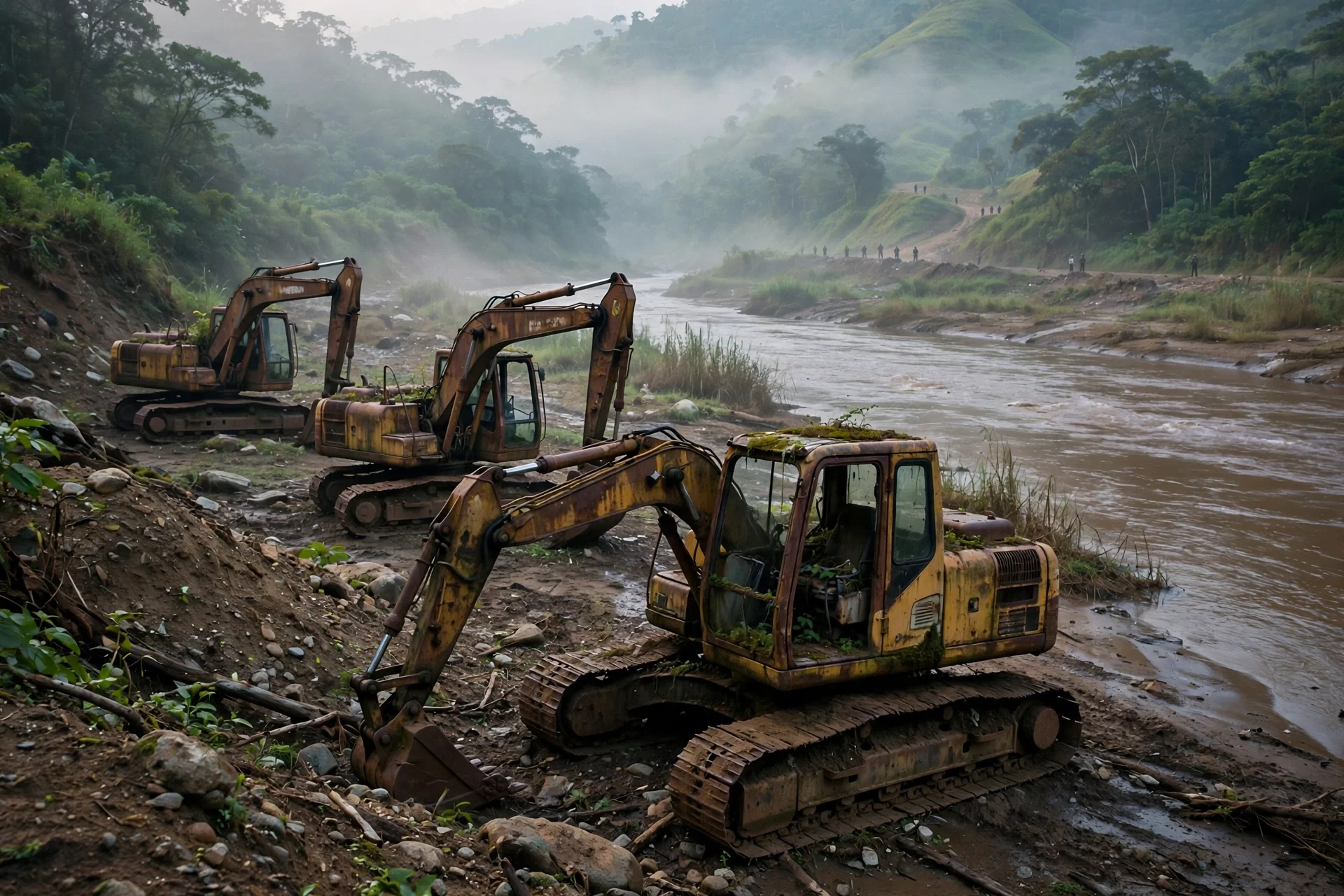
Maquinaria minera inmovilizada junto a un río en el Bajo Cauca antioqueño. · Imagen generada para EPM
Abelardo Announces Dismantling of Deep Gold in Bajo Cauca
President Abelardo de la Espriella announced the dismantling of Deep Gold in El Bagre and Caucasia, with eight captured, 695 grams of gold, 152 grams of…
Blow to Illegal Mining: Deep Gold Dismantled in Bajo Cauca
The October 29, 2026 intervention in El Bagre and Caucasia dismantled the Deep Gold structure, accused of illegal mining along the Nechí River, with eight…
--- The context ---
The Bajo Cauca region of Antioquia is a subregion where gold mining has historic economic relevance and where formal mining coexists with the illicit exploitation of deposits. Its municipalities include Tarazá, Cáceres, Caucasia, Nechí, El Bagre, Zaragoza and Valdivia, and the presence of gold has made the territory a point of interest for structures seeking illegal rents from unauthorized extraction near water sources.
--- The facts ---
President Abelardo de la Espriella announced the dismantling of Deep Gold, a name that in Spanish means intense gold, a structure accused of illicitly exploiting mining deposits in Bajo Cauca. The intervention, carried out on Thursday, October 29, 2026, in El Bagre and Caucasia, left eight people captured and included the seizure of 695 grams of gold, 152 grams of platinum and more than 505 million pesos in cash. Authorities also disabled three excavators valued at 1,200 million pesos, which allegedly extracted minerals on the banks of the Nechí River.
Authorities attribute to the structure deposits exploited without required authorizations, with heavy machinery near water sources, an extraction that can affect soil and alter river channels.
--- The positions ---
The president said his government will not allow criminals to keep enriching themselves at the cost of destroying natural resources, and he described the operation as a blow to the financial and logistical capacity of the organization, because it hits its finances and its machinery. He also said his government will pursue illegal economies and bring those responsible before justice, closing his message by stating that the party is over for those involved. The detainees are investigated for the alleged crimes of conspiracy, damage to natural resources and environmental contamination.
--- What remains unknown ---
The individual responsibility of the eight captured people must be established during the judicial process, and the announcement does not specify the extent of the environmental damage that would be attributed to Deep Gold. That aspect will depend on technical reports and later judicial proceedings. The video released with the announcement shows Police agents entering the intervened site, the detainees and the items found, among them the precious metals and the money, which were left at the disposal of the authorities.
--- Unanswered questions ---
What individual responsibility will be proven against each of the eight captured people in the judicial process? How extensive will be the environmental damage that technical reports attribute to the structure? Will these interventions manage to reduce in a sustained way the financing sources of criminal groups in the subregion?
--- EPM analysis ---
One day earlier, on Wednesday, October 28, 2026, the Army reported another procedure in the village of La Esperanza, in Nechí, where it intervened 12 mining production units and put out of service equipment and supplies valued at more than 1,000 million pesos. That procedure does not necessarily correspond to the Deep Gold case, although it reflects the continuity of official actions, because extraction without authorizations can affect the soil, alter river channels and increase pressure on ecosystems near the rivers.
📌 EPM Take: In EPM's view, the dismantling of Deep Gold strikes the economic heart of illegal mining in Bajo Cauca, by seizing gold, platinum and cash and disabling the machinery that sustained extraction along the Nechí River. The presidential announcement draws a clear line of pursuit against illegal economies and defense of natural resources. Its lasting effect will depend on the judicial process establishing responsibilities and on official presence remaining in the territory.
--- The context ---
In the Bajo Cauca region of Antioquia, gold mining has long supported an important part of economic life, but it has also attracted structures that exploit deposits without authorizations. The subregion gathers municipalities such as Tarazá, Cáceres, Caucasia, Nechí, El Bagre, Zaragoza and Valdivia, and the Nechí River, which crosses part of that zone, has been the scene of interventions against machinery used in the illegal extraction of minerals.
--- The facts ---
President Abelardo de la Espriella announced the dismantling of Deep Gold, a structure accused of illicitly exploiting mining deposits in the Bajo Cauca region of Antioquia. The intervention was carried out on Thursday, October 29, 2026, in the municipalities of El Bagre and Caucasia and left eight people captured. According to the presidential information, authorities seized 695 grams of gold, 152 grams of platinum and more than 505 million pesos in cash, and disabled three excavators valued at 1,200 million pesos that allegedly extracted minerals on the banks of the Nechí River.
The structure allegedly exploited deposits without required authorizations, operating heavy machinery near water sources, an activity that can affect soil and alter river channels.
--- The positions ---
De la Espriella held that criminals will not be allowed to keep enriching themselves at the cost of destroying natural resources, and he described the operation as a blow to the finances and the machinery of the organization. He added that the detainees are investigated for the alleged crimes of conspiracy, damage to natural resources and environmental contamination, and said his government will pursue illegal economies and bring those responsible before justice. Authorities hold that these interventions seek to reduce the financing sources of criminal groups and contain the environmental deterioration associated with unauthorized extractive activity.
--- What remains unknown ---
The statement does not specify the extent of the environmental damage that would be attributed to Deep Gold, an aspect that will depend on technical reports and later judicial proceedings. Nor does it yet define the individual responsibility of the captured people, which must be established during the judicial process. The video released with the announcement shows Police agents entering the intervened place and the items found during the procedure, which were left at the disposal of the authorities.
--- Unanswered questions ---
What evidence will sustain the investigation for conspiracy, damage to natural resources and environmental contamination? How long will the technical reports measuring the damage caused along the Nechí River take? Will official pressure on illegal mining be maintained across the seven municipalities of the subregion?
--- EPM analysis ---
The sequence matters, because the announcement came one day after the Army intervened 12 mining production units in the village of La Esperanza, in Nechí, putting out of service equipment and supplies valued at more than 1,000 million pesos. Although that procedure does not necessarily correspond to the Deep Gold case, both show a sustained effort against an activity that, without authorizations, can affect the soil, alter river channels and pressure ecosystems near the rivers.
📌 EPM Take: In EPM's view, the blow against Deep Gold defends two goods Colombia cannot lose, order in the territory and its natural resources, by dismantling an illegal economy that operated with heavy machinery next to water sources. The firmness of the presidential announcement sends a necessary signal to those who profit from mining without authorizations. The pending task is to sustain that official presence and let justice complete the work begun in El Bagre and Caucasia.
Abelardo anuncia la desarticulación de Deep Gold en el Bajo Cauca
El presidente Abelardo de la Espriella anunció la desarticulación de Deep Gold en El Bagre y Caucasia, con ocho capturados, 695 gramos de oro, 152 gramos de…
Golpe a la minería ilegal: cae Deep Gold en el Bajo Cauca
La intervención del 29 de octubre de 2026 en El Bagre y Caucasia desarticuló la estructura Deep Gold, señalada de minería ilegal junto al río Nechí, con ocho…
--- El contexto ---
El Bajo Cauca antioqueño es una subregión donde la minería aurífera tiene relevancia económica histórica y donde conviven la minería formal y la explotación ilícita de yacimientos. Entre sus municipios se encuentran Tarazá, Cáceres, Caucasia, Nechí, El Bagre, Zaragoza y Valdivia, y la presencia de oro ha convertido al territorio en un punto de interés para estructuras que buscan rentas ilegales.
--- Los hechos ---
El presidente Abelardo de la Espriella anunció la desarticulación de Deep Gold, nombre que en español significa oro intenso, una estructura señalada de explotar en forma ilícita yacimientos mineros en el Bajo Cauca. La intervención, realizada el jueves 29 de octubre de 2026 en El Bagre y Caucasia, dejó ocho capturados e incluyó la incautación de 695 gramos de oro, 152 gramos de platino y más de 505 millones de pesos en efectivo. Además, las autoridades inutilizaron tres excavadoras valoradas en 1.200 millones de pesos, que presuntamente extraían minerales en las orillas del río Nechí, cerca de fuentes hídricas.
Según las autoridades, la estructura explotaba yacimientos sin las autorizaciones exigidas, con maquinaria pesada cerca de fuentes hídricas, afectando potencialmente el suelo y los cauces fluviales.
--- Las posiciones ---
El mandatario afirmó que su Gobierno no permitirá que los criminales sigan enriqueciéndose a costa de la destrucción de los recursos naturales, y calificó la operación como un golpe a la capacidad financiera y logística de la organización, porque golpea sus finanzas y su maquinaria. También aseguró que perseguirá las economías ilegales y llevará ante la justicia a quienes resulten responsables, y cerró su mensaje señalando que a los implicados se les acabó la guachafita. Los detenidos son investigados por los presuntos delitos de concierto para delinquir, daño a los recursos naturales y contaminación ambiental.
--- Lo que falta saber ---
La responsabilidad individual de los ocho capturados deberá establecerse durante el proceso judicial, y el anuncio no precisa la extensión de los daños ambientales que se atribuirían a Deep Gold. Ese aspecto dependerá de los informes técnicos y de las actuaciones judiciales posteriores. El video divulgado con el anuncio muestra el ingreso de agentes de la Policía al lugar intervenido, a los detenidos y los elementos hallados, entre ellos los metales preciosos y el dinero, que quedaron a disposición de las autoridades.
--- Preguntas sin respuesta ---
¿Qué responsabilidad individual se probará contra cada uno de los ocho capturados en el proceso judicial? ¿Qué extensión tendrán los daños ambientales que los informes técnicos atribuyan a la estructura? ¿Lograrán estas intervenciones reducir de forma sostenida las fuentes de financiación de los grupos criminales en la subregión?
--- Análisis EPM ---
Un día antes, el miércoles 28 de octubre de 2026, el Ejército informó sobre otro procedimiento en la vereda La Esperanza, en Nechí, donde intervino 12 unidades de producción minera y dejó fuera de servicio equipos e insumos valorados en más de 1.000 millones de pesos. Ese procedimiento no corresponde necesariamente al caso de Deep Gold, aunque refleja la continuidad de las acciones oficiales, porque la extracción sin autorizaciones puede afectar el suelo, alterar los cauces y aumentar la presión sobre los ecosistemas próximos a los ríos.
📌 Conclusion EPM: A juicio de EPM, la desarticulación de Deep Gold ataca el corazón económico de la minería ilegal en el Bajo Cauca, al incautar oro, platino y dinero e inutilizar la maquinaria que sostenía la extracción junto al río Nechí. El anuncio presidencial marca una línea clara de persecución a las economías ilegales y de defensa de los recursos naturales. Su efecto duradero dependerá de que el proceso judicial establezca responsabilidades y de que la presencia oficial se mantenga en el territorio.
--- El contexto ---
En el Bajo Cauca antioqueño, la minería aurífera sostiene desde hace tiempo una parte importante de la vida económica, pero también ha atraído a estructuras que explotan yacimientos sin autorizaciones. La subregión reúne municipios como Tarazá, Cáceres, Caucasia, Nechí, El Bagre, Zaragoza y Valdivia, y el río Nechí, que atraviesa parte de esa zona, ha sido escenario de intervenciones contra la maquinaria empleada en la extracción ilegal de minerales.
--- Los hechos ---
El presidente Abelardo de la Espriella anunció la desarticulación de Deep Gold, una estructura señalada de explotar en forma ilícita yacimientos mineros en el Bajo Cauca antioqueño. La intervención se realizó el jueves 29 de octubre de 2026 en los municipios de El Bagre y Caucasia y dejó ocho capturados. Según la información presidencial, se incautaron 695 gramos de oro, 152 gramos de platino y más de 505 millones de pesos en efectivo, y se inutilizaron tres excavadoras valoradas en 1.200 millones de pesos que presuntamente extraían minerales en las orillas del río Nechí.
Las autoridades atribuyen a la estructura la explotación de yacimientos sin autorizaciones exigidas, usando maquinaria pesada cerca de fuentes hídricas, con riesgo para suelo y cauces.
--- Las posiciones ---
De la Espriella sostuvo que no se permitirá que los criminales sigan enriqueciéndose a costa de la destrucción de los recursos naturales, y describió la operación como un golpe a las finanzas y a la maquinaria de la organización. Añadió que los detenidos son investigados por los presuntos delitos de concierto para delinquir, daño a los recursos naturales y contaminación ambiental, y aseguró que su Gobierno perseguirá las economías ilegales y llevará ante la justicia a quienes resulten responsables. Las autoridades sostienen que estas intervenciones buscan reducir las fuentes de financiación de grupos criminales y contener el deterioro ambiental asociado a la actividad extractiva no autorizada.
--- Lo que falta saber ---
El comunicado no precisa la extensión de los daños ambientales que se atribuirían a Deep Gold, un aspecto que dependerá de los informes técnicos y de las actuaciones judiciales posteriores. Tampoco define aún la responsabilidad individual de los capturados, que deberá establecerse durante el proceso judicial. El video divulgado con el anuncio muestra a agentes de la Policía ingresando al lugar intervenido y los elementos hallados durante el procedimiento, que quedaron a disposición de las autoridades.
--- Preguntas sin respuesta ---
¿Qué pruebas sostendrán la investigación por concierto para delinquir, daño a los recursos naturales y contaminación ambiental? ¿Cuánto tiempo tomarán los informes técnicos que midan el daño causado junto al río Nechí? ¿Se mantendrá la presión oficial sobre la minería ilegal en los siete municipios de la subregión?
--- Análisis EPM ---
La secuencia importa, porque el anuncio llegó un día después de que el Ejército interviniera 12 unidades de producción minera en la vereda La Esperanza, en Nechí, dejando fuera de servicio equipos e insumos valorados en más de 1.000 millones de pesos. Aunque ese procedimiento no corresponde necesariamente al caso de Deep Gold, ambos muestran un esfuerzo sostenido contra una actividad que, sin autorizaciones, puede afectar el suelo, alterar los cauces y presionar los ecosistemas próximos a los ríos.
📌 Conclusion EPM: A juicio de EPM, el golpe contra Deep Gold defiende dos bienes que Colombia no puede perder, el orden en el territorio y sus recursos naturales, al desmontar una economía ilegal que operaba con maquinaria pesada junto a fuentes hídricas. La firmeza del anuncio presidencial envía una señal necesaria a quienes lucran con la minería sin autorizaciones. La tarea pendiente es sostener esa presencia oficial y que la justicia complete el trabajo iniciado en El Bagre y Caucasia.