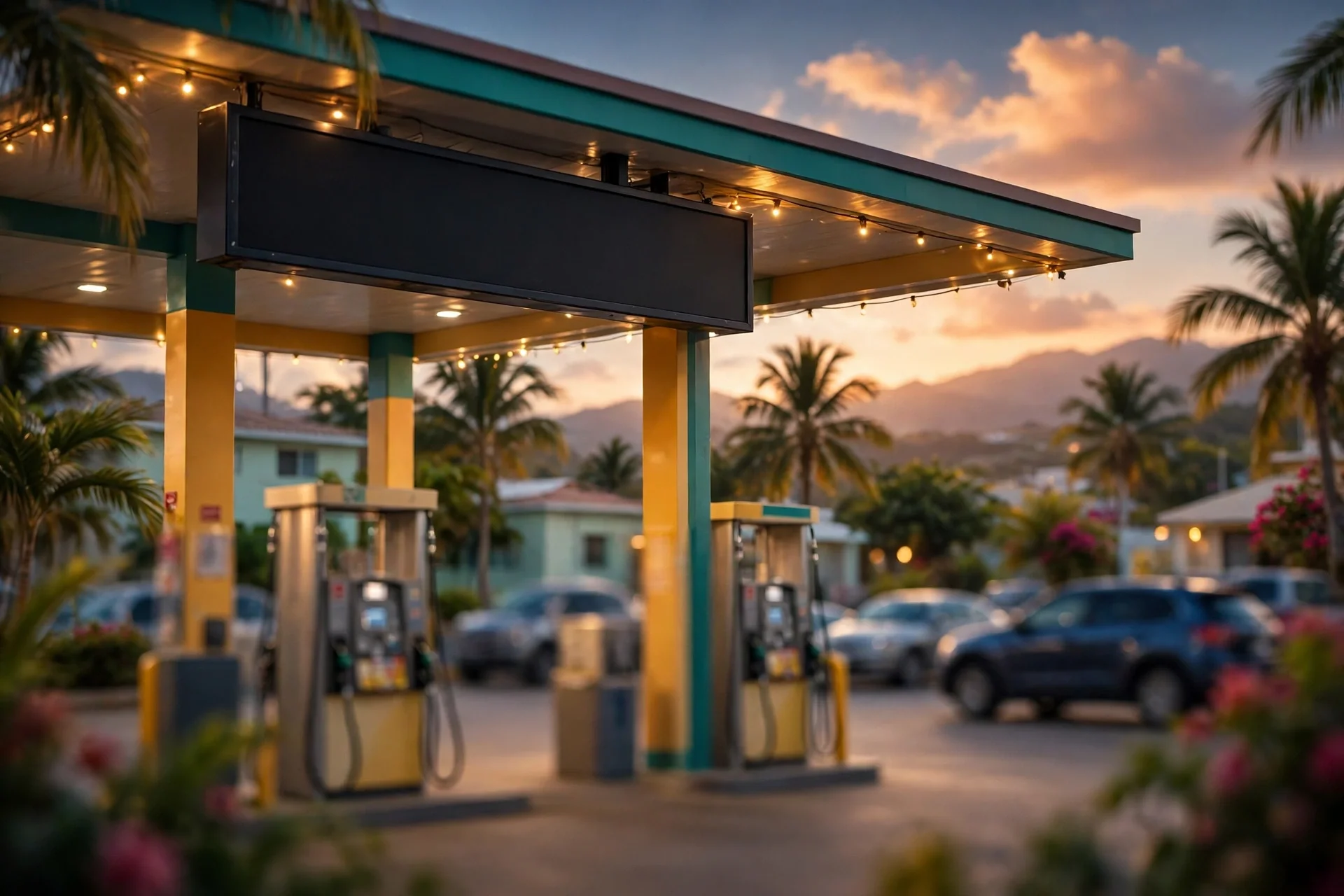
Estación de servicio al atardecer en República Dominicana, en una semana de precios congelados con subsidio estatal. · Imagen generada para EPM
Dominican Republic freezes fuel prices with RD$1,516.5 million subsidy
The Dominican Government allocated RD$1,516.5 million in subsidies to keep essential fuels frozen from 31 October to 6 November 2026.
Fuel prices frozen another week with RD$1,516.5 million subsidy
The Dominican Government keeps fuels frozen from 31 October to 6 November 2026 with RD$1,516.5 million in subsidies.
--- The context ---
The Dominican Republic is using public funds to hold down pump prices. The Ministry of Industry, Commerce and SMEs (MICM) reported that the Government allocated RD$1,516.5 million in subsidies to keep essential fuels frozen from 31 October to 6 November 2026, despite increases in international crude and refined product prices.
--- The facts ---
The clearest case is liquefied petroleum gas. High LPG demand, associated with the arrival of the winter season, has driven up its price. Its real price should be RD$196.46 per gallon, but the Government is subsidizing RD$61.25 per gallon, equivalent to 45.31% of its current price, to keep it at RD$135.20 and avoid passing increases on to households, businesses, industries and urban transport.
The official table leaves Premium Gasoline at RD$358.10 per gallon, Regular Gasoline at RD$317.50, Regular Diesel at RD$270.80, Optimal Diesel at RD$318.10 and LPG at RD$135.20. The average weekly exchange rate is RD$60.82, according to the Central Bank. In October, the average weekly subsidy stood at RD106.54 for Regular Diesel and RD108.07 for Optimal Diesel, and these measures have already cost RD$43,324 million so far in 2026.
--- The positions ---
The Government's position, expressed in the MICM provision, is that the subsidy prevents international increases from being passed on to households, businesses, industries and urban transport. The measure protects those who use LPG for cooking. The counterpart is the cost: RD$43,324 million so far in 2026 is a fiscal burden also paid by citizens.
--- What remains unknown ---
The provision covers only that week and does not announce what will happen afterwards. Nor does it detail how its continuation will be financed if international prices keep rising, or what margin remains when optimal diesel averages US$201.60 per barrel, amid low diesel production related to the Russia-Ukraine conflict.
--- Unanswered questions ---
How many more weeks can a weekly subsidy of RD$1,516.5 million be sustained without adjusting prices to the public? What will happen to LPG if its real price remains above RD$196.46 per gallon as the winter season advances? Will the Government present a gradual exit route from the freeze, or will it renew the measure week after week?
--- EPM analysis ---
The freeze buys immediate stability in exchange for a growing bill. While the real price of LPG is RD$196.46 and the public pays RD$135.20, the State absorbs RD$61.25 per gallon, and that absorption already totals RD$43,324 million so far in 2026. Its sustainability depends on variables the country does not control: winter demand, diesel production and international prices.
📌 EPM Take: In EPM's view, the RD$1,516.5 million subsidy fulfils its immediate function of protecting households, businesses, industries and urban transport from increases they did not cause, and that protection has concrete social value in everyday LPG use. But an anti-crisis measure that already costs RD$43,324 million so far in 2026 requires full transparency about its financing and a public explanation of how long it can be maintained, because freezing the price does not eliminate the cost: it transfers it to everyone's budget.
--- The context ---
Price stability is once again the declared priority in the Dominican Republic. The Ministry of Industry, Commerce and SMEs (MICM) reported that the Government allocated RD$1,516.5 million in subsidies to keep essential fuels frozen from 31 October to 6 November 2026, despite increases in international crude and refined prices. For businesses and transport, a week without increases gives predictability.
--- The facts ---
LPG faces the greatest pressure. High LPG demand, associated with the arrival of the winter season, has driven up its price: its real price should be RD$196.46 per gallon. The Government is subsidizing RD$61.25 per gallon, equivalent to 45.31% of its current price, to keep it at RD$135.20. Low diesel production related to the Russia-Ukraine conflict persists, raising optimal diesel in international markets to an average of US$201.60 per barrel.
The week's prices are: Premium Gasoline at RD$358.10 per gallon, Regular Gasoline at RD$317.50, Regular Diesel at RD$270.80, Optimal Diesel at RD$318.10 and LPG at RD$135.20, all unchanged. The average weekly exchange rate is RD$60.82, according to the Central Bank. In October, the weekly subsidy averaged RD106.54 for Regular Diesel and RD108.07 for Optimal Diesel, with peaks above RD$120 per gallon, and the accumulated cost reaches RD$43,324 million so far in 2026.
--- The positions ---
The MICM's official position is to sustain prices so international increases are not passed on to households, businesses, industries and urban transport. Avoiding a sudden increase protects the planning of businesses and carriers. The demand accompanying that defence is discipline: spending of RD$43,324 million so far in 2026 requires clear accounts and known limits.
--- What remains unknown ---
The provision applies only to that week and does not specify the decision afterwards. It does not report what price level would force a review of the freeze, or how the effort will be shared if low diesel production and winter demand persist.
--- Unanswered questions ---
To what extent can the budget absorb weekly subsidies of RD$1,516.5 million without compromising other obligations? Is there a threshold of international prices beyond which the freeze would cease to be renewed? How will it be guaranteed that the benefit reaches the final consumer in every gallon of LPG sold at RD$135.20?
--- EPM analysis ---
The freeze is a stability decision with a measurable fiscal cost. The gap between the real price of LPG, RD$196.46, and its price to the public, RD$135.20, is covered by the State with RD$61.25 per gallon. Repeating it week after week turns an anti-crisis measure into permanent spending, and permanent spending demands permanent financing.
📌 EPM Take: In EPM's view, keeping fuels frozen with RD$1,516.5 million in subsidies gives households, businesses, industries and urban transport a week of certainty that the economy welcomes, especially for small businesses and carriers planning each week in advance, and avoids an inflationary blow of external origin. But stability bought with RD$43,324 million so far in 2026 is only good policy if accompanied by fiscal discipline, clear exit rules and accountability, so that today's relief does not become tomorrow's burden.
República Dominicana congela combustibles con subsidio de RD$1,516.5 millones
El Gobierno dominicano destinó RD$1,516.5 millones en subsidios para mantener congelados los combustibles esenciales del 31 de octubre al 6 de noviembre de…
Combustibles congelados una semana más con subsidio de RD$1,516.5 millones
El Gobierno dominicano mantiene congelados los combustibles del 31 de octubre al 6 de noviembre de 2026 con RD$1,516.5 millones en subsidios.
--- El contexto ---
La República Dominicana sostiene con fondos públicos el precio del combustible. El Ministerio de Industria, Comercio y Mipymes (MICM) informó que el Gobierno destinó RD$1,516.5 millones en subsidios para mantener congelados los combustibles esenciales del 31 de octubre al 6 de noviembre de 2026, pese a las alzas internacionales del crudo y sus refinados.
--- Los hechos ---
El caso más visible es el gas licuado de petróleo. La alta demanda de GLP, asociada a la temporada de invierno, ha disparado su precio. Su precio real debería ser de RD$196.46 por galón, pero el Gobierno subsidia RD$61.25 por galón, un 45.31% de su precio actual, para mantenerlo en RD$135.20 y no trasladar las alzas a los hogares.
La tabla oficial mantiene la Gasolina Premium en RD$358.10 por galón, la Gasolina Regular en RD$317.50, el Gasoil Regular en RD$270.80, el Gasoil Óptimo en RD$318.10 y el GLP en RD$135.20. La tasa de cambio promedio semanal es de RD$60.82, según el Banco Central. En octubre, el subsidio semanal promedió RD106.54 para el Gasoil Regular y RD108.07 para el Gasoil Óptimo, y las medidas han costado RD$43,324 millones en lo que va del año 2026.
--- Las posiciones ---
La posición del Gobierno, expresada por el MICM, es que el subsidio evita trasladar las alzas a hogares, comercios, industrias y transporte urbano. La medida protege a quienes usan GLP para cocinar. La contrapartida es el costo: RD$43,324 millones en lo que va del año 2026 son una carga fiscal compartida.
--- Lo que falta saber ---
La disposición cubre solo la semana indicada y no anuncia qué ocurrirá después. Tampoco detalla cómo se financiará su continuidad si los precios siguen al alza, ni qué margen queda cuando el gasoil óptimo promedia US$201.60 por barril, con baja producción de gasoil relacionada con el conflicto Rusia-Ucrania.
--- Preguntas sin respuesta ---
¿Cuántas semanas más podrá sostenerse un subsidio de RD$1,516.5 millones sin ajustar precios? ¿Qué ocurrirá con el GLP si su precio real sigue por encima de RD$196.46 por galón en invierno? ¿Presentará el Gobierno una ruta de salida gradual o renovará la medida semana tras semana?
--- Análisis EPM ---
El congelamiento compra estabilidad inmediata a cambio de una factura creciente. Mientras el precio real del GLP sea RD$196.46 y el público pague RD$135.20, el Estado absorbe RD$61.25 por galón, y esa absorción ya suma RD$43,324 millones en 2026. Su sostenibilidad depende de variables que el país no controla: demanda de invierno, producción de gasoil y precios internacionales.
📌 Conclusion EPM: A juicio de EPM, el subsidio de RD$1,516.5 millones cumple su función inmediata de proteger a hogares, comercios, industrias y transporte urbano frente a alzas que no provocaron, y esa protección tiene un valor social concreto en el GLP de uso diario. Pero una medida anticrisis que ya cuesta RD$43,324 millones en lo que va del año 2026 exige transparencia plena sobre su financiamiento y una explicación pública de hasta cuándo podrá mantenerse, porque congelar el precio no elimina el costo: lo traslada al presupuesto de todos.
--- El contexto ---
La estabilidad de precios vuelve a ser la prioridad en la República Dominicana. El Ministerio de Industria, Comercio y Mipymes (MICM) informó que el Gobierno destinó RD$1,516.5 millones en subsidios para mantener congelados los combustibles esenciales del 31 de octubre al 6 de noviembre de 2026, pese a las alzas internacionales del crudo y sus refinados.
--- Los hechos ---
El GLP concentra la mayor presión. La alta demanda de GLP, asociada a la temporada de invierno, ha disparado su precio: su precio real debería ser de RD$196.46 por galón. El Gobierno subsidia RD$61.25 por galón, un 45.31% de su precio actual, para mantenerlo en RD$135.20. Persiste además una baja producción de gasoil relacionada con el conflicto Rusia-Ucrania, que eleva el gasoil óptimo internacional hasta promediar US$201.60 por barril.
Los precios quedan así: Gasolina Premium en RD$358.10 por galón, Gasolina Regular en RD$317.50, Gasoil Regular en RD$270.80, Gasoil Óptimo en RD$318.10 y GLP en RD$135.20, todos sin cambios. La tasa de cambio promedio semanal es de RD$60.82, según el Banco Central. En octubre, el subsidio promedió RD106.54 para el Gasoil Regular y RD108.07 para el Gasoil Óptimo, y el costo acumulado llega a RD$43,324 millones en lo que va del año 2026.
--- Las posiciones ---
La posición oficial del MICM es sostener los precios para no trasladar las alzas a hogares, comercios, industrias y transporte urbano. Evitar un aumento brusco protege la planificación empresarial. La exigencia es de disciplina: un gasto de RD$43,324 millones en lo que va del año 2026 requiere cuentas claras.
--- Lo que falta saber ---
La disposición rige solo para esa semana y no precisa la decisión posterior. No se informa qué nivel de precios obligaría a revisar el congelamiento, ni cómo se repartirá el esfuerzo si persisten la baja producción de gasoil y la demanda de invierno.
--- Preguntas sin respuesta ---
¿Hasta qué punto puede el presupuesto absorber subsidios semanales de RD$1,516.5 millones sin comprometer otras obligaciones? ¿Existe un umbral de precios internacionales a partir del cual el congelamiento dejaría de renovarse? ¿Cómo se garantizará que el beneficio llegue al consumidor final en cada galón de GLP vendido a RD$135.20?
--- Análisis EPM ---
El congelamiento es una decisión de estabilidad con costo fiscal medible. La brecha entre el precio real del GLP, RD$196.46, y su precio al público, RD$135.20, la cubre el Estado con RD$61.25 por galón. Repetirla semana tras semana convierte una medida anticrisis en gasto permanente, y el gasto permanente exige financiamiento permanente.
📌 Conclusion EPM: A juicio de EPM, mantener los combustibles congelados con RD$1,516.5 millones en subsidios da a hogares, comercios, industrias y transporte urbano una semana de certidumbre que la economía agradece, y evita un golpe inflacionario de origen externo. Pero la estabilidad comprada con RD$43,324 millones en lo que va del año 2026 solo es buena política si viene acompañada de disciplina fiscal, reglas claras de salida y rendición de cuentas, para que el alivio de hoy no se convierta en la carga de mañana.