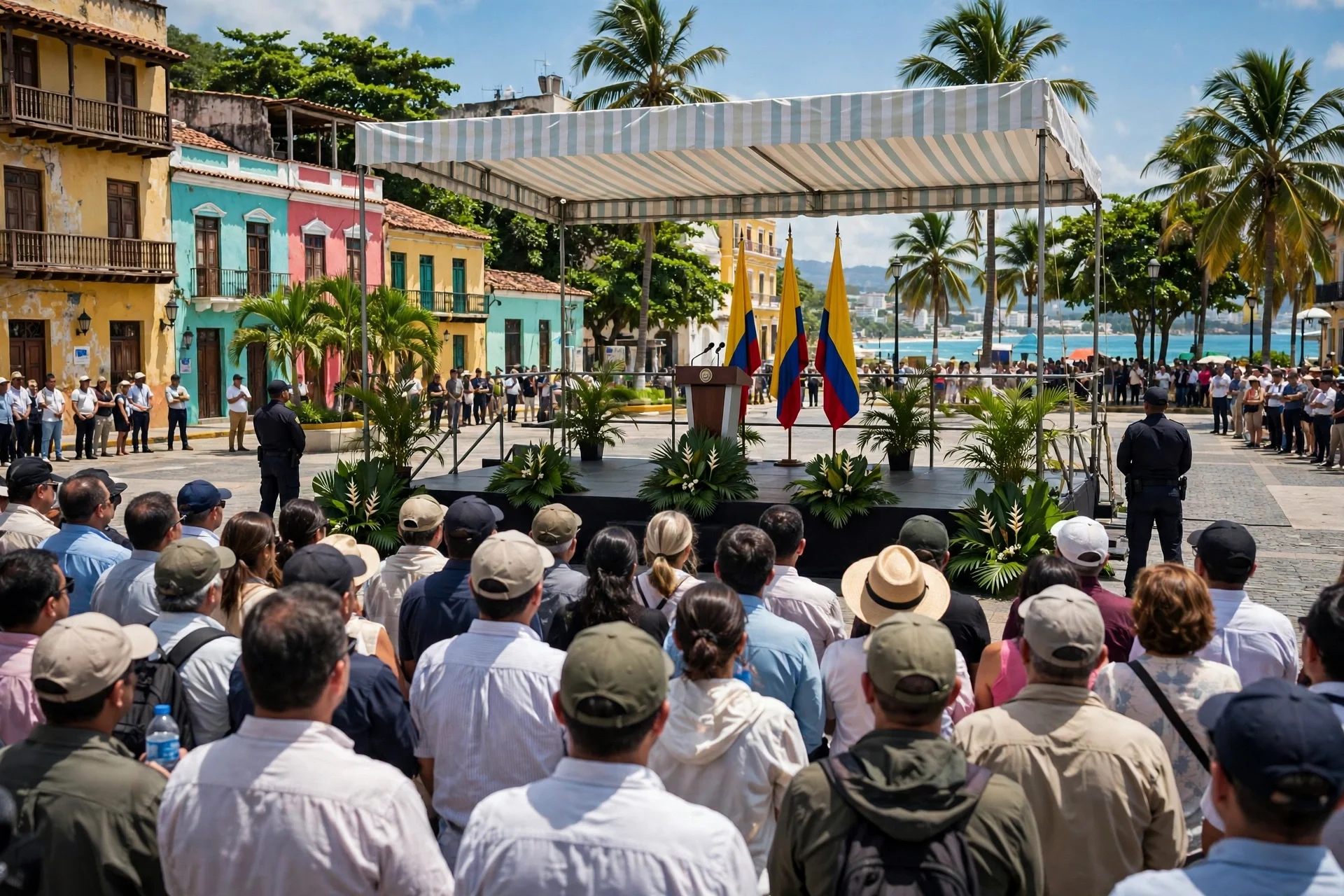
Imagen alusiva a un acto público presidencial en una plaza caribeña colombiana, con tarima y público reunido. · Imagen generada por EPM
De La Espriella denounces a water tanker mafia in Santa Marta
President Abelardo De La Espriella reported in Santa Marta an alleged case of corruption related to water tanker trucks and said the case is already with the…
President reports tanker scheme to prosecutors in Santa Marta
In Santa Marta, President Abelardo De La Espriella said his government detected an alleged business behind the water tanker trucks and that the complaint is in…
--- The context ---
Santa Marta faces a drinking water crisis. At the close of a busy work agenda in the Colombian Caribbean, President Abelardo De La Espriella visited the city and spoke about the measures to address the water crisis in Magdalena, making the issue the center of his public address.
--- The facts ---
While delivering his speech, the head of state said his government had detected an alleged case of corruption related to water tanker trucks in Santa Marta, and stated that there would be a mafia interested in preventing definitive solutions for the region's water from being found.
The president explained that the plants are not moving forward for two reasons. The financial one: a liter of water from the plant costs a thousand times more, which makes it financially unviable. The environmental one: an impact that is impossible to resolve, or very costly to resolve, in a city with so many natural wonders. He stressed that it was not a whim, but a search for a lasting solution.
He also acknowledged that he took longer than announced: 20 days ago he said he had the solution in 10 days, he admitted it took 10 more because they began reviewing absolutely everything, and today there is a clearer picture.
--- The positions ---
The president argued that a temporary solution, such as water tanker trucks, cannot become the constant, and stated that behind it there is a business that his government has already reported. He indicated that the case is in the hands of the attorney general of the Nation and in the power of the Prosecutor's Office, with names, information, evidence, videos and all the material.
He stressed that in his government there is no fear of pointing out what must be pointed out, and that there are people who do not want Santa Marta to have water because they live off that business. He attributed part of the problem to the neglect of Bogota centralism, which abandoned this district and Magdalena to their fate many years ago, and argued that great transformations are made from the central government.
--- What remains unknown ---
The text does not detail who the people named would be or what concrete evidence already rests with the Prosecutor's Office. Nor does it specify the immediate measures to guarantee water while the complaint advances, or the timeline for the lasting solution that was announced.
--- Unanswered questions ---
Who makes up the alleged water tanker mafia identified by the president? What evidence and videos did the government hand over to the Prosecutor's Office? When will there be decisions on the complaint that was filed? What will happen to Santa Marta's water supply while the lasting solution is defined?
--- EPM analysis ---
The speech combined the financial and environmental explanation for ruling out the plants with a complaint that, according to the president, is already with the Prosecutor's Office. In closing, he recalled that for the first time in 140 years another son of the Caribbean sits in the seat of Bolivar and assured that Santa Marta's water problem will be solved.
📌 EPM Take: In EPM's view, the complaint places Santa Marta's water where it belongs: on the ground of verifiable facts and responsibilities before the Prosecutor's Office. If the government maintains that it has names, information, evidence and videos, the next step is for that evidence to produce decisions and for the city to see a clear route to leave behind the temporary water tanker solution. The credibility of the promise will be measured in available water.
--- The context ---
President Abelardo De La Espriella led a busy work agenda in the Colombian Caribbean and closed it in Santa Marta, where he spoke about the measures to address the drinking water crisis in Magdalena. His address focused on order and on the responsibilities behind the problem.
--- The facts ---
During his speech, the head of state said his government had detected an alleged case of corruption related to water tanker trucks in Santa Marta. He stated that there would be a mafia interested in preventing definitive solutions for the region's water from being found, and said his government had already filed the corresponding complaint.
On the plants, he explained that they are not going ahead for two reasons. The first is cost: a liter of water from the plant costs a thousand times more, which makes it financially unviable. The second is the environmental impact, impossible to resolve or very costly to resolve in a city with so many natural wonders. He clarified that it was not a whim, but a search for a lasting solution.
The president also admitted a delay compared with what was announced. He recalled that 20 days ago he said he had the solution in 10 days, acknowledged that it took him 10 more, and attributed it to having begun to review absolutely everything, with a clearer picture today.
--- The positions ---
De La Espriella stressed that a temporary solution, such as water tanker trucks, cannot become the constant, and argued that there are people who do not want Santa Marta to have water because they live off the water tanker business. He stated that nobody had dared to report it, that his government did so, and that the case is in the hands of the attorney general of the Nation, with the decision to go to the bottom of it, whoever may fall.
He also pointed to the neglect of Bogota centralism and argued that the capital abandoned this district and the department of Magdalena to their fate many years ago. He argued that a son of the Caribbean, who feels the region's pain, had to come to do what must be done from the central government.
--- What remains unknown ---
The names of those accused and the detail of the evidence the government says it has are not known. Nor was it specified what immediate measures will guarantee supply while the Prosecutor's Office acts, or within what timeframe the lasting solution for the city will arrive.
--- Unanswered questions ---
Who are those accused in the alleged water tanker business? What do the videos and the evidence the government says it has contain? What decisions will the Prosecutor's Office take with the complaint received? How will Santa Marta's water be guaranteed in the meantime?
--- EPM analysis ---
The address combined self-criticism for the delay, technical reasons against the plants and a criminal complaint already delivered, according to the president, to the Prosecutor's Office. In the end, he recalled that for the first time in 140 years another son of the Caribbean sits in the seat of Bolivar and assured that the water problem will be solved.
📌 EPM Take: In EPM's view, the value of the complaint is that it orders the debate with facts and with a clear instance: the Prosecutor's Office, which according to the government already holds names, information and evidence. The commitment assumed in public now obliges verifiable results, both in the investigation and in the city's daily supply. A lasting solution, with explicit costs and timelines, is the answer Santa Marta can demand as of right.
De La Espriella denuncia en Santa Marta una mafia de carrotanques
El presidente Abelardo De La Espriella denunció en Santa Marta un presunto caso de corrupción relacionado con carrotanques y afirmó que el caso ya está en la…
Presidente denuncia negocio de carrotanques y lo lleva a la Fiscalía
En Santa Marta, el presidente Abelardo De La Espriella afirmó que su Gobierno detectó un presunto negocio detrás de los carrotanques y que la denuncia está en…
--- El contexto ---
Santa Marta enfrenta una crisis de agua potable. Al cierre de una agitada agenda de trabajo en el Caribe colombiano, el presidente Abelardo De La Espriella estuvo en la ciudad y habló sobre las medidas para atender la crisis del agua en el Magdalena.
--- Los hechos ---
Mientras pronunciaba su discurso, el jefe de Estado mencionó que su Gobierno detectó un presunto caso de corrupción relacionado con carrotanques en Santa Marta, y señaló que habría una mafia interesada en impedir que se encuentren soluciones definitivas para el agua de la región.
El mandatario explicó que las plantas no avanzan por dos razones. La financiera: un litro de agua con la planta vale mil veces más y eso lo hace inviable financieramente. La ambiental: un impacto imposible de resolver, o muy costoso de resolver, en una ciudad con tantas maravillas naturales. Precisó que no fue un capricho, sino la búsqueda de una solución de fondo.
También reconoció que se demoró más de lo anunciado: hace 20 días dijo que tenía la solución en 10 días, admitió que tardó 10 más porque empezaron a revisar absolutamente todo, y hoy hay un panorama más claro.
--- Las posiciones ---
El presidente sostuvo que no puede ser que una solución temporal, como son los carrotanques, se haya vuelto la constante, y afirmó que detrás de eso hay un negocio que su Gobierno ya denunció. Indicó que el caso está en manos de la fiscal general de la Nación y en poder de la Fiscalía, con nombres, información, pruebas, videos y todo el material.
Recalcó que en su Gobierno no hay miedo para señalar lo que haya que señalar y que hay gente que no quiere que Santa Marta tenga agua porque vive de ese negocio. Atribuyó parte del problema al olvido del centralismo bogotano, que abandonó a su suerte a este distrito y al Magdalena hace muchos años, y planteó que las grandes transformaciones se hacen desde el gobierno central.
--- Lo que falta saber ---
El texto no detalla quiénes serían las personas señaladas ni qué pruebas concretas reposan ya en la Fiscalía. Tampoco precisa las medidas inmediatas para garantizar el agua mientras avanza la denuncia ni el plazo de la solución de fondo anunciada.
--- Preguntas sin respuesta ---
¿Quiénes integran la presunta mafia de los carrotanques señalada por el presidente? ¿Qué pruebas y videos entregó el Gobierno a la Fiscalía? ¿Cuándo habrá decisiones sobre la denuncia presentada? ¿Qué pasará con el suministro de agua mientras se define la solución de fondo?
--- Análisis EPM ---
El discurso unió la explicación financiera y ambiental para descartar las plantas con una denuncia que, según el presidente, ya está en la Fiscalía. Al cierre, recordó que por primera vez en 140 años hay otro hijo del Caribe sentado en el solio de Bolívar y aseguró que el problema del agua de Santa Marta se va a resolver.
📌 Conclusion EPM: A juicio de EPM, la denuncia coloca el agua de Santa Marta en el terreno de los hechos verificables y de las responsabilidades ante la Fiscalía. Si el Gobierno sostiene que tiene nombres, información, pruebas y videos, el paso siguiente es que esas evidencias produzcan decisiones y que la ciudad vea una ruta clara para dejar atrás la solución temporal de los carrotanques. La credibilidad de la promesa se medirá en agua disponible.
--- El contexto ---
El presidente Abelardo De La Espriella lideró una agitada agenda de trabajo en el Caribe colombiano y la cerró en Santa Marta, donde habló sobre las medidas para atender la crisis de agua potable en el Magdalena. Su intervención puso el foco en el orden y en las responsabilidades detrás del problema.
--- Los hechos ---
Durante su discurso, el jefe de Estado mencionó que su Gobierno detectó un presunto caso de corrupción relacionado con carrotanques en Santa Marta. Señaló que habría una mafia interesada en impedir que se encuentren soluciones definitivas para el agua de la región, y afirmó que su Gobierno ya hizo la denuncia correspondiente.
Sobre las plantas, explicó que no van por dos razones. La primera es el costo: un litro de agua con la planta vale mil veces más y eso lo hace inviable financieramente. La segunda es el impacto ambiental, imposible de resolver o muy costoso de resolver en una ciudad con tantas maravillas naturales. Aclaró que no fue un capricho, sino la búsqueda de una solución de fondo.
El mandatario también admitió una demora frente a lo anunciado. Recordó que hace 20 días dijo que tenía la solución en 10 días, reconoció que se demoró 10 más y lo atribuyó a que empezaron a revisar absolutamente todo, con un panorama hoy más claro.
--- Las posiciones ---
De La Espriella recalcó que una solución temporal, como son los carrotanques, no puede volverse la constante, y sostuvo que hay gente que no quiere que Santa Marta tenga agua porque vive del negocio de los carrotanques. Afirmó que nadie se había atrevido a denunciarlo, que su Gobierno lo hizo y que el caso está en manos de la fiscal general de la Nación, con la decisión de llegar hasta el fondo, caiga quien caiga.
También señaló el olvido del centralismo bogotano y sostuvo que la capital abandonó a su suerte a este distrito y al departamento del Magdalena hace muchos años. Planteó que tenía que venir un hijo del Caribe, al que le duela la región, para hacer lo que hay que hacer desde el gobierno central.
--- Lo que falta saber ---
No se conocen los nombres de los señalados ni el detalle de las pruebas que el Gobierno dice tener. Tampoco se precisó qué medidas inmediatas garantizarán el suministro mientras la Fiscalía actúa, ni en qué plazo llegará la solución de fondo para la ciudad.
--- Preguntas sin respuesta ---
¿Quiénes son los señalados por el presunto negocio de los carrotanques? ¿Qué contienen los videos y las pruebas que el Gobierno dice tener? ¿Qué decisiones tomará la Fiscalía con la denuncia recibida? ¿Cómo se garantizará el agua de Santa Marta mientras tanto?
--- Análisis EPM ---
La intervención combinó autocrítica por la demora, razones técnicas contra las plantas y una denuncia penal ya entregada, según el presidente, a la Fiscalía. Al final, recordó que por primera vez en 140 años hay otro hijo del Caribe sentado en el solio de Bolívar y aseguró que el problema del agua se va a resolver.
📌 Conclusion EPM: A juicio de EPM, el valor de la denuncia está en que ordena el debate con hechos y con una instancia clara: la Fiscalía, que ya tendría nombres, información y pruebas según el Gobierno. El compromiso asumido en público obliga ahora a resultados comprobables, tanto en la investigación como en el suministro diario de la ciudad. Una solución de fondo, con costos y plazos explícitos, es la respuesta que Santa Marta puede exigir con pleno derecho.