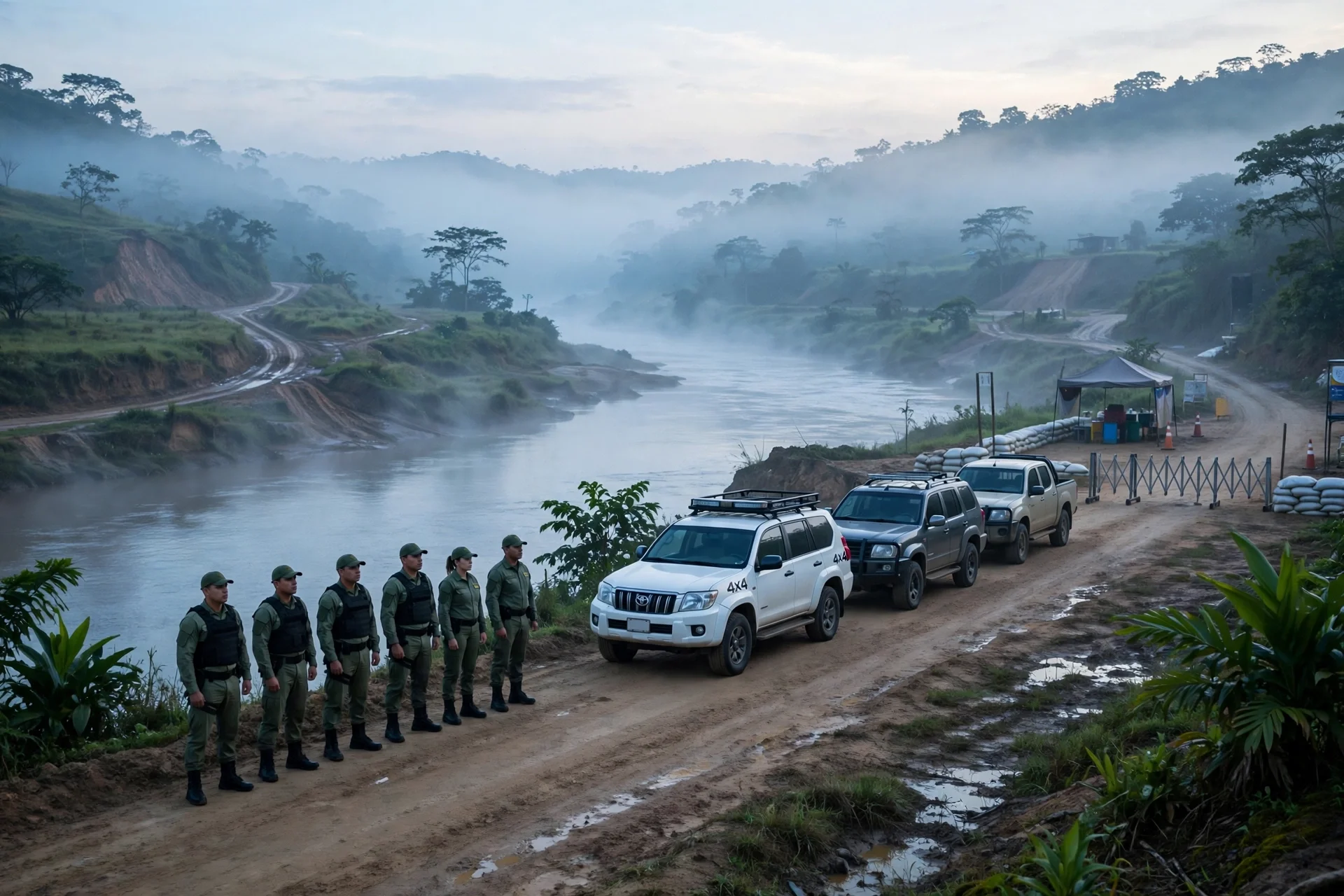
Imagen alusiva: un control fronterizo junto al río al amanecer, con agentes y vehículos oficiales en una trocha.
Colombia teams up with FBI and Europol to guard Venezuela border
The government of Abelardo De La Espriella announced an alliance with the FBI and Europol, supported by Ameripol, the DEA and Interpol, to strengthen security…
FBI and Europol alliance strengthens control at the border
The government of Abelardo De La Espriella announced an alliance with the FBI and Europol to strengthen security on the border with Venezuela, supported by…
--- The context ---
The border between Colombia and Venezuela concentrates irregular crossings, the trochas, in Norte de Santander, La Guajira and Arauca, through which drug trafficking, smuggling, human trafficking and kidnappings circulate. That territory also carries the flow of thousands of Venezuelan migrants.
--- The facts ---
The government of Abelardo De La Espriella announced an alliance with the FBI and Europol to strengthen security along that border. The strategy will add Ameripol and the United States Drug Enforcement Administration in intelligence work to locate transnational networks, pursue money laundering and drug financing, and enforce Interpol red and blue notices against people linked to those structures.
Norte de Santander was prioritized because of public order problems associated with the National Liberation Army, dissidents of the Revolutionary Armed Forces of Colombia and other criminal gangs. The deployment was delayed by the earthquake emergency in the Eje Cafetero, and rural Cúcuta and the municipalities of the Catatumbo subregion will be the focus of the Esparta Military Campaign reactivation.
--- The positions ---
A retired Army colonel explained that the plan seeks to recover the capacity to intercept and verify radio communications used by illegal organizations, a capacity limited by lack of tools and personnel. A border analyst argued that Venezuela must take part in the security councils held on the Colombian side, because the operations in Cúcuta and its metropolitan area could lead criminal structures to reorganize on Venezuelan territory.
--- What remains unknown ---
It is not specified how tasks will be divided between the foreign agencies and the Colombian authorities, or when the deployment delayed by the emergency will begin. It also does not detail whether the Venezuelan authorities will agree to take part in the proposed security councils.
--- Unanswered questions ---
How will tasks be divided between the allied agencies and the Colombian authorities along the border? When will the deployment in Norte de Santander begin after the delay caused by the emergency? Will Venezuela agree to take part in the security councils held on the Colombian side?
--- EPM analysis ---
The alliance combines international intelligence with protection tasks: serving the flow of migrants, preventing the forced recruitment of minors and speeding up judicial proceedings against captured people. The Government plans to complement the military and police offensive with road works, educational improvements and stronger binational trade, backed by the United States government.
📌 EPM Take: In EPM's view, the alliance is right to combine the pursuit of transnational networks with protection for the people who inhabit the border, because controlling the trochas is not exhausted by armed surveillance alone. Its success will be measured by verifiable results: less smuggling, less trafficking, faster judicial proceedings against those captured and communities with better roads, education and trade. To achieve that, coordination with Venezuela and continuity of the recovered intelligence will be decisive.
--- The context ---
The authorities will concentrate surveillance on the irregular crossings between Colombia and Venezuela, through which trafficked vehicles, smuggled goods and trafficking victims circulate, alongside kidnappings and other transnational crimes. The immediate and temporary militarization of Cúcuta forms part of that response.
--- The facts ---
The government of Abelardo De La Espriella announced an alliance with the FBI and Europol to strengthen security on the border with Venezuela, with controls over the trochas of Norte de Santander, La Guajira and Arauca. The cooperation will add Ameripol and the United States Drug Enforcement Administration in intelligence work, and includes support to detect Iranian-made drones that, according to the authorities, entered through Venezuela and are used in acts of terrorism inside Colombia.
The urban intervention will rest on the Urban Security Operational Block, known as Bosul, a structure to coordinate the Military Forces, the National Police, Migración Colombia, the Colombian Family Welfare Institute, the National Penitentiary and Prison Institute, the Attorney General Office and the Technical Investigation Corps. The authorities attribute the increase in violent actions to the decrease in military intelligence and to budget cuts inherited from the previous administration.
--- The positions ---
A retired Army colonel explained that the plan seeks to recover the interception and verification of radio communications used by illegal organizations, and recalled that the Army had technology to geolocate those transmissions. A border analyst argued that the operations on the Colombian side would be of no use if they are not complemented on the Venezuelan side by its authorities.
--- What remains unknown ---
The timetable of the deployment, delayed by the earthquake emergency in the Eje Cafetero, and the scope of the foreign support to detect drones are not detailed. It also does not specify how illegal groups will be prevented from moving into Táchira state.
--- Unanswered questions ---
When will the initial deployment delayed by the earthquake emergency in the Eje Cafetero be carried out? How will the operations prevent illegal groups from moving into Táchira state? What scope will the foreign support have to detect the drones identified by the authorities?
--- EPM analysis ---
The design orders the State response: recovered intelligence, coordination through Bosul and international cooperation against money laundering and drug financing. Added to that is the plan for road works, educational improvements and stronger binational trade, backed by the United States government.
📌 EPM Take: In EPM's view, the alliance returns to the State tools it had lost, because without sufficient intelligence the armed groups gained room to act along the border. Recovering interception, coordinating institutions within Bosul and adding cooperation from the FBI, Europol, Ameripol and the DEA aims to close that room with authority. The test will lie in sustained execution: effective controls, captures with faster proceedings and a border where order also protects binational trade.
Colombia suma al FBI y Europol para cuidar su frontera con Venezuela
El gobierno de Abelardo De La Espriella anunció una alianza con el FBI y Europol, con apoyo de Ameripol, la DEA e Interpol, para reforzar la seguridad en la…
Alianza con FBI y Europol refuerza el control en la frontera
El gobierno de Abelardo De La Espriella anunció una alianza con el FBI y Europol para reforzar la seguridad en la frontera con Venezuela, con apoyo de…
--- El contexto ---
La frontera colombo-venezolana concentra las trochas de Norte de Santander, La Guajira y Arauca, por donde circulan el narcotráfico, el contrabando, la trata de personas y los secuestros. Por ese territorio se mueve el flujo de miles de migrantes venezolanos.
--- Los hechos ---
El gobierno de Abelardo De La Espriella anunció una alianza con el FBI y Europol para reforzar la seguridad en esa frontera. La estrategia sumará a Ameripol y a la Administración de Control de Drogas de Estados Unidos en inteligencia para localizar redes transnacionales, perseguir el lavado de activos y el financiamiento del narcotráfico, y hacer efectivas las circulares rojas y azules de Interpol contra personas vinculadas a esas estructuras.
Norte de Santander fue priorizado por problemas de orden público asociados al Ejército de Liberación Nacional, las disidencias de las Fuerzas Armadas Revolucionarias de Colombia y otras bandas criminales. El despliegue se retrasó por la emergencia de los terremotos en el Eje Cafetero, y la zona rural de Cúcuta y los municipios del Catatumbo serán foco de reactivación de la Campaña Militar Esparta.
--- Las posiciones ---
Un coronel retirado del Ejército explicó que el plan busca recuperar la interceptación y verificación de las comunicaciones de radio de organizaciones ilegales, capacidad limitada por falta de herramientas y personal. Un analista fronterizo sostuvo que Venezuela debe participar en los consejos de seguridad del lado colombiano, porque los operativos en Cúcuta podrían llevar a las estructuras criminales a reorganizarse en territorio venezolano.
--- Lo que falta saber ---
No se precisa cómo se repartirán las tareas entre las agencias extranjeras y las autoridades colombianas, ni cuándo comenzará el despliegue retrasado por la emergencia. Tampoco detalla si las autoridades venezolanas aceptarán participar en los consejos de seguridad propuestos.
--- Preguntas sin respuesta ---
¿Cómo se repartirán las tareas entre las agencias aliadas y las autoridades colombianas en la frontera? ¿Cuándo comenzará el despliegue en Norte de Santander tras el retraso por la emergencia? ¿Aceptará Venezuela participar en los consejos de seguridad del lado colombiano?
--- Análisis EPM ---
La alianza combina inteligencia internacional con protección: atender el flujo de migrantes, prevenir el reclutamiento forzado de menores y acelerar los procesos judiciales contra las personas capturadas. El Gobierno proyecta complementar la ofensiva militar y policial con obras viales, mejoras educativas y fortalecimiento del comercio binacional, con respaldo de Estados Unidos.
📌 Conclusion EPM: A juicio de EPM, la alianza acierta al combinar la persecución de las redes transnacionales con la protección de las personas que habitan la frontera, porque controlar las trochas no se agota en la vigilancia armada. Su éxito se medirá con resultados verificables: menos contrabando, menos trata, procesos más ágiles contra los capturados y comunidades con mejores vías, educación y comercio. Para lograrlo, la coordinación con Venezuela y la continuidad de la inteligencia recuperada serán decisivas.
--- El contexto ---
Las autoridades concentrarán la vigilancia en los pasos irregulares entre Colombia y Venezuela, por los que circulan vehículos traficados, mercancías de contrabando y víctimas de trata, además de secuestros y otros delitos transnacionales. La militarización inmediata y temporal de Cúcuta forma parte de esa respuesta.
--- Los hechos ---
El gobierno de Abelardo De La Espriella anunció una alianza con FBI y Europol para reforzar la seguridad en la frontera con Venezuela, con controles sobre las trochas de Norte de Santander, La Guajira y Arauca. La cooperación sumará a Ameripol y a la Administración de Control de Drogas de Estados Unidos en inteligencia, e incluye apoyo para detectar drones de fabricación iraní que, según las autoridades, ingresaron por Venezuela y se emplean en actos de terrorismo en Colombia.
La intervención urbana se apoyará en el Bloque Operacional de Seguridad Urbana, conocido como Bosul, estructura para coordinar a Fuerzas Militares, Policía Nacional, Migración Colombia, Instituto Colombiano de Bienestar Familiar, Instituto Nacional Penitenciario y Carcelario, Fiscalía General de la Nación y Cuerpo Técnico de Investigación. Las autoridades atribuyen el aumento de las acciones violentas a la disminución de la inteligencia militar y a recortes presupuestarios heredados de la administración anterior.
--- Las posiciones ---
Un coronel retirado del Ejército explicó que el plan busca recuperar la interceptación y verificación de las comunicaciones de radio de organizaciones ilegales, y recordó la tecnología del Ejército para geolocalizar esas transmisiones. Un analista fronterizo sostuvo que de nada servirían los operativos del lado colombiano si no se complementan del lado venezolano.
--- Lo que falta saber ---
No se detallan los plazos del despliegue, retrasado por la emergencia de los terremotos en el Eje Cafetero, ni el alcance del apoyo extranjero para detectar drones. Tampoco precisa cómo se impedirá que los grupos ilegales se trasladen al estado Táchira.
--- Preguntas sin respuesta ---
¿Cuándo se ejecutará el despliegue retrasado por la emergencia de los terremotos en el Eje Cafetero? ¿Cómo impedirán los operativos que los grupos ilegales se trasladen al estado Táchira? ¿Qué alcance tendrá el apoyo extranjero para detectar los drones señalados?
--- Análisis EPM ---
El diseño ordena la respuesta del Estado: inteligencia recuperada, coordinación mediante el Bosul y cooperación contra el lavado de activos y el financiamiento del narcotráfico. Se suman obras viales, mejoras educativas y comercio binacional fortalecido, con respaldo de Estados Unidos.
📌 Conclusion EPM: A juicio de EPM, la alianza devuelve al Estado herramientas que había perdido, porque sin inteligencia suficiente los grupos armados ganaron margen para actuar en la frontera. Recuperar la interceptación, coordinar instituciones en el Bosul y sumar la cooperación del FBI, Europol, Ameripol y la DEA apunta a cerrar ese margen con autoridad. La prueba estará en la ejecución: controles efectivos, capturas con procesos acelerados y una frontera donde el orden proteja el comercio binacional.