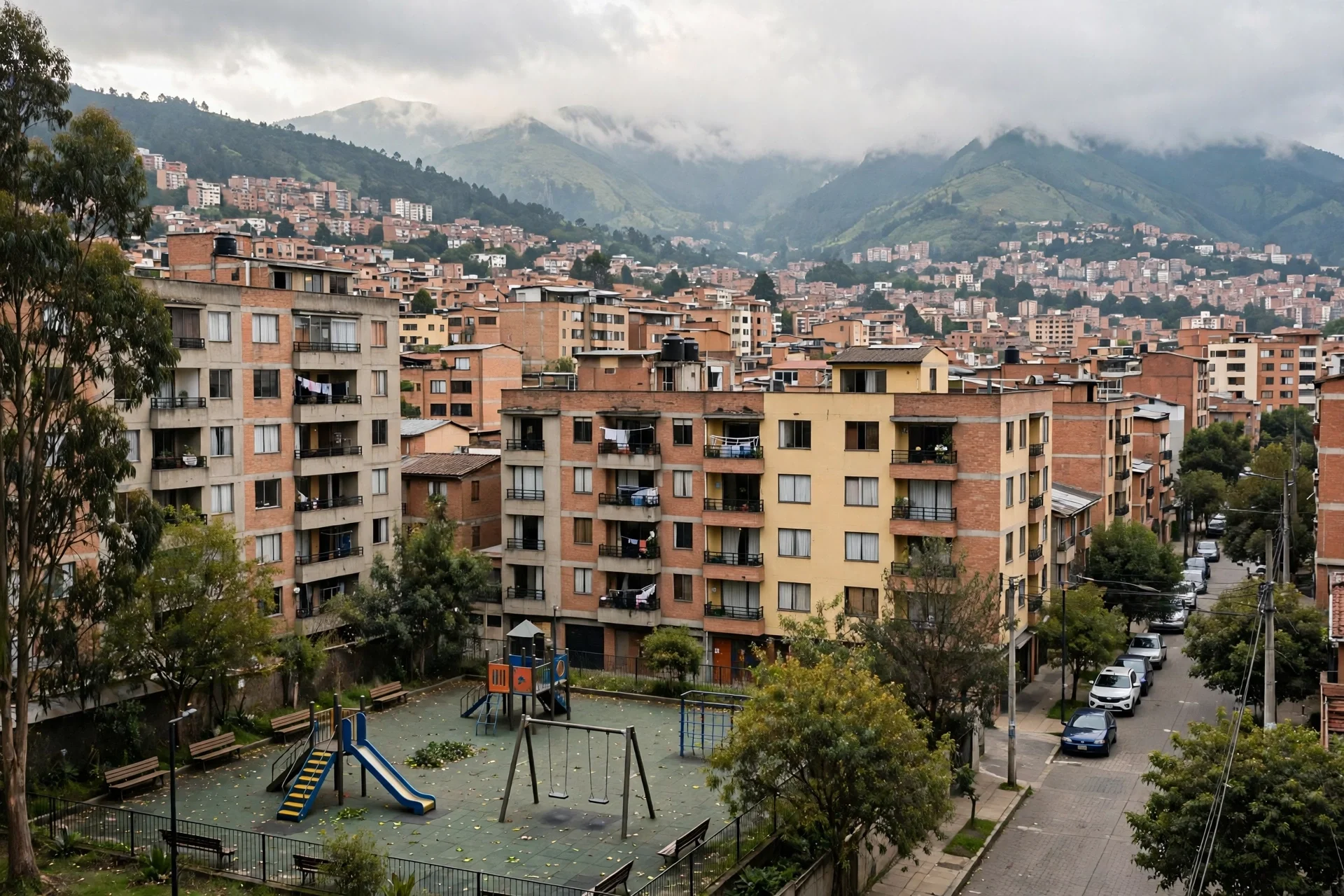
Parque infantil sin niños entre edificios residenciales de Bogotá, en una imagen alusiva a la caída de los nacimientos en la capital. · Imagen generada por EPM
Bogotá births fall sharply over nine years
Births in Bogotá fell from 98,653 in 2016 to 55,793 in 2025, a drop of 43.4% according to the Health Secretariat, with fertility at 0.8 children per woman and…
Fewer births in Bogotá reshape future planning
Bogotá went from 98,653 births in 2016 to 55,793 in 2025, according to official Health Secretariat figures.
--- The context ---
Bogotá is going through a deep and sustained demographic transformation. Official figures from the Bogotá Health Secretariat show that the capital went from recording 98,653 births in 2016 to 55,793 in 2025, a reduction of 43.4% in nine years that changes the composition of its households and its neighbourhoods across the city.
--- The facts ---
The series confirms a continuous decline over time. In 2022 there were 64,765 live births, with a birth rate of 8.2 per 1,000 inhabitants, while in 2024 the figure fell to 56,541 and in 2025 it reached 55,793, with a rate of 7.0 for every 1,000 inhabitants. So far in 2026, with a preliminary cut-off in September, the register stands at 43,911 live births.
The total fertility rate stood at around 0.8 children per woman, well below the generational replacement level. By locality, according to the SaluData platform of the Bogotá Health Observatory, the largest volumes in 2025 were in Suba with 8,091 births, Kennedy with 7,621, Ciudad Bolívar with 5,546, Bosa with 5,426 and Engativá with 5,052. The highest rate was in Los Mártires, at 10.3 per 1,000 inhabitants, and the lowest in Teusaquillo, at 4.6.
--- The positions ---
From the official measurement, the reading in the data is clear: the Health Secretariat provides the register of live births and SaluData makes it possible to observe distribution by locality. That institutional view indicates that the trend is not stopping and that its effects reach the economic structure of the capital and of the country, rather than being an isolated event in a single year.
--- What remains unknown ---
It remains unknown how the final register for 2026 will close once the year is complete and the preliminary September cut-off is confirmed. It also remains to be seen how fertility evolves afterwards and whether differences between localities will persist, widen or narrow in the next official registers that are published for the capital.
--- Unanswered questions ---
How will Bogotá close the full birth register when the preliminary figure for this year becomes final? Will fertility stay around its current level or show a change in the coming years? Which localities will keep concentrating the largest volume of births and which will keep recording the lowest rates in the city?
--- EPM analysis ---
The impact described reaches several dimensions at the same time. In the medium and long term there will be less population replacement, a smaller labour force and accelerated ageing, with pressure on the pension system. In health, demand shifts from paediatric care towards chronic diseases linked to old age and makes public health more expensive, while education, clothing, entertainment and family consumer goods must reconfigure their commercial supply.
📌 EPM Take: In EPM's view, the scale of the decline should be read as a deep change in the life of Bogotá rather than a passing variation, because fewer births today mean less generational replacement tomorrow, a population ageing more quickly and services that must adapt, from health care to education and family supply, through decisions grounded in verified data and in the wellbeing of everyone who lives in the capital while also paying close attention to the differences between localities already visible in the most recent official registers published.
--- The context ---
The Colombian capital is recording fewer and fewer births and the trend now spans nine years. According to official figures from the Bogotá Health Secretariat, live births went from 98,653 in 2016 to 55,793 in 2025, representing a reduction of 43.4% that requires planning for a smaller child population in the city.
--- The facts ---
The decline does not belong to a single period. In 2022 there were 64,765 live births, with a birth rate of 8.2 per 1,000 inhabitants, and then the series fell to 56,541 in 2024 and to 55,793 in 2025, with a rate of 7.0 for every 1,000 inhabitants. For 2026, with a preliminary cut-off in September, the preliminary register marks 43,911 live births in the capital.
The total fertility rate stood at around 0.8 children per woman, below the generational replacement level. In 2025, according to SaluData from the Bogotá Health Observatory, Suba recorded 8,091 births, Kennedy 7,621, Ciudad Bolívar 5,546, Bosa 5,426 and Engativá 5,052. By rate, Los Mártires reached 10.3 per 1,000 inhabitants, the highest, while Teusaquillo marked 4.6, the lowest in the register.
--- The positions ---
The position emerging from the official registers is one of monitoring and measurement: the Health Secretariat presents the evolution of births and the Health Observatory, through SaluData, details the territorial distribution. From that base, the source warns that the sustained fall poses challenges for the economic structure and for the organisation of essential services in the capital.
--- What remains unknown ---
The final close of the current year is still missing, along with confirmation of whether the pace observed through September holds when the register is completed. It also remains to be seen how the different localities respond, where high volumes of births coexist with very different rates between one area of the city and another.
--- Unanswered questions ---
Will the final register for this year confirm the downward trend shown by the preliminary figures available so far? How will health services prepare as demand shifts towards old age and chronic care? In what way will education and family consumption adjust their supply in response to a smaller child population?
--- EPM analysis ---
The consequences described point to the medium and long term. Less population replacement will translate into a smaller labour force and accelerated ageing, with pressure on the pension system. Public health becomes more expensive as demand moves from paediatrics to chronic diseases of old age, and sectors such as education, clothing, entertainment and family consumption will need to reconfigure their supply.
📌 EPM Take: In EPM's view, the central fact is the continuity of the fall over nine years and its cumulative effect on Bogotá, because a city with fewer births will face less replacement, faster ageing and greater pension and health pressure, so it is prudent to measure rigorously each year with official data and adjust education, health and family supply without improvisation and without losing sight of household stability, supported by comparable official data year after year and by decisions proportionate to the real scale of the demographic change recorded.
Bogotá registra muchos menos nacimientos en nueve años
Los nacimientos en Bogotá bajaron de 98.653 en 2016 a 55.793 en 2025, una caída del 43,4% según la Secretaría de Salud, con una fecundidad de 0,8 hijos por…
La caída de nacimientos obliga a repensar Bogotá
Bogotá pasó de 98.653 nacimientos en 2016 a 55.793 en 2025, según cifras oficiales de la Secretaría de Salud.
--- El contexto ---
Bogotá atraviesa una transformación demográfica profunda y sostenida. Las cifras oficiales de la Secretaría de Salud de Bogotá muestran que la capital pasó de registrar 98.653 nacimientos en 2016 a 55.793 en 2025, una reducción del 43,4% en nueve años que cambia la composición de sus hogares y de sus barrios.
--- Los hechos ---
La serie confirma un descenso continuo a través del tiempo. En 2022 se registraron 64.765 nacidos vivos, con una tasa de natalidad de 8,2 por 1.000 habitantes, mientras que en 2024 la cifra bajó a 56.541 y en 2025 llegó a 55.793, con una tasa de 7,0 por cada 1.000 habitantes. En lo que va de 2026, con corte preliminar a septiembre, el registro se ubica en 43.911 nacidos vivos.
La tasa global de fecundidad se situó en alrededor de 0,8 hijos por mujer, muy por debajo del nivel de reemplazo generacional. Por localidades, según la plataforma SaluData del Observatorio de Salud de Bogotá, los mayores volúmenes en 2025 estuvieron en Suba con 8.091 nacimientos, Kennedy con 7.621, Ciudad Bolívar con 5.546, Bosa con 5.426 y Engativá con 5.052. La tasa más alta fue la de Los Mártires, con 10,3 por 1.000 habitantes, y la más baja la de Teusaquillo, con 4,6.
--- Las posiciones ---
Desde la medición oficial, la lectura es clara en los datos: la Secretaría de Salud aporta el registro de nacidos vivos y SaluData permite observar la distribución por localidades. Esa mirada institucional señala que la tendencia no se detiene y que sus efectos alcanzan la estructura económica de la capital y del país, sin que se trate de un hecho aislado de un solo año.
--- Lo que falta saber ---
Falta saber cómo cerrará el registro definitivo de 2026 una vez se complete el año y se confirme el corte preliminar a septiembre. También falta conocer la evolución posterior de la fecundidad y si las diferencias entre localidades se mantendrán, se ampliarán o se reducirán en los próximos registros oficiales que se publiquen.
--- Preguntas sin respuesta ---
¿Cómo cerrará Bogotá el registro completo de nacimientos cuando el dato preliminar de 2026 se vuelva definitivo? ¿Se mantendrá la fecundidad alrededor del nivel actual o mostrará un cambio en los próximos años? ¿Qué localidades seguirán concentrando el mayor volumen de nacimientos y cuáles mantendrán las tasas más bajas?
--- Análisis EPM ---
El impacto señalado alcanza varias dimensiones al mismo tiempo. A mediano y largo plazo habrá un menor recambio poblacional, una fuerza laboral más reducida y un envejecimiento acelerado, con presión sobre el sistema pensional. En salud, la demanda migra de la atención pediátrica hacia enfermedades crónicas asociadas a la vejez y encarece la salud pública, mientras educación, vestuario, entretenimiento y bienes de consumo familiar deben reconfigurar su oferta comercial.
📌 Conclusion EPM: A juicio de EPM, la magnitud de la caída exige leerla como un cambio de fondo en la vida de Bogotá y no como una variación pasajera, porque menos nacimientos hoy significan menos recambio mañana, una población que envejece con mayor rapidez y servicios que deberán adaptarse, desde la atención en salud hasta la oferta educativa y familiar, con decisiones basadas en datos verificados y en el bienestar de quienes habitan la capital y atendiendo las diferencias entre localidades que muestran los registros oficiales recientes.
--- El contexto ---
La capital colombiana registra cada vez menos nacimientos y la tendencia ya suma nueve años. De acuerdo con las cifras oficiales de la Secretaría de Salud de Bogotá, los nacidos vivos pasaron de 98.653 en 2016 a 55.793 en 2025, lo que representa una reducción del 43,4% que obliga a planificar con una población infantil menor.
--- Los hechos ---
El descenso no corresponde a un solo periodo. En 2022 hubo 64.765 nacidos vivos, con una tasa de natalidad de 8,2 por 1.000 habitantes, y luego la serie bajó a 56.541 en 2024 y a 55.793 en 2025, con una tasa de 7,0 por cada 1.000 habitantes. Para 2026, con corte preliminar a septiembre, el registro preliminar marca 43.911 nacidos vivos en la capital.
La tasa global de fecundidad se ubicó en alrededor de 0,8 hijos por mujer, por debajo del nivel de reemplazo generacional. En 2025, según SaluData del Observatorio de Salud de Bogotá, Suba registró 8.091 nacimientos, Kennedy 7.621, Ciudad Bolívar 5.546, Bosa 5.426 y Engativá 5.052. Por tasa, Los Mártires alcanzó 10,3 por 1.000 habitantes, la más alta, mientras Teusaquillo marcó 4,6, la más baja del registro.
--- Las posiciones ---
La posición que emerge de los registros oficiales es de seguimiento y medición: la Secretaría de Salud presenta la evolución de los nacimientos y el Observatorio de Salud, mediante SaluData, detalla el reparto territorial. Desde esa base, la fuente advierte que la caída sostenida plantea desafíos para la estructura económica y para la organización de servicios esenciales en la capital.
--- Lo que falta saber ---
Todavía falta el cierre definitivo del año en curso y la confirmación de si el ritmo observado hasta septiembre se mantiene al completar el registro. También falta saber cómo responderán las distintas localidades, donde conviven volúmenes altos de nacimientos con tasas muy diferentes entre unas zonas y otras de la ciudad.
--- Preguntas sin respuesta ---
¿Confirmará el registro definitivo de este año la tendencia de descenso que muestran las cifras preliminares disponibles? ¿Cómo se prepararán los servicios de salud ante una demanda que se desplaza hacia la vejez? ¿De qué manera ajustarán su oferta la educación y el consumo familiar ante una población infantil menor?
--- Análisis EPM ---
Las consecuencias descritas apuntan al mediano y al largo plazo. Un menor recambio poblacional se traducirá en una fuerza laboral más reducida y en un envejecimiento acelerado, con presión sobre el sistema pensional. La salud pública se encarece al pasar la demanda de la pediatría a las enfermedades crónicas de la vejez, y sectores como educación, vestuario, entretenimiento y consumo familiar deberán reconfigurar su oferta.
📌 Conclusion EPM: A juicio de EPM, el dato central es la continuidad de la caída durante nueve años y su efecto acumulativo sobre Bogotá, porque una ciudad con menos nacimientos enfrentará menor recambio, envejecimiento acelerado y mayor presión pensional y sanitaria, por lo que conviene actuar con prudencia, medir cada año con rigor oficial y ajustar educación, salud y oferta familiar sin improvisar ni perder de vista la estabilidad de los hogares, con datos comparables año a año y decisiones proporcionadas a la magnitud real del cambio demográfico registrado.