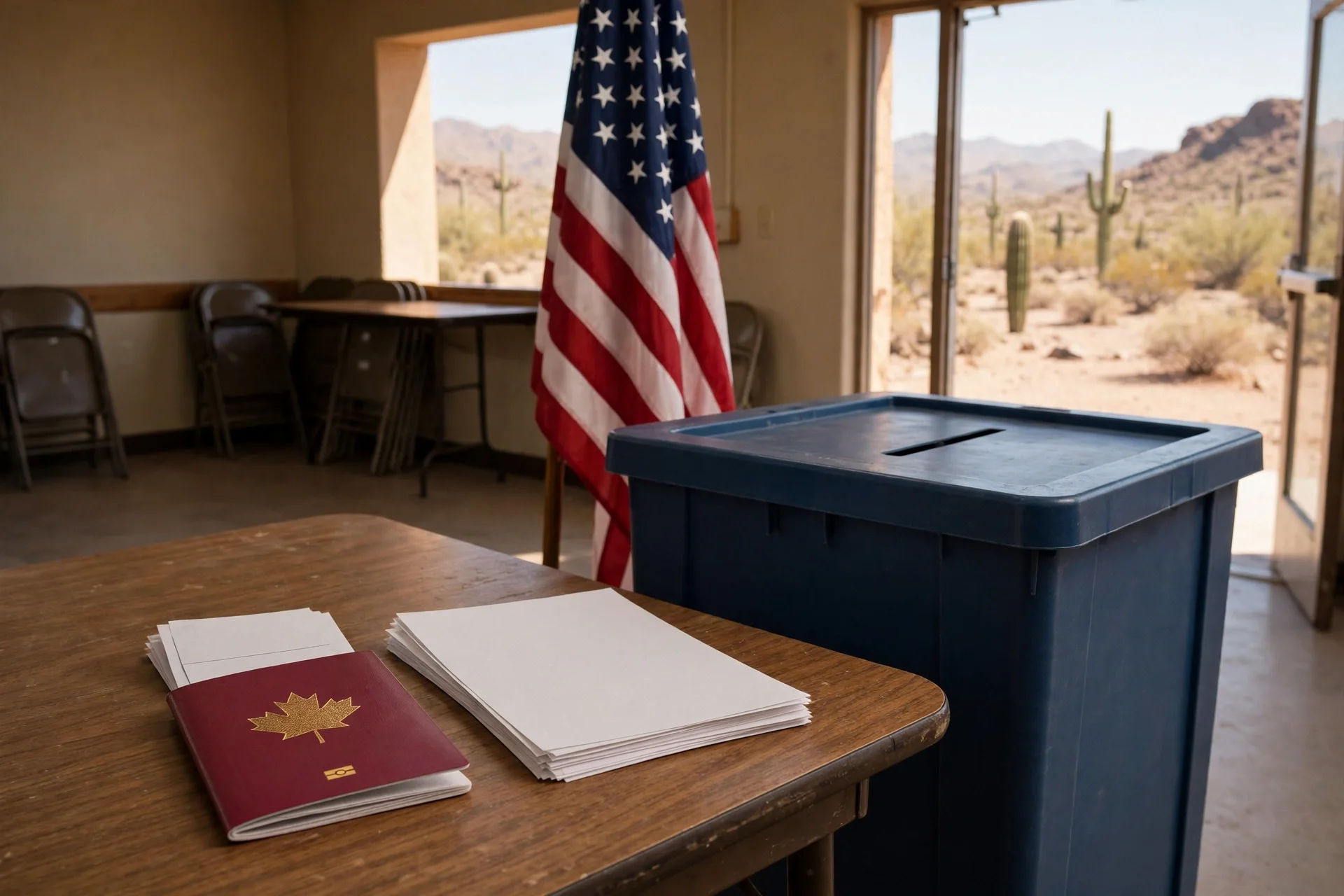
Centro de votación en Arizona. · Imagen generada para EPM
ICE arrests Canadian in Tucson over alleged illegal voting
ICE took Canadian lawful permanent resident Monique Gignac-Yochum into custody on Oct.
Canadian arrested in Arizona on federal voter fraud warrant
Federal agents arrested Monique Gignac-Yochum, a Canadian lawful permanent resident, in Tucson on Oct.
--- The context ---
Only United States citizens may vote in federal elections. A registration based on a false citizenship claim becomes a federal criminal matter, while investigators must still prove the facts before any conviction.
--- The facts ---
Monique Gignac-Yochum, a lawful permanent resident from Canada, was taken into custody on Oct. 28 by ICE Homeland Security Investigations in Tucson for allegedly voting illegally as an alien. ICE says she registered in Wisconsin by falsely claiming citizenship and voted in the general elections of Nov. 8, 2022, and Nov. 5, 2024.
--- The positions ---
On Oct. 23, 2026, a federal misdemeanor arrest warrant was issued out of the Western District of Wisconsin. She had moved to Arizona, HSI Milwaukee contacted HSI Tucson, and she was arrested days later. ICE Assistant Director of Public Affairs Micah Bock said in indirect, attributed remarks that she allegedly voted illegally in two federal elections, that falsely claiming citizenship is not a paperwork mistake, and that moving did not put her beyond federal reach.
--- What remains unknown ---
The release does not explain how the registration was detected, what evidence will follow, or the next step. It mentions no additional charges or hearings. She is detained, not convicted.
--- Unanswered questions ---
How was the alleged false registration discovered? What records support the claim about both ballots? When will she appear before a judicial authority?
--- EPM analysis ---
The case links Wisconsin and Arizona: registration, two alleged votes, a 2026 warrant and a coordinated arrest. ICE frames it as electoral integrity, which also depends on due process.
📌 EPM Take: In EPM's view, this arrest should be judged by evidence, not by headline. Coordination between Milwaukee and Tucson explains how a Wisconsin warrant produced an Arizona arrest, but it does not replace proof of registration, claim and voting. Election integrity is strongest when enforcement is firm and procedure remains exact, especially while she remains only accused.
--- The context ---
Federal voting is reserved for United States citizens. Falsely claiming that status to register undermines public trust, and authorities treat it as serious even when the person later leaves the state.
--- The facts ---
Monique Gignac-Yochum, a lawful permanent resident from Canada, was taken into custody on Oct. 28 by ICE Homeland Security Investigations in Tucson for allegedly voting illegally as an alien. ICE says she registered in Wisconsin by falsely claiming citizenship and voted in the general elections of Nov. 8, 2022, and Nov. 5, 2024.
--- The positions ---
On Oct. 23, 2026, a federal misdemeanor arrest warrant was issued out of the Western District of Wisconsin. She had moved to Arizona; HSI Milwaukee reached out to HSI Tucson, leading to an arrest days later. ICE Assistant Director of Public Affairs Micah Bock said in indirect, attributed remarks that she allegedly voted illegally in two federal elections, that falsely claiming citizenship is not a paperwork mistake, and that moving did not put her beyond federal reach.
--- What remains unknown ---
The release gives no detailed evidence, additional charges or hearings. What is known is narrow: a warrant, coordination between offices, an arrest, and an accusation to be proven.
--- Unanswered questions ---
What evidence ties the registration to both ballots? How did Milwaukee and Tucson coordinate the arrest? What accountability follows if the allegation is proven?
--- EPM analysis ---
ICE presents the investigation as commitment to electoral integrity with federal, state and local partners. The line is direct: alleged voting in Wisconsin, a 2026 warrant, enforcement in Arizona.
📌 EPM Take: In EPM's view, the arrest sends the right signal that election laws do not expire at a state border. If evidence proves a permanent resident claimed citizenship and voted in 2022 and 2024, accountability should be clear and lawful. Protecting elections means deterring false registration firmly, because every illegal ballot dilutes a lawful vote nationwide.
ICE arresta en Tucson a canadiense acusada de votar ilegalmente
ICE detuvo el 28 de octubre en Tucson a Monique Gignac-Yochum, residente permanente canadiense, por presuntamente registrarse en Wisconsin afirmando ser…
Detenida en Arizona una canadiense por presunto fraude electoral
Autoridades federales detuvieron en Tucson a Monique Gignac-Yochum, residente permanente de Canadá, acusada de registrarse en Wisconsin con una falsa…
--- El contexto ---
Solo los ciudadanos estadounidenses pueden votar en elecciones federales. Un registro con afirmación falsa de ciudadanía convierte un trámite en asunto penal federal que sigue a la persona aunque cambie de estado.
--- Los hechos ---
Monique Gignac-Yochum, residente permanente legal de Canadá, fue detenida el 28 de octubre por Investigaciones de Seguridad Nacional de ICE en Tucson por presuntamente votar ilegalmente como extranjera. Según ICE, se registró en Wisconsin afirmando falsamente ser ciudadana y votó en las elecciones del 8 de noviembre de 2022 y del 5 de noviembre de 2024.
--- Las posiciones ---
El 23 de octubre de 2026 se emitió una orden federal de arresto por delito menor desde el Distrito Oeste de Wisconsin. Ella se había mudado a Arizona, HSI Milwaukee contactó a HSI Tucson y fue arrestada días después. Micah Bock, subdirector de Asuntos Públicos de ICE, afirmó en indirecto que presuntamente votó ilegalmente en dos elecciones federales, que afirmar falsamente la ciudadanía no es un error de papeleo y que mudarse no la puso fuera del alcance federal.
--- Lo que falta saber ---
El comunicado no detalla cómo se detectó el registro, qué pruebas se presentarán ni el siguiente paso. No menciona cargos adicionales ni audiencias. Es una detenida, no una condenada.
--- Preguntas sin respuesta ---
¿Cómo se descubrió el presunto registro falso? ¿Qué documentos sustentan la acusación sobre ambos votos? ¿Cuándo comparecerá ante la autoridad judicial?
--- Análisis EPM ---
El caso conecta Wisconsin y Arizona: registro, dos votos presuntos, orden en 2026 y detención coordinada. ICE lo enmarca en la integridad electoral, que exige debido proceso.
📌 Conclusion EPM: A juicio de EPM, este arresto exige doble rigor: firmeza ante el voto ilegal presunto y cautela antes de dar hechos por probados. La coordinación entre Milwaukee y Tucson explica la detención, pero solo la evidencia determinará si hubo fraude. Proteger las elecciones incluye distinguir con precisión entre acusación formal y condena en un proceso federal todavía abierto.
--- El contexto ---
Votar en elecciones federales es derecho de los ciudadanos estadounidenses. Afirmar falsamente esa condición para registrarse ataca la confianza pública y justifica una respuesta penal aunque la persona se mude.
--- Los hechos ---
Monique Gignac-Yochum, residente permanente legal de Canadá, fue detenida el 28 de octubre por Investigaciones de Seguridad Nacional de ICE en Tucson por presuntamente votar ilegalmente como extranjera. Según ICE, se registró en Wisconsin afirmando falsamente ser ciudadana y votó en las elecciones generales del 8 de noviembre de 2022 y del 5 de noviembre de 2024.
--- Las posiciones ---
El 23 de octubre de 2026, el Distrito Oeste de Wisconsin emitió una orden federal de arresto por delito menor. Ella ya vivía en Arizona; HSI Milwaukee avisó a HSI Tucson y el arresto ocurrió días después. Micah Bock, subdirector de Asuntos Públicos de ICE, sostuvo en indirecto que presuntamente votó ilegalmente en dos elecciones federales, que afirmar falsamente la ciudadanía no es un error de papeleo y que mudarse no la dejó fuera del alcance federal.
--- Lo que falta saber ---
El comunicado no aporta detalle probatorio, cargos adicionales ni audiencias. Lo conocido es delimitado: una orden vigente, una detención ejecutada y una acusación por probarse.
--- Preguntas sin respuesta ---
¿Qué prueba vincula el registro con los dos votos? ¿Cómo cooperaron Wisconsin y Arizona para localizarla? ¿Qué consecuencias habrá si se confirma judicialmente?
--- Análisis EPM ---
La secuencia es clara: mudarse no interrumpió la acción federal. Milwaukee aportó el origen, Tucson ejecutó la detención e ICE la presentó como defensa electoral.
📌 Conclusion EPM: A juicio de EPM, la detención envía un mensaje necesario: la ciudadanía no se declara a conveniencia y el voto federal exige verificación estricta. Si la evidencia confirma que una residente permanente votó en 2022 y 2024, la respuesta debe ser ejemplar dentro de la ley. La confianza electoral se defiende persiguiendo el fraude presunto sin excepciones territoriales.