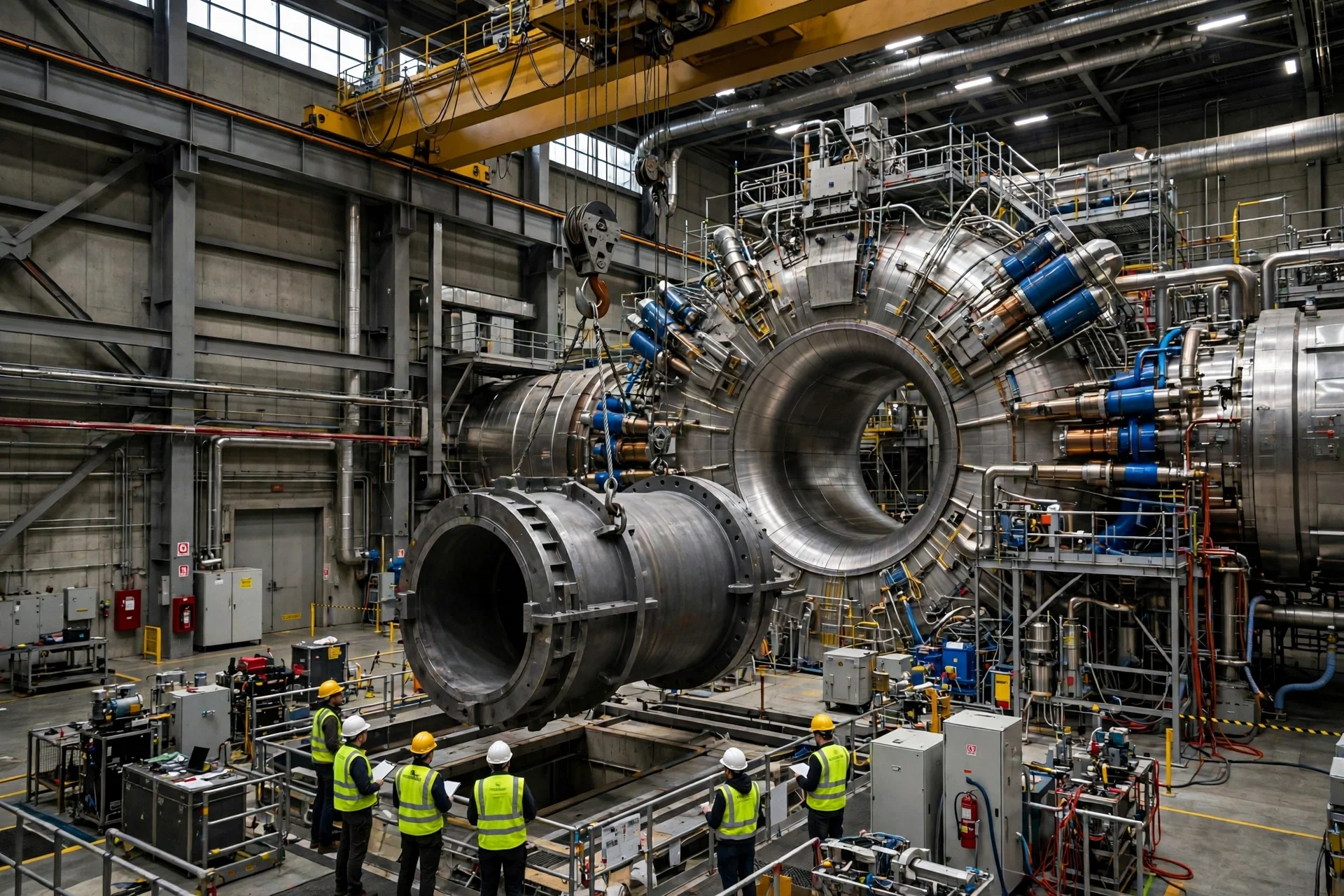
UKAEA engineers lowered a 12-tonne double beam box into place for MAST Upgrade at Culham Campus.
--- The context ---
MAST Upgrade is the United Kingdom's flagship fusion machine, based at UKAEA's Culham Campus. Its work is to heat plasma to extreme temperatures so researchers can investigate the technologies and physics that future fusion power plants will need, including STEP, the United Kingdom's prototype fusion power plant.
--- The facts ---
Engineers at the UK Atomic Energy Authority (UKAEA) achieved a technological milestone by manoeuvring a massive 12-tonne component into position for MAST Upgrade. The double beam box has a double-decker layout designed to house two neutral beam injectors, which fire high-energy neutral atoms into the plasma, raising its temperature to more than 30 million degrees Celsius.
By adding two more injectors to the existing setup, the new double beam box will double the machine's neutral beam heating power from 4.4 MW to 8.8 MW. The hotter plasma conditions, expected to double from 30 million to 60 million degrees Celsius, will let researchers investigate what future fusion power plants require, including STEP.
The completed vessel, including its lid, will weigh around 15 tonnes, with a volume of 20 cubic metres, about the same as 130 bathtubs. It is made from 316L stainless steel, a grade used in offshore infrastructure and medical implants for its strength, durability and resistance to corrosion, with good vacuum compatibility.
--- The positions ---
Andrew Thornton, Head of MAST Upgrade Operations at UKAEA, said in attributed terms that the lift of the double beam box is a huge step forward for the machine. As he put it indirectly, doubling the heating power will open plasma conditions that could not be reached before, allowing the team to study the stability of higher-pressure plasmas and test how the exhaust system copes with hotter plasmas, questions he described as crucial for STEP and future fusion power plants, while praising the collaboration across UKAEA teams.
--- What remains unknown ---
There are no experimental results yet from the new setup, because the major hardware still has to be manufactured and fitted inside the vessel. How the plasma will actually perform under the hotter, higher-pressure conditions also remains to be seen once experiments begin.
--- Unanswered questions ---
How will the plasma respond when heating power rises from 4.4 MW to 8.8 MW? What will the stability of higher-pressure plasmas reveal? How will the exhaust system cope with temperatures of 60 million degrees Celsius?
--- EPM analysis ---
The lift is part of wider engineering work now underway: a new electron Bernstein wave (EBW) microwave heating system, power supply equipment repurposed from the Joint European Torus (JET), the beam line module, a cryopump that will control pressure inside the vessel, and the positive ion neutral injectors (PINIs). All major hardware is expected by the end of autumn 2027, with experiments due in 2028.
📌 EPM Take: In EPM's view, lowering a 12-tonne component into place matters because of what it unlocks: doubled heating power and access to a plasma regime that was previously out of reach. The real measure of this milestone will be what that regime teaches STEP and the fusion power plants that follow, and its credibility rests on a concrete timetable, with hardware fitted by the end of autumn 2027 and scientific experiments beginning in 2028, which must now be met step by step.
--- The context ---
At Culham Campus, UKAEA runs MAST Upgrade, the United Kingdom's flagship fusion machine. The machine heats plasma to extreme temperatures so that researchers can investigate the technologies and physics needed for future fusion power plants, among them STEP, the United Kingdom's prototype fusion power plant.
--- The facts ---
Engineers at the UK Atomic Energy Authority (UKAEA) reached a technological milestone after manoeuvring a massive 12-tonne component into position for MAST Upgrade. The component is the double beam box, built with a double-decker layout to house two neutral beam injectors. Those injectors fire high-energy neutral atoms into the plasma, raising its temperature to more than 30 million degrees Celsius.
Adding two more injectors to the existing setup will double the machine's neutral beam heating power from 4.4 MW to 8.8 MW. Plasma conditions are expected to double from 30 million to 60 million degrees Celsius, enabling researchers to investigate the technologies and physics needed for future fusion power plants, including STEP.
With its lid, the completed vessel will weigh around 15 tonnes and hold a volume of 20 cubic metres, about the same as 130 bathtubs. It is made from 316L stainless steel, a grade widely used in offshore infrastructure and medical implants for its strength, durability and resistance to corrosion, with good vacuum compatibility for the ultra-high vacuum conditions required inside the vessel.
--- The positions ---
Andrew Thornton, Head of MAST Upgrade Operations at UKAEA, said in attributed terms that the lift is a huge step forward for MAST Upgrade. As he put it indirectly, doubling the heating power will allow the team to explore plasma conditions it simply could not reach before, study the stability of higher-pressure plasmas and test how the exhaust system copes with hotter, higher-performance plasmas, questions he described as crucial for STEP and future fusion power plants, while crediting the collaboration across UKAEA's science and engineering teams.
--- What remains unknown ---
No results from the new configuration are available yet, and the real performance of the plasma under the planned hotter conditions is still unknown. Those answers depend on the vessel being completed, made vacuum-tight and commissioned for scientific use.
--- Unanswered questions ---
Will the exhaust system hold up under plasmas of 60 million degrees Celsius? What will higher-pressure plasma stability demand once power reaches 8.8 MW? Will the timetable hold, with all major hardware fitted by the end of autumn 2027?
--- EPM analysis ---
The box is one part of a wider programme underway: a new electron Bernstein wave (EBW) microwave heating system, power supply equipment repurposed from the Joint European Torus (JET), the beam line module, a cryopump to control pressure inside the box, and the positive ion neutral injectors (PINIs). Experiments are due to begin in 2028.
📌 EPM Take: In EPM's view, the strength of this milestone is its discipline: a 12-tonne component, a proven material in 316L stainless steel and equipment repurposed from JET amount to a measurable upgrade rather than an abstract promise. Doubling power from 4.4 MW to 8.8 MW will only count if the timetable is respected and if the experiments starting in 2028 confirm in the plasma what engineering has now installed at Culham Campus, under public scrutiny as the programme advances toward its first results.
Una pieza de 12 toneladas duplica la potencia de calentamiento de MAST Upgrade
Ingenieros de la UKAEA colocaron en su posición un componente de 12 toneladas para MAST Upgrade, en Culham Campus.
MAST Upgrade instala su caja de 12 toneladas rumbo a los experimentos de 2028
La UKAEA colocó en su posición la double beam box de 12 toneladas para MAST Upgrade, en Culham Campus.
--- El contexto ---
MAST Upgrade es la máquina insignia de fusión del Reino Unido y opera en el Culham Campus de la UKAEA. Su tarea es calentar plasma a temperaturas extremas para estudiar las tecnologías y la física que necesitarán las futuras plantas de fusión, entre ellas STEP, el prototipo británico.
--- Los hechos ---
Ingenieros de la UKAEA maniobraron hasta su posición un componente de 12 toneladas para MAST Upgrade, un hito tecnológico. Es la double beam box, una caja de doble nivel diseñada para alojar dos inyectores de haz neutro, que disparan átomos neutros de alta energía hacia el plasma y elevan su temperatura a más de 30 millones de grados Celsius.
Al sumar dos inyectores más a la configuración existente, la nueva caja duplicará la potencia de calentamiento por haz neutro de la máquina, de 4,4 MW a 8,8 MW. Las condiciones más calientes, que se espera que pasen de 30 millones a 60 millones de grados Celsius, permitirán investigar lo necesario para las futuras plantas, incluido STEP.
El recipiente completo de la caja, con su tapa, pesará unas 15 toneladas, con un volumen de 20 metros cúbicos, equivalente a 130 bañeras. Está fabricado en acero inoxidable 316L, usado en infraestructura marina e implantes médicos por su resistencia, durabilidad y resistencia a la corrosión, y con buena compatibilidad con el vacío.
--- Las posiciones ---
Andrew Thornton, jefe de Operaciones de MAST Upgrade en la UKAEA, planteó en términos atribuidos que la instalación de la caja es un gran paso adelante y que, al duplicar la potencia, se explorarán condiciones de plasma antes inalcanzables. Según su planteamiento, se podrá estudiar la estabilidad de plasmas de mayor presión y probar cómo responde el sistema de escape ante plasmas más calientes y de mayor rendimiento, cuestiones cruciales, en su descripción, para STEP y las futuras plantas, y destacó la colaboración de los equipos de la UKAEA.
--- Lo que falta saber ---
Todavía no hay resultados experimentales de la nueva configuración, porque el hardware principal aún debe fabricarse e instalarse. Tampoco se sabe cómo rendirá el plasma cuando se alcancen las nuevas condiciones previstas.
--- Preguntas sin respuesta ---
¿Cómo responderá el plasma cuando la potencia pase de 4,4 MW a 8,8 MW? ¿Qué mostrará el estudio de la estabilidad de los plasmas de mayor presión? ¿Cómo se comportará el sistema de escape ante temperaturas de 60 millones de grados Celsius?
--- Análisis EPM ---
La maniobra se suma a otros trabajos en curso: un sistema de calentamiento por microondas EBW, equipos eléctricos reutilizados de JET, el módulo de línea de haz, una criobomba que controlará la presión dentro del recipiente y los inyectores PINIs. El calendario marca el hardware principal listo a finales de otoño de 2027 y los experimentos en 2028.
📌 Conclusion EPM: A juicio de EPM, colocar una pieza de 12 toneladas en su sitio vale más que el gesto de fuerza: es la condición material para duplicar la potencia y entrar en un régimen de plasma antes inalcanzable. El valor del avance se medirá en lo que ese régimen enseñe para STEP y para las futuras plantas de fusión, y su credibilidad descansa en un calendario concreto que ahora deberá cumplirse paso a paso, sin atajos ni triunfalismo previo.
--- El contexto ---
En el Culham Campus, la UKAEA desarrolla MAST Upgrade, la máquina insignia de fusión del Reino Unido. Su función es someter el plasma a temperaturas extremas para investigar las tecnologías y la física que exigirán las futuras plantas de energía de fusión, incluido STEP, el prototipo de planta de fusión del Reino Unido.
--- Los hechos ---
Ingenieros de la UKAEA lograron un hito tecnológico al maniobrar hasta su posición un componente de 12 toneladas destinado a MAST Upgrade. Es la double beam box, una caja de doble nivel diseñada para alojar dos inyectores de haz neutro. Esos inyectores disparan átomos neutros de alta energía hacia el plasma y elevan su temperatura a más de 30 millones de grados Celsius.
Con dos inyectores adicionales sobre la configuración existente, la caja duplicará la potencia de calentamiento por haz neutro, de 4,4 MW a 8,8 MW. Las condiciones de plasma, que se espera que pasen de 30 millones a 60 millones de grados Celsius, permitirán estudiar lo necesario para las futuras plantas, entre ellas STEP.
El recipiente completo, con su tapa, pesará unas 15 toneladas y ocupará 20 metros cúbicos, el equivalente a 130 bañeras. Su material es acero inoxidable 316L, empleado en infraestructura marina e implantes médicos por su resistencia, durabilidad y resistencia a la corrosión, y con buena compatibilidad con el vacío.
--- Las posiciones ---
Andrew Thornton, jefe de Operaciones de MAST Upgrade en la UKAEA, sostuvo en términos atribuidos que la colocación de la caja es un gran paso adelante para la máquina. Según su planteamiento, duplicar la potencia permitirá explorar condiciones de plasma antes inalcanzables, estudiar la estabilidad de plasmas de mayor presión y probar el sistema de escape con plasmas más calientes, asuntos cruciales, en su valoración, para STEP y las futuras plantas, y resaltó la colaboración entre los equipos científicos y de ingeniería de la UKAEA.
--- Lo que falta saber ---
Aún no se conocen resultados de la nueva configuración ni el rendimiento real del plasma bajo las nuevas condiciones. Esos datos solo llegarán cuando el hardware esté completo y el recipiente quede puesto en servicio.
--- Preguntas sin respuesta ---
¿Sostendrá el sistema de escape el trabajo con plasmas de 60 millones de grados Celsius? ¿Qué exigirá la estabilidad de los plasmas de mayor presión cuando la potencia llegue a 8,8 MW? ¿Se cumplirá el calendario que prevé el hardware listo a finales de otoño de 2027?
--- Análisis EPM ---
El avance no llega solo: avanzan también el sistema de calentamiento por microondas EBW, la reutilización de equipos eléctricos de JET, el módulo de línea de haz, una criobomba que controlará la presión en la caja y los inyectores PINIs. Todo el hardware principal debe estar listo a finales de otoño de 2027, con experimentos desde 2028.
📌 Conclusion EPM: A juicio de EPM, el mérito de esta maniobra está en su disciplina: una pieza de 12 toneladas, un material probado como el acero 316L y equipos reutilizados de JET componen una mejora medible, no una promesa abstracta. Duplicar la potencia de 4,4 MW a 8,8 MW solo tendrá valor si el calendario se respeta y si los experimentos de 2028 confirman en el plasma lo que hoy la ingeniería ha dejado instalado en Culham Campus.