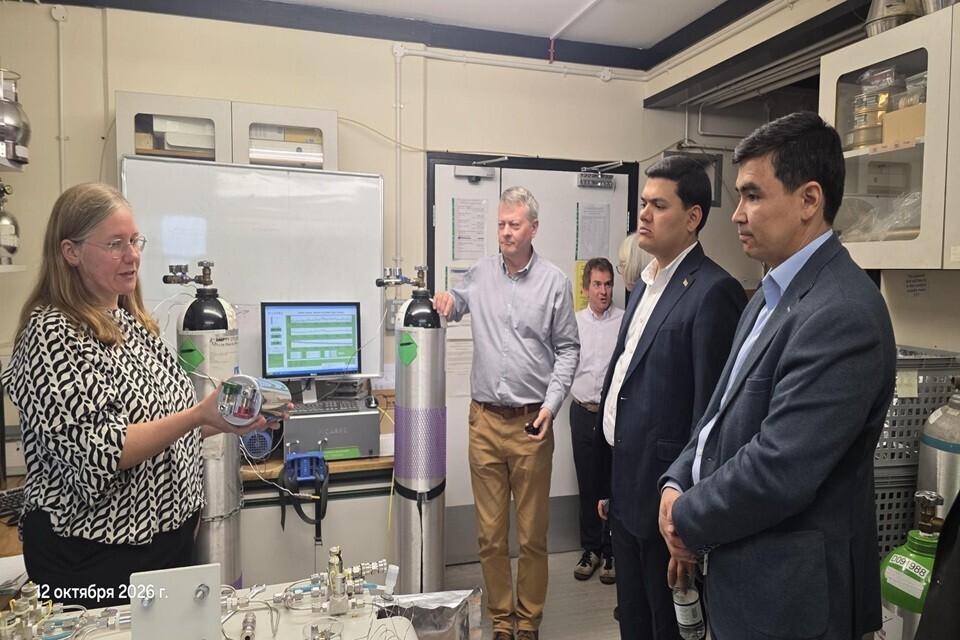
Funcionarios turcomanos en Royal Holloway, University of London, durante la visita de estudio sobre metano. · British Embassy in Turkmenistan / GOV.UK (OGL)
Turkmenistan officials study UK expertise on cutting methane emissions
Senior Turkmenistan officials visited London, Aberdeen and Teesside from 12 to 16 October 2026 to explore UK expertise on methane policy, regulation…
UK methane know-how draws a Turkmen delegation to London and beyond
Senior officials from Turkmengas, Turkmenoil and three Turkmen ministries toured British centres in London, Aberdeen and Teesside to study methane regulation…
--- The context ---
A delegation of senior Turkmenistan officials travelled to the United Kingdom to learn first-hand from UK expertise on reducing methane emissions in the oil and gas sector. The study visit ran from 12 to 16 October 2026 and was organised by the British Embassy in Turkmenistan jointly with GIZ, with a programme spanning government, scientific and industrial centres in London, Aberdeen and Teesside.
--- The facts ---
The delegation brought together officials from the Turkmengas and Turkmenoil State Concerns and from the Ministry of Energy, the Ministry of Environmental Protection and the Ministry of Foreign Affairs. In London, the officials engaged with experts from the Department for Energy Security and Net Zero (DESNZ), the North Sea Transition Authority (NSTA), the Offshore Petroleum Regulator for Environment and Decommissioning (OPRED), the Environment Agency and the National Physical Laboratory (NPL).
Sessions explored UK approaches to methane policy and regulation, environmental permits and compliance, and methane measurement, monitoring and verification. The programme included technical visits to the St Fergus gas plant in Peterhead and the CATS gas terminal in Teesside, alongside engagement with Offshore Energies UK (OEUK) and private-sector specialists in London and Aberdeen.
--- The positions ---
The delegation also engaged with the Greenhouse Gas Research Group of Royal Holloway, University of London, and received expert briefings from companies Score, bp and GHGSat on fugitive emissions management, high-precision satellite monitoring and other issues. According to the official account, the productive partnership between the British Embassy in Turkmenistan and GIZ is helping turn knowledge into action, supporting Turkmenistan's practical efforts under the Paris Agreement and the Global Methane Pledge.
--- What remains unknown ---
The available information does not say which concrete measures Turkmenistan will adopt after the visit, or what timetable will govern the application of the lessons learned at its oil and gas facilities. No measurable emissions reductions resulting from this exchange have been reported, and no further phase of the joint work between the British Embassy and GIZ has been announced.
--- Unanswered questions ---
Which regulatory changes might Turkmenistan introduce based on the UK approaches to environmental permits and compliance? Will high-precision satellite monitoring be applied at facilities run by Turkmengas and Turkmenoil? Will the British Embassy, GIZ and the Turkmen authorities follow this visit with new exchanges or programmes?
--- EPM analysis ---
The exchange reflects a model of technical cooperation built on practical capabilities: regulation, measurement and verification, rather than general declarations. In an oil and gas sector where fugitive emissions demand precise detection, the combination of British regulatory experience, university science and satellite technology offers the visiting delegation a concrete path for learning.
📌 EPM Take: In EPM's view, the visit confirms that the fight against methane is won with rigorous measurement and clear rules, and that the United Kingdom has turned its regulatory and scientific experience into an asset for international cooperation. That energy, environment and foreign affairs officials travelled together suggests a will to apply the lessons in a coordinated way. The real value of the trip will be measured by the changes Turkmenistan introduces in its oil and gas sector in the months and years ahead.
--- The context ---
The United Kingdom hosted a delegation of senior Turkmenistan officials keen to see how methane is regulated and controlled in a mature oil and gas industry. The study visit, held from 12 to 16 October 2026, was organised by the British Embassy in Turkmenistan jointly with GIZ and took in government, scientific and industrial centres in London, Aberdeen and Teesside.
--- The facts ---
The delegation included officials from the Turkmengas and Turkmenoil State Concerns and from the Ministry of Energy, the Ministry of Environmental Protection and the Ministry of Foreign Affairs. In London they met experts from the Department for Energy Security and Net Zero (DESNZ), the North Sea Transition Authority (NSTA), the Offshore Petroleum Regulator for Environment and Decommissioning (OPRED), the Environment Agency and the National Physical Laboratory (NPL).
Sessions focused on UK methane policy and regulation, environmental permits and compliance, and methane measurement, monitoring and verification. Technical visits took the delegation to the St Fergus gas plant in Peterhead and the CATS gas terminal in Teesside, alongside engagement with Offshore Energies UK (OEUK) and private-sector specialists in London and Aberdeen.
--- The positions ---
The visitors also met the Greenhouse Gas Research Group of Royal Holloway, University of London, and heard briefings from companies Score, bp and GHGSat on fugitive emissions management and high-precision satellite monitoring. According to the official account, the partnership between the British Embassy in Turkmenistan and GIZ is helping turn knowledge into action, supporting Turkmenistan's practical efforts under the Paris Agreement and the Global Methane Pledge.
--- What remains unknown ---
No agreements signed during the visit have been reported, and no deadlines have been given for transferring the lessons learned into Turkmen rules or facilities. It is also unclear what follow-up the British Embassy and GIZ will provide, or what emissions reductions may in future be attributed to this cooperation.
--- Unanswered questions ---
Which practices seen at the St Fergus plant or the CATS terminal could be transferred to Turkmen facilities? What role will Turkmengas and Turkmenoil play in applying what was learned during the visit? Will cooperation between the British Embassy, GIZ and the Turkmen authorities continue beyond this exchange?
--- EPM analysis ---
The visit showcases a British asset built over decades: an ecosystem in which the regulator, the industry and the university work on the same problems. For a delegation that manages state gas and oil concerns, watching permits, compliance and detection technology in operation is worth more than any theoretical presentation.
📌 EPM Take: In EPM's view, the Turkmen delegation's interest reflects a simple lesson: cutting methane requires institutions that work, rules that are enforced and technology proven in the field. The United Kingdom offers that complete package, from the regulator to the gas plant, and projects it abroad through its embassy and partners such as GIZ. If Turkmenistan uses this visit as seriously as it was organised, its energy sector will emerge stronger and its international commitments will gain credibility.
Funcionarios de Turkmenistán estudian en Reino Unido cómo reducir el metano
Una delegación de altos funcionarios de Turkmenistán visitó Londres, Aberdeen y Teesside del 12 al 16 de octubre de 2026 para conocer la experiencia británica…
La experiencia británica en metano atrae a una delegación de Turkmenistán
Altos funcionarios de Turkmengas, Turkmenoil y tres ministerios de Turkmenistán recorrieron centros británicos en Londres, Aberdeen y Teesside para estudiar la…
--- El contexto ---
Una delegación de altos funcionarios de Turkmenistán viajó al Reino Unido para conocer de primera mano la experiencia británica en la reducción de las emisiones de metano en el sector del petróleo y el gas. La visita de estudio se desarrolló del 12 al 16 de octubre de 2026 y fue organizada por la embajada británica en Turkmenistán junto con GIZ, con un programa repartido entre centros gubernamentales, científicos e industriales de Londres, Aberdeen y Teesside.
--- Los hechos ---
La delegación reunió a representantes de las empresas estatales Turkmengas y Turkmenoil y de los ministerios de Energía, de Protección Ambiental y de Asuntos Exteriores. En Londres, los funcionarios se reunieron con expertos del Department for Energy Security and Net Zero (DESNZ), la North Sea Transition Authority (NSTA), el Offshore Petroleum Regulator for Environment and Decommissioning (OPRED), la Environment Agency y el National Physical Laboratory (NPL).
Las sesiones examinaron los enfoques británicos de política y regulación del metano, los permisos ambientales y su cumplimiento, y la medición, el monitoreo y la verificación de las emisiones. El programa incluyó visitas técnicas a la planta de gas de St Fergus, en Peterhead, y a la terminal de gas CATS, en Teesside, además de encuentros con Offshore Energies UK (OEUK) y con especialistas del sector privado en Londres y Aberdeen.
--- Las posiciones ---
La delegación trabajó también con el Greenhouse Gas Research Group de Royal Holloway, University of London, y recibió sesiones informativas de las empresas Score, bp y GHGSat sobre la gestión de las emisiones fugitivas, el monitoreo satelital de alta precisión y otros asuntos. Según la información oficial, la alianza productiva entre la embajada británica en Turkmenistán y GIZ está ayudando a convertir el conocimiento en acción, en apoyo de los esfuerzos de Turkmenistán bajo el Acuerdo de París y el Global Methane Pledge.
--- Lo que falta saber ---
La información disponible no detalla qué medidas concretas adoptará Turkmenistán tras la visita ni qué calendario seguirá la aplicación de lo aprendido en sus instalaciones de petróleo y gas. Tampoco se conocen resultados medibles de reducción de emisiones derivados de este intercambio, ni se ha anunciado una nueva fase del programa conjunto entre la embajada británica y GIZ.
--- Preguntas sin respuesta ---
¿Qué cambios regulatorios podría introducir Turkmenistán a partir de los enfoques británicos de permisos ambientales y cumplimiento? ¿Se aplicará el monitoreo satelital de alta precisión en las instalaciones de Turkmengas y Turkmenoil? ¿Habrá nuevas visitas o programas de seguimiento entre la embajada británica, GIZ y las autoridades turcomanas?
--- Análisis EPM ---
El intercambio muestra un modelo de cooperación técnica centrado en capacidades prácticas: regulación, medición y verificación, más que en declaraciones generales. Para un sector como el del petróleo y el gas, donde las emisiones fugitivas exigen detección precisa, la combinación de experiencia reguladora británica, ciencia universitaria y tecnología satelital ofrece una ruta concreta de aprendizaje para la delegación visitante.
📌 Conclusion EPM: A juicio de EPM, la visita confirma que la lucha contra el metano se gana con medición rigurosa y reglas claras, y que el Reino Unido ha sabido convertir su experiencia reguladora y científica en un activo de cooperación internacional. Que funcionarios de energía, medio ambiente y exteriores viajen juntos sugiere una voluntad de aplicar lo aprendido de forma coordinada. El valor real del viaje se medirá en los cambios que Turkmenistán introduzca en su sector de petróleo y gas durante los próximos meses y años.
--- El contexto ---
El Reino Unido recibió a una delegación de altos funcionarios de Turkmenistán interesados en conocer cómo se regula y se controla el metano en una industria de petróleo y gas consolidada. La visita de estudio, del 12 al 16 de octubre de 2026, fue organizada por la embajada británica en Turkmenistán junto con GIZ y recorrió centros gubernamentales, científicos e industriales de Londres, Aberdeen y Teesside.
--- Los hechos ---
Integraron la delegación funcionarios de las empresas estatales Turkmengas y Turkmenoil y de los ministerios de Energía, de Protección Ambiental y de Asuntos Exteriores. En Londres mantuvieron reuniones con expertos del Department for Energy Security and Net Zero (DESNZ), la North Sea Transition Authority (NSTA), el Offshore Petroleum Regulator for Environment and Decommissioning (OPRED), la Environment Agency y el National Physical Laboratory (NPL).
Las sesiones se centraron en la política y la regulación británicas del metano, en los permisos ambientales y su cumplimiento, y en la medición, el monitoreo y la verificación de las emisiones. El programa sumó visitas técnicas a la planta de gas de St Fergus, en Peterhead, y a la terminal de gas CATS, en Teesside, junto con el contacto con Offshore Energies UK (OEUK) y especialistas del sector privado en Londres y Aberdeen.
--- Las posiciones ---
La delegación se reunió además con el Greenhouse Gas Research Group de Royal Holloway, University of London, y escuchó presentaciones de las empresas Score, bp y GHGSat sobre gestión de emisiones fugitivas y monitoreo satelital de alta precisión. Según la información oficial, la alianza entre la embajada británica y GIZ ayuda a convertir el conocimiento en acción sobre el terreno, en apoyo de los esfuerzos prácticos de Turkmenistán bajo el Acuerdo de París y el Global Methane Pledge.
--- Lo que falta saber ---
No se ha informado de acuerdos firmados durante la visita ni de plazos para trasladar lo aprendido a la normativa o a las instalaciones turcomanas. Tampoco consta qué seguimiento darán la embajada británica y GIZ al intercambio, ni qué resultados de reducción de emisiones podrán atribuirse a esta cooperación en el futuro.
--- Preguntas sin respuesta ---
¿Qué prácticas observadas en la planta de St Fergus o en la terminal CATS podrían trasladarse a las instalaciones turcomanas? ¿Qué papel tendrán Turkmengas y Turkmenoil en la aplicación de lo aprendido durante la visita? ¿Se mantendrá la cooperación entre la embajada británica, GIZ y las autoridades de Turkmenistán más allá de este intercambio?
--- Análisis EPM ---
La visita pone en valor un activo británico construido durante décadas: un ecosistema donde el regulador, la industria y la universidad trabajan sobre los mismos problemas. Para una delegación que gestiona empresas estatales de gas y petróleo, observar permisos, cumplimiento y tecnología de detección en funcionamiento vale más que cualquier presentación teórica.
📌 Conclusion EPM: A juicio de EPM, el interés de la delegación turcomana refleja una lección sencilla: reducir el metano exige instituciones que funcionen, normas que se cumplan y tecnología probada sobre el terreno. El Reino Unido ofrece ese paquete completo, desde el regulador hasta la planta de gas, y lo proyecta hacia el exterior mediante su embajada y socios como GIZ. Si Turkmenistán aprovecha la visita con la misma seriedad con la que fue organizada, su sector energético saldrá fortalecido y sus compromisos internacionales ganarán credibilidad.