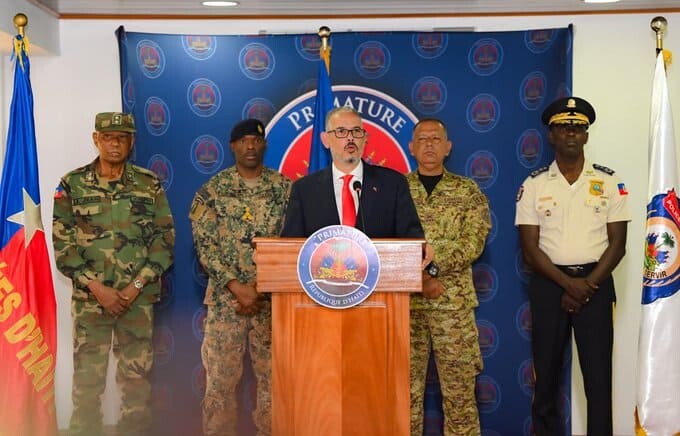
El primer ministro Fils-Aimé anuncia la etapa decisiva de la lucha contra las pandillas, junto a los jefes de seguridad. · Noticias Entre Amigos
Haiti announces decisive phase against gangs with Salvadoran support
Prime Minister Alix Didier Fils-Aimé announced a decisive phase against gangs in Haiti with 4,000 international soldiers, support from El Salvador and more…
Haiti strengthens anti gang offensive and pledges credible elections
Haiti announced a stronger offensive against gangs with 4,000 international soldiers, more than 2,000 soldiers sent by El Salvador and more than 100 armored…
--- The context ---
Haiti has gone years without holding elections because of violence and political instability, while armed gangs hold the population hostage across wide areas of the country. Against that backdrop, Prime Minister Alix Didier Fils-Aimé presented a new phase in the fight against the gangs as the path to restore security across the national territory and organize credible elections for Haitians.
--- The facts ---
Fils-Aimé said on Tuesday that his government is determined, with support from El Salvador, to end the armed gangs that spread terror in the country. Speaking alongside national and international security chiefs, he explained that international forces have now reached 4,000 soldiers in Haiti and warned that, with that reinforcement, the time of the armed gangs is running out and they will no longer be able to sleep.
Last month, Salvadoran President Nayib Bukele sent more than 2,000 soldiers to Haiti with the initial purpose of joining the search for four Salvadoran GSF soldiers missing since October 18 after being ambushed by armed gangs in Croix-de-Bouquets, outside Port-au-Prince. Fils-Aimé also said that more than 100 armored vehicles have been made available to the national security forces to support the operations.
--- The positions ---
The prime minister held that the Haitian National Police, the Armed Forces and the GSF are joining forces around a common strategy to end gang rule and restore state authority. He thanked Bukele for understanding a battle that he described as similar to the one El Salvador faced against its gangs, praised the work of the GSF in support of the fight, and also pointed to those who finance these armed groups.
--- What remains unknown ---
The statement does not specify concrete results from operations or deadlines to recover each announced area. It also does not detail what happened to the four Salvadoran soldiers missing since October 18 or how progress will be measured for the common strategy among Haitian forces, the GSF and the allied countries supporting the international deployment present on national territory.
--- Unanswered questions ---
Will the decisive phase sustainably recover the districts of Kenscoff, Pétion-Ville and Gressier? Will the four Salvadoran soldiers missing since October 18 after the ambush in Croix-de-Bouquets be found? Will Haiti finally hold the presidential and legislative first round on July 18, 2027, after moving it from December 13?
--- EPM analysis ---
The announcement combines force and guarantees in a single message, and that balance defines its reach. On one side it promises permanent pressure on the gangs with 4,000 international soldiers and more than 100 armored vehicles. On the other, it insists that every operation will respect the law of the country, the international commitments signed by Haiti and human rights, with civilians protected and bandits sanctioned, without tolerating abuses or illegal violence.
📌 EPM Take: In EPM's view, the decisive phase announced will only matter if recovered security translates into effective protection for civilians and credible elections on July 18, 2027. International reinforcements and more than 100 armored vehicles can shift the balance, but discipline, respect for human rights and Haitian direction of operations will be the real test that the state acts with legitimacy and not only with force in Port-au-Prince and in the departments where new operations were announced.
--- The context ---
Gang violence has prevented elections in Haiti in recent years and has weakened state authority across its territory. Faced with that picture, Prime Minister Alix Didier Fils-Aimé announced that the fight against the gangs is entering a decisive phase, with the declared goal of restoring security across the national territory and organizing credible elections for the country.
--- The facts ---
According to Fils-Aimé, international forces now total 4,000 soldiers in Haiti and, with that reinforcement, the gangs will no longer be able to sleep because their time is running out. The statement was made alongside national and international security chiefs. He also said that his government is determined, with support from El Salvador, to end the armed gangs that spread terror in the country.
President Nayib Bukele sent last month more than 2,000 soldiers to Haiti with the initial purpose of searching for four Salvadoran GSF soldiers missing since October 18 after an ambush by armed gangs in Croix-de-Bouquets, outside Port-au-Prince. The prime minister also said that more than 100 armored vehicles were made available to the national security forces to sustain the operations now under way.
--- The positions ---
Fils-Aimé stressed that the Haitian state is responsible for the political and strategic direction of the battle against insecurity, answering those who claim that the Salvadoran troops act autonomously. According to his explanation, international forces are not in Haiti to replace the state, but to support it and strengthen its capacity. He added that police, Haitian military personnel and the GSF are joining forces around a common strategy.
--- What remains unknown ---
It remains to be seen how command will be shared in practice between Haitian and international forces and what results the announced operations will produce. The statement also does not clarify the fate of the four missing soldiers or offer an operational calendar for the fronts in the metropolitan area of Port-au-Prince or for the West and Artibonite departments and the Central Plateau.
--- Unanswered questions ---
Will the Haitian state keep effective direction of every operation, as its prime minister promised? Will the deployments in Kenscoff, Pétion-Ville and Gressier and the operations announced in the West, Artibonite and the Central Plateau deliver results? Will security arrive in time to vote on July 18, 2027, after the move from December 13?
--- EPM analysis ---
The central message is authority with written limits. Fils-Aimé clarified that his government is not at war against the people, but against the gangs that hold them hostage, and that civilians must be protected and bandits sanctioned. At the same time, he warned that abuses, mistreatment, illegal acts of violence and human rights violations will not be tolerated in any operation carried out on national territory.
📌 EPM Take: In EPM's view, restoring state authority is the precondition for any credible election and for Haitians to recover daily life without being hostages of the gangs. The announcement sets clear priorities with Haitian command, international support and sanctions for bandits, but its credibility will depend on sustained results in Kenscoff, Pétion-Ville, Gressier, the West, Artibonite and the Central Plateau, without abuses and with the law as the permanent limit of every operation deployed across the country.
Haití anuncia etapa decisiva contra las pandillas con apoyo salvadoreño
El primer ministro de Haití, Alix Didier Fils-Aimé, anunció una etapa decisiva contra las pandillas con 4,000 soldados internacionales, apoyo de El Salvador y…
Haití refuerza ofensiva contra pandillas y promete elecciones creíbles
Haití anunció el refuerzo de su ofensiva contra las pandillas con 4,000 soldados internacionales, más de 2,000 soldados enviados por El Salvador y más de 100…
--- El contexto ---
Haití lleva años sin poder celebrar elecciones por la violencia y la inestabilidad política, mientras las bandas armadas mantienen como rehén a la población en amplias zonas del país. En ese escenario, el primer ministro Alix Didier Fils-Aimé presentó una nueva fase de la lucha contra las pandillas como el camino para restablecer la seguridad en todo el territorio nacional y organizar elecciones creíbles.
--- Los hechos ---
Fils-Aimé afirmó este martes que su Gobierno está decidido, con el apoyo de El Salvador, a acabar con las bandas armadas que siembran el terror en el país. Según explicó junto a los jefes de seguridad nacionales e internacionales, las fuerzas internacionales ya llegan a 4,000 soldados en Haití y, con ese refuerzo, advirtió que el tiempo de las bandas armadas se está agotando y que ya no podrán dormir.
El mes pasado, el presidente salvadoreño Nayib Bukele envió más de 2,000 soldados a Haití con el propósito inicial de participar en la búsqueda de cuatro militares salvadoreños de la GSF desaparecidos desde el 18 de octubre tras ser emboscados por bandas armadas en Croix-de-Bouquets, en las afueras de Puerto Príncipe. Fils-Aimé también aseguró que se han puesto a disposición de las fuerzas de seguridad nacionales más de 100 blindados.
--- Las posiciones ---
El primer ministro sostuvo que la Policía Nacional de Haití, las Fuerzas Armadas y la GSF unen fuerzas en torno a una estrategia común para acabar con el dominio de las pandillas y restaurar la autoridad del Estado. Agradeció a Bukele por haber comprendido una batalla que describió como similar a la que El Salvador enfrentó contra sus pandillas, y destacó el trabajo de la GSF en apoyo de la lucha contra las bandas armadas. También señaló a quienes financian a estos grupos armados.
--- Lo que falta saber ---
La declaración no precisa resultados concretos de operaciones ni plazos para recuperar cada zona anunciada. Tampoco detalla qué ocurrió con los cuatro militares salvadoreños desaparecidos desde el 18 de octubre ni cómo se medirá el avance de la estrategia común entre las fuerzas haitianas, la GSF y los países aliados que apoyan el despliegue internacional presente en el territorio nacional.
--- Preguntas sin respuesta ---
¿Logrará la etapa decisiva recuperar de forma sostenida los distritos de Kenscoff, Pétion-Ville y Gressier? ¿Aparecerán los cuatro militares salvadoreños desaparecidos desde el 18 de octubre tras la emboscada en Croix-de-Bouquets? ¿Podrá Haití celebrar por fin la primera vuelta presidencial y legislativa el 18 de julio de 2027, tras trasladarla desde el 13 de diciembre?
--- Análisis EPM ---
El anuncio combina fuerza y garantías en un mismo mensaje, y ese equilibrio define su alcance. Por un lado promete presión permanente sobre las bandas con 4,000 soldados internacionales y más de 100 blindados. Por otro, insiste en que toda operación respetará la ley del país, los compromisos internacionales firmados por Haití y los derechos humanos, con civiles protegidos y bandidos sancionados, sin tolerar abusos ni violencia ilegal.
📌 Conclusion EPM: A juicio de EPM, la etapa decisiva anunciada solo tendrá valor si la seguridad recuperada se traduce en protección efectiva para los civiles y en elecciones creíbles el 18 de julio de 2027. El refuerzo internacional y los más de 100 blindados pueden cambiar el equilibrio, pero la disciplina, el respeto a los derechos humanos y la dirección haitiana de las operaciones serán la prueba real de que el Estado actúa con legitimidad y no solo con fuerza en Puerto Príncipe y en los departamentos anunciados.
--- El contexto ---
La violencia de las bandas armadas ha impedido la celebración de elecciones en Haití durante los últimos años y ha debilitado la autoridad del Estado en su territorio. Frente a ese cuadro, el primer ministro Alix Didier Fils-Aimé anunció que la lucha contra las pandillas entra en una etapa decisiva, con el objetivo declarado de restablecer la seguridad en todo el territorio nacional y organizar elecciones creíbles.
--- Los hechos ---
Según Fils-Aimé, las fuerzas internacionales ya suman 4,000 soldados en Haití y, con ese refuerzo, las pandillas ya no podrán dormir porque su tiempo se está agotando. La declaración se produjo junto a los jefes de seguridad nacionales e internacionales. El gobernante afirmó además que su Gobierno está decidido, con el apoyo de El Salvador, a acabar con las bandas armadas que siembran el terror en el país.
El presidente Nayib Bukele envió el mes pasado más de 2,000 soldados a Haití con el propósito inicial de buscar a cuatro militares salvadoreños de la GSF desaparecidos desde el 18 de octubre tras una emboscada de bandas armadas en Croix-de-Bouquets, en las afueras de Puerto Príncipe. El primer ministro aseguró también que más de 100 blindados quedaron a disposición de las fuerzas de seguridad nacionales para sostener las operaciones.
--- Las posiciones ---
Fils-Aimé subrayó que es el Estado haitiano el responsable de la dirección política y estratégica de la batalla contra la inseguridad, y respondió así a quienes afirman que la tropa salvadoreña actúa de manera autónoma. Según explicó, las fuerzas internacionales no están en Haití para reemplazar al Estado, sino para apoyarlo y reforzar su capacidad. Policías, militares haitianos y la GSF, añadió, unen fuerzas en torno a una estrategia común.
--- Lo que falta saber ---
Queda por ver cómo se repartirá en la práctica el mando entre las fuerzas haitianas y las internacionales y qué resultados tendrán las operaciones anunciadas. La declaración tampoco aclara el destino de los cuatro militares desaparecidos ni ofrece un calendario operativo para los frentes del área metropolitana de Puerto Príncipe ni para los departamentos de Oeste y Artibonite y la Meseta Central.
--- Preguntas sin respuesta ---
¿Mantendrá el Estado haitiano la dirección efectiva de cada operación, como prometió su primer ministro? ¿Darán resultado los despliegues en Kenscoff, Pétion-Ville y Gressier y las operaciones anunciadas en el Oeste, Artibonite y la Meseta Central? ¿Llegará la seguridad a tiempo para votar el 18 de julio de 2027, tras el traslado desde el 13 de diciembre?
--- Análisis EPM ---
El mensaje central es de autoridad con límites escritos. Fils-Aimé aclaró que su Gobierno no está en guerra contra el pueblo, sino contra las pandillas que lo mantienen como rehén, y que los civiles deben ser protegidos y los bandidos sancionados. Al mismo tiempo advirtió que no se tolerarán abusos, malos tratos, actos de violencia ilegales ni violaciones de los derechos humanos en ninguna operación.
📌 Conclusion EPM: A juicio de EPM, restaurar la autoridad del Estado es la condición previa para cualquier elección creíble y para que los haitianos recuperen su vida cotidiana sin rehenes de las pandillas. El anuncio ordena prioridades claras con mando haitiano, apoyo internacional y sanción a los bandidos, pero su credibilidad dependerá de resultados sostenidos en Kenscoff, Pétion-Ville, Gressier, el Oeste, Artibonite y la Meseta Central, sin abusos y con la ley como límite permanente de cada operación desplegada en el país.