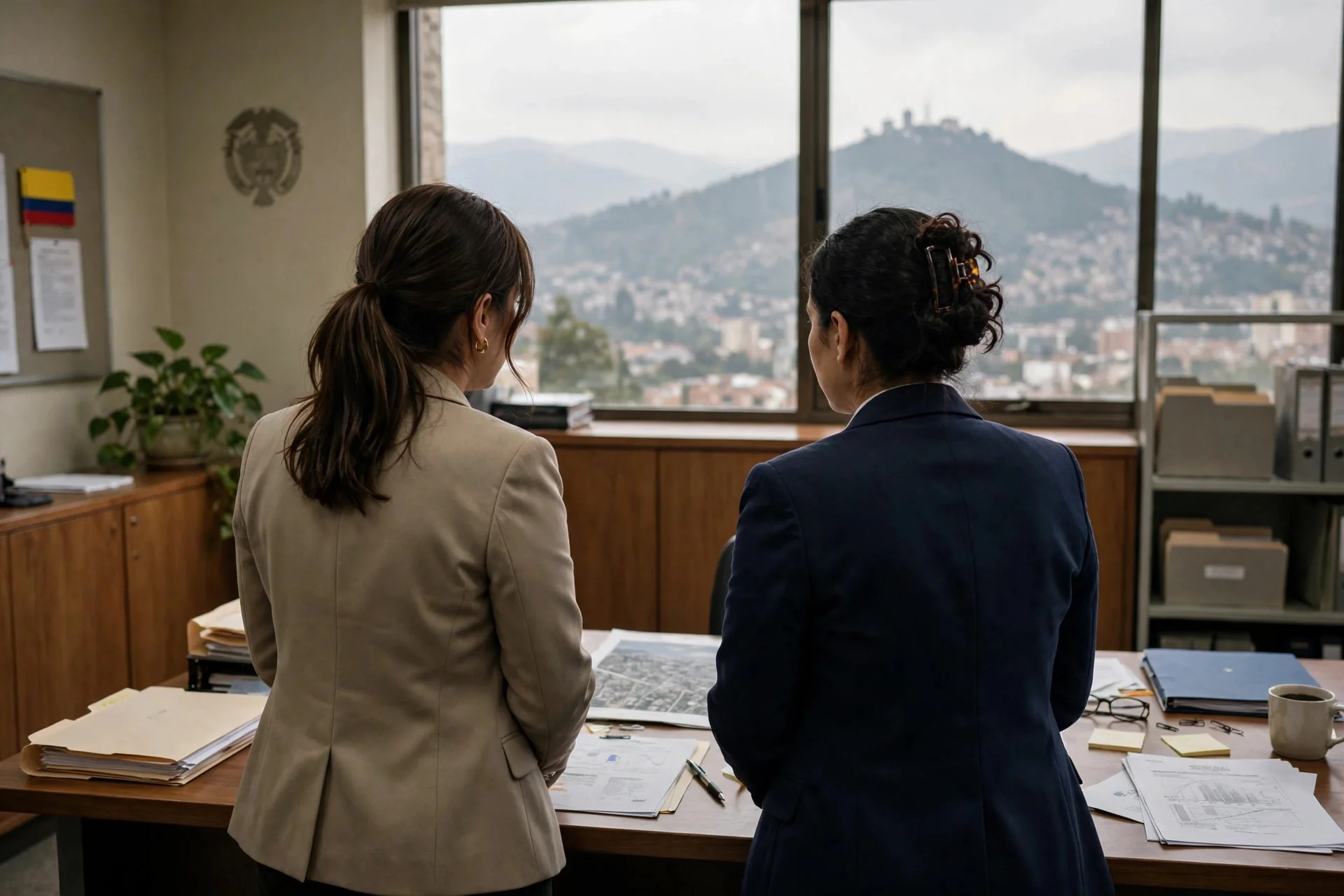
Ilustración alusiva al encuentro entre las dos denunciantes en Bogotá · Imagen generada para EPM
Angie Rodríguez and Deicy Jiménez coordinate reports on alleged network
According to Rodríguez, her meeting with Deicy Jiménez identified common elements between their complaints about an alleged network and alleged irregularities…
Complainants join efforts over alleged network in Petro government
According to Rodríguez, she and Deicy Jiménez identified common elements between their complaints about an alleged network and alleged contractual…
--- The context ---
Angie Rodríguez, former director of the Administrative Department of the Presidency, met on Wednesday, November 4, 2026, with Deicy Jiménez, who has reported an alleged sexual exploitation network and alleged deliveries of state contracts in exchange for sexual favors during the government of Gustavo Petro. These are unproven allegations, now before the authorities, with no judicial decision so far.
--- The facts ---
According to Rodríguez, the meeting was brief and made it possible to identify common elements between the claims both women have raised about alleged irregularities within the Presidency. According to Rodríguez, the two decided to coordinate actions to provide new data to the justice system.
According to Jiménez, her public complaints concern an alleged network and alleged irregularities in the delivery of state contracts, which, according to her complaint, would be linked to members of the Petro administration. Rodríguez raised questions about events that, according to her, would have occurred inside the Presidency.
Jiménez did not testify before the Prosecutor's Office at the proceeding scheduled for November 3, because her lawyer, Andrés Felipe Caballero, resigned from representing her for security reasons, after reporting threats. The proceeding was postponed, under Marcela Abadía, third prosecutor delegated to the Supreme Court, with no new date reported.
--- The positions ---
According to Caballero, his decision seeks to keep attention from drifting away from the safety of the complainant and of other possible declarants, and he said in public statements that the priority is ensuring they can testify and provide evidence.
Jiménez already testified before the Special Instruction Chamber of the Supreme Court on October 29, 2026, in a proceeding lasting nearly four hours. There, according to her testimony, she ratified her complaints about the alleged network, said she met the then senator in 2019 through an adult website, and mentioned former senator María José Pizarro, who, according to Jiménez, would have known the circumstances of her hiring into a Legislative Work Unit.
Among the contracts mentioned by the complainant is one for nearly $34 millones to support work for the First Vice Presidency of the Senate, then headed by Pizarro, always according to Jiménez. She also committed to hand over her cell phone for inspection by the Judicial Police, with the date still pending.
--- What remains unknown ---
Still unknown are the new date for the proceeding before the Prosecutor's Office, whether Jiménez will have new legal representation, and what the authorities will determine. The outcome of the committed cell phone inspection is also unknown.
--- Unanswered questions ---
When will the proceeding for Jiménez before the Prosecutor's Office be rescheduled? What new data will Rodríguez and Jiménez provide to the justice system, as they announced? What will the authorities determine about complaints that still have no judicial decision?
--- EPM analysis ---
The value of this meeting will be measured by concrete steps before the authorities, not by announcements. Coordinating accounts does not prove any fact: it is up to the Prosecutor's Office and the Supreme Court to test testimony, documents, and the contracts mentioned, with full guarantees for complainants and those named.
📌 EPM Take: In EPM's view, these complaints must be handled as what they are so far: serious allegations made by their complainants, pending before the authorities, with no judicial decision confirming or dismissing them. Protecting the safety of those who testify is essential, as is guaranteeing due process for every person named. The public deserves verified answers, with the presumption of innocence intact, and not early convictions built on accounts still to be tested.
--- The context ---
Angie Rodríguez, former director of the Administrative Department of the Presidency, met on Wednesday, November 4, 2026, with Deicy Jiménez, who has reported an alleged sexual exploitation network and alleged deliveries of state contracts in exchange for sexual favors during the government of Gustavo Petro. Everything known comes from both women's complaints: unproven allegations, pending before the authorities, with no judicial decision so far.
--- The facts ---
According to Rodríguez, the meeting was brief and made it possible to identify common elements between their claims about alleged irregularities within the Presidency. According to Rodríguez, the two decided to coordinate actions to provide new data to the justice system, because they consider that their complaints converge.
Jiménez has publicly reported the alleged network and alleged irregularities in state contracts that, according to her complaint, would be linked to members of the Petro administration. Rodríguez raised questions about events that, according to her, would have occurred inside the Presidency.
The complainant did not testify before the Prosecutor's Office at the proceeding scheduled for November 3, after her lawyer, Andrés Felipe Caballero, resigned from representing her for security reasons, after reporting threats. The proceeding was postponed, in the hands of Marcela Abadía, third prosecutor delegated to the Supreme Court, with no new date reported.
--- The positions ---
Caballero said in public statements that his decision seeks to keep attention from drifting away from the safety of the complainant and of other possible declarants, and that the priority is ensuring they can testify and provide further evidence.
Jiménez already testified before the Special Instruction Chamber of the Supreme Court on October 29, 2026, in a proceeding lasting nearly four hours. There, according to her testimony, she ratified her complaint about the alleged network, said she had met the then senator in 2019 through an adult website, and mentioned former senator María José Pizarro, who, according to Jiménez, would have known the circumstances of her hiring into a Legislative Work Unit.
Among the contracts mentioned by the complainant is one for nearly $34 millones to support work for the First Vice Presidency of the Senate, then headed by Pizarro, a detail that forms part of Jiménez's account, not an established fact. She also committed to hand over her cell phone for inspection by the Judicial Police, with the date still pending.
--- What remains unknown ---
Still to be known are when the proceeding will be rescheduled, who will take over Jiménez's legal representation, and what the authorities will conclude. Also pending are the committed cell phone inspection and any substantive ruling.
--- Unanswered questions ---
When will Jiménez testify before the Prosecutor's Office after the postponement? What concrete elements will the announced coordination between both complainants provide? What will the Prosecutor's Office and the Supreme Court establish about these still unproven claims?
--- EPM analysis ---
Institutional order requires complaints of this seriousness to move through the established channels: protected testimony, technical gathering of evidence, and reasoned decisions. Agreement between accounts does not replace proof, nor does the seriousness of what is reported authorize treating any person as guilty before a judge rules.
📌 EPM Take: In EPM's view, the country needs these complaints investigated to the end, with real protection for those who testify and strict respect for the presumption of innocence of every person named. So far there are allegations attributed to their complainants, proceedings under way, and no judicial decision. Confusing a complaint with a conviction weakens justice. Let the evidence speak, and let each conclusion arrive only when a formal ruling supports it.
Angie Rodríguez y Deicy Jiménez coordinan denuncias sobre presunta red
Según Rodríguez, su reunión con Deicy Jiménez permitió identificar elementos comunes entre sus denuncias sobre una presunta red y supuestas irregularidades en…
Denunciantes unen esfuerzos por presunta red en el Gobierno Petro
De acuerdo con Rodríguez, ella y Deicy Jiménez identificaron elementos comunes entre sus denuncias sobre una presunta red y supuestas irregularidades…
--- El contexto ---
La exdirectora del Departamento Administrativo de la Presidencia, Angie Rodríguez, se reunió el miércoles 4 de noviembre de 2026 con Deicy Jiménez, quien ha denunciado una presunta red de explotación sexual y supuestas entregas de contratación estatal a cambio de favores sexuales durante el gobierno de Gustavo Petro. Son denuncias no probadas, en curso ante las autoridades y sin decisión judicial alguna.
--- Los hechos ---
Según Rodríguez, el encuentro fue breve y permitió identificar elementos comunes entre los señalamientos que ambas han expuesto sobre presuntas irregularidades en la Presidencia. De acuerdo con Rodríguez, ambas decidieron coordinar acciones para aportar nuevos datos a la justicia.
Según lo expuesto por Jiménez, sus denuncias públicas se refieren a una supuesta red y a presuntas irregularidades en la entrega de contratos estatales, que según su denuncia se relacionarían con integrantes de la administración Petro. Rodríguez formuló cuestionamientos sobre hechos que, según ella, habrían ocurrido dentro de la Presidencia.
Jiménez no declaró ante la Fiscalía en la diligencia prevista para el 3 de noviembre, porque su abogado, Andrés Felipe Caballero, renunció a su representación por motivos de seguridad, tras denunciar amenazas. La diligencia quedó aplazada, a cargo de Marcela Abadía, fiscal tercera delegada ante la Corte Suprema, sin nueva fecha informada.
--- Las posiciones ---
Según Caballero, su decisión busca evitar que la atención se aparte de la seguridad de la denunciante y de otras posibles declarantes, y sostuvo en declaraciones públicas que lo prioritario es garantizar que puedan declarar y aportar elementos de prueba.
Jiménez ya declaró ante la Sala Especial de Instrucción de la Corte Suprema el 29 de octubre de 2026, en una diligencia de cerca de cuatro horas. Allí, según su testimonio, ratificó sus denuncias sobre la supuesta red, afirmó que conoció al entonces senador en 2019 a través de una página para adultos y mencionó a la exsenadora María José Pizarro, quien según Jiménez habría conocido las circunstancias de su vinculación a una Unidad de Trabajo Legislativo.
Entre los contratos mencionados por la denunciante figura uno por cerca de $34 millones para apoyar labores de la Primera Vicepresidencia del Senado, entonces encabezada por Pizarro, siempre según Jiménez. También se comprometió a entregar su teléfono celular para inspección de la Policía Judicial, con fecha pendiente.
--- Lo que falta saber ---
Falta conocer la nueva fecha de la diligencia ante la Fiscalía, si Jiménez contará con nueva representación judicial y qué determinen las autoridades. Tampoco se conoce el resultado de la inspección del teléfono celular comprometida.
--- Preguntas sin respuesta ---
¿Cuándo se reprogramará la diligencia de Jiménez ante la Fiscalía? ¿Qué nuevos datos aportarán Rodríguez y Jiménez a la justicia, según anunciaron? ¿Qué determinarán las autoridades sobre las denuncias, que siguen sin decisión judicial?
--- Análisis EPM ---
El valor de este encuentro se medirá en las actuaciones ante las autoridades, no en los anuncios. Coordinar versiones no prueba hecho alguno: corresponde a la Fiscalía y a la Corte Suprema contrastar testimonios, documentos y contratos mencionados, con plenas garantías para denunciantes y señalados.
📌 Conclusion EPM: A juicio de EPM, estas denuncias deben tramitarse como lo que son hasta ahora: señalamientos graves formulados por sus denunciantes, en curso ante las autoridades y sin decisión judicial que los confirme o los descarte. Proteger la seguridad de quien declara es indispensable, lo mismo que garantizar el debido proceso de toda persona mencionada. La ciudadanía merece respuestas verificadas, con presunción de inocencia intacta, y no condenas anticipadas sobre versiones aún por contrastar.
--- El contexto ---
Angie Rodríguez, exdirectora del Departamento Administrativo de la Presidencia, se reunió el miércoles 4 de noviembre de 2026 con Deicy Jiménez, denunciante de una presunta red de explotación sexual y de supuestas entregas de contratación estatal a cambio de favores sexuales durante el gobierno de Gustavo Petro. Todo proviene de las denuncias de ambas: son señalamientos no probados, en curso ante las autoridades y sin decisión judicial.
--- Los hechos ---
De acuerdo con Rodríguez, el encuentro fue breve y permitió identificar elementos comunes entre los señalamientos de ambas sobre presuntas irregularidades en la Presidencia. Según Rodríguez, decidieron coordinar acciones para aportar nuevos datos a la justicia, porque consideran que sus denuncias presentan convergencias.
Jiménez ha denunciado públicamente la supuesta red y presuntas irregularidades en contratos estatales que, según su denuncia, se relacionarían con integrantes de la administración Petro. Rodríguez formuló cuestionamientos sobre hechos que, según ella, habrían ocurrido dentro de la Presidencia.
La denunciante no declaró ante la Fiscalía en la diligencia prevista para el 3 de noviembre, luego de que su abogado, Andrés Felipe Caballero, renunciara a su representación por motivos de seguridad, tras denunciar amenazas. La diligencia quedó aplazada, en manos de Marcela Abadía, fiscal tercera delegada ante la Corte Suprema, sin nueva fecha informada.
--- Las posiciones ---
Caballero sostuvo en declaraciones públicas que su decisión busca que la atención no se aparte de la seguridad de la denunciante y de otras posibles declarantes, y que lo prioritario es garantizar que puedan declarar y aportar otros elementos de prueba.
Jiménez ya declaró ante la Sala Especial de Instrucción de la Corte Suprema el 29 de octubre de 2026, en diligencia de cerca de cuatro horas. Allí, según su testimonio, ratificó la denuncia de la supuesta red, afirmó haber conocido al entonces senador en 2019 a través de una página para adultos y mencionó a la exsenadora María José Pizarro, quien según Jiménez habría conocido su vinculación a una Unidad de Trabajo Legislativo.
Entre los contratos mencionados por la denunciante figura uno por cerca de $34 millones para apoyar labores de la Primera Vicepresidencia del Senado, entonces encabezada por Pizarro, dato que forma parte de la versión de Jiménez y no de un hecho establecido. Se comprometió además a entregar su teléfono celular para inspección de la Policía Judicial, con fecha pendiente.
--- Lo que falta saber ---
Aún falta saber cuándo se reprogramará la diligencia ante la Fiscalía, quién asumirá la representación de Jiménez y qué concluyan las autoridades. También está pendiente la inspección del teléfono celular comprometida y cualquier pronunciamiento de fondo.
--- Preguntas sin respuesta ---
¿Cuándo declarará Jiménez ante la Fiscalía tras el aplazamiento de la diligencia? ¿Qué elementos concretos aportará la coordinación anunciada entre ambas denunciantes? ¿Qué establecerán la Fiscalía y la Corte Suprema sobre estos señalamientos aún no probados?
--- Análisis EPM ---
El orden institucional exige que denuncias de esta gravedad avancen por los cauces previstos: declaración protegida, recaudo técnico de pruebas y decisiones motivadas. Ni la coincidencia entre versiones sustituye la prueba, ni la gravedad de lo denunciado autoriza a dar por culpable a persona alguna antes de un pronunciamiento judicial.
📌 Conclusion EPM: A juicio de EPM, el país necesita que estas denuncias se investiguen hasta el final, con protección real para quienes declaran y con respeto estricto por la presunción de inocencia de toda persona mencionada. Hasta ahora hay señalamientos atribuidos a sus denunciantes, diligencias en curso y ninguna decisión judicial. Confundir una denuncia con una condena debilita la justicia. Que hablen las pruebas y que cada conclusión llegue solo con un pronunciamiento formal que la sustente.