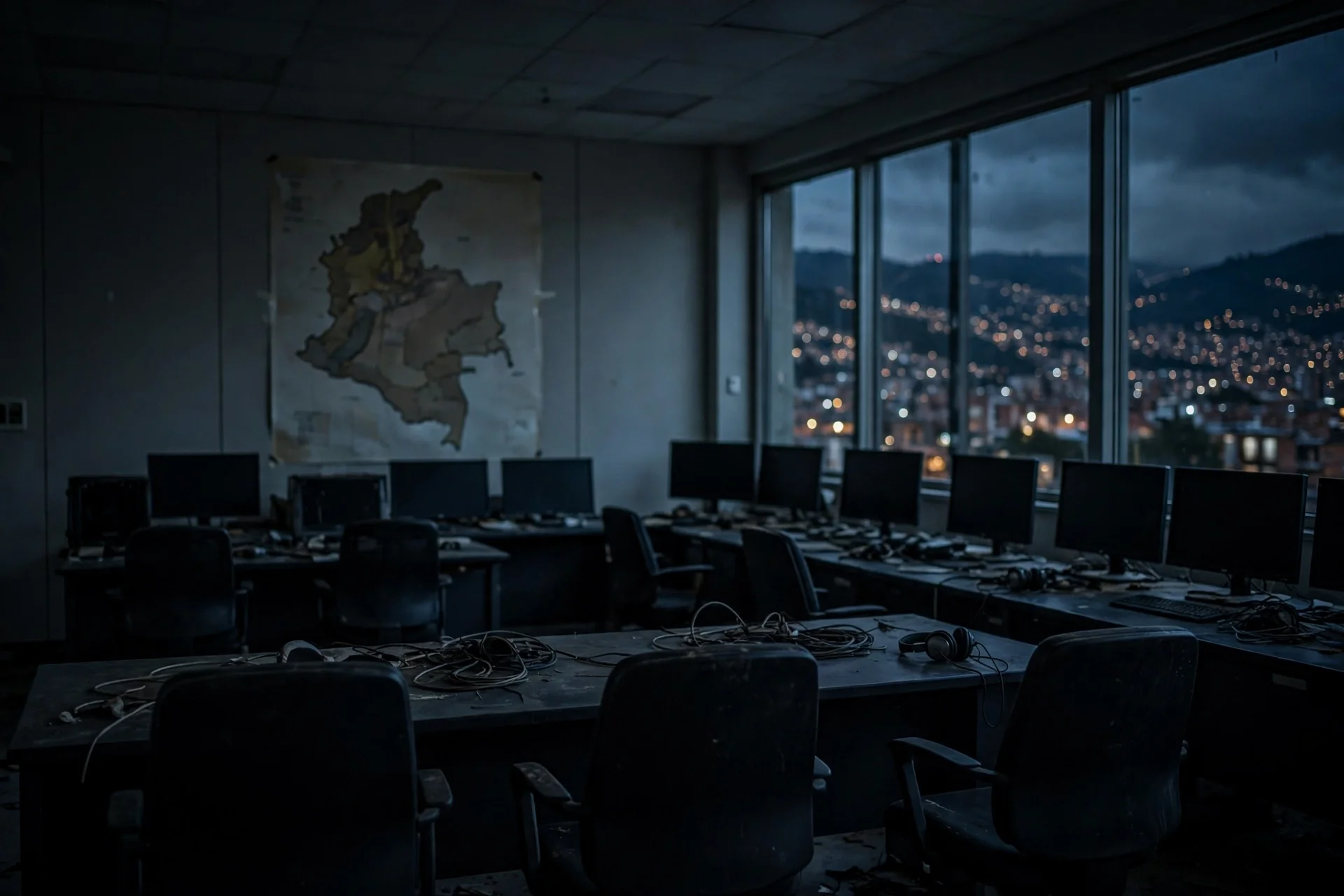
Una sala de inteligencia vacía, símbolo del desmantelamiento denunciado por el coronel retirado. · Imagen generada por EPM
Retired colonel alleges dismantling of Colombian military intelligence
Retired Colonel Tito González, a former counterintelligence chief, claims the weakening of military intelligence began in 2015 and deepened under Gustavo…
Former counterintelligence chief accuses Petro government over intelligence
Retired Colonel Tito González claims former Minister Iván Velásquez formed an advisory group to control intelligence through channels he calls illegal, asked…
--- The context ---
Retired Colonel Tito González, who says he had just handed over the counterintelligence command and served as chief of staff and acting commander, argues that Colombian military intelligence has suffered a long weakening that deepened critically under former President Gustavo Petro.
According to González, the starting point was 2015, during the peace agreement with the Farc, when strategic review exercises were carried out across Army subsystems. The colonel claims those exercises, known as CREI, produced direct damage to the capabilities of the military intelligence and counterintelligence system.
--- The facts ---
In González testimony, Colonel Juan Carlos Mazo led the transformation of intelligence between 2016 and 2018, an initiative that was presented as modernization but, according to the retired officer, ended up weakening and destroying capabilities, especially in the Army. González also claims that under former President Iván Duque he took part in a diagnostic exercise that detected close to 75 weaknesses in the system.
The retired colonel adds that, as he recalls, 57 percent of those weaknesses were linked to organization, institutional structure and the improper use of counterintelligence to pursue officers, a problem already structural before 2022.
González further claims that in 2022 former Defense Minister Iván Velásquez formed an advisory group that sought to influence selection processes for intelligence and counterintelligence officers. According to his version, that team intended to control the flow of information from all state agencies and bypassed the channels of the general commander of the Military Forces and the Army commander.
--- The positions ---
González describes former Minister Velásquez as the instigator of the dismantling and claims he handled counterintelligence directly against officers he considered untrustworthy. These are claims by the retired colonel, presented strictly as his version.
The colonel also recounts that he was asked for information on possible irregularities involving Colonel Sarmiento and Generals González Lamprea and Zapateiro. González claims he identified the request as pressure and that his assignment in the United States was suspended by order of Minister Velásquez.
--- What remains unknown ---
The testimony includes no documents that independently verify each claim about the advisory group, the alleged parallel structure including the National Intelligence Directorate, or the orders González attributes to the former minister. It also includes no responses from Velásquez or Mazo.
It also remains unclear how much of the weakening came from budget decisions, technical gaps or personnel decisions, three factors González cites as part of the initial blow.
--- Unanswered questions ---
Why, according to González, did a review exercise born in 2015 end up damaging intelligence and counterintelligence capabilities for years?
Are there documents or additional witnesses confirming that the advisory group sought to control agencies outside institutional channels?
What response do former Minister Velásquez and Colonel Mazo offer to the claims that they tried to build a parallel and illegal structure?
Who ordered the suspension of the United States assignment that González claims was cancelled, and on what grounds?
--- EPM analysis ---
The value of this testimony lies in its source: it comes, by his own account, from the officer who commanded counterintelligence and took part in the Duque diagnostic. His narrative connects 2015, the period from 2016 to 2018 and 2022 in a single line of weakening. Its evidentiary strength is limited because it rests on a single voice, without documents shown, so each claim must be read as an attributed allegation rather than an established conclusion.
📌 EPM Take: In EPM's view, González testimony deserves serious attention because it describes concrete mechanisms, precise dates and a prior diagnostic with 75 weaknesses that merit rigorous public verification. The gravity of claiming that information was sought through illegal channels requires documents, responses from those named and institutional oversight, not only the memory of the protagonists. Protecting intelligence capabilities within the law is a task for the entire state, and any reform, wherever it comes from, must strengthen professional suitability, the chain of command and legality without turning counterintelligence into an instrument of internal persecution under any circumstances whatsoever.
--- The context ---
Retired Colonel Tito González, a former counterintelligence chief by his account, claims military intelligence suffered a progressive dismantling that began in 2015 and deepened under former President Gustavo Petro, with loss of suitability, budget gaps and no technical upgrades.
González places the origin in strategic review exercises carried out during the peace agreement with the Farc. According to the colonel, the committees known as CREI produced direct damage to the capabilities of the intelligence and counterintelligence system, harm that, in his judgment, no later government corrected in time.
--- The facts ---
According to González, Colonel Juan Carlos Mazo led the transformation of intelligence between 2016 and 2018, a process presented as modernization that, in his version, ended up weakening and destroying capabilities, especially in the Army. The retired colonel adds that under former President Iván Duque a diagnostic exercise in which he participated detected close to 75 weaknesses in the system.
From that diagnostic, González recalls that 57 percent were related to organization, institutional structure and the improper use of counterintelligence to pursue officers. For him, counterintelligence was diverted from its mission and used against uniformed personnel themselves.
The colonel claims that in 2022 former Defense Minister Iván Velásquez formed an advisory group that sought to influence officer selection and tried to control the entire flow of intelligence and counterintelligence information. According to his testimony, that group bypassed the channels of the general commander and the Army commander and intended to create a parallel structure reaching even the National Intelligence Directorate, an initiative González calls illegal and illegitimate because, in his judgment, it contravened the intelligence law.
--- The positions ---
González argues that Velásquez was the instigator of the dismantling and that, with Mazo as adviser, counterintelligence was steered against officers considered untrustworthy. These are claims by the retired colonel, presented as his version and not as proven facts.
González also claims he was asked for information on Colonel Sarmiento and Generals González Lamprea and Zapateiro, identified the request as pressure, had his assignment in the United States suspended by order of Velásquez, and says Mazo had no authority to request that information.
--- What remains unknown ---
The piece provides no documents proving the orders attributed to the former minister or the creation of the advisory group, and it does not include the version of Velásquez or Mazo. Without that counterpoint, the claims remain allegations attributed to a retired officer.
It also remains to be specified which personnel decisions affected officers selected for courses and promotions to lieutenant colonel who were removed, dismissed or not called, and the impact of the budget and technical gaps denounced.
--- Unanswered questions ---
Will González present documents or witnesses supporting that counterintelligence information was sought through illegal channels?
What do former Minister Velásquez and Colonel Mazo say about the alleged parallel structure to control intelligence agencies?
How can it be explained that a diagnostic with 75 weaknesses did not lead to a complete correction before 2022?
Why was the United States assignment of an officer who had just handed over the counterintelligence command suspended?
--- EPM analysis ---
The allegation touches the nerve of any serious state: without suitable and legal intelligence, security goes blind. González describes parallel control, bypassing of the chain of command and internal use of counterintelligence, practices that, if confirmed, erode the effectiveness and legitimacy of the Military Forces. His account also warns the damage began in 2015, not 2022.
📌 EPM Take: In EPM's view, González claims must be investigated with the seriousness national security demands, because a country cannot afford weakened intelligence or counterintelligence used against its own officers. Each allegation needs documentary proof, a hearing for those named and institutional decisions that restore suitability, budget and technology without illegal shortcuts. The chain of command exists to protect both the mission and legality, and bypassing it from a ministerial office, as the colonel claims, would be a grave rupture that Colombia cannot normalize or repeat in the future under any government or political pretext whatsoever.
Coronel retirado denuncia desmantelamiento de la inteligencia militar en Colombia
El coronel retirado Tito González, exjefe de contrainteligencia, afirma que el debilitamiento de la inteligencia militar comenzó en 2015 y se profundizó bajo…
Exjefe de contrainteligencia acusa al Gobierno Petro de destruir la inteligencia
El coronel retirado Tito González afirma que el exministro Iván Velásquez conformó un grupo asesor para controlar la inteligencia por canales que califica de…
--- El contexto ---
El coronel retirado Tito González, quien según su relato acababa de entregar el comando de contrainteligencia y ejercía como jefe de Estado Mayor y comandante encargado del Comando de Contrainteligencia, sostiene que la inteligencia militar atraviesa un debilitamiento de larga data que se profundizó bajo el expresidente Gustavo Petro.
Según González, el punto de partida se remonta a 2015, en el marco del acuerdo de paz con las Farc, cuando se adelantaron ejercicios de revisión estratégica. El coronel afirma que esos ejercicios, conocidos como CREI, generaron afectaciones directas a las capacidades de inteligencia y contrainteligencia.
--- Los hechos ---
De acuerdo con el testimonio de González, entre 2016 y 2018 el coronel Juan Carlos Mazo lideró la transformación de la inteligencia, una iniciativa que, según él, se presentó como modernización pero terminó debilitando el sistema. González afirma que en el Gobierno de Iván Duque participó en un diagnóstico que detectó cerca de 75 debilidades.
El coronel precisa que el 57 por ciento se relacionaba con organización, estructura institucional y uso indebido de la contrainteligencia para perseguir a oficiales, un problema ya estructural antes de 2022.
González afirma además que en 2022 el exministro de Defensa Iván Velásquez conformó un grupo asesor que buscó incidir en la selección de oficiales. Según su versión, ese equipo pretendía controlar el flujo de información de todos los organismos y se saltaba los canales del comandante general y del comandante del Ejército.
--- Las posiciones ---
En su testimonio, González califica al exministro Velásquez como instigador de la desarticulación y sostiene que manejaba directamente la contrainteligencia contra oficiales que consideraba no confiables. Son afirmaciones del coronel retirado, presentadas estrictamente como su versión.
El coronel también relata que le pidieron información sobre posibles irregularidades del coronel Sarmiento y los generales González Lamprea y Zapateiro. González afirma que identificó la solicitud como un abordaje para presionarlo y que su comisión en Estados Unidos le fue suspendida por orden del ministro Velásquez.
--- Lo que falta saber ---
El testimonio no incluye documentos que permitan verificar cada afirmación sobre el grupo asesor, la supuesta estructura paralela incluida la Dirección Nacional de Inteligencia, ni las órdenes atribuidas al exministro. Tampoco se conocen respuestas de Velásquez ni de Mazo frente a estos señalamientos.
Tampoco queda claro qué parte del debilitamiento obedeció a decisiones presupuestales, qué parte a la falta de actualización técnica y qué parte a decisiones de personal, tres factores que González menciona como parte de la estocada inicial.
--- Preguntas sin respuesta ---
¿Por qué, según González, un ejercicio de revisión nacido en 2015 terminó afectando de forma duradera las capacidades de inteligencia y contrainteligencia?
¿Existen documentos que confirmen que el grupo asesor buscó controlar los organismos por fuera de los canales institucionales?
¿Qué respuesta ofrecen el exministro Velásquez y el coronel Mazo ante las afirmaciones de que intentaron crear una estructura paralela e ilegal?
¿Quién ordenó suspender la comisión en Estados Unidos que González afirma que le fue cancelada?
--- Análisis EPM ---
El valor de este testimonio está en su origen: proviene, según su relato, de quien comandó la contrainteligencia y participó en el diagnóstico del Gobierno de Duque. Su relato conecta 2015, el periodo 2016 a 2018 y 2022 en una sola línea de debilitamiento. Al mismo tiempo, su fuerza probatoria es limitada porque descansa en una sola voz, sin documentos exhibidos, por lo que cada afirmación debe leerse como denuncia atribuida y no como conclusión establecida.
📌 Conclusion EPM: A juicio de EPM, el testimonio de González obliga a tomar en serio la alerta sobre la inteligencia militar porque describe mecanismos concretos, fechas precisas y un diagnóstico previo con 75 debilidades que merecen verificación pública y rigurosa. La gravedad de afirmar que se buscó información por canales ilegales exige documentos, respuestas de los señalados y control institucional, no solo memoria de los protagonistas. Proteger las capacidades de inteligencia dentro de la ley es una tarea del Estado entero, y cualquier reforma, venga de donde venga, debe fortalecer la idoneidad profesional, la cadena de mando y la legalidad sin convertir la contrainteligencia en instrumento de persecución interna bajo ninguna circunstancia.
--- El contexto ---
El coronel retirado Tito González, exjefe de contrainteligencia según su relato, afirma que la inteligencia militar sufrió un desmantelamiento progresivo que comenzó en 2015 y se profundizó bajo el expresidente Gustavo Petro, con pérdida de idoneidad, falta de presupuesto y ausencia de actualización técnica.
González sitúa el origen en los ejercicios de revisión estratégica del acuerdo de paz con las Farc. Según el coronel, los comités conocidos como CREI produjeron afectaciones directas a las capacidades de inteligencia y contrainteligencia, un daño que ningún gobierno posterior corrigió a tiempo.
--- Los hechos ---
Según González, el coronel Juan Carlos Mazo lideró la transformación de la inteligencia entre 2016 y 2018, un proceso que, en su versión, terminó destruyendo capacidades en el Ejército. El coronel retirado añade que en el Gobierno del expresidente Iván Duque un diagnóstico en el que participó detectó cerca de 75 debilidades del sistema.
De ese diagnóstico, González recuerda que el 57 por ciento se relacionaba con la organización, la estructura institucional y el uso indebido de la contrainteligencia para perseguir a oficiales. Para el entrevistado, la contrainteligencia se desvió de su misión y se usó contra los propios uniformados.
El coronel afirma que en 2022 el exministro Iván Velásquez conformó un grupo asesor que buscó incidir en la selección de oficiales y controlar el flujo de información. Según su testimonio, ese grupo se saltaba los canales del comandante general y del comandante del Ejército y pretendía crear una estructura paralela que alcanzara incluso a la Dirección Nacional de Inteligencia, iniciativa que González califica de ilegal e ilegítima.
--- Las posiciones ---
González sostiene que Velásquez fue el instigador de la desarticulación y que, con Mazo como asesor, se direccionó la contrainteligencia contra oficiales considerados no confiables. Son afirmaciones del coronel retirado, presentadas como su versión y no como hechos probados.
González afirma además que le pidieron información sobre el coronel Sarmiento y los generales González Lamprea y Zapateiro, que identificó la solicitud como un abordaje para presionarlo, que su comisión en Estados Unidos fue suspendida por orden de Velásquez y que Mazo no tenía facultad para pedir esa información.
--- Lo que falta saber ---
La pieza no aporta documentos que acrediten las órdenes atribuidas al exministro ni la conformación del grupo asesor, y no incluye la versión de Velásquez ni de Mazo. Sin ese contraste, las afirmaciones quedan como denuncia atribuida a un oficial retirado.
También falta precisar qué decisiones de personal afectaron a oficiales seleccionados para cursos y ascensos a teniente coronel que fueron desvinculados, destituidos o no llamados, así como el impacto de la falta de presupuesto y de actualización técnica.
--- Preguntas sin respuesta ---
¿Presentará González documentos o testimonios que respalden que se buscó información de contrainteligencia por canales ilegales?
¿Qué dicen el exministro Velásquez y el coronel Mazo sobre la supuesta estructura paralela para controlar los organismos de inteligencia?
¿Cómo se explica que un diagnóstico con 75 debilidades no derivara en una corrección completa antes de 2022?
¿Por qué se suspendió la comisión en Estados Unidos de un oficial que acababa de entregar el comando de contrainteligencia?
--- Análisis EPM ---
La denuncia toca el nervio de cualquier Estado serio: sin inteligencia idónea y legal, la seguridad queda ciega. González describe un patrón de control paralelo, bypass de la cadena de mando y uso interno de la contrainteligencia, prácticas que, de confirmarse, erosionan la eficacia y la legitimidad de las Fuerzas Militares. Su relato advierte además que el daño no empezó en 2022, sino en 2015.
📌 Conclusion EPM: A juicio de EPM, las afirmaciones de González deben investigarse con la seriedad que exige la seguridad nacional, porque un país no puede permitirse una inteligencia debilitada ni una contrainteligencia usada contra sus propios oficiales. Cada señalamiento necesita prueba documental, contradicción de los señalados y decisiones institucionales que restauren la idoneidad, el presupuesto y la tecnología sin atajos ilegales. La cadena de mando existe para proteger tanto la misión como la legalidad, y saltársela desde un despacho ministerial, como afirma el coronel, sería una ruptura grave que Colombia no puede normalizar ni repetir en el futuro bajo ningún gobierno ni pretexto político.