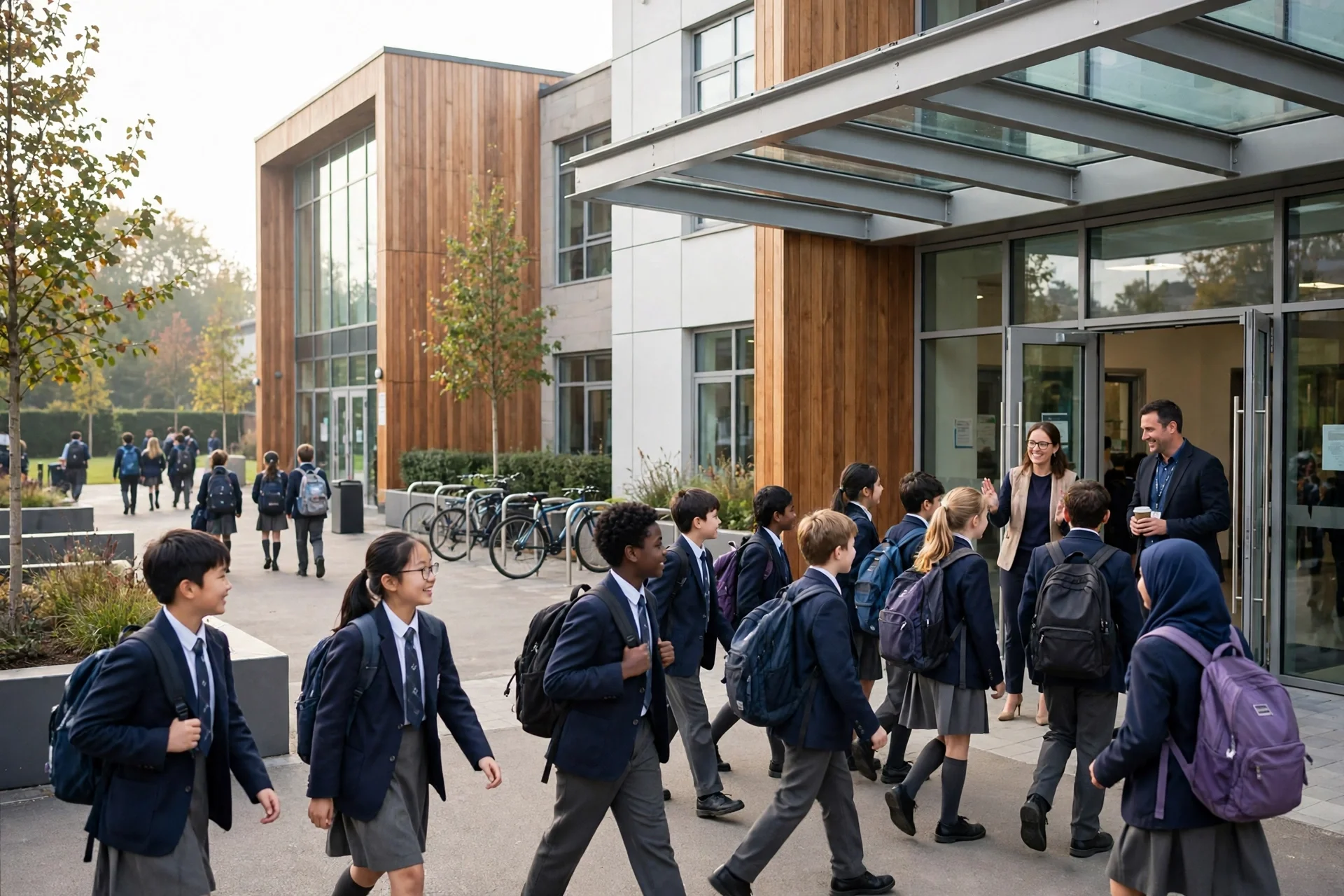
Alumnos entrando en un centro de secundaria por la mañana. Imagen generada.
UK protects early secondary years to re-engage pupils at risk
The UK government will restore Key Stage 3 as a distinct three-year phase, slim over-crowded content and curb early GCSE preparation to tackle disengagement…
Britain restores order and standards to early secondary schooling
Britain will restore the first three years of secondary school as a distinct phase, sequence a slimmer curriculum, raise expectations in core skills and stop…
--- The context ---
Too many children are switching off in their early teens, with consequences for attendance, attainment and life outcomes. Others miss the rich specialist teaching they should expect at secondary school, or are rushed through content before grasping the fundamentals. Growing evidence has pushed the government to give the first years of secondary school a distinct focus.
--- The facts ---
The government announced that focus as part of its major review of the National Curriculum, alongside plans to tackle disengagement, the disadvantage gap and the rising number of young people not in education, employment or training. It will restore Key Stage 3, the first three years of secondary school, as a distinct three-year phase. The new curriculum, developed by subject experts and due in full later this year, will slim down over-crowded content and sequence it better across all stages.
The plan raises expectations in oracy and confident speaking, reading fluently and for pleasure, and numeracy. It promises a more engaging offer in drama, physical education, music and modern foreign languages, alongside technical and digital skills. New expectations will stop schools encroaching on Key Stage 3 with an ever earlier focus on GCSEs, the secondary examinations. More than half of teachers say GCSE courses dominate the first three years, though that content is not intended until Year 10, with some schools starting in Year 7. Persistent absence almost doubles between Year 7 and Year 9 to one in four children.
--- The positions ---
Education Secretary Lucy Powell argued in indirect terms that those years should be a time of excitement for broader specialist teaching, while warning of disengagement, persistent absence and a stubborn disadvantage gap. Sir Hamid Patel, co-chair of the Independent Inquiry into White Working-Class Educational Outcomes, said research found huge challenges in Key Stage 3 and welcomed renewal of the phase. Baroness Estelle Morris, the inquiry co-chair, highlighted transition problems and disengagement. Becks Boomer-Clark, chief executive of Lift Schools, said protecting these years could transform trajectories for those at greatest risk of disengaging.
--- What remains unknown ---
The full curriculum is still to come later this year, so final sequencing and detailed expectations remain unknown. The new enrichment framework, meant to make space for experiences from practical experiments to debate, has been announced but its practical detail is not yet set out. The inquiry into white working-class outcomes also said it would soon bring fresh plans, whose measures have not yet been published.
--- Unanswered questions ---
Will a distinct three-year phase bring back pupils already switching off in their early teens? Can schools cut persistent absence, which now reaches one in four children by Year 9? Will the gap narrow for white working-class pupils, whose persistent absence rates are 75% higher in secondary than in primary? And will richer experiences make school a place where all children want to be?
--- EPM analysis ---
Disengagement builds quietly when lessons feel rushed, narrow or disconnected from any passion a young person might discover. Treating Key Stage 3 as valuable in itself, with time for depth and exploration, gives schools a chance to intervene before absence hardens into leaving education altogether. The test will be whether pupils at greatest risk feel that change daily.
📌 EPM Take: In EPM's view, restoring the first three years of secondary school as a phase worth protecting is the right response to a quiet emergency of disengagement and absence. A less crowded and better sequenced curriculum can give every child, and especially those facing disadvantage, time to understand deeply, speak confidently and discover what excites them. The commitment to white working-class pupils is significant because their outcomes have too often been overlooked. What counts now is delivery in real classrooms, sustained over time, so that more young people stay engaged, attend regularly and leave school ready to thrive.
--- The context ---
Examinations matter, but when preparation takes over too early, schooling loses sequence and purpose. In the first years of secondary school, an over-crowded curriculum and an ever earlier focus on exams are narrowing learning and rushing pupils forward before fundamentals are secure. The government now proposes to restore structure, core knowledge and clear expectations to that phase.
--- The facts ---
The government announced a distinct focus on the first years of secondary school as part of its major review of the National Curriculum. It will restore Key Stage 3, the first three years of secondary school, as a distinct three-year phase. The new curriculum, developed by subject experts and due in full later this year, will slim down over-crowded content and sequence it better across all stages, creating more space for deeper understanding and richer experiences.
That structure comes with higher expectations in oracy and confident speaking, reading fluently and for pleasure, and numeracy, plus a more engaging offer in drama, physical education, music and modern foreign languages, alongside technical and digital skills. Schools will also face new expectations to stop encroaching on Key Stage 3 with an early focus on GCSEs, the secondary examinations. More than half of teachers say GCSE courses dominate the first three years though the content is not intended until Year 10, and some schools start in Year 7. Persistent absence almost doubles between Year 7 and Year 9 to one in four children.
--- The positions ---
Education Secretary Lucy Powell said in indirect terms that GCSE pressures and an overcrowded curriculum are narrowing the offer and rushing children towards exams without grasping fundamentals, and that she is putting a stop to that. Sir Hamid Patel, co-chair of the Independent Inquiry into White Working-Class Educational Outcomes, welcomed commitment to renewing a phase where huge challenges were found. Baroness Estelle Morris, his fellow co-chair, pointed to transition problems and disengagement. Becks Boomer-Clark, of Lift Schools, stressed this is not about lowering expectations but about building secure foundations in knowledge.
--- What remains unknown ---
Important specifics remain unpublished because the full curriculum will only appear later this year. Schools still need the final wording on not starting GCSE specifications early for large cohorts, not narrowing options earlier and not entering pupils earlier for exams, while teachers retain flexibility to stretch high achievers. The detail of the enrichment framework and the inquiry further plans also remain to be seen.
--- Unanswered questions ---
Will better sequencing ensure pupils truly master fundamentals before examination pressure begins? Will schools stop narrowing options early in practice, not only on paper? Can persistent absence be brought down, including for white working-class children whose rates are 75% higher in secondary than in primary? And will higher expectations in reading, speaking and numeracy be upheld in every classroom?
--- EPM analysis ---
Good schooling means doing the right thing at the right time. Secure foundations, broad knowledge and confident reading and speaking are the precondition for later achievement, not obstacles to it. By protecting Key Stage 3 from premature examination pressure while raising expectations in the essentials, the reform restores a sensible order. Its credibility will rest on disciplined implementation and honest measurement.
📌 EPM Take: In EPM's view, the strength of this reform lies in its order, because it puts foundations first, breadth second and examination pressure only in its proper place. Raising expectations in fluent reading, confident speaking and numeracy is exactly where a serious curriculum should start. Stopping the early invasion of GCSE courses protects pupils options and gives teachers time to teach for understanding rather than haste. If the full publication holds that line and schools are held to it, early secondary education can recover the rigour, clarity and steady progress that families have every right to expect.
Reino Unido protege los primeros años de secundaria frente a los GCSE
El Gobierno británico restaurará el Key Stage 3 como fase distinta de tres años, reducirá contenidos sobrecargados y frenará la preparación anticipada para los…
Londres eleva la exigencia y ordena el currículo de secundaria inicial
Reino Unido restaurará los primeros tres años de secundaria como fase propia, ordenará un currículo sobrecargado, elevará expectativas en lectura, expresión…
--- El contexto ---
Demasiados alumnos se desconectan al inicio de la adolescencia, con efectos sobre asistencia, rendimiento y oportunidades futuras. Otros reciben una enseñanza más estrecha de lo esperado en secundaria o avanzan con prisas sin dominar los fundamentos. Ese diagnóstico, apoyado en evidencias crecientes, está detrás del anuncio del Gobierno británico sobre los primeros años de secundaria.
--- Los hechos ---
El Gobierno anunció un enfoque específico para esa etapa dentro de su amplia revisión del currículo nacional. Restaurará el Key Stage 3, los primeros tres años de secundaria, como una fase distinta de tres años. El nuevo currículo nacional, desarrollado por expertos y cuya publicación completa está prevista para más adelante este año, reducirá contenidos sobrecargados y los ordenará mejor en todas las etapas para dar más espacio a la comprensión profunda y a experiencias más ricas.
El plan eleva expectativas en expresión oral y hablar con confianza, lectura fluida y por placer y numeración. Promete una oferta más atractiva en teatro, educación física, música y lenguas extranjeras modernas, junto a habilidades técnicas y digitales. También frenará la invasión del Key Stage 3 por la preparación anticipada para los GCSE, los exámenes de secundaria. Más de la mitad de los docentes afirma que los GCSE ya dominan los primeros tres años, aunque no deberían empezar hasta Year 10, y algunas escuelas los inician en Year 7. El absentismo persistente casi se duplica entre Year 7 y Year 9 hasta uno de cada cuatro niños.
--- Las posiciones ---
La secretaria de Educación, Lucy Powell, defendió en términos indirectos que esos años deberían ser de entusiasmo por aprender y lamentó la desconexión, el absentismo persistente y la brecha de desventaja. Sir Hamid Patel, copresidente de la investigación independiente sobre la clase trabajadora blanca, señaló que allí debería crecer el amor por aprender con un currículo amplio, pero que demasiados niños de ese grupo se desconectan, y valoró la renovación. La baronesa Estelle Morris, también copresidenta, subrayó los problemas de transición de primaria a secundaria. Becks Boomer-Clark, de Lift Schools, afirmó que esos años son una fase crítica por sí misma y no solo preparación para los GCSE.
--- Lo que falta saber ---
Aún no se conoce el texto completo del nuevo currículo, previsto para más adelante este año, por lo que faltan los detalles finales de secuenciación por etapas. Tampoco se ha detallado cómo se aplicará el nuevo marco de enriquecimiento, pensado para experiencias como experimentos prácticos y debate. La investigación sobre la clase trabajadora blanca anunció que presentará pronto nuevos planes, cuyo contenido aún no se conoce.
--- Preguntas sin respuesta ---
¿Logrará el nuevo currículo mantener el interés durante los primeros tres años de secundaria? ¿Reducirá el absentismo persistente, que hoy alcanza a uno de cada cuatro niños en Year 9? ¿Podrán las escuelas frenar la preparación anticipada para los GCSE sin perder exigencia? ¿Mejorarán los resultados de los niños blancos de clase trabajadora, cuyas tasas de absentismo persistente son 75% más altas en secundaria que en primaria?
--- Análisis EPM ---
Tratar el inicio de la secundaria como etapa propia y no como trámite hacia los exámenes ataca una causa temprana de desconexión que luego se traduce en absentismo y en jóvenes que no estudian, no trabajan ni se forman. Su éxito dependerá de que la protección anunciada llegue a las aulas con un currículo menos saturado y experiencias que devuelvan motivos para estar en la escuela.
📌 Conclusion EPM: A juicio de EPM, proteger los primeros tres años de secundaria es una corrección necesaria porque allí se decide, en silencio, buena parte del futuro educativo de un niño. Si el currículo se aligera, se ordena mejor y deja espacio para comprender antes de examinar, la escuela puede recuperar a quienes hoy se apagan demasiado pronto. La medida acierta al mirar de frente la brecha que afecta al alumnado blanco de clase trabajadora y al vincular asistencia, interés y oportunidades. Ahora falta que la publicación completa confirme el alcance real y que las escuelas sostengan el cambio sin convertirlo en otro anuncio bien intencionado.
--- El contexto ---
La preparación para los exámenes ocupa un espacio que no le corresponde en los primeros años de secundaria. Contenidos de etapas posteriores entran cada vez antes, la oferta se estrecha y muchos alumnos pasan sin dominar los fundamentos. Frente a esa deriva, el Gobierno plantea recuperar orden, secuencia y expectativas claras desde el inicio de la secundaria.
--- Los hechos ---
El Gobierno anunció un enfoque distinto para esa etapa en su amplia revisión del currículo nacional. Restaurará el Key Stage 3, los primeros tres años de secundaria, como fase distinta de tres años. El nuevo currículo, desarrollado por expertos y que se publicará completo más adelante este año, reducirá el contenido sobrecargado y lo secuenciará mejor en todas las etapas para dar más espacio a comprensión profunda, experiencias más ricas y progreso real.
Habrá expectativas más altas en expresión oral y hablar con confianza, leer con fluidez y por placer y numeración, y una oferta más atractiva en teatro, educación física, música y lenguas extranjeras modernas, además de habilidades técnicas y digitales. Se fijan además nuevas expectativas para detener la invasión del Key Stage 3 por los GCSE, los exámenes de secundaria. Más de la mitad de los docentes sostiene que los GCSE dominan los primeros tres años, pese a que no deberían comenzar hasta Year 10, y algunas escuelas empiezan en Year 7. El absentismo persistente casi se duplica entre Year 7 y Year 9 hasta uno de cada cuatro niños.
--- Las posiciones ---
La secretaria de Educación, Lucy Powell, sostuvo en forma indirecta que las presiones de los GCSE y un currículo sobrecargado estrechan la oferta y empujan hacia los exámenes sin dominar fundamentos, y aseguró que pondrá fin a esa práctica. Sir Hamid Patel, copresidente de la investigación sobre la clase trabajadora blanca, advirtió que allí se concentran enormes desafíos y demasiados niños se desconectan. La baronesa Estelle Morris, copresidenta, recordó los problemas de transición y desconexión en esos años. Becks Boomer-Clark, de Lift Schools, recalcó que proteger esta fase no baja las expectativas, sino que permite construir bases seguras.
--- Lo que falta saber ---
El detalle decisivo aún no está sobre la mesa porque el currículo completo se publicará más adelante este año. Falta la secuencia final por materias, el alcance de no iniciar especificaciones de GCSE para grupos grandes y cómo se mantendrá la flexibilidad para estirar al alumnado avanzado sin estrechar opciones. También están pendientes el marco de enriquecimiento y los próximos planes de la investigación sobre la clase trabajadora blanca.
--- Preguntas sin respuesta ---
¿Bastará reordenar el contenido para dominar de verdad los fundamentos antes de los exámenes? ¿Cumplirán las escuelas no anticipar los GCSE ni estrechar opciones antes de tiempo? ¿Se reducirá el absentismo persistente, que en niños blancos de clase trabajadora es 75% más alto en secundaria que en primaria? ¿Se mantendrá la exigencia en lectura, expresión oral y numeración en todas las aulas?
--- Análisis EPM ---
Una escuela seria no confunde prisa con rigor. Adelantar exámenes sin bases firmes produce alumnos frágiles en comprensión, lectura y cálculo. Al devolver al Key Stage 3 su carácter propio, exigir más en lo esencial y reservar los GCSE para su momento, la reforma recupera el orden educativo. Su prueba será si cada centro sostiene la secuencia y rinde cuentas por asistencia y progreso.
📌 Conclusion EPM: A juicio de EPM, el acierto de este plan está en el orden que impone, porque primero vienen los fundamentos, después la amplitud y solo al final la presión del examen. Exigir lectura fluida, expresión oral segura y numeración sólida no es un adorno, es la base sin la cual todo lo demás se tambalea. Frenar la invasión anticipada de los GCSE devuelve criterio a los primeros tres años y protege opciones futuras. Si el Gobierno mantiene esa disciplina en la publicación completa y en su aplicación, la secundaria inicial ganará en rigor, en claridad y en resultados verificables.