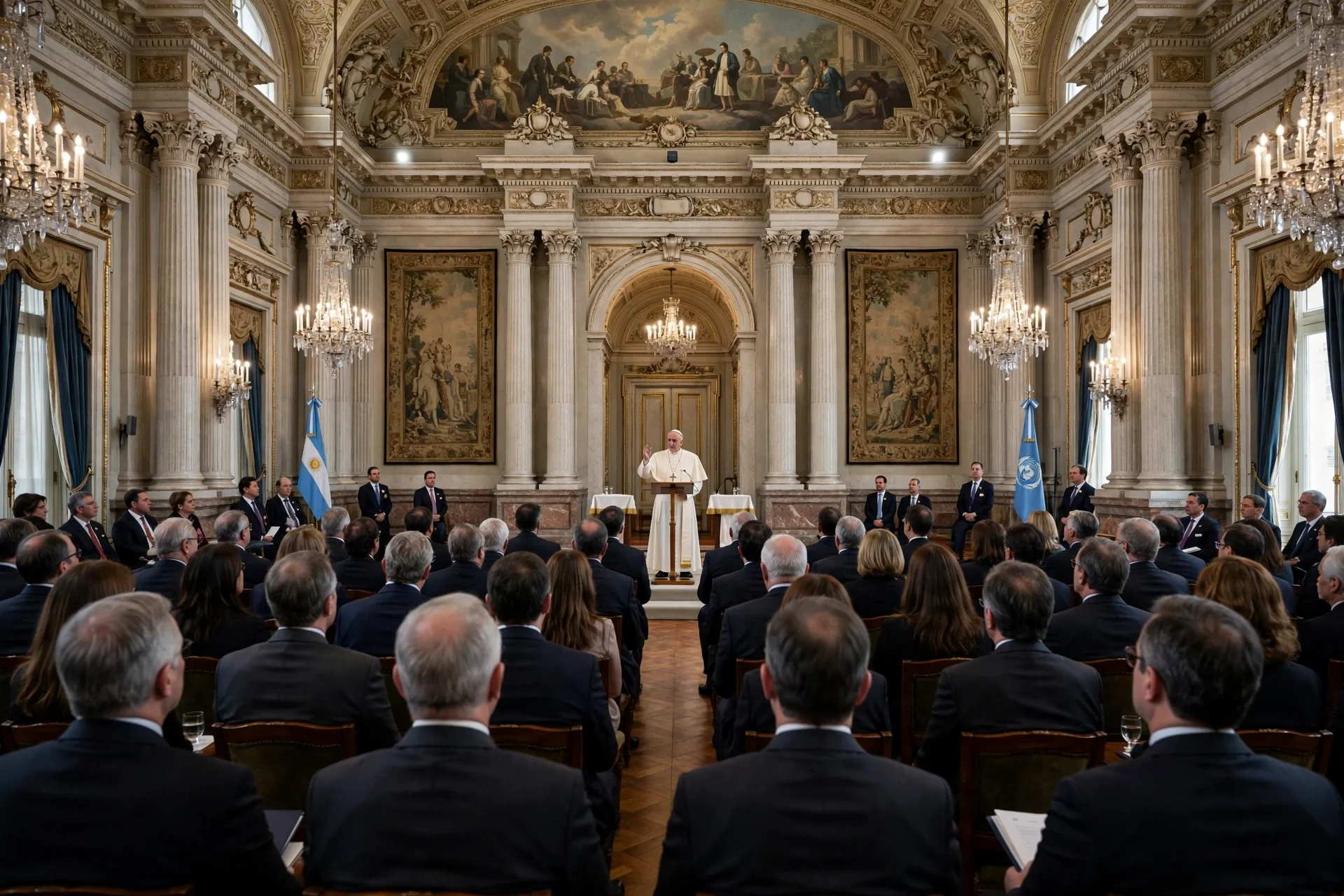
Imagen generada alusiva al mensaje del papa León XIV ante autoridades y cuerpo diplomático en Buenos Aires. · EPM
Leo XIV in Buenos Aires: dignity, dialogue and an economy serving people
At the Libertad Palace, Leo XIV spoke for 25 minutes to officials and diplomats about dignity, life, work, integrity and democracy, calling for an economy that…
Leo XIV defends life, integrity and limits on power in Buenos Aires
In Buenos Aires Leo XIV defended life from its beginning, work as family support, integrity against corruption and authority as service limited by law, before…
--- The context ---
The Libertad Palace in Buenos Aires hosted a nationally broadcast ceremony with officials and the diplomatic corps. The gathering was presented as a reflection on human dignity, concord and the common good, ideas that structured the address and connect with work, education and trust in institutions.
--- The facts ---
The ceremony opened with an address by Milei, after which Leo XIV spoke for 25 minutes. The pope recalled Francis and presented his arrival in Argentina as the reverse journey toward the homeland where the previous pontiff began his story.
The pope argued that the economy must serve the person and not the other way around, referring to families, workers, the unemployed and older adults. He described work as a condition that allows families to sustain themselves and called for policies that expand opportunities for those who cannot cover their household needs.
--- The positions ---
Leo XIV said public decisions should consider those not yet born and stated a position opposed to abortion, arguing that responsibility toward future generations begins by welcoming life from its first moments and guarding it until its natural end. That defence extended to sick, dependent and disabled people, whose lives, he said, always retain a value that no circumstance can diminish.
The pontiff demanded integrity in the face of corruption, which he warned erodes citizens trust in institutions. He identified organized crime, trafficking in people, arms and drugs as threats requiring coordinated action, defended democracy through suffrage, participation, freedom of expression and trust in the law, and argued that authority is exercised as service, recognizing the limits of power.
--- What remains unknown ---
The address set out principles without detailing measures or timetables. It remains to be seen how it will translate into debates and into employment and education policies, and how sectors that disagree with his position on abortion or on the economy will receive it.
--- Unanswered questions ---
How will officials receive the call to place the economy at the service of people? What steps will follow the request to strengthen education, vocational training, universities and research to retain young people? Will there be a coordinated response to corruption and organized crime?
--- EPM analysis ---
By speaking of young people who leave the country to pursue their dreams and suggesting that a nation must ask itself where it has failed, the pope touched an open wound and linked it to a formative proposal. He also called for South American cooperation and for defending interests through dialogue and the law, closing by recalling that each generation must hand over a united homeland to the future.
📌 EPM Take:
In EPM's view, the value of the address lies in the way it orders priorities without assigning partisan blame: the person before the economy, integrity before office and dialogue before imposition. That hierarchy challenges government and opposition alike, because it measures each administration by its ability to protect life, create opportunities and preserve trust in the law. If those words remain ceremonial, they will pass; if they guide verifiable decisions on jobs, education and transparency, they could become a lasting and demanding meeting point for the country.
--- The context ---
At the Libertad Palace in Buenos Aires, before officials and the diplomatic corps and in a nationally broadcast ceremony, Leo XIV reflected on human dignity, concord and the common good. The address recovered enduring values — life, family, work and the law — as the foundation of institutions worthy of trust.
--- The facts ---
After the opening address by Milei, the pope spoke for 25 minutes. He recalled Francis and described his arrival in Argentina as the reverse journey toward the homeland where the previous pontiff began his story, in a gesture of continuity.
The pontiff said public decisions should consider those not yet born and stated a position opposed to abortion, understanding that responsibility toward future generations begins by welcoming life from its first moments and guarding it until its natural end. He extended that defence to sick, dependent and disabled people, whose lives always retain a value that no circumstance can diminish.
--- The positions ---
Leo XIV stated that the economy must serve the person and not that the person must serve the economy, thinking of families, workers, the unemployed and older adults. He placed work as the support of families, called for opportunity policies and asked for stronger education, vocational training, universities and research so young people can develop their abilities at home.
On corruption he demanded integrity from those who govern and warned that it erodes trust in institutions. He identified organized crime, human trafficking and arms and drug trafficking as threats requiring coordinated action, defended democracy, suffrage, freedom of expression and trust in the law, and argued that authority is service with limits. He also called for South American cooperation and for defending interests through dialogue and the law, closing with handing over a united homeland to future generations.
--- What remains unknown ---
The speech set out principles rather than a plan of measures: it did not specify instruments, deadlines or financing for the educational improvements proposed. Those definitions remain with governments and legislators, who must translate principles into verifiable rules and budgets.
--- Unanswered questions ---
Will public officials translate the defence of life and family into concrete policies? What integrity measures will accompany the demand against corruption? How will regional cooperation be organized against organized crime and in defence of each countrys interests?
--- EPM analysis ---
The strength of the address lies in its clear moral order: without protected life, without work that sustains the family and without authority limited by law, democracy is emptied. By lamenting that young people must leave their land to pursue their dreams, the pope joined rootedness and responsibility, with a demand for continuity and duty fulfilled.
📌 EPM Take:
In EPM's view, Leo XIV recalled truths that do not go out of fashion: life is welcomed from its beginning, work dignifies, corruption destroys trust and power is legitimized only as service limited by law. That framework offers a calm criterion for judging policies and public conduct without falling into slogans. It is now up to leaders and citizens to show, with deeds and not only with applause, that those convictions can sustain families, institutions and a united homeland for the next Argentine generations to inherit and to improve.
León XIV en Buenos Aires: dignidad, diálogo y economía al servicio de la persona
En el Palacio Libertad, León XIV habló 25 minutos ante autoridades y diplomáticos sobre dignidad, vida, trabajo, integridad y democracia, y pidió una economía…
León XIV defiende la vida, la integridad y los límites del poder en Buenos Aires
León XIV defendió en Buenos Aires la vida desde su inicio, el trabajo como sostén familiar, la integridad frente a la corrupción y la autoridad como servicio…
--- El contexto ---
El Palacio Libertad, en Buenos Aires, acogió un acto transmitido por cadena nacional con autoridades y cuerpo diplomático. La cita se presentó como una reflexión sobre la dignidad humana, la concordia y el bien común, ideas que ordenaron el mensaje.
--- Los hechos ---
El acto se abrió con el discurso de Milei y León XIV habló después durante 25 minutos. El pontífice recordó a Francisco y presentó su llegada a Argentina como el recorrido inverso hacia la patria donde el anterior pontífice inició su historia.
El papa planteó que la economía debe estar al servicio de la persona y no al revés, al referirse a familias, trabajadores, desempleados y adultos mayores. Situó el trabajo como condición para que las familias se sostengan y reclamó políticas que amplíen las oportunidades de quienes no cubren las necesidades de sus hogares.
--- Las posiciones ---
León XIV sostuvo que las decisiones públicas deben considerar a quienes aún no nacieron y expresó una posición contraria al aborto, al plantear que la responsabilidad hacia las generaciones venideras comienza por acoger la vida desde sus primeros instantes y custodiarla hasta su término natural. Extendió esa defensa a personas enfermas, dependientes o con discapacidad, cuya vida, dijo, conserva siempre un valor que ninguna circunstancia puede disminuir.
El pontífice reclamó integridad frente a la corrupción, que erosiona la confianza ciudadana en las instituciones. Señaló al crimen organizado, la trata y el tráfico de armas y drogas como amenazas que exigen acción coordinada, defendió la democracia con sufragio, participación, libertad de expresión y confianza en la ley, y sostuvo que la autoridad se ejerce como servicio, reconociendo los límites del poder.
--- Lo que falta saber ---
El mensaje enunció principios sin detallar medidas ni calendarios. Queda por ver cómo se traducirá en debates y políticas de empleo y educación,
--- Preguntas sin respuesta ---
¿Cómo recibirán las autoridades el llamado a poner la economía al servicio de las personas? ¿Qué pasos seguirán al pedido de reforzar educación, formación profesional, universidad e investigación para retener a los jóvenes? ¿Habrá una respuesta coordinada frente a la corrupción y al crimen organizado?
--- Análisis EPM ---
Al hablar de los jóvenes que abandonan el país para realizar sus sueños y plantear que una nación debe preguntarse en qué ha fallado, el papa tocó una herida abierta y la unió a una propuesta formativa. También pidió cooperación sudamericana y defender los intereses por el diálogo y el derecho, y cerró recordando que cada generación debe entregar la patria unida a las futuras.
📌 Conclusion EPM:
A juicio de EPM, el valor del mensaje está en que ordena prioridades sin repartir culpas partidarias: la persona antes que la economía, la integridad antes que el cargo y el diálogo antes que la imposición. Esa jerarquía interpela por igual a oficialismo y oposición, porque mide a cada gobierno por su capacidad de cuidar la vida, generar oportunidades y preservar la confianza en la ley. Si esas palabras se quedan en ceremonia, pasarán; si orientan decisiones verificables sobre empleo, educación y transparencia, pueden convertirse en un punto de encuentro nacional duradero y exigente.
--- El contexto ---
En el Palacio Libertad de Buenos Aires, ante autoridades y cuerpo diplomático y en un acto transmitido por cadena nacional, León XIV reflexionó sobre la dignidad humana, la concordia y el bien común. El mensaje recuperó valores permanentes como fundamento institucional.
--- Los hechos ---
Tras la apertura con el discurso de Milei, el papa habló durante 25 minutos. Recordó a Francisco y definió su llegada a Argentina como el recorrido inverso hacia la patria donde el anterior pontífice inició su historia.
El pontífice sostuvo que las decisiones públicas deben considerar a quienes aún no nacieron y manifestó una posición contraria al aborto, al entender que la responsabilidad hacia las generaciones venideras comienza por acoger la vida desde sus primeros instantes y custodiarla hasta su término natural. Extendió esa defensa a personas enfermas, dependientes o con discapacidad, cuya vida conserva siempre un valor que ninguna circunstancia puede disminuir.
--- Las posiciones ---
León XIV afirmó que la economía debe estar al servicio de la persona y no la persona al servicio de la economía, al pensar en familias, trabajadores, desempleados y adultos mayores. Situó el trabajo como sostén familiar, reclamó políticas de oportunidades y pidió reforzar educación, formación profesional, universidad e investigación para que los jóvenes desarrollen sus capacidades en su país.
Frente a la corrupción reclamó integridad a quienes gobiernan y advirtió que erosiona la confianza en las instituciones. Identificó al crimen organizado, la trata y el tráfico de armas y drogas como amenazas que exigen acción coordinada, defendió la democracia, el sufragio, la libertad de expresión y la confianza en la ley, y sostuvo que la autoridad es servicio con límites. Pidió además cooperación sudamericana y defender los intereses por el diálogo y el derecho, cerrando con la entrega de la patria unida a las generaciones futuras.
--- Lo que falta saber ---
El discurso enunció principios y no un plan de medidas: no precisó instrumentos, plazos ni financiación para las mejoras educativas propuestas. Esas definiciones quedan en manos de gobiernos y legisladores,
--- Preguntas sin respuesta ---
¿Traducirán los responsables públicos la defensa de la vida y de la familia en políticas concretas? ¿Qué medidas de integridad acompañarán el reclamo contra la corrupción? ¿Cómo se articulará la cooperación regional frente al crimen organizado y en defensa de los intereses de cada país?
--- Análisis EPM ---
La fuerza del mensaje está en su orden moral: sin vida protegida, sin trabajo que sostenga a la familia y sin autoridad limitada por la ley, la democracia se vacía. Al lamentar que jóvenes deban abandonar su tierra para realizar sus sueños, el papa unió arraigo y responsabilidad,
📌 Conclusion EPM:
A juicio de EPM, León XIV recordó verdades que no pasan de moda: la vida se acoge desde su inicio, el trabajo dignifica, la corrupción destruye la confianza y el poder solo se legitima como servicio limitado por la ley. Ese marco ofrece un criterio sereno para juzgar políticas y conductas públicas sin caer en consignas. Corresponde ahora a dirigentes y ciudadanos demostrar, con hechos y no solo con aplausos, que esas convicciones pueden sostener familias, instituciones y una patria unida para las próximas generaciones argentinas.