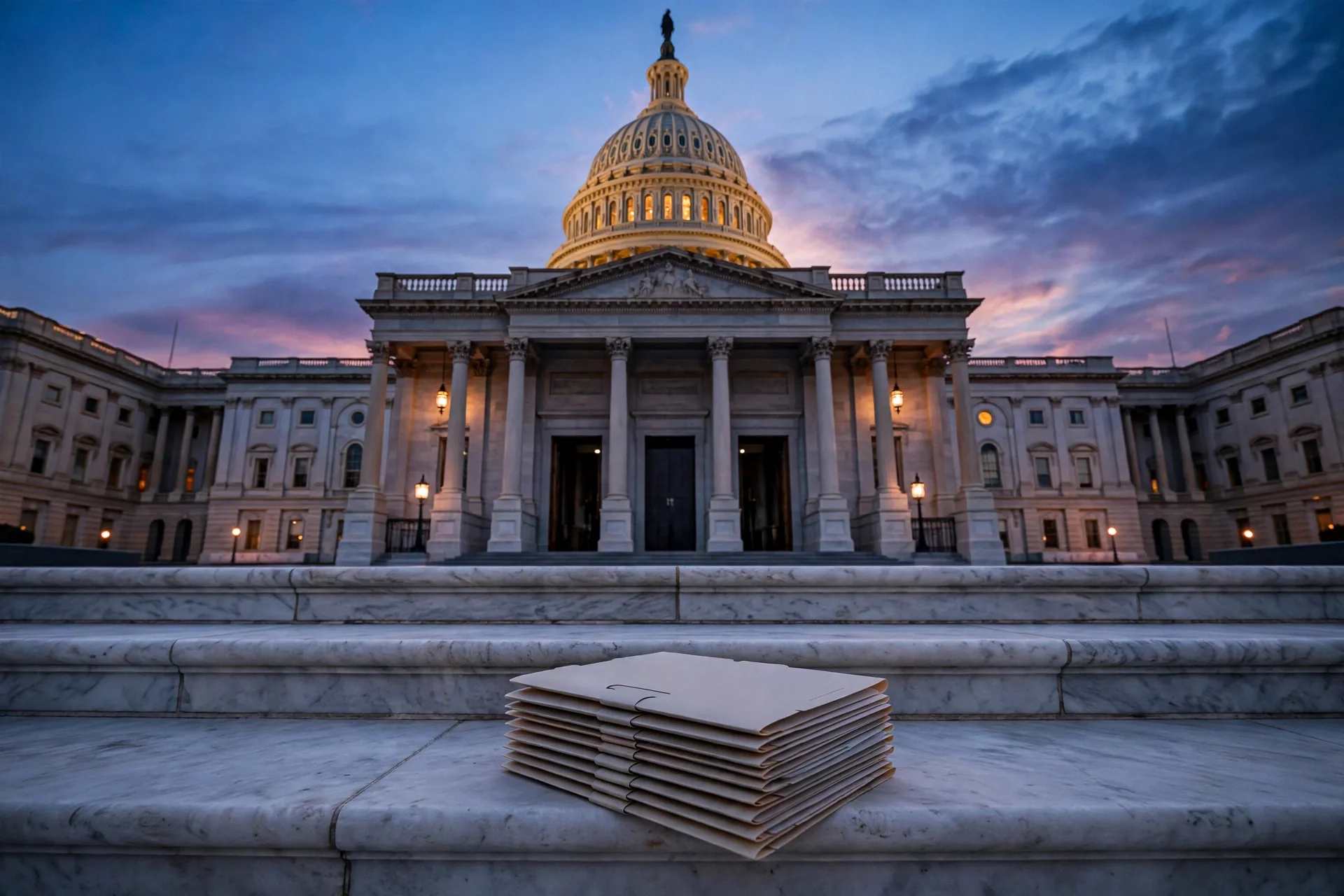
Imagen alusiva a las nominaciones enviadas al Senado de Estados Unidos. · Imagen generada por EPM
White House sends Senate twenty-two nominations and one withdrawal
The White House sent the Senate twenty-two nominations for judges, ambassadors and agency posts, and withdrew the nomination of David MacNeil as a Federal…
Slate of twenty-two nominations reaches Senate for confirmation
The Senate received twenty-two White House nominations for the judiciary, embassies and agencies, along with the withdrawal of the David MacNeil nomination…
--- The context ---
The White House sent the Senate a broad slate to fill vacancies in federal courts, embassies and executive agencies. The official list totals twenty-two nominations and 1 withdrawal, by a direct count of every name and post. Post by post, the vacancies arose from retirements, resignations or expired terms.
--- The facts ---
The judicial names are Philip Lawrence Aubart for district judge in the Middle District of North Carolina, Gregory Todd Butler for circuit judge for the Fifth Circuit, Joseph Patrick Falvey for the Northern District of Indiana, Eric James Hamilton for the District of Nebraska and Brian S. Meyers for the Eastern District of North Carolina. They are joined by three associate judges of the Superior Court of the District of Columbia for fifteen years: Fernando Campoamor-Sanchez, Roman Marian Chaban and Eric Sebastian Glover.
For embassies, the list proposes Natalie Baker for Pakistan, Jeffrey Colyer for the United Arab Emirates, Benita Gunn for Burundi, Cynthia Kierscht for Senegal and, concurrently without additional compensation, for Guinea-Bissau, Ian McCary for Mali and Christy McCormick for North Macedonia. Baker, Kierscht and McCary are career members of the Senior Foreign Service, Class of Minister-Counselor. Other posts include Toby Deen as Assistant Secretary of Energy for Hydrocarbons and Geothermal Energy, Michael LoSapio as Director of the Cybersecurity and Infrastructure Security Agency and Christopher Mufarrige as a Federal Trade Commissioner for seven years from September 26, 2026.
--- The positions ---
The White House position is the one expressed by the submission itself: to propose specific names for each vacancy and place them before the confirmation process, with no additional statements in the list. The position of the process is equally clear: no one holds the post yet by this submission alone, because each nomination requires Senate proceedings and a vote.
--- What remains unknown ---
What remains unknown is the Senate schedule for hearings and votes and the outcome of each confirmation. The slate also includes Arthur Kleinschmidt as Assistant Attorney General, Gary Lawkowski as General Counsel of the Office of the Director of National Intelligence, Arthur Miller as Assistant Secretary of the Navy, Loren Smith, Jr., as Assistant Secretary of Transportation and Matthew Zandi at the Equal Employment Opportunity Commission until July 1, 2031. The withdrawal is the nomination of David MacNeil, of Florida, as a Federal Trade Commissioner, sent on January 13, 2026.
--- Unanswered questions ---
In what order will the Senate examine a slate that mixes judges, ambassadors and agency officials? How long will judicial vacancies take to fill compared with diplomatic and technical ones? Will each name be voted on separately or will agreements speed up part of the list?
--- EPM analysis ---
The slate can be read as a map of operational priorities: federal justice, foreign representation and sensitive areas such as energy, cybersecurity, trade and intelligence. By grouping twenty-two nominations, the White House hands the Senate a multiple decision requiring scrutiny name by name.
📌 EPM Take: In EPM's view, this slate shows that governing also means filling on time the posts that sustain justice, diplomacy and security without leaving prolonged vacancies that weaken the State. The value of the list lies in its breadth and in mixing the judiciary, embassies and technical agencies in a single verifiable submission. The Senate must now examine each name rigorously, without turning confirmation into an automatic formality or into a permanent blockade that paralyzes functions essential to citizens.
--- The context ---
The Senate received from the White House a slate of twenty-two nominations and 1 withdrawal covering courts, embassies and key executive posts. The count comes from verifying the names on the official list one by one. Each proposal responds, as stated post by post, to a vacancy opened by retirement, resignation or an expired term, and all now stand subject to confirmation.
--- The facts ---
The judicial block includes Philip Lawrence Aubart for the Middle District of North Carolina, Gregory Todd Butler for the Fifth Circuit, Joseph Patrick Falvey for the Northern District of Indiana, Eric James Hamilton for Nebraska and Brian S. Meyers for the Eastern District of North Carolina. For the Superior Court of the District of Columbia, for fifteen years, Fernando Campoamor-Sanchez, Roman Marian Chaban and Eric Sebastian Glover are proposed as associate judges.
On the foreign front, Natalie Baker is proposed for Pakistan, Jeffrey Colyer for the United Arab Emirates, Benita Gunn for Burundi, Cynthia Kierscht for Senegal and concurrently, without additional compensation, for Guinea-Bissau, Ian McCary for Mali and Christy McCormick for North Macedonia. Baker, Kierscht and McCary belong to the career Senior Foreign Service, Class of Minister-Counselor. The slate is completed, among others, by Toby Deen at Energy, Arthur Kleinschmidt as Assistant Attorney General and Michael LoSapio to lead the Cybersecurity and Infrastructure Security Agency.
--- The positions ---
The White House position is defined by the act of submission: to fill the vacancies with precise names and posts, without adding to the list justifications beyond the vacancy each person replaces. The institutional position of the Senate is to examine and vote: without its confirmation, no nomination becomes an appointment. That balance between executive proposal and Senate control is the core of the procedure now opening.
--- What remains unknown ---
Still to be known are the pace of hearings and votes and the outcome of each case, including Arthur Miller as Assistant Secretary of the Navy, Gary Lawkowski as General Counsel of the Office of the Director of National Intelligence, Loren Smith, Jr., as Assistant Secretary of Transportation, Christopher Mufarrige as a Federal Trade Commissioner for seven years from September 26, 2026 and Matthew Zandi until July 1, 2031. The sole withdrawal is that of David MacNeil, of Florida, sent on January 13, 2026.
--- Unanswered questions ---
Will the Senate confirm the security and justice posts quickly? Will concrete objections to any name force separate and slower votes? When will the embassies included in this slate actually be filled?
--- EPM analysis ---
The list combines institutional continuity and orderly replacement: judges for fifteen years in the District of Columbia, a seven-year term at the Federal Trade Commission and a term running until 2031. The diversity of functions requires a review post by post, without shortcuts.
📌 EPM Take: In EPM's view, filling vacancies with defined profiles and subjecting them to confirmation is the orderly way to exercise authority without improvisation or opaque appointments. The slate covers courts, embassies and security and energy posts that require clear command and direct accountability under the law. The Senate should act promptly and seriously, approving those who prove their fitness and rejecting without delay those who do not, because a State with vacant offices loses its capacity to decide and to protect.
Casa Blanca envía al Senado veintidós nominaciones y una retirada
La Casa Blanca envió al Senado veintidós nominaciones para jueces, embajadores y cargos en agencias, y retiró la nominación de David MacNeil como comisionado…
Tanda de veintidós nominaciones llega al Senado para confirmación
El Senado recibió veintidós nominaciones de la Casa Blanca para la judicatura, embajadas y agencias, junto con la retirada de la nominación de David MacNeil…
--- El contexto ---
La Casa Blanca envió al Senado una tanda amplia para cubrir vacantes en tribunales federales, embajadas y agencias del Ejecutivo. La lista oficial suma veintidós nominaciones y 1 retirada, según el conteo directo de cada nombre y cargo. Puesto a puesto, las vacantes quedaron libres por jubilaciones, renuncias o mandatos vencidos.
--- Los hechos ---
En la judicatura figuran Philip Lawrence Aubart para juez de distrito en el distrito Medio de Carolina del Norte, Gregory Todd Butler para juez de circuito del Quinto Circuito, Joseph Patrick Falvey para el distrito Norte de Indiana, Eric James Hamilton para el distrito de Nebraska y Brian S. Meyers para el distrito Este de Carolina del Norte. A ellos se suman tres jueces asociados del Tribunal Superior del Distrito de Columbia por quince años: Fernando Campoamor-Sanchez, Roman Marian Chaban y Eric Sebastian Glover.
En embajadas, la lista propone a Natalie Baker para Pakistán, Jeffrey Colyer para Emiratos Árabes Unidos, Benita Gunn para Burundi, Cynthia Kierscht para Senegal y, concurrentemente sin pago adicional, para Guinea-Bissau, Ian McCary para Malí y Christy McCormick para Macedonia del Norte. Baker, Kierscht y McCary son miembros de carrera del Servicio Exterior Senior, clase Ministro Consejero. En otros cargos figuran Toby Deen como secretario adjunto de Energía para Hidrocarburos y Energía Geotérmica, Michael LoSapio como director de la Agencia de Ciberseguridad y Seguridad de Infraestructuras y Christopher Mufarrige como comisionado de Comercio Federal por siete años desde el 26 de septiembre de 2026.
--- Las posiciones ---
La posición de la Casa Blanca es la que expresa el propio envío: proponer nombres concretos para cada vacante y someterlos a confirmación, sin declaraciones adicionales en la lista. La del proceso es igualmente clara: nadie ocupa aún el cargo por este solo envío, porque cada nominación requiere el trámite y el voto del Senado.
--- Lo que falta saber ---
Falta saber el calendario del Senado para audiencias y votaciones y el resultado de cada confirmación. La tanda incluye además a Arthur Kleinschmidt como fiscal general adjunto, Gary Lawkowski como asesor general de la Oficina del Director de Inteligencia Nacional, Arthur Miller como secretario adjunto de la Marina, Loren Smith, Jr., como secretario adjunto de Transporte y Matthew Zandi en la Comisión de Igualdad de Oportunidades en el Empleo hasta el 1 de julio de 2031. La retirada es la nominación de David MacNeil, de Florida, como comisionado de Comercio Federal, enviada el 13 de enero de 2026.
--- Preguntas sin respuesta ---
¿En qué orden examinará el Senado una tanda que mezcla jueces, embajadores y directivos de agencias? ¿Cuánto tardarán en cubrirse las vacantes judiciales frente a las diplomáticas y las técnicas? ¿Se votará cada nombre por separado o habrá acuerdos para acelerar parte de la lista?
--- Análisis EPM ---
La tanda puede leerse como un mapa de prioridades operativas: justicia federal, representación exterior y áreas sensibles como energía, ciberseguridad, comercio e inteligencia. Al agrupar veintidós nominaciones, la Casa Blanca traslada al Senado una decisión múltiple que exigirá escrutinio nombre por nombre.
📌 Conclusion EPM: A juicio de EPM, esta tanda muestra que gobernar también consiste en ocupar a tiempo los cargos que sostienen la justicia, la diplomacia y la seguridad sin dejar vacantes prolongadas que debiliten al Estado. El valor de la lista está en su amplitud y en que mezcla judicatura, embajadas y agencias técnicas en un solo envío verificable. Ahora corresponde al Senado examinar cada nombre con rigor, sin convertir la confirmación en un trámite automático ni en un bloqueo permanente que paralice funciones esenciales para la ciudadanía.
--- El contexto ---
El Senado recibió una tanda de veintidós nominaciones y 1 retirada que abarca tribunales, embajadas y puestos clave del Ejecutivo. El conteo surge de verificar uno a uno los nombres de la lista oficial. Cada propuesta responde a una vacante por jubilación, renuncia o vencimiento de mandato, y todas quedan sujetas a confirmación.
--- Los hechos ---
El bloque judicial incluye a Philip Lawrence Aubart para el distrito Medio de Carolina del Norte, Gregory Todd Butler para el Quinto Circuito, Joseph Patrick Falvey para el distrito Norte de Indiana, Eric James Hamilton para Nebraska y Brian S. Meyers para el distrito Este de Carolina del Norte. Para el Tribunal Superior del Distrito de Columbia, por quince años, se propone a Fernando Campoamor-Sanchez, Roman Marian Chaban y Eric Sebastian Glover como jueces asociados.
En el frente exterior se propone a Natalie Baker para Pakistán, Jeffrey Colyer para Emiratos Árabes Unidos, Benita Gunn para Burundi, Cynthia Kierscht para Senegal y concurrentemente, sin pago adicional, para Guinea-Bissau, Ian McCary para Malí y Christy McCormick para Macedonia del Norte. Baker, Kierscht y McCary pertenecen a la carrera del Servicio Exterior Senior, clase Ministro Consejero. Completan la tanda, entre otros, Toby Deen en Energía, Arthur Kleinschmidt como fiscal general adjunto y Michael LoSapio al frente de la Agencia de Ciberseguridad y Seguridad de Infraestructuras.
--- Las posiciones ---
La posición de la Casa Blanca queda definida por el acto de envío: cubrir las vacantes con nombres y cargos precisos, sin añadir en la lista justificaciones distintas a la vacante que cada uno reemplaza. La posición institucional del Senado es la de examinar y votar: sin su confirmación, ninguna nominación se convierte en nombramiento. Ese equilibrio entre propuesta del Ejecutivo y control del Senado es el núcleo del procedimiento que ahora se abre.
--- Lo que falta saber ---
Queda por saber el ritmo de audiencias y votaciones y el desenlace de cada caso, incluidos Arthur Miller como secretario adjunto de la Marina, Gary Lawkowski como asesor general de la Oficina del Director de Inteligencia Nacional, Loren Smith, Jr., como secretario adjunto de Transporte, Christopher Mufarrige como comisionado de Comercio Federal por siete años desde el 26 de septiembre de 2026 y Matthew Zandi hasta el 1 de julio de 2031. La única retirada es la de David MacNeil, de Florida, enviada el 13 de enero de 2026.
--- Preguntas sin respuesta ---
¿Confirmará el Senado con rapidez los cargos de seguridad y justicia? ¿Habrá objeciones concretas a algún nombre que obliguen a votaciones separadas y más lentas? ¿Cuándo quedarán efectivamente cubiertas las embajadas incluidas en esta tanda?
--- Análisis EPM ---
La lista combina continuidad institucional y relevo ordenado: jueces por quince años en el Distrito de Columbia, un mandato de siete años en Comercio Federal y un término que llega hasta 2031. La diversidad de funciones obliga a una revisión cargo por cargo, sin atajos.
📌 Conclusion EPM: A juicio de EPM, cubrir vacantes con perfiles definidos y someterlos a confirmación es la forma ordenada de ejercer la autoridad sin improvisaciones ni nombramientos opacos. La tanda abarca tribunales, embajadas y puestos de seguridad y energía que requieren mando claro y responsabilidad directa ante la ley. El Senado debe actuar con prontitud y seriedad, aprobando a quienes acrediten idoneidad y rechazando sin dilación a quienes no la tengan, porque un Estado con cargos vacíos pierde capacidad de decisión y de protección.