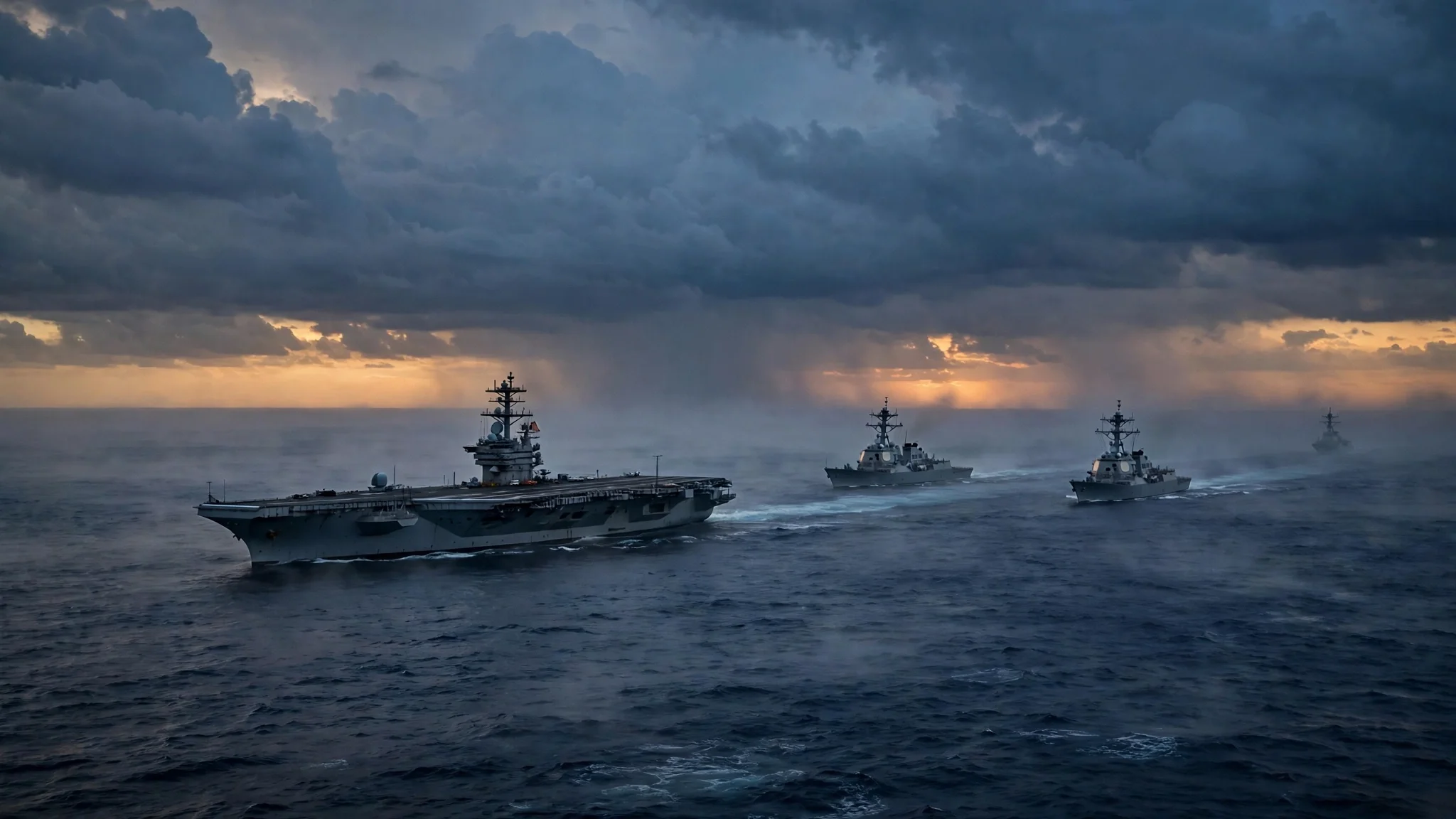
Imagen alusiva generada para EPM: una flota naval estadounidense en el mar. · EPM
Trump says war with Iran is militarily over in practice
At the White House, the president said the war against Iran is militarily over in practice, ruled out resuming bombing for now, and confirmed the naval…
Trump keeps Iran blockade while declaring war effectively over
The president argued that bombing Iran again is not necessary because the war is militarily over, but he kept the naval blockade and readiness in place while…
--- The context ---
The remarks at the White House came after a meeting with Qatar's prime minister, Mohammed bin Abdulrahman Al Thani, whose country mediates between Washington and Tehran. The backdrop is a conflict that, by his own assessment, left Iran's military structure severely weakened, and a bombing pause he had conditioned on Sunday on a strong agreement.
--- The facts ---
The president said that the war against Iran is militarily over in practice and argued that his government does not consider it necessary to resume bombing. He added that the status quo is being maintained and that there is positive momentum toward ending the conflict, while declining to detail progress in indirect nuclear talks. He also confirmed that the naval blockade on Iranian ports will continue to prevent oil exports, a deployment he described as the largest military blockade in history.
--- The positions ---
Washington seeks a lasting solution that prevents the Iranian regime from developing military nuclear capabilities, keeping pressure in place while talks proceed. Tehran demands the lifting of the blockade and sanctions, the release of frozen assets, compensation for war damage, and an end to regional hostilities, including Israeli operations in Lebanon, conditions the administration has not accepted. Qatar presented nuclear proposals, according to Middle Eastern officials, and the White House declined to comment.
--- What remains unknown ---
Despite the declared ending, United States forces carried out at least two limited attacks on Iranian air defense systems in the past week, and on Saturday they fired on a commercial vessel and disabled it under the argument that it was trying to cross the blockade. The Pentagon also identified targets for a possible offensive, among them 38 bridges, a sign that contingency planning remains active.
--- Unanswered questions ---
On what verifiable terms would Tehran limit its nuclear program in exchange for lifting the blockade and sanctions? What real scope will Qatar's mediation have if Washington will not comment on its nuclear proposals? How can the status quo hold if limited attacks on Iranian air defenses continue? What guarantees would ensure that a pause without a formal agreement does not turn into a sudden resumption of bombing?
--- EPM analysis ---
The announcement combines a declared closure with intact pressure: the blockade continues and Iran's demands were not accepted. Defense Secretary Pete Hegseth said that the decision on next steps belongs to the president and defended the offensive before lawmakers who question its legality because it proceeded without congressional authorization. Republican Thomas Massie introduced an impeachment motion against Hegseth over his conduct of the war, after Republicans lost control of both chambers last week.
The defense secretary also raised a monitored closing path: telling Tehran that Washington considers the campaign concluded, while continuing to watch Iranian nuclear materials closely in order to detect any renewed move toward military capabilities.
📌 EPM Take:
In EPM's view, declaring the war over while maintaining the largest blockade and keeping identified targets does not close the conflict but moves it into a phase of negotiating pressure whose outcome will depend on nuclear verification and on the economic concessions Washington is willing to discuss. For Iranians and for the region, the difference between a tactical pause and a lasting peace will be measured in verifiable facts, not announcements, and Congress will have to decide whether it recovers its role in war decisions of this scale.
--- The context ---
The president spoke to reporters at the White House after meeting Qatar's prime minister, Mohammed bin Abdulrahman Al Thani, while Doha mediates between Washington and Tehran. The statement follows a campaign that, he said, left Iran's military structure severely weakened, a day after he conditioned the bombing pause on a strong agreement.
--- The facts ---
He said that the war against Iran is militarily over in practice and argued that resuming bombing does not appear very necessary because the status quo is being maintained. He pointed to positive momentum toward ending the conflict and acknowledged indirect talks with Tehran on its nuclear program, while declining to detail advances. He also confirmed that the naval blockade will remain to prevent oil exports, a deployment he described as the largest military blockade in history, and stressed that forces are prepared.
--- The positions ---
Washington's position is to prevent, in a lasting way, the Iranian regime from developing military nuclear capabilities, sustaining pressure while negotiating from strength. Tehran demands the lifting of the blockade and sanctions, the release of frozen assets, compensation for war damage, and an end to regional hostilities, including Israeli operations in Lebanon, conditions the administration has not accepted. Qatar presented nuclear proposals, according to Middle Eastern officials, and the White House declined to comment.
--- What remains unknown ---
The pause did not eliminate recent military activity: in the past week there were at least two limited attacks on Iranian air defense systems, and on Saturday a shot was fired at a commercial vessel that was disabled under the argument that it was trying to cross the blockade. The president also revealed that the Pentagon identified targets for a possible offensive, among them 38 bridges, a sign deterrence rests on concrete plans.
--- Unanswered questions ---
Will Tehran accept effective verification of its nuclear program in exchange for economic relief, or will it only seek to gain time under the blockade? How long can the status quo last without a formal agreement? How will Washington respond if Iran tries to force the naval blockade? Can Qatar's mediation turn its nuclear proposals into a text that both capitals can accept?
--- EPM analysis ---
The approach combines firmness and restraint: not resuming bombing, but not lifting the pressure either. Defense Secretary Pete Hegseth said that the decision on next steps belongs to the president and defended the offensive before lawmakers who question its legality for lack of congressional authorization. Republican Thomas Massie introduced an impeachment motion against Hegseth over his conduct of the war, after Republicans lost control of both chambers last week in elections marked by rejection of the conflict.
In the same vein, the defense secretary mentioned the possibility of notifying Tehran that Washington considers the campaign concluded, without giving up close monitoring of Iranian nuclear materials against any attempt to rebuild military capabilities over time.
📌 EPM Take:
In EPM's view, the strength of this exit will depend on firmness producing a verifiable agreement rather than a pause that Tehran uses to rebuild. Keeping the blockade, preserving the capacity to respond, and demanding real nuclear guarantees is consistent with the declared goal of preventing Iranian military capabilities. The risk is political and strategic at once: without measurable results, pressure loses credibility at home and abroad, and any incident at sea could reopen within hours a conflict presented today as over in practice.
Trump dice que la guerra con Irán terminó en lo militar
El presidente afirmó en la Casa Blanca que la guerra contra Irán está militarmente terminada en la práctica, descartó reanudar los bombardeos y confirmó que…
Trump mantiene el bloqueo a Irán tras dar por cerrada la guerra
El presidente sostuvo que no es necesario reanudar los bombardeos contra Irán porque la guerra terminó en lo militar, pero confirmó el bloqueo naval y la…
--- El contexto ---
La comparecencia en la Casa Blanca llegó tras una reunión con el primer ministro de Qatar, Mohammed bin Abdulrahman Al Thani, cuyo país media entre Washington y Teherán. El trasfondo es un conflicto que dejó la estructura militar iraní severamente debilitada, según la evaluación del propio presidente, y una pausa en los bombardeos condicionada el domingo a un acuerdo fuerte.
--- Los hechos ---
El presidente afirmó que la guerra contra Irán está militarmente terminada en la práctica y sostuvo que su gobierno no considera necesario reanudar los bombardeos. Añadió que se mantiene el statu quo y que existe un impulso positivo para poner fin al conflicto, aunque evitó detallar avances de las conversaciones indirectas sobre el programa nuclear. También confirmó que continuará el bloqueo naval sobre los puertos iraníes para impedir las exportaciones de petróleo, dispositivo que describió como el mayor bloqueo militar de la historia.
--- Las posiciones ---
Washington busca una solución duradera que impida que el régimen iraní desarrolle capacidades nucleares militares, y mantiene a sus fuerzas preparadas si cambia la situación. Teherán reclama que se levante el bloqueo y las sanciones, se liberen los activos congelados y se compensen los daños, además de exigir el cese de las hostilidades regionales, incluidas las operaciones israelíes en Líbano. La administración no aceptó esas condiciones, y la Casa Blanca evitó pronunciarse sobre las propuestas nucleares de Qatar, según funcionarios de Medio Oriente.
--- Lo que falta saber ---
Pese al anuncio, en la última semana las fuerzas estadounidenses realizaron al menos dos ataques limitados contra sistemas de defensa aérea iraníes, y el sábado dispararon contra un buque comercial que quedó inutilizado bajo el argumento de que intentaba atravesar el bloqueo. El Pentágono identificó además objetivos para una eventual ofensiva, entre ellos 38 puentes, señal de que la planificación de contingencia sigue activa.
--- Preguntas sin respuesta ---
¿En qué condiciones verificables aceptaría Teherán limitar su programa nuclear a cambio del levantamiento del bloqueo y de las sanciones? ¿Qué alcance tendrá la mediación de Qatar si Washington no se pronuncia sobre sus propuestas? ¿Cómo se sostendrá el statu quo si continúan los ataques limitados? ¿Qué garantías habrá para que una pausa sin acuerdo formal no derive en una reanudación repentina de los bombardeos?
--- Análisis EPM ---
El anuncio combina cierre declarado con presión intacta: el bloqueo sigue y las exigencias iraníes no fueron aceptadas. El secretario de Defensa, Pete Hegseth, afirmó que la decisión corresponde al presidente y defendió la ofensiva ante legisladores que cuestionan su legalidad por haberse desarrollado sin autorización del Congreso. El republicano Thomas Massie presentó una moción de juicio político contra Hegseth, tras una semana en la que los republicanos perdieron el control de ambas cámaras.
El secretario de Defensa también planteó una vía de cierre vigilado: comunicar a Teherán que Washington da por concluida la campaña, manteniendo al mismo tiempo la vigilancia sobre los materiales nucleares iraníes para detectar cualquier avance militar.
📌 Conclusion EPM:
A juicio de EPM, declarar terminada la guerra mientras se mantiene el mayor bloqueo y se conservan objetivos identificados no cierra el conflicto, sino que lo traslada a una fase de presión negociadora cuyo resultado dependerá de la verificación nuclear y de las concesiones económicas que Washington esté dispuesto a discutir. Para la población iraní y para la región, la diferencia entre una pausa táctica y una paz duradera se medirá en hechos comprobables, no en anuncios, y el Congreso tendrá que definir si recupera su papel en decisiones de guerra.
--- El contexto ---
El presidente habló ante la prensa en la Casa Blanca tras reunirse con el primer ministro de Qatar, Mohammed bin Abdulrahman Al Thani, mientras Doha media entre Washington y Teherán. La declaración llega tras una campaña que, según el mandatario, dejó la estructura militar iraní severamente debilitada, un día después de condicionar la pausa a un acuerdo fuerte.
--- Los hechos ---
El mandatario afirmó que la guerra contra Irán está militarmente terminada en la práctica y sostuvo que no considera necesario reanudar los bombardeos porque se mantiene el statu quo. Señaló que existe un impulso positivo para poner fin al conflicto y reconoció que hay conversaciones indirectas con Teherán sobre su programa nuclear, aunque evitó detallar avances. También confirmó que continuará el bloqueo naval para impedir las exportaciones de petróleo, dispositivo que describió como el mayor bloqueo militar de la historia, y advirtió que las fuerzas están preparadas.
--- Las posiciones ---
La posición de Washington es impedir de forma duradera que el régimen iraní desarrolle capacidades nucleares militares, sosteniendo la presión mientras se negocia. Teherán reclama el levantamiento del bloqueo y de las sanciones, la liberación de activos congelados, una compensación por los daños y el cese de las hostilidades regionales, incluidas las operaciones israelíes en Líbano, condiciones que la administración no aceptó. Qatar presentó propuestas nucleares, según funcionarios de Medio Oriente, y la Casa Blanca evitó pronunciarse.
--- Lo que falta saber ---
La pausa no eliminó la actividad militar reciente: en la última semana hubo al menos dos ataques limitados contra sistemas de defensa aérea iraníes, y el sábado un disparo contra un buque comercial que quedó inutilizado bajo el argumento de que intentaba atravesar el bloqueo. El presidente reveló además que el Pentágono identificó objetivos para una eventual ofensiva, entre ellos 38 puentes, señal de que la disuasión se apoya en planes concretos.
--- Preguntas sin respuesta ---
¿Aceptará Teherán una verificación efectiva de su programa nuclear a cambio de alivio económico, o buscará solo ganar tiempo bajo el bloqueo? ¿Hasta cuándo puede mantenerse el statu quo sin un acuerdo formal? ¿Qué respuesta dará Washington si Irán intenta forzar el bloqueo naval? ¿Logrará la mediación de Qatar convertir sus propuestas nucleares en un texto que ambas capitales puedan aceptar?
--- Análisis EPM ---
El planteamiento combina firmeza y contención: no reanudar bombardeos, pero tampoco levantar la presión. El secretario de Defensa, Pete Hegseth, afirmó que la decisión corresponde al presidente y defendió la ofensiva ante legisladores que cuestionan su legalidad por falta de autorización del Congreso. El republicano Thomas Massie presentó una moción de juicio político contra Hegseth por su conducción de la guerra, después de que los republicanos perdieran el control de ambas cámaras la semana pasada.
En esa misma línea, el secretario de Defensa mencionó la posibilidad de notificar a Teherán que Washington da por concluida la campaña, sin renunciar a vigilar de cerca los materiales nucleares iraníes ante cualquier intento de recomposición militar.
📌 Conclusion EPM:
A juicio de EPM, la fortaleza de esta salida dependerá de que la firmeza se traduzca en un acuerdo verificable y no en una pausa que Teherán aproveche para recomponerse. Mantener el bloqueo, conservar la capacidad de respuesta y exigir garantías nucleares reales es coherente con el objetivo declarado de impedir capacidades militares iraníes. El riesgo es político y estratégico a la vez: sin resultados medibles, la presión pierde credibilidad en casa y fuera, y cualquier incidente en el mar puede reabrir en horas un conflicto que hoy se presenta como terminado.