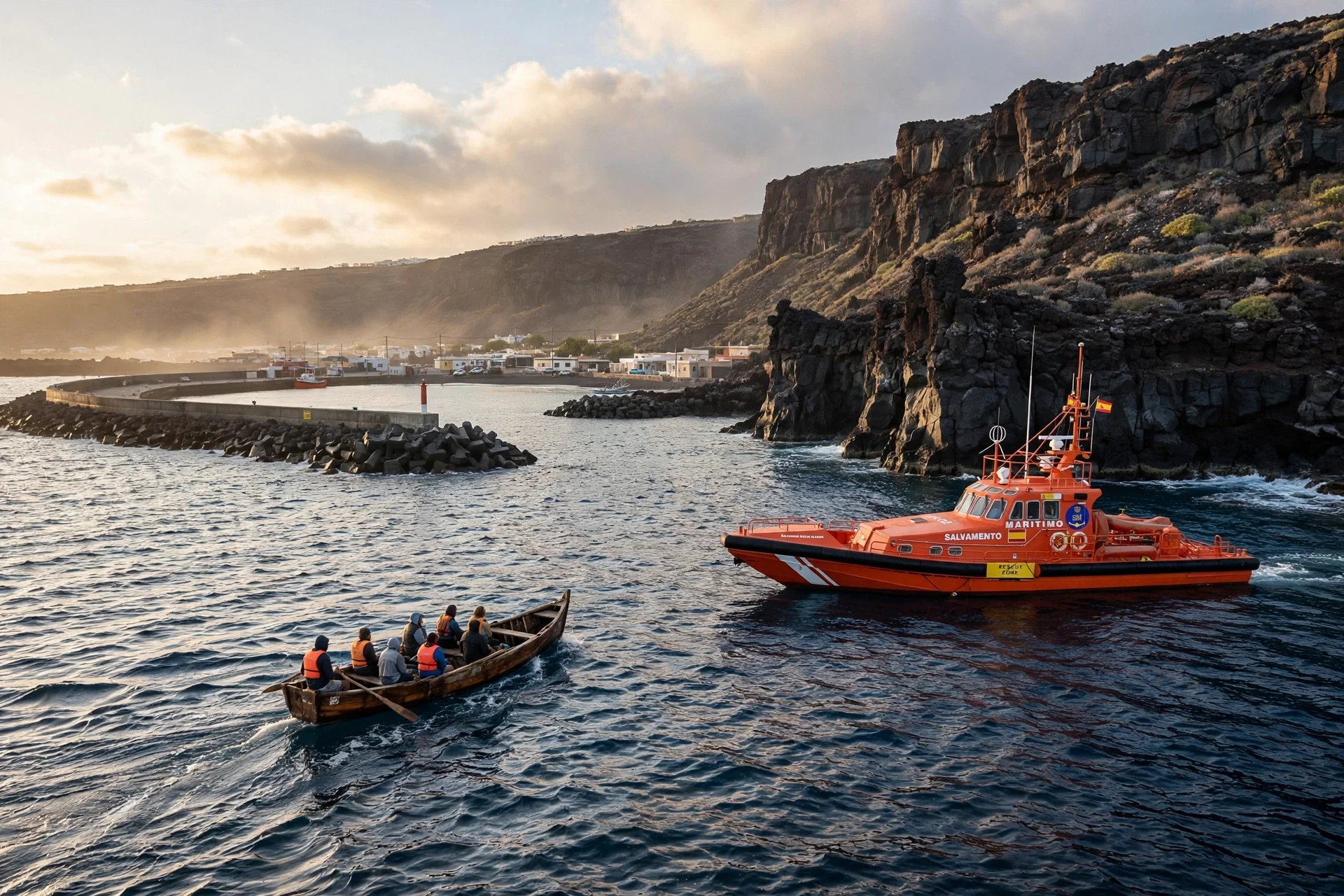
Un cayuco y una embarcación de salvamento junto a la costa de El Hierro, en una imagen alusiva. · Imagen generada
Canary Islands demand an extraordinary package for El Hierro and weekly meetings
The Canary Islands government will present a nine-point document in Madrid this Tuesday, agreed by all regional parties except Vox, calling for fiscal aid and…
El Hierro seeks order, aid and control amid migration pressure in the Canaries
The Canaries will take a nine-point document to Madrid this Tuesday calling for a fiscal and aid package for El Hierro, stronger security and rescue capacity…
--- The context ---
The Canary Islands government will present a nine-point document in Madrid this Tuesday at the Interministerial Commission, ahead of the Council of Ministers, to address migration to the islands and, above all, to El Hierro. The proposal arrives after another day of sea arrivals, with the island having already received about 6,000 migrants so far in November, a pressure that overwhelms the scale of a small island and its public services.
The document does not come from a single party. According to the regional government, it was agreed by every party represented in the regional parliament, with the sole exception of Vox. That breadth is meant to give the demand weight before the central state: it is presented not as one government's claim, but as a position shared by almost the whole of Canary Islands representation, on an issue that affects reception, security and the local economy alike.
--- The facts ---
On the most recent day, the maritime rescue service pulled five cayucos carrying 578 people from the sea since midnight around El Hierro, Tenerife and Gran Canaria, according to emergency service counts. Canary Islands president Fernando Clavijo described the situation on El Hierro on Monday, at a press conference, as one of extreme gravity, and said the islands' citizens are demanding answers and unity, a mandate he said he would carry into Tuesday's meeting.
The figures show a sharp reversal. Between January and June, 3,708 people reached the Canaries by sea in 49 boats, in a first half marked by a 67% reduction from the 11,321 arrivals of the same period in 2025. Between July and October the trend flipped: 9,619 people arrived in 111 boats, more than triple the 2,778 recorded in those same four months of 2025. In October, 6,194 people arrived, almost five times the 1,251 of October 2025, and in the first nine days of November the data already matched the whole of the previous month.
--- The positions ---
The document calls for an extraordinary package for El Hierro with fiscal measures, direct aid to businesses and the self-employed and Social Security rebates, taking the measures approved by the state for Ceuta as a reference. It also asks for funds to compensate the island's population, stronger state security forces and rescue vessels, and a permanent coordination mechanism between the state and the Canaries with weekly follow-up for as long as the situation lasts.
It also proposes more resources for the European border agency, activation of the solidarity mechanisms of the European Pact on Migration and Asylum, urgent diplomacy with countries of departure, especially Senegal, and recognition of the islands as a southern border within the European emergency response framework. Minister Ángel Víctor Torres, who will chair the commission, argues that the responsibility for receiving arrivals must be shared by Europe and Spain and that the government will not turn the islands into a prison for immigrants, answering criticism from Popular Party leader Alberto Núñez Feijóo of transfers of migrants to the mainland.
--- What remains unknown ---
It is not yet known whether the central state will accept the economic package or at what level, nor whether weekly meetings will be formalized as a stable mechanism. The concrete reinforcement of the European border agency also remains undefined. The real scope of the proposed legal reform to prosecute homicides committed on the high seas is likewise undecided.
--- Unanswered questions ---
Will the central government accept the extraordinary package for El Hierro using the Ceuta model as its reference? Will the state and the Canaries actually meet every week while the emergency lasts, as the document requests? Will Europe activate its solidarity mechanisms and a larger deployment of its border agency in the islands? Will the reform move forward so that homicides committed beyond the 12 miles of territorial waters can be prosecuted?
--- EPM analysis ---
The reversal in the figures explains the urgency. The first-half decline was attributed to preventive measures by Mauritania and, more recently, by Senegal and Gambia in collaboration with Spain and the European Union, but that containment flipped from July onward. The Canary proposal combines three planes: compensating the island that bears the arrivals, sharing reception so the Canaries do not become a permanent center, and tackling causes at origin through diplomacy and European border support. Its political strength lies in the almost total regional consensus behind it.
📌 EPM Take: In EPM's view, the Canary Islands claim is right to frame migration as a shared responsibility rather than a burden that one small island must absorb alone. El Hierro needs real compensation, verifiable weekly coordination and effective European backing, because solidarity declared without funds or resources remains rhetoric. Sharing reception within Spain and Europe protects both those who arrive and the island's population, whose concern is legitimate and deserves an answer. Tuesday's meeting will show whether Madrid turns that regional consensus into concrete decisions, with a calendar, resources and permanent public follow-up for the islands and their residents.
--- The context ---
The Canaries will present a nine-point document in Madrid this Tuesday before the Interministerial Commission, ahead of the Council of Ministers, focused on migration to the islands and on the pressure borne by El Hierro. The island has received about 6,000 migrants so far in November, and the regional government considers the state's current response insufficient in the face of a sustained arrival of cayucos that strains reception, security and services on a small island.
The text was agreed by every party represented in the regional parliament except Vox. President Fernando Clavijo will defend it after describing the situation on Monday as one of extreme gravity, at a press conference where he said citizens demand answers and unity and that not just a president, but Canary society as a whole, will be seated at the meeting.
--- The facts ---
The pressure is not theoretical. The maritime rescue service rescued five cayucos carrying 578 people since midnight around El Hierro, Tenerife and Gran Canaria, according to emergency service counts. The president of the El Hierro island council, Alpidio Armas, said over the weekend that the island's society is very worried about the great proliferation of cayuco arrivals it is enduring, a nervousness that is growing among the local population.
The data confirm the rebound. Between January and June, 3,708 people arrived by sea in 49 boats, after a 67% reduction from the 11,321 of the first half of 2025. But between July and October, 9,619 people arrived in 111 boats, more than triple the 2,778 of those same months of 2025. In October, 6,194 people arrived, almost five times the 1,251 of October 2025, and in the first nine days of November the total for the whole previous month was already matched.
--- The positions ---
The document calls for a fiscal and aid package for El Hierro, with direct support for businesses and the self-employed and Social Security rebates, following the model approved for Ceuta, plus funds to compensate the affected population. It asks for stronger state security forces and rescue vessels, a contingency plan and a permanent coordination mechanism with weekly follow-up while the situation lasts, so that the response does not depend on improvisation each time a boat arrives.
The proposal adds a dimension of order and law: more resources for the European border agency, activation of the solidarity in the European Pact on Migration and Asylum, urgent diplomacy with countries of departure, especially Senegal, and reform of the judiciary law to restore universal jurisdiction over homicides and murders on the high seas. Today Spain can only judge crimes in its territorial waters, up to 12 miles, and such homicides between foreigners fall outside unless there is a connecting point with Spain. Against that backdrop, Minister Ángel Víctor Torres defends sharing reception with Europe and Spain and rejects turning the islands into a prison, answering Alberto Núñez Feijóo's criticism of transfers to the mainland.
--- What remains unknown ---
It is not yet known which part of the package the state will accept, nor whether funds and rebates will match the intensity applied in Ceuta. Nor is it clear what reinforcement the European border agency will receive, since a larger presence is a long-standing aspiration of the Canary government while the central government has traditionally considered the deployed resources sufficient, or whether the high seas reform will gather support.
--- Unanswered questions ---
Will the state assume the full cost of the extraordinary package for El Hierro, including rebates and aid to businesses and the self-employed? Will there be a contingency plan and weekly meetings with real follow-up, or will coordination remain reactive? Will Europe reinforce its border agency in the Canaries and will diplomacy with Senegal reduce departures? Will the legal gap that today prevents prosecuting homicides committed beyond 12 miles finally be closed?
--- EPM analysis ---
The change of trend is the key. The initial fall responded, according to the European agency, to preventive measures by Mauritania and later by Senegal and Gambia in collaboration with Spain and the European Union; when that containment weakened, arrivals multiplied. That is why the document combines economic relief for the island, more security and rescue capacity, diplomatic pressure at origin and a legal correction. Without effective control of the routes and without consequences for crimes on the high seas, any internal distribution only administers the problem.
📌 EPM Take: In EPM's view, the Canaries are demanding what any overwhelmed border would require: order, resources and compensation for those who bear the impact. El Hierro cannot absorb thousands of arrivals on its own while its businesses, services and population pay the cost of a policy decided far away. What is needed is reinforced security, diplomacy that curbs departures, effective prosecution of crimes on the high seas and real aid to the island, not just transfers that spread the problem around. The state's credibility is at stake this Tuesday in whether it offers a verifiable plan, weekly and with sufficient resources assigned.
Canarias reclama un paquete extraordinario para El Hierro y reuniones semanales
El Gobierno canario presentará este martes en Madrid un documento de nueve puntos, pactado por todos los partidos regionales salvo Vox, que reclama ayudas…
El Hierro pide orden, ayudas y control ante la presión migratoria en Canarias
Canarias llevará este martes a Madrid un documento de nueve puntos que pide un paquete fiscal y de ayudas para El Hierro, más seguridad y salvamento, un plan…
--- El contexto ---
El Gobierno de Canarias llevará este martes a Madrid un documento de nueve puntos que se debatirá en la Comisión Interministerial, en una reunión previa al Consejo de Ministros, para abordar la situación migratoria de las islas y, en especial, la de El Hierro. La propuesta llega tras una nueva jornada de llegadas por mar y en un momento en el que la isla suma ya unos 6.000 migrantes recibidos en lo que va de noviembre, una presión que desborda su escala y sus servicios.
El documento no nace de un solo partido. Según lo expuesto por el Ejecutivo autonómico, ha sido pactado por todas las formaciones presentes en el Parlamento regional, con la única excepción de Vox. Esa amplitud busca dar peso a la reclamación ante el Estado: no se presenta como una demanda de gobierno, sino como una posición compartida por la representación canaria casi al completo.
--- Los hechos ---
En la jornada más reciente, Salvamento Marítimo rescató desde la medianoche cinco cayucos con 578 personas en El Hierro, Tenerife y Gran Canaria, según los recuentos de los servicios de emergencia. El presidente canario, Fernando Clavijo, calificó este lunes en rueda de prensa la situación de El Hierro como de extrema gravedad y sostuvo que la ciudadanía de las islas reclama respuestas y unidad, un mandato que, según explicó, llevará a la reunión de este martes.
Las cifras muestran un giro brusco. Entre enero y junio llegaron a Canarias por mar 3.708 personas en 49 embarcaciones, con una reducción del 67% frente a las 11.321 llegadas del mismo periodo de 2025. Entre julio y octubre la tendencia se invirtió: arribaron 9.619 personas en 111 embarcaciones, más del triple que en esos mismos cuatro meses de 2025, cuando fueron 2.778. En octubre llegaron 6.194 personas, casi cinco veces más que las 1.251 de octubre de 2025, y en los nueve primeros días de noviembre los datos ya igualaron a todos los del mes anterior.
--- Las posiciones ---
El documento reclama un paquete extraordinario para El Hierro con medidas fiscales, ayudas directas a empresas y autónomos y bonificaciones a la Seguridad Social, tomando como referencia las actuaciones aprobadas por el Estado para Ceuta. Pide además fondos para compensar a la población herreña, reforzar las fuerzas y cuerpos de seguridad del Estado y las embarcaciones de salvamento, y crear un mecanismo permanente de coordinación entre el Estado y Canarias con seguimiento semanal mientras dure la situación.
También plantea más medios de la agencia europea de fronteras, activar los mecanismos de solidaridad del Pacto Europeo de Migración y Asilo, una iniciativa diplomática urgente con los países de salida, especialmente Senegal, y que las islas figuren como frontera sur en el marco europeo de respuesta a emergencias. El ministro Ángel Víctor Torres, que presidirá la comisión, defiende que la responsabilidad de acoger debe ser compartida por Europa y España y que el Gobierno no convertirá las islas en una cárcel para inmigrantes, frente a las críticas de Alberto Núñez Feijóo a los traslados a la Península.
--- Lo que falta saber ---
Todavía no se conoce si el Estado aceptará el paquete económico ni con qué cuantía, ni si las reuniones semanales se formalizarán como mecanismo estable. Tampoco está definido el refuerzo concreto de la agencia europea de fronteras ni el alcance real de la reforma legal propuesta para juzgar homicidios cometidos en alta mar.
--- Preguntas sin respuesta ---
¿Aceptará el Gobierno central el paquete extraordinario para El Hierro con el modelo aplicado en Ceuta como referencia? ¿Se reunirán Estado y Canarias cada semana mientras dure la emergencia, como pide el documento? ¿Activará Europa los mecanismos de solidaridad y un mayor despliegue de su agencia de fronteras en las islas? ¿Saldrá adelante la reforma para perseguir los homicidios cometidos más allá de las 12 millas de aguas territoriales?
--- Análisis EPM ---
El giro de las cifras explica la urgencia. El descenso del primer semestre se atribuyó a las medidas preventivas de Mauritania y, más recientemente, de Senegal y Gambia en colaboración con España y la Unión Europea, pero esa contención se revirtió desde julio. La propuesta canaria combina tres planos: compensar a la isla que soporta la llegada, compartir la acogida para no convertir Canarias en un centro permanente y atacar las causas en origen con diplomacia y control europeo.
📌 Conclusion EPM: A juicio de EPM, la reclamación canaria acierta al plantear la migración como una responsabilidad compartida y no como un problema que una isla pequeña deba absorber en soledad. El Hierro necesita compensaciones reales, coordinación semanal verificable y respaldo europeo efectivo, porque la solidaridad declarada sin fondos ni medios se queda en retórica. Al mismo tiempo, compartir la acogida dentro de España y de Europa protege tanto a quienes llegan como a la población herreña, cuya preocupación es legítima y merece respuesta. La reunión de este martes medirá si Madrid convierte ese consenso regional en decisiones concretas, con calendario, recursos y seguimiento público permanente.
--- El contexto ---
Canarias presentará este martes en Madrid un documento de nueve puntos ante la Comisión Interministerial, antes del Consejo de Ministros, centrado en la situación migratoria de las islas y en la presión que soporta El Hierro. La isla ha recibido unos 6.000 migrantes en lo que va de noviembre, y el Ejecutivo autonómico considera que la respuesta actual del Estado resulta insuficiente ante una llegada sostenida de cayucos.
El texto ha sido pactado por todos los partidos con presencia en el Parlamento regional, salvo Vox. El presidente Fernando Clavijo lo defenderá tras calificar este lunes la situación de extrema gravedad en rueda de prensa, donde sostuvo que la ciudadanía reclama respuestas y unidad y que a la reunión no acude solo un presidente, sino el conjunto de la sociedad canaria. Ese respaldo amplio convierte la cita en una prueba de la capacidad del Estado para responder en su frontera sur.
--- Los hechos ---
La presión no es teórica. Salvamento Marítimo rescató desde la medianoche cinco cayucos con 578 personas en El Hierro, Tenerife y Gran Canaria, según los recuentos de los servicios de emergencia. El presidente del Cabildo herreño, Alpidio Armas, aseguró el fin de semana que la sociedad de la isla está muy preocupada por la gran proliferación de llegadas que está soportando.
Los datos confirman el repunte. Entre enero y junio llegaron por mar 3.708 personas en 49 embarcaciones, tras una reducción del 67% respecto a las 11.321 del primer semestre de 2025. Pero entre julio y octubre arribaron 9.619 personas en 111 embarcaciones, más del triple que las 2.778 de esos mismos meses de 2025. En octubre llegaron 6.194 personas, casi cinco veces más que las 1.251 de octubre de 2025, y en los nueve primeros días de noviembre ya se igualó el total del mes anterior completo.
--- Las posiciones ---
El documento reclama un paquete fiscal y de ayudas para El Hierro, con apoyos directos a empresas y autónomos y bonificaciones a la Seguridad Social, siguiendo el modelo aprobado para Ceuta, además de fondos para compensar a la población afectada. Pide reforzar las fuerzas y cuerpos de seguridad del Estado y las embarcaciones de salvamento, un plan de contingencia y un mecanismo permanente de coordinación con seguimiento semanal mientras dure la situación.
La propuesta suma una dimensión de orden y de ley: más medios de la agencia europea de fronteras, activar la solidaridad del Pacto Europeo de Migración y Asilo, diplomacia urgente con los países de salida, en especial Senegal, y reformar la Ley Orgánica del Poder Judicial para recuperar la jurisdicción universal sobre homicidios y asesinatos en alta mar. Hoy España solo juzga delitos en sus aguas territoriales, hasta las 12 millas, y esos homicidios entre extranjeros quedan fuera si no hay un punto de conexión con España. Frente a ello, el ministro Ángel Víctor Torres defiende compartir la acogida con Europa y España y rechaza convertir las islas en una cárcel, en respuesta a las críticas de Alberto Núñez Feijóo a los traslados a la Península.
--- Lo que falta saber ---
No se sabe aún qué parte del paquete aceptará el Estado, ni si habrá fondos y bonificaciones con la misma intensidad aplicada en Ceuta. Tampoco está claro el refuerzo que recibirá la agencia europea de fronteras ni si la reforma sobre alta mar reunirá apoyos.
--- Preguntas sin respuesta ---
¿Asumirá el Estado el coste completo del paquete extraordinario para El Hierro, incluidas las bonificaciones y las ayudas a empresas y autónomos? ¿Habrá un plan de contingencia y reuniones semanales con seguimiento real, o la coordinación seguirá siendo reactiva? ¿Reforzará Europa su agencia de fronteras en Canarias y la diplomacia con Senegal reducirá las salidas? ¿Se cerrará el vacío legal que hoy impide juzgar homicidios cometidos más allá de las 12 millas?
--- Análisis EPM ---
El cambio de tendencia es la clave. La caída inicial respondió, según la agencia europea, a las medidas preventivas de Mauritania y después de Senegal y Gambia en colaboración con España y la Unión Europea; cuando esa contención flojeó, las llegadas se multiplicaron. Por eso el documento combina alivio económico para la isla, más seguridad y salvamento, presión diplomática en origen y una corrección legal. Sin control efectivo de las rutas y sin consecuencias para los delitos en alta mar, cualquier reparto interior solo administra el problema.
📌 Conclusion EPM: A juicio de EPM, Canarias plantea lo que cualquier frontera desbordada exigiría: orden, medios y compensación para quien soporta el impacto. El Hierro no puede asumir en solitario miles de llegadas mientras sus empresas, sus servicios y su población pagan el coste de una política que se decide lejos. Hacen falta seguridad reforzada, diplomacia que frene las salidas, persecución efectiva de los delitos en alta mar y ayudas reales a la isla, no solo traslados que reparten el problema. La credibilidad del Estado se juega este martes en si ofrece un plan verificable, semanal y con recursos suficientes asignados.