United States • • EPM Editorial Desk • 🌿 Progressive
Houthis seize Red Sea island as AI firm exposes rebel missile program
Houthi rebels confirmed the seizure of the island of Mayun at the Red Sea entrance, threatening a corridor carrying roughly 12% of world goods.
Houthis control a Red Sea chokepoint, exposing cracks in Western deterrence
Iranian-backed Houthi rebels seized the island of Mayun, gaining leverage over the Bab el-Mandeb strait that carries roughly 12% of world goods.
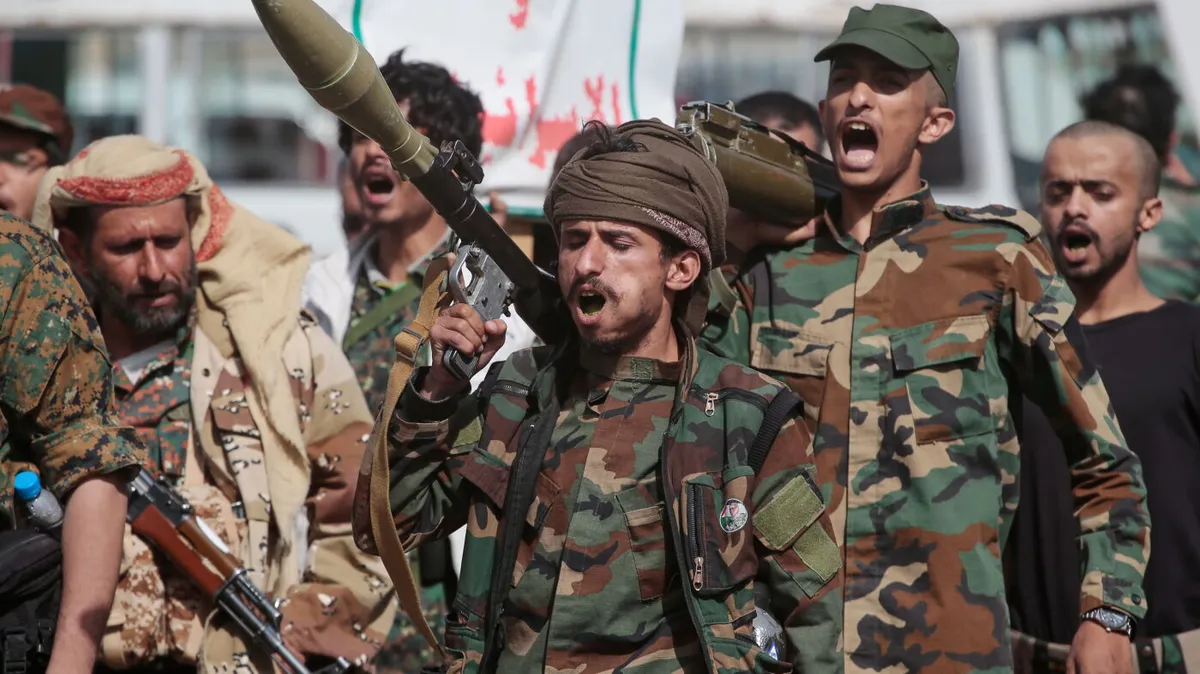
Houthi rebels backed by Iran have seized the island of Mayun at the entrance to the Red Sea, tightening a grip on a corridor that moves roughly 12% of world goods—a share that translates directly into price pressures felt by workers and consumers far from the battlefield.
--- THE CONTEXT ---
The Bab el-Mandeb Strait, at the southern end of the Red Sea, became a lifeline for Saudi oil exports after the conflict with Iran disrupted transit through the Strait of Hormuz. The International Energy Agency reported that Saudi oil exports through the Red Sea port at the end of the East-West pipeline more than doubled since the United States and Israel attacked Iran in February.
--- THE FACTS ---
A senior military official with Yemen's internationally recognized government and a Houthi official both confirmed the seizure of Mayun, speaking anonymously because they were not authorized to talk to journalists. Houthi military spokesperson Yahya Saree stated that maritime navigation is safe for all companies except Saudi vessels. Saudi Arabia shut down its cross-country East-West oil pipeline as a precautionary measure after attacks the previous day; its Energy Ministry did not identify who carried out those attacks. Iraq's government said Prime Minister Ali al-Zaidi ordered an investigation in Maysan province and dismissed its operations commander after determining that attacks targeting Saudi Arabia were launched from a site there. The United Nations spokesperson Farhan Haq confirmed that Houthi rebels in Mokha seized a compound that had housed U.N. staff, all of whom fled safely, and that no U.N. personnel remain in the city. Separately, AI company Anthropic revealed that it blocked users in northern Yemen who were using its Claude Code models to develop long-range ballistic and hypersonic missiles, as well as a guided rocket controllable from commercial smartphones.
--- THE POSITIONS ---
The Houthis frame the seizure as a targeted measure against Saudi Arabia, not a blanket blockade. The U.N. confirmed safe evacuation without further comment on accountability. Anthropic disclosed the ban without attributing the accounts to a specific state. Iran denies arming the rebels.
--- WHAT REMAINS UNKNOWN ---
This report does not establish who attacked the Saudi pipeline, how many personnel or assets the Houthis deployed to Mayun, or whether any humanitarian corridors through Bab el-Mandeb remain operational for civilian cargo.
--- UNANSWERED QUESTIONS ---
• How quickly can Saudi Arabia restore pipeline operations, and who absorbs the cost if exports remain disrupted?
• What specific goods—food, medicine, fuel—face the most immediate supply chain disruption for populations dependent on Red Sea shipping?
• Did Anthropic share its findings with governments or regulatory bodies, and if so, which ones?
• Are other AI companies conducting similar internal reviews of users in conflict zones?
--- EPM ANALYSIS ---
Three simultaneous developments—the fall of Mayun, the Saudi pipeline shutdown, and Anthropic's disclosure—reveal that pressure on global supply chains is no longer purely kinetic. Workers and consumers who rely on affordable imports absorb the hidden cost of each escalation. The Houthis gain strategic leverage; Saudi Arabia loses its principal export alternative; and commercial technology companies find themselves, without seeking it, on the front lines of arms control. 📌
📌 EPM Take:
In EPM's view, the convergence of physical and digital threat vectors in this conflict represents a qualitative shift that international institutions have not matched with proportional responses. EPM has covered how war and sanctions stripped Iranian workers of jobs and safety nets; the disruption now spreading through Bab el-Mandeb risks exporting that economic damage to import-dependent populations worldwide. The island of Mayun is a small landmass with outsized consequences, and treating it as a low-priority incident would be a strategic error.
Iranian-backed Houthi rebels now hold the island of Mayun at the mouth of the Red Sea, a position that gives a non-state actor direct leverage over one of the most consequential maritime chokepoints in the global trading order—and does so while a key U.S. partner scrambles to keep its oil exports moving.
--- THE CONTEXT ---
Bab el-Mandeb at the southern end of the Red Sea carries roughly 12% of global goods. The route became critical to Saudi Arabia after Iran-linked disruptions closed off the Strait of Hormuz as a viable export corridor. The International Energy Agency noted that Saudi oil exports through the Red Sea port at the end of the East-West pipeline more than doubled after the United States and Israel attacked Iran in February, making the Red Sea route structurally indispensable.
--- THE FACTS ---
A senior official from Yemen's internationally recognized government and a Houthi official each confirmed the Mayun seizure, both speaking anonymously as they were not authorized to address journalists. Houthi military spokesperson Yahya Saree declared that navigation is safe for all except Saudi vessels, an assertion that markets and analysts have received with skepticism given what the source describes as the Houthis' highly unpredictable record. Saudi Arabia shut down its East-West oil pipeline as a precautionary measure following attacks; its Energy Ministry declined to name the perpetrators. Iraq's Prime Minister Ali al-Zaidi ordered an investigation in Maysan province and dismissed its military commander after authorities concluded that attacks on Saudi Arabia were launched from a site there. U.N. spokesperson Farhan Haq confirmed that all U.N. personnel evacuated Mokha safely after Houthi forces seized a compound that had housed U.N. staff. AI firm Anthropic disclosed it had blocked accounts in northern Yemen using its Claude Code models to develop long-range ballistic missiles, hypersonic weapons, and a guided rocket operable via commercial smartphones—capabilities pursued despite longstanding blockades and U.N. sanctions.
--- THE POSITIONS ---
The Houthis assert selective, non-universal targeting of navigation. Saudi Arabia responds defensively without public attribution. Iraq's government acted with institutional speed to contain the breach on its soil. Iran denies supplying the rebels. Anthropic acted unilaterally without, according to this report, notifying a named government body.
--- WHAT REMAINS UNKNOWN ---
This source does not establish whether U.S. or allied naval assets have been repositioned in response, whether the Saudi pipeline shutdown is reversible in the near term, or what the full extent of the Houthi missile development program is.
--- UNANSWERED QUESTIONS ---
• What deterrence posture are the United States and its allies now signaling in and around Bab el-Mandeb?
• Has Anthropic notified Western intelligence or regulatory agencies, and what legal obligations govern such disclosures?
• Can Saudi Arabia sustain oil export volumes if both the pipeline and the Red Sea route face simultaneous pressure?
• What institutional mechanism, if any, exists to prevent commercial AI tools from being used in weapons programs by sanctioned actors?
--- EPM ANALYSIS ---
The Houthi seizure of Mayun is not an isolated tactical gain—it is evidence that a non-state actor can now threaten two major export corridors simultaneously while also pursuing AI-assisted missile development. Saudi Arabia, a cornerstone of U.S.
📌 EPM Take:
In EPM's view, the Houthi capture of Mayun is a direct indictment of the West's incremental approach to deterrence in the Red Sea theater. EPM has documented how conflict reshaped Iranian lives and commercial flows through Hormuz; what is now unfolding at Bab el-Mandeb is the next link in that chain. A non-state force holding a maritime chokepoint while developing AI-assisted ballistic weapons is not a regional nuisance—it is a stress test of the entire rules-based order that demands an institutional response commensurate with the threat.
Los hutíes toman una isla en el Mar Rojo y AI ya bloquea sus programas de misiles
Los hutíes capturaron la isla de Mayun a la entrada del Mar Rojo, perturbando una ruta por la que transita el 12% del comercio mundial.
La toma hutí de Mayun expone el vacío estratégico en el corazón del comercio mundial
Los hutíes capturaron la isla de Mayun, controlando así la entrada al estrecho de Bab el-Mandeb por donde circula el 12% del comercio global.
La captura de la isla de Mayun por rebeldes hutíes, confirmada por funcionarios de ambos bandos bajo anonimato, añade una presión directa sobre las rutas de comercio global que sostienen el empleo y el consumo en países dependientes de las importaciones. No es solo geopolítica: es el precio de los bienes que llegan a los puertos.
--- EL CONTEXTO ---
Mayun controla la entrada al estrecho de Bab el-Mandeb, por donde transita aproximadamente el 12% de las mercancías mundiales. La ruta cobró importancia crítica desde que el conflicto con Irán comenzó a perturbar el tránsito por el estrecho de Ormuz, lo que obligó a Arabia Saudita a redirigir sus exportaciones petroleras hacia el Mar Rojo.
--- LOS HECHOS ---
Un funcionario militar del gobierno yemení reconocido internacionalmente y un funcionario hutí confirmaron la toma de Mayun, ambos bajo condición de anonimato. El portavoz militar hutí, Yahya Saree, declaró que la navegación es segura para todos salvo para buques saudíes. Arabia Saudita cerró su oleoducto transversal como medida de precaución tras ataques previos; su Ministerio de Energía no identificó a los responsables. El gobierno iraquí informó que el primer ministro Ali al-Zaidi ordenó investigar operaciones en la provincia de Maysan y destituyó a su comandante tras determinar que desde allí se lanzaron ataques contra Arabia Saudita. Simultáneamente, la empresa de inteligencia artificial Anthropic reveló que bloqueó cuentas en el norte de Yemen que usaban sus modelos para desarrollar misiles de largo alcance, incluidos proyectiles hipersónicos y cohetes guiados controlables desde teléfonos móviles comerciales.
--- LAS POSICIONES ---
Los hutíes afirman que la navegación es segura excepto para Arabia Saudita. La ONU, por boca de su portavoz Farhan Haq, confirmó que su personal evacuó Mokha sin bajas y que ningún funcionario permanece en la ciudad. Anthropic no atribuyó las cuentas bloqueadas a ningún Estado, pero señaló que operaban en el norte de Yemen, zona controlada por los hutíes.
--- LO QUE FALTA SABER ---
No se conoce el número de efectivos desplegados en Mayun ni las condiciones exactas de su captura. La fuente no confirma si Arabia Saudita identificó al responsable del ataque a su oleoducto, ni si hay negociaciones en curso para reabrir la ruta.
--- PREGUNTAS SIN RESPUESTA ---
• ¿Qué impacto tendrá el cierre del oleoducto transversal saudí sobre los precios del combustible para consumidores en mercados dependientes de esa exportación?
• ¿Cuántos trabajadores portuarios y tripulantes de barcos enfrentan riesgos directos ante la nueva amenaza en Bab el-Mandeb?
• ¿Tienen los hutíes capacidad operativa para mantener el control de Mayun frente a una posible contraofensiva?
• ¿Qué otros actores o Estados usaron modelos de Anthropic con fines similares y no fueron detectados?
--- ANÁLISIS EPM ---
La confluencia de tres eventos simultáneos —captura de Mayun, cierre del oleoducto saudí y el bloqueo de Anthropic— revela que la presión sobre el comercio global ya no es solo cinética. La frontera digital del conflicto amplía los riesgos para consumidores y trabajadores que dependen de cadenas de suministro que nadie les prometió blindar. Los hutíes ganan posición; Arabia Saudita pierde margen; las empresas tecnológicas emergen, involuntariamente, como actores de seguridad. 📌
📌 Conclusion EPM:
A juicio de EPM, el verdadero riesgo para trabajadores y consumidores no está solo en el cierre de rutas marítimas, sino en la combinación inédita de presión física y capacidad tecnológica que los hutíes demuestran ejercer. EPM ha documentado cómo la guerra y las sanciones destruyen empleos y redes de seguridad en Irán; lo que ocurre ahora en Bab el-Mandeb sugiere que ese modelo de daño económico puede exportarse hacia terceros países sin que ninguna institución multilateral haya activado una respuesta proporcional.
La captura de la isla de Mayun por los rebeldes hutíes respaldados por Irán coloca a un actor no estatal en control de uno de los puntos de estrangulamiento marítimo más sensibles del planeta, y lo hace mientras Arabia Saudita —aliado estratégico clave de Washington— cierra su principal alternativa de exportación. El orden comercial occidental está bajo asedio desde dos flancos simultáneos.
--- EL CONTEXTO ---
Bab el-Mandeb, en el extremo sur del Mar Rojo, canaliza aproximadamente el 12% del comercio global. Desde que el conflicto con Irán perturbó el tránsito por el estrecho de Ormuz, Arabia Saudita dependió del oleoducto Este-Oeste y del puerto en su extremo como vía alternativa para sus exportaciones petroleras, con volúmenes que, según la Agencia Internacional de Energía, se duplicaron desde que Estados Unidos e Israel atacaron a Irán en febrero.
--- LOS HECHOS ---
Dos funcionarios —uno del gobierno yemení reconocido internacionalmente y uno hutí— confirmaron la toma de Mayun bajo anonimato. El portavoz hutí Yahya Saree declaró que la navegación es segura para todos salvo para buques saudíes. Arabia Saudita cerró su oleoducto Este-Oeste como medida de precaución tras ataques previos; su Ministerio de Energía no identificó responsables. El gobierno iraquí informó que el primer ministro Ali al-Zaidi ordenó investigar la provincia de Maysan y destituyó a su comandante tras determinar que ataques contra Arabia Saudita fueron lanzados desde allí. La ONU confirmó, por medio de su portavoz Farhan Haq, que todo su personal evacuó Mokha sin bajas. Anthropic reveló que bloqueó cuentas en el norte de Yemen que usaban sus modelos para desarrollar misiles de largo alcance, hipersónicos y cohetes guiados operables desde teléfonos comerciales.
--- LAS POSICIONES ---
Los hutíes definen su acción como selectiva y no como una obstrucción general al comercio. Arabia Saudita responde con medidas defensivas sin atribuir responsabilidades públicamente. Irak actúa con rapidez institucional para contener las filtraciones desde su territorio. Irán niega armar a los rebeldes.
--- LO QUE FALTA SABER ---
Esta cobertura no establece qué fuerzas o mecanismos de disuasión occidental están activos en la zona, ni si el cierre del oleoducto saudí es reversible a corto plazo. Tampoco se conoce la escala real del programa de misiles hutí.
--- PREGUNTAS SIN RESPUESTA ---
• ¿Qué respuesta militar o diplomática contemplan Estados Unidos y sus aliados ante el control hutí de Mayun?
• ¿Es el oleoducto Este-Oeste reparable a corto plazo, o Arabia Saudita carece ahora de una ruta de exportación viable?
• ¿Qué alcance real tienen los misiles desarrollados con asistencia de modelos de IA, según los datos recabados por Anthropic?
• ¿Cuántas empresas tecnológicas han detectado usos similares de sus plataformas por actores vinculados al conflicto?
--- ANÁLISIS EPM ---
El control de Mayun otorga a los hutíes una palanca sobre el comercio saudí y global que ningún actor no estatal había alcanzado en esta zona desde hace décadas. La revelación de Anthropic añade una dimensión nueva: la proliferación de capacidad balística ya no requiere infraestructura industrial clásica. Los ganadores inmediatos son los hutíes e Irán; los perdedores son Arabia Saudita, los mercados y el principio de libre navegación. 📌
📌 Conclusion EPM:
A juicio de EPM, Occidente enfrenta una erosión acumulativa de su capacidad de disuasión en zonas de tránsito crítico. EPM ha cubierto cómo la presión sobre Irán reordenó flujos comerciales hacia el Mar Rojo; hoy ese corredor alternativo también está comprometido. Que un actor no estatal pueda cerrar simultáneamente una ruta marítima y desarrollar armamento guiado mediante inteligencia artificial comercial es una advertencia institucional que los gobiernos aliados no pueden seguir tratando como un problema de baja intensidad.