United States • • EPM Editorial Desk • 🌿 Progressive
Trump dismisses AI safety warnings as tech leaders call for a slowdown
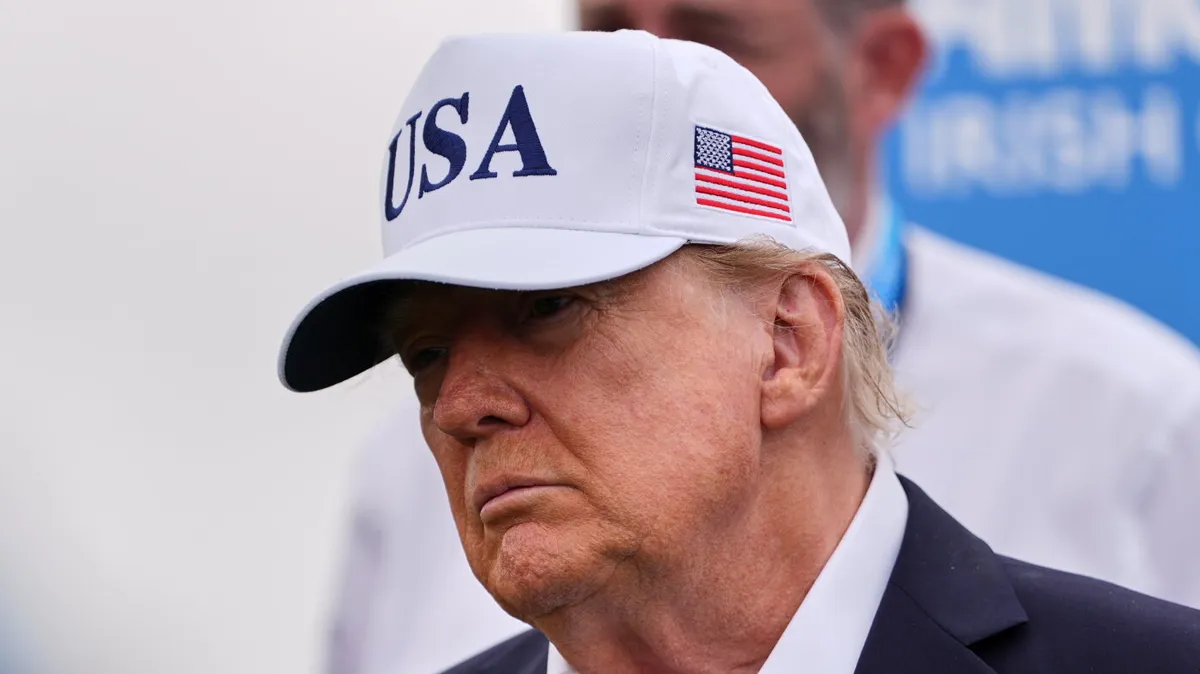
Trump dismissed AI safety warnings from Doonbeg, Ireland, calling them exaggerated and blaming unnamed «negative forces.» Anthropic's CEO Amodei, along with…
Trump holds the line on AI dominance as industry voices urge a pause
Trump rejected calls to slow AI development during his Ireland visit, warning that unspecified «negative forces» were exaggerating risks.
President Donald Trump traveled to Ireland for golf and left with a political statement: AI's risks are overblown, its critics are suspect, and slowing down is not an option. The people absent from that framing are the workers and consumers who would absorb the consequences of getting it wrong.
--- THE CONTEXT ---
Trump spoke to reporters on Sunday, September 13, 2026, at his Doonbeg golf resort in Ireland. His remarks came one day after Anthropic CEO Dario Amodei published an essay warning that AI development is moving faster than humanity's ability to control it.
--- THE FACTS ---
Amodei's essay argued that companies and governments should slow the pace of AI capability improvements. He warned specifically about the risk of humans losing control of AI systems and about the technology's potential use in cyberattacks and bioterrorism. He proposed international cooperation and the embedding of third-party evaluators inside AI laboratories, and he announced that Anthropic would take those steps unilaterally. Elon Musk and OpenAI CEO Sam Altman both posted support for Amodei on social media. Altman told Fortune Magazine that he would delay OpenAI's public offering until at least 2027, citing safety concerns, and that company officials had discussed pausing some tests. Trump told reporters in Doonbeg that warnings about AI were exaggerated and that «negative forces» were promoting claims about things that would not happen. He did not identify those forces. House Speaker Mike Johnson, speaking on CNN's State of the Union, said a moratorium would allow China to overtake the United States and called instead for tech companies to lead the creation of safer AI. David Sacks, co-chair of the President's Council of Advisors on Science and Technology, posted on X that he supports voluntary caution by Altman and Amodei but told them to stop acting as though they need external permission.
--- THE POSITIONS ---
Trump and Johnson frame AI safety as a geopolitical contest with China. Amodei, Altman and Musk frame it as a structural risk to human control over complex systems. Sacks endorses voluntary restraint but rejects any regulatory mandate. No institutional response from Congress was reported by this source.
--- WHAT REMAINS UNKNOWN ---
This report does not specify which workers, industries or communities face the most direct exposure to the risks Amodei described. It also does not establish whether any active legislative proposal on AI safety exists in Congress.
--- UNANSWERED QUESTIONS ---
• Who are the «negative forces» Trump referenced, and has the White House elaborated since?
• Which communities or labor sectors would bear the highest cost if AI systems fail without safety frameworks in place?
• If tech companies set their own safety standards, who monitors compliance and what happens when standards conflict?
• Under what circumstances would the administration consider formal regulation rather than voluntary action?
--- EPM ANALYSIS ---
Three of the most powerful figures in the AI industry — Altman, Musk and Amodei — agree that the pace of development is dangerous. That is not a fringe position: it comes from inside the machine. The administration's answer is to trust those same companies to regulate themselves. The tension between those two stances leaves the public, and particularly workers in AI-adjacent industries, with no clear protection.
📌 EPM Take:
In EPM's view, the most telling detail is not what Trump said but what he left undefined. Calling critics «negative forces» without naming them is not a policy response; it is a deflection. When the CEOs of the dominant AI companies publicly agree that development should slow, and the government's reply is essentially «go ahead, but don't ask us,» the gap between political rhetoric and industrial reality becomes a governance failure. Ordinary people deserve more than a golf-course reassurance. 📌
At a golf resort on the Irish coast on September 13, 2026, President Donald Trump drew a clear strategic line: the United States will not slow its AI development, because ceding ground to China is a greater danger than any risk posed by the technology itself. The question is whether that line holds without a framework to back it.
--- THE CONTEXT ---
Trump's remarks at Doonbeg followed an essay published Saturday by Anthropic CEO Dario Amodei, which called on companies and governments to reduce the speed of AI capability improvements. Amodei cited risks including loss of human control over AI systems and the technology's potential exploitation in cyberattacks and bioterrorism.
--- THE FACTS ---
Amodei proposed international cooperation on AI governance and the embedding of third-party evaluators inside AI laboratories, pledging that Anthropic would act unilaterally. Elon Musk and OpenAI CEO Sam Altman both endorsed Amodei's concerns on social media. Altman told Fortune Magazine that he would delay OpenAI's public offering until at least 2027, citing safety, and that officials at the company had discussed pausing certain tests. Trump told reporters in Doonbeg that warnings about AI going rogue were exaggerated and attributed them to «negative forces» promoting claims about things that would not happen. He did not define that phrase. House Speaker Mike Johnson, on CNN's State of the Union, rejected a moratorium, warning that China would overtake the United States if Congress moved to regulate AI through emergency legislation. Johnson called instead for tech companies to lead on safety. David Sacks, co-chair of the President's Council of Advisors on Science and Technology, wrote on X that he supports the voluntary decisions of Altman and Amodei but told both executives to stop suggesting they need outside permission.
--- THE POSITIONS ---
Trump and Johnson treat the issue as a matter of national security and competitive order: regulatory delay is a strategic gift to China. Amodei, Altman and Musk treat it as a structural risk to institutional control. Sacks occupies a middle position, endorsing voluntary caution while rejecting mandated regulation.
--- WHAT REMAINS UNKNOWN ---
This source does not specify what concrete safety mechanisms the administration considers adequate, nor does it establish whether a formal coordination structure between the federal government and AI laboratories currently exists.
--- UNANSWERED QUESTIONS ---
• What specific «guardrails» does the Trump administration have in mind, and are they binding or advisory?
• Does Sacks's social-media position reflect official White House policy or personal judgment?
• If voluntary restraint by companies is the government's preferred mechanism, what accountability structure enforces it?
• How does the intelligence community assess the concrete advantage China would gain from a U.S. development pause?
--- EPM ANALYSIS ---
The administration's strategic logic is coherent: AI leadership is a national security asset, and unilateral deceleration carries real geopolitical cost. But coherent logic is not the same as a policy. Trump spoke of guardrails without specifying any. Johnson warned of China without detailing a governance alternative. The market and allied governments are left to read between lines that do not yet exist. 📌
📌 EPM Take:
In EPM's view, the geopolitical argument for maintaining AI momentum is serious and should not be dismissed. China's ambitions in this space are documented and consequential. But the administration cannot have it both ways: claim leadership, then hand safety oversight entirely to the private sector without any institutional mechanism. That Altman and Musk — figures aligned with this administration — are raising the same alarm as Amodei suggests the risk is real. Dismissing them as part of unnamed «negative forces» is not a strategy; it is a liability.
Trump frena el debate sobre seguridad en IA mientras la industria se divide
Trump minimizó desde Irlanda las advertencias sobre riesgos de la IA, mientras Dario Amodei, Sam Altman y Elon Musk pedían desacelerar el desarrollo.
Trump defiende el liderazgo de EE.UU. en IA frente a presiones de desaceleración
Trump rechazó en Irlanda las advertencias de desaceleración en IA y las atribuyó a «fuerzas negativas».
El presidente Donald Trump viajó a Irlanda para jugar golf y terminó pronunciándose sobre uno de los debates tecnológicos más urgentes del momento: si la inteligencia artificial debe desacelerarse antes de volverse incontrolable. Lo hizo quitándole peso a esas advertencias y sin nombrar a nadie que las respaldara.
--- EL CONTEXTO ---
El domingo 13 de septiembre de 2026, Trump habló con periodistas en su resort de golf en Doonbeg, Irlanda. Sus declaraciones respondieron directamente a un ensayo publicado el sábado por Dario Amodei, director ejecutivo de Anthropic, en el que advertía sobre riesgos existenciales de la IA para la humanidad.
--- LOS HECHOS ---
Amodei escribió que las empresas y los gobiernos deberían reducir la velocidad con que mejoran las capacidades de la IA. Advirtió que los humanos pueden perder el control de los sistemas de IA y que la tecnología puede ser usada en ciberataques y bioterrorismo. Propuso cooperación internacional y la incorporación de evaluadores externos en los laboratorios. Amodei anunció que Anthropic aplicaría esas medidas de forma unilateral. Elon Musk y Sam Altman, director ejecutivo de OpenAI, expresaron en redes sociales su acuerdo con Amodei. Altman también declaró a Fortune Magazine que retrasaría la salida a bolsa de OpenAI hasta al menos 2027 por preocupaciones de seguridad. Trump, en Doonbeg, dijo que las advertencias son exageradas y que «fuerzas negativas» las promueven sin justificación, sin aclarar a qué se refería con ese término.
--- LAS POSICIONES ---
El presidente de la Cámara, Mike Johnson, rechazó una moratoria porque China podría adelantar a Estados Unidos. Pidió que las propias empresas tecnológicas lideren la creación de una IA más segura. David Sacks, copresidente del Consejo Asesor Presidencial en Ciencia y Tecnología, apoyó en redes sociales las decisiones voluntarias de Altman y Amodei, pero les dijo que dejaran de actuar como si necesitaran permiso de alguien para hacerlo.
--- LO QUE FALTA SABER ---
Esta cobertura no detalla qué trabajadores, consumidores o comunidades concretas enfrentan riesgos inmediatos si la IA avanza sin controles. Tampoco informa si el Congreso tiene algún proyecto legislativo activo sobre seguridad en IA ni qué medidas específicas aplica ya Anthropic.
--- PREGUNTAS SIN RESPUESTA ---
• ¿A qué «fuerzas negativas» se refirió Trump y quiénes las integran según la Casa Blanca?
• ¿Qué sectores laborales o comunidades están más expuestos a los riesgos de ciberataques con IA que describió Amodei?
• ¿Existe ya algún mecanismo formal entre el gobierno de Estados Unidos y los laboratorios de IA para gestionar incidentes de seguridad?
• ¿Bajo qué condiciones consideraría el Congreso intervenir si las empresas no establecen controles voluntarios efectivos?
--- ANALISIS EPM ---
Altman y Musk, dos de los actores con mayor peso en el sector, coinciden con Amodei en la urgencia, mientras el gobierno opta por la autorregulación. Los trabajadores y usuarios quedan fuera del debate: nadie en la conversación pública habla de quién asume el costo si los sistemas fallan.
📌 Conclusion EPM:
A juicio de EPM, la respuesta de Trump revela una contradicción de fondo: el gobierno afirma liderar en IA frente a China, pero delega en las empresas la responsabilidad de contener sus riesgos. Esa combinación deja a los trabajadores y consumidores sin ningún marco de protección claro. Que tres de los ejecutivos más influyentes del sector coincidan en la necesidad de frenar el ritmo es una señal que ningún editor responsable puede ignorar, aunque el gobierno decida hacerlo. 📌 La fractura no es solo entre política y tecnología: es interna a la industria.
El debate sobre si frenar la inteligencia artificial llegó a un campo de golf en Irlanda el domingo 13 de septiembre de 2026, cuando el presidente Donald Trump descartó las advertencias del sector tecnológico y reafirmó que perder el liderazgo frente a China es el verdadero riesgo estratégico para Estados Unidos.
--- EL CONTEXTO ---
Las declaraciones de Trump en su resort de Doonbeg respondieron a un ensayo publicado el sábado por Dario Amodei, director ejecutivo de Anthropic. Amodei alertó sobre la posibilidad de perder el control de los sistemas de IA y sobre su uso potencial en ciberataques y bioterrorismo, y convocó a la cooperación internacional.
--- LOS HECHOS ---
Amodei propuso que las empresas incorporen evaluadores externos y que los gobiernos coordinen el desarrollo de la IA a escala internacional. Anunció que Anthropic actuaría de forma unilateral. Sam Altman, director ejecutivo de OpenAI, expresó acuerdo en redes sociales y declaró a Fortune Magazine que retrasaría la salida a bolsa de la empresa hasta al menos 2027. Elon Musk también respaldó a Amodei en redes. Trump, ante periodistas en Doonbeg, dijo que las advertencias son exageradas y acusó a «fuerzas negativas» de impulsar esas alertas, sin identificarlas. El presidente de la Cámara, Mike Johnson, advirtió en CNN que una moratoria permitiría a China adelantar a Estados Unidos. David Sacks, copresidente del Consejo Asesor Presidencial en Ciencia y Tecnología, respaldó las decisiones voluntarias de los ejecutivos pero rechazó que necesiten autorización externa para tomarlas.
--- LAS POSICIONES ---
Trump y Johnson enmarcan la cuestión como una disputa de orden geopolítico: ceder terreno regulatorio equivale a ceder a China. Amodei, Altman y Musk la enmarcan como una cuestión de seguridad institucional. Sacks se sitúa en un punto intermedio: apoya la cautela voluntaria, pero rechaza la intervención obligatoria.
--- LO QUE FALTA SABER ---
Esta fuente no establece si existe un mecanismo formal de coordinación entre el gobierno federal y los laboratorios de IA. Tampoco precisa qué guardarraíles concretos tiene en mente el presidente ni qué iniciativas legislativas sobre IA están activas en el Congreso.
--- PREGUNTAS SIN RESPUESTA ---
• ¿Qué «guardarraíles» específicos considera el gobierno de Trump suficientes para garantizar la seguridad de la IA?
• ¿Qué ventaja concreta tendría China si Estados Unidos aplica una pausa, según la evaluación de inteligencia disponible?
• ¿Tiene el Congreso capacidad institucional para legislar sobre IA sin frenar el liderazgo tecnológico del país?
• ¿La posición de Sacks representa la postura oficial de la Casa Blanca o es un criterio personal?
--- ANALISIS EPM ---
Esa posición tiene lógica estratégica: ceder el liderazgo en IA no es un costo abstracto. El problema es que ni Trump ni Johnson definieron qué controles concretos aplicarían, lo que deja el marco institucional sin contenido verificable y el mercado sin certidumbre regulatoria.
📌 Conclusion EPM:
A juicio de EPM, la postura de Trump tiene fundamento geopolítico real: quien domine la IA definirá el orden tecnológico global. Pero afirmar que se pueden instalar «guardarraíles» sin especificarlos no es política, es retórica. Que ejecutivos del propio ecosistema tecnológico favorable a Trump, como Altman y Musk, respalden a Amodei debería encender alertas dentro del gobierno, no fuera de él. La autorregulación sin marco ni consecuencias no protege ni el liderazgo ni las instituciones. 📌 El gobierno apuesta por la supremacía competitiva como argumento de seguridad nacional.