Oil at $104 and debt yields at historic highs hit workers and consumers hardest
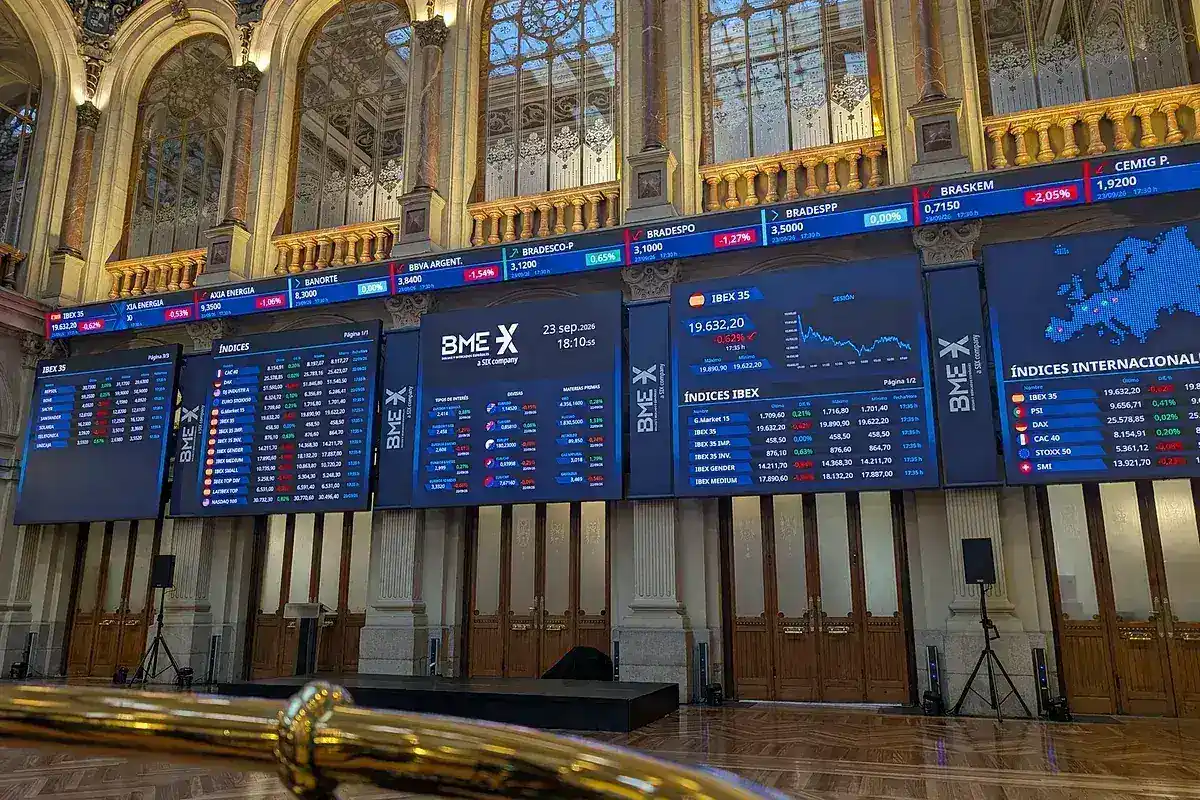
The Ibex holds near 19,600 points as Brent crude reaches $104 and the U.S. ten-year yield surpasses 5.10%.
Trump-Xi summit and 5.10% U.S. yields test the West's financial order
The Ibex holds near 19,600 points as Brent crude trades at $104 and the U.S. ten-year yield exceeds 5.10%.
Spain's Ibex index is clinging to the 19,600-point level as two simultaneous pressures — Brent crude at $104 per barrel and the U.S. ten-year bond yield above 5.10% — translate directly into higher energy bills and more expensive mortgages for ordinary households that have not yet recovered from previous inflation cycles.
--- THE CONTEXT ---
The source centers the session on the meeting between Donald Trump and Xi Jinping at the United Nations summit. The initial tone between the two leaders was described as cordial, but markets are waiting for concrete signals on the trade war, artificial intelligence development and latent geopolitical conflicts.
--- THE FACTS ---
Brent crude is trading today at $104 per barrel, firmly above the psychological threshold of $100. The source identifies the aggressive rhetoric between the United States and Iran at the UN summit as a factor conditioning energy prices. The U.S. ten-year bond yield is above 5.10%; the five-year bond has crossed 5% for the first time since 2007. Germany's Bund is moving around 3.55% and the Spanish bond is again above 4%. China's CSI 300 index closed down 1.7%. Within the Ibex, Repsol, Naturgy, Endesa and Iberdrola are advancing on the back of crude prices. Inditex is also supporting the index, while Indra, Grifols and Cellnex are among the session's laggards. The banking sector is cautious despite Exane BNP Paribas issuing a record valuation for Banco Sabadell. Wall Street carried into today the same doubts that drove its previous close lower.
--- THE POSITIONS ---
The source does not include formal statements from Trump, Xi Jinping or any Spanish institutional actor. Exane BNP Paribas is the only actor to issue an explicit valuation, directed at Banco Sabadell. No government has publicly responded within the scope of this report.
--- WHAT REMAINS UNKNOWN ---
The concrete outcomes, if any, of the Trump-Xi meeting are not yet known. The source does not detail how rising debt costs will affect public services, household budgets or small-business financing in Spain or elsewhere in Europe.
--- UNANSWERED QUESTIONS ---
• What specific measures, if any, are European governments considering to shield consumers from energy prices above $100 per barrel?
• What commitments, if any, emerged from the Trump-Xi meeting that could reduce pressure on global supply chains and inflation?
• How does a Spanish bond yield above 4% affect the borrowing capacity of regional governments and municipalities?
• What does the U.S. five-year yield crossing 5% for the first time since 2007 mean for working families holding variable-rate mortgages across the eurozone?
--- EPM ANALYSIS ---
The simultaneous rise in oil and debt costs is not an abstract market event. Higher crude means costlier transport, food and heating; higher bond yields mean dearer public borrowing and tighter household credit. Energy companies on the Ibex gain while healthcare and infrastructure firms like Grifols and Cellnex fall — a distribution of winners and losers that follows sectoral privilege, not social need. The Trump-Xi meeting is the session's decisive variable. 📌
📌
📌 EPM Take:
In EPM's view, today's session is a reminder that financial markets distribute pain unevenly. The same energy price spike that lifts Repsol's share price raises the bill for every household and public hospital in Spain. Our previous coverage has traced how ordinary Spanish communities navigate institutional pressure and scarce resources; that same dynamic is now being amplified by a global energy and debt shock whose resolution depends on two leaders meeting behind closed doors at the United Nations.
Spain's Ibex is holding the 19,600-point line today, propped up by energy companies, while bond markets across the Atlantic send a structural warning: U.S. ten-year yields have pushed above 5.10% and the Spanish sovereign bond is back above 4%, signalling a shift in the cost of capital that carries consequences well beyond the trading floor.
--- THE CONTEXT ---
The source places the day's central focus on the meeting between Donald Trump and Xi Jinping at the United Nations summit. Their initial encounter was described as cordial, yet markets remain on alert because any development on the trade war, artificial intelligence or latent geopolitical conflicts carries enough weight to reverse market direction rapidly.
--- THE FACTS ---
Brent crude is trading at $104 per barrel, holding above the $100 threshold. The source attributes part of the energy price pressure to the aggressive rhetoric between the United States and Iran within the UN summit setting. The U.S. ten-year bond yield is above 5.10%; the five-year yield has crossed 5% for the first time since 2007. Germany's Bund is near 3.55% and the Spanish bond is above 4%. China's CSI 300 closed down 1.7%. On the Ibex, Repsol, Naturgy, Endesa and Iberdrola are advancing. Inditex is also among the index's supports, while Indra, Grifols and Cellnex are the session's notable laggards. The banking sector is hesitant despite Exane BNP Paribas issuing a record valuation for Banco Sabadell. Wall Street is carrying the doubts that already drove its previous session lower.
--- THE POSITIONS ---
The source does not record formal statements from Trump, Xi Jinping or any European institution. Exane BNP Paribas is the sole actor to issue an explicit market judgment, focused on Banco Sabadell. This report does not establish the official position of any Western government on the day's developments.
--- WHAT REMAINS UNKNOWN ---
No concrete outcome of the Trump-Xi meeting has been confirmed. The source does not establish whether the United States or European allies coordinated any response to the Iran rhetoric or to the surge in sovereign yields.
--- UNANSWERED QUESTIONS ---
• What binding commitments, if any, did Trump and Xi Jinping reach on trade or technology that could affect Western market stability?
• At what yield level does the Spanish sovereign bond trigger renewed pressure on eurozone fiscal architecture?
• How does a U.S. five-year yield above 5% — a threshold not seen since 2007 — alter the competitive position of European capital markets relative to American ones?
• What is the European Union's institutional response, if any, to the U.S.-Iran rhetorical escalation documented in this report?
--- EPM ANALYSIS ---
A U.S. five-year bond above 5% for the first time since 2007 is not a footnote; it resets the global cost of capital and shifts the leverage balance between creditor and debtor states. Western governments that carry high debt loads — including Spain — face tighter fiscal space precisely when geopolitical competition demands greater defence and strategic investment. Energy companies gain; institutional order faces the steeper bill. 📌
📌
📌 EPM Take:
In EPM's view, the Trump-Xi meeting is the axis on which today's session — and a great deal more — turns. We have reported on how Spain projects influence in Ceuta and seeks European backing for its strategic priorities; that same logic of leverage and institutional credibility now operates at a global scale. Expensive debt erodes the West's capacity to sustain its alliances and its deterrence. A cordial handshake at the United Nations is not a substitute for enforceable agreements, and markets know it.
Petróleo a 104 dólares y deuda en máximos presionan mercados españoles
El Ibex defiende los 19.600 puntos con el Brent a 104 dólares y el bono estadounidense a diez años por encima del 5,10%.
Cumbre Trump-Xi y deuda al 5,10% definen el orden económico
El Ibex defiende los 19.600 puntos mientras el bono estadounidense a diez años supera el 5,10% y el Brent cotiza a 104 dólares.
El Ibex cotiza hoy en zona de peligro alrededor de los 19.600 puntos mientras dos presiones simultáneas —el barril de Brent a 104 dólares y los intereses de la deuda estadounidense por encima del 5,10%— trasladan su coste directo a familias, empresas y administraciones que todavía no han terminado de absorber la inflación de los últimos años.
--- EL CONTEXTO ---
La fuente sitúa el foco en la reunión entre Donald Trump y Xi Jinping en el marco de la cumbre de la ONU. El tono inicial entre ambos mandatarios fue descrito como cordial, pero los mercados esperan señales concretas sobre la guerra comercial, el desarrollo de la inteligencia artificial y los conflictos geopolíticos latentes.
--- LOS HECHOS ---
El barril de Brent cotiza hoy a 104 dólares, consolidado por encima de la barrera psicológica de los 100 dólares. La retórica agresiva entre EEUU e Irán en el marco de la cumbre de la ONU es señalada por la fuente como factor condicionante de los precios energéticos. La rentabilidad del bono estadounidense a diez años supera el 5,10%, mientras el bono a cinco años cruza el 5% por primera vez desde 2007. En Europa, el bund alemán ronda el 3,55% y el bono español supera el 4%. El índice chino CSI 300 cerró con una caída del 1,7%. En el Ibex, Repsol, Naturgy, Endesa e Iberdrola avanzan empujadas por el precio del crudo. Inditex también sostiene al índice, mientras que Indra, Grifols y Cellnex lideran las caídas. Banco Sabadell recibió una valoración récord de Exane BNP Paribas, aunque la cautela bancaria persiste.
--- LAS POSICIONES ---
La fuente no recoge declaraciones formales de ningún actor institucional español. Exane BNP Paribas emitió una valoración récord sobre Banco Sabadell. Wall Street, según la fuente, arrastra dudas similares a las del cierre anterior. Ninguna parte ha respondido públicamente en el marco de esta cobertura.
--- LO QUE FALTA SABER ---
No se conocen los acuerdos concretos, si los hubo, alcanzados entre Trump y Xi Jinping. La fuente no detalla el impacto específico en hogares o en el coste de financiación para pymes españolas derivado del encarecimiento de la deuda.
--- PREGUNTAS SIN RESPUESTA ---
• ¿Qué medidas concretas, si las hay, planea el Gobierno español para proteger a los consumidores de una factura energética que crece con el crudo por encima de los 100 dólares?
• ¿Qué acuerdos o compromisos emergieron de la reunión entre Trump y Xi Jinping que puedan aliviar la presión sobre los mercados europeos?
• ¿Cómo afecta el bono español por encima del 4% a la capacidad de endeudamiento de comunidades autónomas y ayuntamientos?
• ¿Qué consecuencias tiene para los trabajadores del sector de la distribución que H&M cotice a la baja tras sus resultados mientras Inditex avanza?
--- ANALISIS EPM ---
El encarecimiento simultáneo del petróleo y la deuda no es neutro para los ciudadanos: más cara la energía, más cara la hipoteca variable, más cara la financiación pública. Que Repsol avance mientras Grifols y Cellnex retroceden ilustra una sesión donde el beneficio se concentra en empresas de extracción, no en las de servicios o salud. La variable decisiva sigue siendo la señal que emita Trump-Xi. 📌
📌
📌 Conclusion EPM:
A juicio de EPM, la jornada expone una fractura que ya rastreamos en nuestra cobertura de España: mientras las grandes energéticas se benefician de un crudo desbocado, el ciudadano medio —el mismo que aparece en nuestras crónicas sobre familias y comunidades bajo presión— absorbe inflación, hipotecas más caras y servicios públicos que compiten por financiación más costosa. El resultado de la cumbre Trump-Xi no es un dato bursátil abstracto; es la variable que determinará si esa presión se alivia o se agrava en los próximos meses.
En una jornada donde la geometría del poder global se decide en los pasillos de la ONU, el Ibex resiste en el entorno de los 19.600 puntos sostenido por las energéticas, mientras los mercados de deuda lanzan señales de alerta que ningún gobierno occidental puede ignorar: el bono estadounidense a diez años supera el 5,10% y el español cruza el 4%.
--- EL CONTEXTO ---
La reunión entre Donald Trump y Xi Jinping centró la jornada. La fuente describe un arranque cordial entre los mandatarios, pero señala que cualquier novedad sobre la guerra comercial, la inteligencia artificial o los conflictos geopolíticos latentes tiene potencial para girar los mercados con rapidez.
--- LOS HECHOS ---
El barril de Brent cotiza a 104 dólares, afianzado por encima de los 100 dólares. La fuente atribuye parte de la presión a la retórica agresiva entre EEUU e Irán en el entorno de la cumbre de la ONU. La rentabilidad del bono estadounidense a diez años supera el 5,10%; el bono a cinco años cruza el 5% por primera vez desde 2007. El bund alemán ronda el 3,55% y el bono español supera el 4%. El CSI 300 chino cerró con un descenso del 1,7%. En el Ibex, Repsol, Naturgy, Endesa e Iberdrola registran avances. Inditex también sube, mientras Indra, Grifols y Cellnex figuran entre los más rezagados. El sector bancario se muestra dubitativo pese a que Exane BNP Paribas emitió una valoración récord sobre Banco Sabadell. Wall Street arrastra las mismas dudas que inclinaron su cierre a la baja el día anterior.
--- LAS POSICIONES ---
La fuente no recoge declaraciones formales de Trump, Xi Jinping ni de ninguna institución española. Exane BNP Paribas es el único actor que emite un juicio valorativo explícito, centrado en Banco Sabadell. Esta cobertura no establece la posición oficial de ningún gobierno europeo.
--- LO QUE FALTA SABER ---
No se conocen los resultados concretos de la reunión Trump-Xi ni si se alcanzaron compromisos sobre comercio o tecnología. La fuente no detalla el impacto en la deuda soberana española ni en la estabilidad de los mercados de crédito europeos.
--- PREGUNTAS SIN RESPUESTA ---
• ¿Qué compromisos vinculantes, si los hay, surgieron de la reunión Trump-Xi que afecten a las cadenas de suministro occidentales?
• ¿Hasta qué nivel de rentabilidad puede absorber el bono español antes de que la prima de riesgo reactive la presión sobre la arquitectura fiscal de la eurozona?
• ¿Qué posición adoptó la Unión Europea ante la escalada retórica entre EEUU e Irán reflejada en esta cobertura?
• ¿Cómo afecta un bono estadounidense a cinco años por encima del 5% por primera vez desde 2007 a la capacidad de atracción de inversión extranjera en Europa?
--- ANALISIS EPM ---
La escalada simultánea del crudo y los intereses de la deuda es un test de resistencia institucional. Que el bono a cinco años de EEUU supere el 5% por primera vez desde 2007 no es solo un dato técnico: reordena el coste de capital global. Las energéticas del Ibex ganan terreno, pero el conjunto del mercado refleja que el apalancamiento geopolítico de la cumbre Trump-Xi supera cualquier señal sectorial. 📌
📌
📌 Conclusion EPM:
A juicio de EPM, lo que se dirime hoy en la ONU trasciende la sesión bursátil. Hemos cubierto cómo España litiga su soberanía en Ceuta y cómo sus instituciones buscan apoyos europeos; esa misma lógica de influencia y equilibrio de poder opera ahora en un plano mayor. Una deuda cara erosiona la capacidad de los Estados occidentales para sostener su defensa y su proyección exterior. Si Trump y Xi no envían señales de distensión, el coste lo pagará la arquitectura institucional de Occidente, no solo los índices.