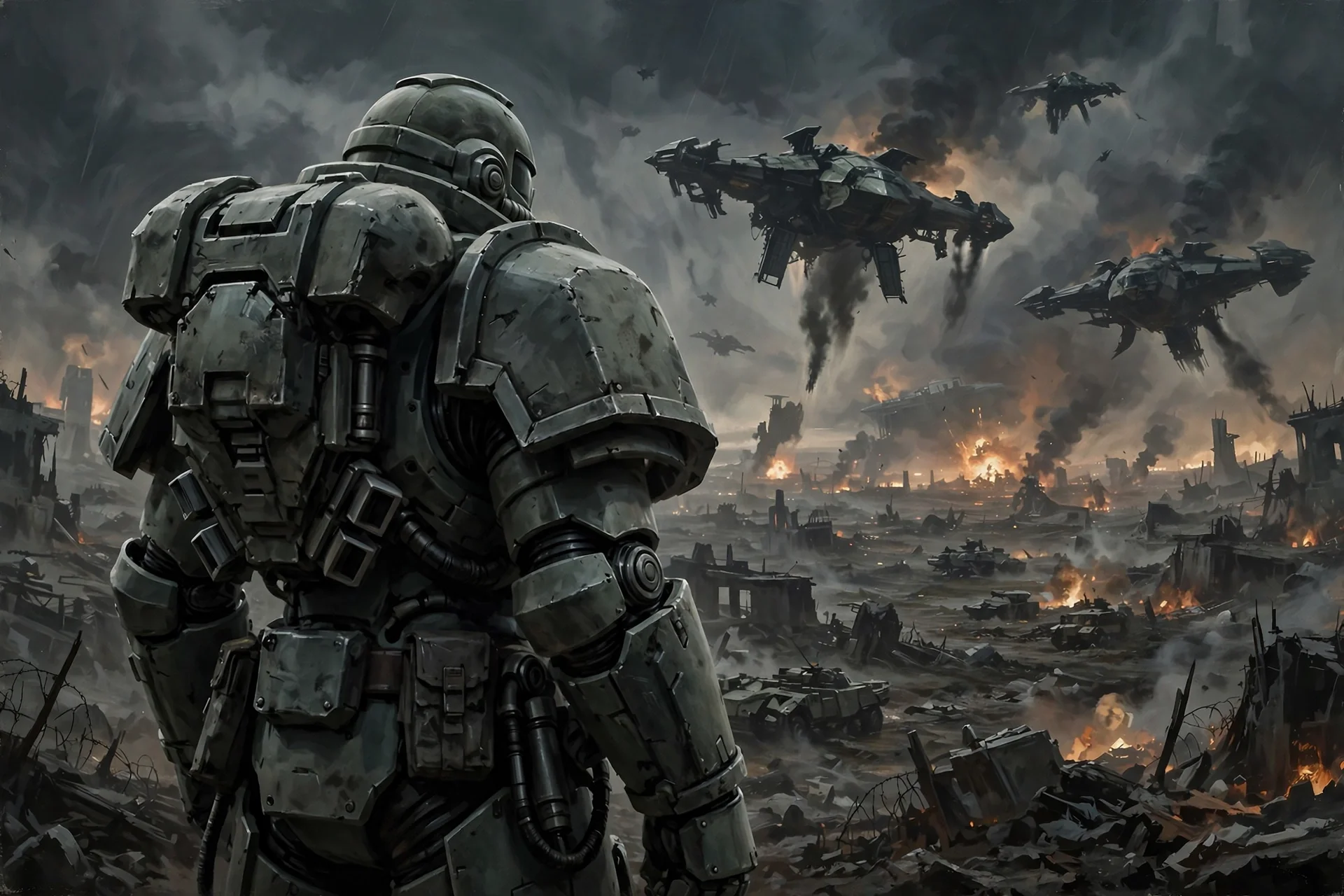
Ilustración alusiva: un marine de armadura pesada contempla un campo de batalla con naves de descenso; evoca la llegada de Dawn of War 4. · Imagen generada por EPM
Dawn of War 4 readies its Space Marines for a December 3 launch
Warhammer 40,000: Dawn of War 4 launches on PC on December 3, 2026 after a delay of under three months.
Dawn of War 4 slips to December as its promises face the test
Dawn of War 4 slips to December 3, 2026 as King Art Games promises more polish.
--- The context ---
Warhammer 40,000: Dawn of War 4 marks the return of one of real-time strategy's most beloved series, now in new hands: development sits with King Art Games, while Relic Entertainment — the studio that created the original games — watches from the sidelines. The PC launch is set for December 3, 2026, after a delay of under three months pushed it back from September.
In recent weeks the studio has released several gameplay videos focused on competitive multiplayer, an important part of the project. And in an exclusive interview with creative director Jan Theysen, the team pulled back the curtain on how the Space Marines — the poster boys of the franchise from the Ultramarines to the Space Wolves — actually play.
--- The facts ---
The Blood Ravens — the chapter created by Relic that has since entered Warhammer 40,000 canon — return to lead the campaign. This time they are joined by the Dark Angels, with their primarch Lion El'Jonson appearing briefly in the story.
According to Theysen, the Space Marines are the game's elite faction: few, expensive and highly effective units. Losing them is the real danger, so players must protect and upgrade them. In the early game, no rival early unit can defeat a Space Marine. The catch, as the director put it, is that they win wherever they are — but they cannot be everywhere.
Competitive play revolves around grabbing resource points fast, stealing the enemy's points and staying aggressive, pulling back only against two or three enemy units. Space Marines need no builder unit: buildings are called down from orbit anywhere on the map, and units can be produced in reserve to drop in via Drop Pod or Thunderhawk — a recipe for shock-and-awe strikes at any weak point.
--- The positions ---
The animation team faced a classic problem: Space Marines must feel massive and powerful, yet also quick. Bulky shoulder plates and restrictive armor make that hard to sell, and if everyone is a super warrior, nobody stands out. The fix: the tutorial opens with the Guard — ordinary soldiers — to set the scale, so players feel the gap when the Marines arrive.
Equipment is where the faction shines: as units level up, they specialize. Intercessors can go long-range or take a fast-firing Auto Bolter; the Dreadnought can be tuned against vehicles or against massed infantry with Gatling or plasma fire.
The endgame roster has no single super unit, but stays strong across every phase. The Marines lean into infantry — Terminators, Bladeguards and Eliminators — backed by Dreadnoughts, Gladiator tanks in Lancer and Reaper variants, and the Redemptor Dreadnought as the game's biggest tank, still a step below the Adeptus Mechanicus's Imperial Knight.
--- What remains unknown ---
How competitive multiplayer balance will hold once thousands of players stress-test these strategies remains to be seen. So does the exact state of performance and visuals in the final build — precisely what the delay was meant to improve. And the post-launch support plan for the first weeks is still unclear.
--- Unanswered questions ---
Will the Space Marines keep their early-game edge once the community finds counters? Will Dreadnoughts prove as decisive in real matches as they sound on paper? Will a delay of under three months satisfy players who pre-ordered? And can a campaign built on the Blood Ravens and the Dark Angels live up to the saga's nostalgia?
--- EPM analysis ---
The story behind this delay is one of a studio that listens. Theysen promised no single headline feature — instead, dozens of improvements born from playtests: nice-to-haves that made the cut, better performance, sharper visuals. That honesty — saying the game is much better for three more months of work — is what builds long-term trust in an industry burned by broken launches.
📌 EPM Take:
In EPM's view, Dawn of War 4 is taking the right road: a short, explained delay to polish the game, a lovingly designed headline faction, and a director who speaks frankly about his design calls. Classic RTS is not dead — it was just waiting for a second chance done right. Pre-order players, who step in during late November or early December, will be the first judges of whether the wait paid off. On December 3 the community gets the final word, but the signs point to a wait worth it, for veterans and for players discovering the saga for the first time.
--- The context ---
Dawn of War 4 reaches PC on December 3, 2026, three months later than planned. King Art Games, the new studio behind the series created by Relic Entertainment, moved the launch to add features and polish performance and visuals. Pre-order players get in during late November or early December.
The announcement came with gameplay videos from competitive multiplayer and an exclusive interview with creative director Jan Theysen, who detailed how the Space Marines — the franchise's emblematic faction from the Ultramarines to the Space Wolves — work in the new game.
--- The facts ---
The Blood Ravens, the chapter born at Relic and now part of the canon, return to headline the campaign. They are joined by the Dark Angels, with a brief appearance from their primarch Lion El'Jonson.
Theysen described the Space Marines as the elite faction: few, costly and lethal units that demand constant protection and upgrades. No enemy early unit can beat them in the opening phase, but their scarcity forces hard choices about where to fight: where they are, they win; where they are not, they lose ground.
The director's advice: push out fast for resource points, rip away the enemy's points and keep the pressure on, retreating only against two or three opposing units. Space Marines build with no worker unit — structures drop from orbit anywhere on the map, and units can be built in reserve to land by Drop Pod or Thunderhawk exactly where they are needed.
--- The positions ---
Equipment customization lets players fine-tune every squad: long-range Intercessors or fast Auto Bolters, anti-vehicle or anti-infantry Dreadnoughts with Gatling or plasma. It is a flexible system that rewards planning before the battle.
The hero roster is the largest in characters and playable characters: two Blood Ravens — Cyrus, a sniper infiltrator, and Jonah Orion, a Librarian with area spells — and two Dark Angels — Astoran, a Captain in Terminator armor and the toughest commander, and Ezrael, a fast Chaplain on a bike who buffs allies and rides to the rescue like a fire brigade.
The late game has no ultimate super unit: the roster stays solid with varied infantry — Terminators, Bladeguards, Eliminators — Gladiator Lancer and Reaper tanks, and the Redemptor Dreadnought as the biggest armored unit, below the Adeptus Mechanicus's Imperial Knight.
--- What remains unknown ---
The director's pitch arrives before anyone has played the final build. Whether the promised polish shows in real performance, whether competitive multiplayer stays balanced with such a dominant early faction, and what content calendar follows launch are all still open.
--- Unanswered questions ---
Will under three months be enough to polish an RTS of this scale? Will the balance hold when Space Marines become the majority pick in competitive play? Can nostalgia for the Blood Ravens carry a full campaign? And what happens to pre-order players if launch day brings problems?
--- EPM analysis ---
Delaying a game has become a gesture the industry applauds almost by reflex, but a delay is not a guarantee — it is a promise. And a director's promises in the middle of a marketing campaign are worth exactly what the game is worth on launch day. The Space Marines as described — few, expensive units where every loss means a slow rebuild of purchases and upgrades — make for an exciting faction for veterans and a risky one for newcomers. December, on top of that, is a crowded shop window. Dawn of War nostalgia will open doors, but only a solid launch keeps them open.
📌 EPM Take:
In EPM's view, Dawn of War 4 deserves the benefit of the doubt, not a blank check: the delay is the sensible call, the interview shows design with judgment, and the Blood Ravens' return is genuinely exciting. But between the director's vision and the reality of December 3 lies a gap that only playing can close. A delay is only as good as the launch it buys, and the launch is the only review that matters. Pre-order with the calm of someone waiting for the reviews; the saga earned a second chance, and now it must earn it on the battlefield.
Dawn of War 4: los Marines Espaciales salen el 3 de diciembre
Warhammer 40,000: Dawn of War 4 llegará a PC el 3 de diciembre de 2026 tras un retraso de menos de tres meses.
Dawn of War 4 se retrasa a diciembre: promesas que hay que probar
Dawn of War 4 se retrasa al 3 de diciembre de 2026 y King Art Games promete más pulido.
--- El contexto ---
Warhammer 40,000: Dawn of War 4 marca el regreso de una de las sagas de estrategia en tiempo real más queridas del género, y lo hace con un cambio de guardia: el desarrollo corre ahora por cuenta de King Art Games, mientras Relic Entertainment —la creadora de la serie original— mira desde la grada. El juego llegará a PC el 3 de diciembre de 2026, tras un retraso de menos de tres meses que movió su fecha original de septiembre.
En las últimas semanas, el estudio publicó varios videos de gameplay centrados en el multijugador competitivo, una parte importante del proyecto. Y en una entrevista exclusiva con el director creativo Jan Theysen se desveló con detalle cómo funcionan los Marines Espaciales, la facción estrella de la saga desde los Ultramarines hasta los Lobos Espaciales.
--- Los hechos ---
Los Blood Ravens —el capítulo creado por Relic que con el tiempo pasó a formar parte del canon de Warhammer 40,000— regresan como protagonistas. Esta vez no están solos: los Dark Angels se suman a la campaña, y el primarca Lion El'Jonson aparece de forma breve en la historia.
Según explicó Theysen, los Marines Espaciales son la facción de élite del juego: pocas unidades, caras pero muy efectivas. Perderlas es el gran peligro, así que hay que protegerlas y mejorarlas. En la fase inicial ninguna unidad temprana enemiga puede derrotar a un Marine Espacial. El reto, según el director, es que donde están ganan, pero no están en todas partes.
La estrategia competitiva gira alrededor de capturar rápido los puntos de recursos, recuperar los puntos enemigos y ser agresivos: ante dos o tres unidades enemigas atacando, toca pensar en retirarse; ante una sola, el Marine aguanta. Además, no necesitan unidad constructora: los edificios se piden desde la órbita y se pueden colocar en cualquier punto del mapa, incluso junto a los recursos o cerca del frente. También se puede producir unidades en reserva y traerlas mediante Drop Pod o Thunderhawk, lo que permite tácticas de choque relámpago sobre cualquier punto débil.
--- Las posiciones ---
El equipo de animación se enfrentó a un problema clásico: los Marines deben sentirse masivos y poderosos, pero también rápidos. Las hombreras enormes y la armadura restringen el movimiento, y si todos fueran súper guerreros, nadie destacaría. La solución: el tutorial empieza con la Guardia, soldados normales, para fijar la escala y que el jugador sienta la diferencia cuando aparezcan los Marines.
El equipamiento es donde la facción brilla: al subir de nivel, las unidades se especializan. Los Intercessors pueden optar por mayor alcance o por un Auto Bolter de disparo rápido; el Dreadnought puede configurarse contra vehículos o contra infantería masiva con Gatling o plasma.
El director también detalló el plantel del tramo final: sin una única súper unidad, pero con un roster sólido en todas las fases. Los Marines se concentran en la infantería —Terminators, Bladeguards y Eliminators—, con Dreadnoughts, tanques Gladiator en versiones Lancer y Reaper, y el Redemptor Dreadnought como el tanque más grande del juego, aunque sin llegar al nivel del Caballero Imperial de los Adeptus Mechanicus.
--- Lo que falta saber ---
Aún no se ha visto cómo quedará el balance del multijugador competitivo cuando miles de jugadores pongan a prueba las estrategias descritas. Tampoco se conoce el estado exacto del rendimiento y los visuales en la versión final, precisamente el terreno que el retraso debía mejorar. Y queda por ver qué apoyo post-lanzamiento acompañará al juego en sus primeras semanas.
--- Preguntas sin respuesta ---
¿Mantendrán los Marines Espaciales su dominio en la fase inicial una vez que la comunidad descubra contraestrategias? ¿Serán los Dreadnoughts tan decisivos en partidas reales como prometen sobre el papel? ¿Justificará el retraso de menos de tres meses la espera para quienes reservaron el juego? ¿Y podrá la campaña con los Blood Ravens y los Dark Angels estar a la altura de la nostalgia que despierta la saga?
--- Análisis EPM ---
La historia que cuenta este retraso es la de un estudio que escucha. Theysen no prometió una única gran función nueva, sino decenas de mejoras nacidas de pruebas de juego: funciones que se habían quedado en la lista de deseos, pulido de rendimiento y visuales más cuidados. Esa honestidad —decir que el juego es mucho mejor por tres meses más de trabajo— es la que construye confianza a largo plazo en una industria quemada por lanzamientos rotos.
📌 Conclusion EPM:
A juicio de EPM, Dawn of War 4 está tomando el camino correcto: un retraso breve y explicado para pulir el juego, una facción protagonista diseñada con mimo y un director que habla con franqueza de sus decisiones de diseño. El RTS clásico no está muerto, solo pedía una segunda oportunidad bien hecha. Los jugadores de preventa, que entran a finales de noviembre o principios de diciembre, serán los primeros jueces. El 3 de diciembre, la comunidad tendrá la última palabra, pero las señales apuntan a que la espera valdrá la pena para los veteranos y para quienes descubran la saga por primera vez.
--- El contexto ---
Dawn of War 4 llegará a PC el 3 de diciembre de 2026, tres meses después de lo previsto. King Art Games, el nuevo estudio responsable de la saga creada por Relic Entertainment, decidió mover el lanzamiento para añadir funciones y pulir rendimiento y visuales. Quienes reservaron el juego podrán empezar a finales de noviembre o principios de diciembre.
El anuncio llegó acompañado de videos de gameplay del multijugador competitivo y de una entrevista exclusiva con el director creativo Jan Theysen, quien describió en detalle el funcionamiento de los Marines Espaciales, la facción emblema de Warhammer 40,000 desde los Ultramarines hasta los Lobos Espaciales.
--- Los hechos ---
Los Blood Ravens, el capítulo nacido en Relic y ya integrado en el canon, vuelven a encabezar la campaña. Les acompañan los Dark Angels, con una aparición breve de su primarca Lion El'Jonson.
Theysen presentó a los Marines Espaciales como la facción de élite: pocas unidades, costosas y letales, que exigen protección constante y mejoras. Ninguna unidad enemiga temprana puede vencerlos en la fase inicial, pero su escasez obliga a elegir dónde luchar: donde están, ganan; donde no, pierden terreno.
El director recomienda salir rápido a por los puntos de recursos, arrebatar los del enemigo y presionar sin pausa, retirándose solo ante dos o tres unidades rivales. Los Marines construyen sin unidad obrera: los edificios llegan desde la órbita a cualquier punto del mapa, y las unidades pueden fabricarse en reserva para descender en Drop Pod o Thunderhawk donde más falta hagan.
--- Las posiciones ---
La personalización del equipo permite afinar cada escuadra: Intercessors de largo alcance o con Auto Bolter rápido, Dreadnoughts antivehículo o antiinfantería con Gatling o plasma. Es un sistema flexible que premia la planificación previa a la batalla.
El reparto de héroes es el más numeroso en personajes y personajes jugables: dos de los Blood Ravens —Cyrus, francotirador e infiltrado, y Jonah Orion, bibliotecario con hechizos de área— y dos de los Dark Angels —Astoran, capitán con armadura Terminator y el comandante más resistente, y Ezrael, capellán en moto rápido que potencia a sus aliados y actúa como brigada de extinción de incendios.
En el tramo final no hay una súper unidad definitiva: el plantel se mantiene sólido con infantería variada —Terminators, Bladeguards, Eliminators—, tanques Gladiator Lancer y Reaper, y el Redemptor Dreadnought como el blindado más grande, por debajo del Caballero Imperial de los Adeptus Mechanicus.
--- Lo que falta saber ---
El discurso del director llega antes de que nadie haya jugado la versión final. Falta comprobar si el pulido prometido se nota en el rendimiento real, si el multijugador competitivo mantiene el equilibrio con una facción tan dominante al inicio y qué calendario de contenido seguirá al lanzamiento.
--- Preguntas sin respuesta ---
¿Bastarán menos de tres meses para pulir un RTS de esta escala? ¿Resistirá el equilibrio cuando los Marines Espaciales sean la elección mayoritaria en competitivo? ¿Aguantará el interés una campaña que apuesta por la nostalgia de los Blood Ravens? ¿Y qué pasará con los jugadores de preventa si el lanzamiento llega con problemas?
--- Análisis EPM ---
Retrasar un juego se ha convertido en un gesto que la industria aplaude casi por reflejo, pero un retraso no es una garantía: es una promesa. Y las promesas de un director en plena campaña de marketing valen lo que valga el juego el día del lanzamiento. La descripción de los Marines Espaciales —pocas unidades caras que castigan cada error con una recuperación lenta— dibuja una facción emocionante para veteranos y peligrosa para novatos: quien pierda su fuerza de élite no solo la recompra, sino que debe volver a mejorarla. Diciembre, además, es un escaparate abarrotado. La nostalgia de Dawn of War abrirá puertas, pero solo un lanzamiento sólido las mantendrá abiertas.
📌 Conclusion EPM:
A juicio de EPM, Dawn of War 4 merece el beneficio de la duda, pero no el cheque en blanco: el retraso es la decisión sensata, la entrevista muestra un diseño con criterio y el regreso de los Blood Ravens ilusiona. Sin embargo, entre la visión del director y la realidad del 3 de diciembre hay un abismo que solo se cruza jugando. Quien reserve, que lo haga con la calma de quien espera a las reseñas; la saga se ganó una segunda oportunidad, y ahora le toca ganársela en el campo de batalla.