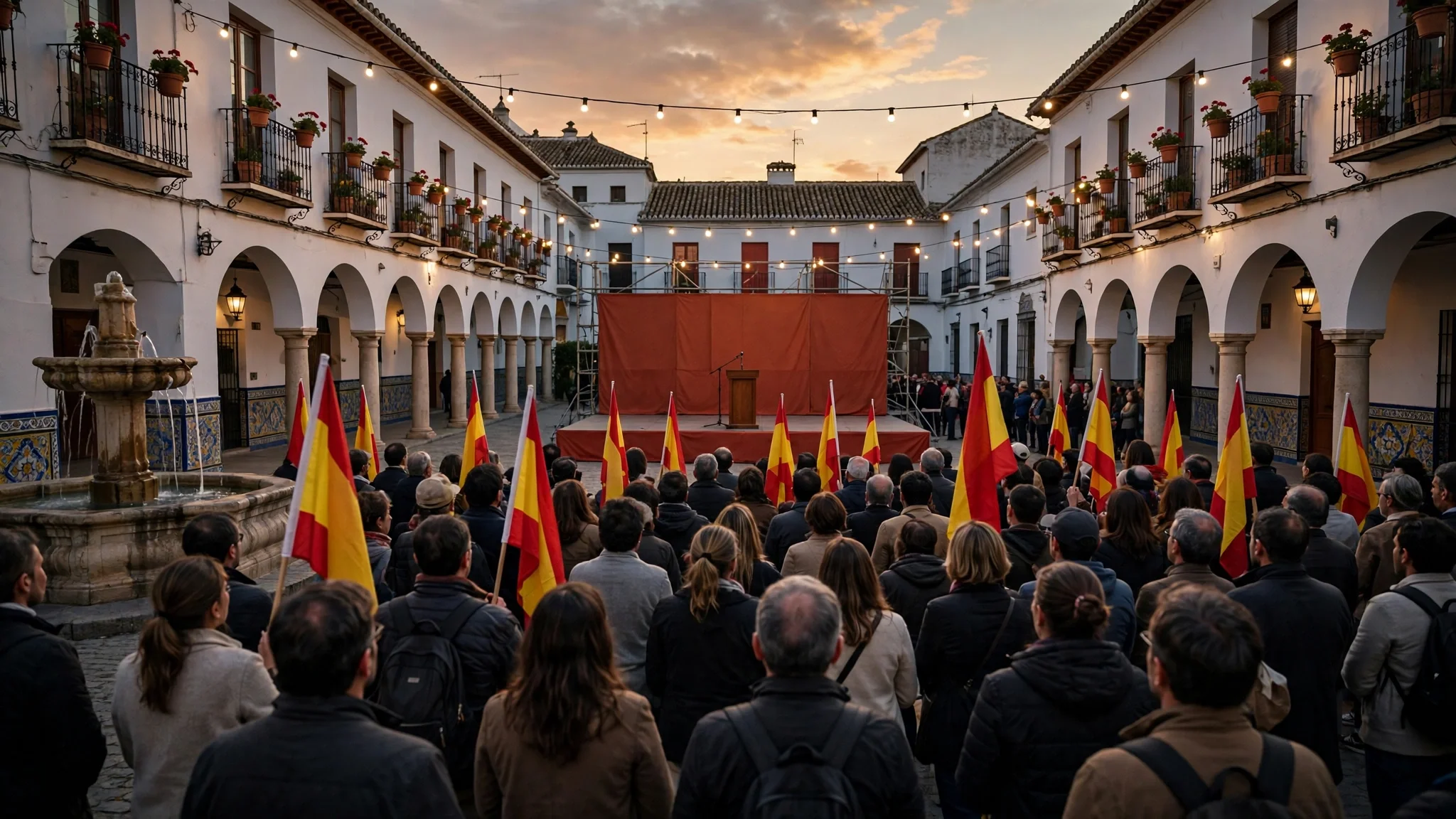
Mitin de precampaña en una plaza andaluza al atardecer (imagen ilustrativa generada para este artículo).
Sánchez kicks off pre-campaign in Seville with housing as his banner
The PSOE opened its November 29 pre-campaign in Dos Hermanas (Seville), with Pedro Sánchez centering his speech on housing, while a 40dB poll gives the PP…
Spain's Socialists open 29N pre-campaign focused on housing
The PSOE inaugurated its pre-campaign for the November 29 election in Dos Hermanas, making housing the axis of Pedro Sánchez's speech.
--- The context ---
Spain's November 29 general election entered its pre-campaign phase on Saturday with two parallel rallies: the PSOE opened its pre-campaign in Dos Hermanas, Seville, one of its historic strongholds in Andalusia, while the PP held its own rally at the Ifema fairgrounds in Madrid. The Socialist event took place at the Los del Río municipal auditorium, in La Alquería park.
The rally comes days after the prime minister announced the snap election, with polls still leaving the outlook for the left undefined. The Socialists have chosen two anchors for their opening message: housing as the great social cause and massive turnout on election day.
--- The facts ---
Francisco Rodríguez, mayor of Dos Hermanas and organizational secretary of the Andalusian PSOE, opened the event. He argued that Pedro Sánchez's project is still alive even though many had written it off years ago, and that the prime minister governs with people in mind. He contrasted purposeful leadership and a social majority with a PP that, in his view, has no project, shows only anger, and can merely follow Vox while doing politics alongside the powerful.
Next came María Jesús Montero, secretary general of the Andalusian PSOE and deputy secretary general of the party at the federal level. She said the party will go all out to win this election and thanked Sánchez for choosing Dos Hermanas once again. She argued that the years in government have shown that from the left, with progressive policies, it is possible to grow more, redistribute better, and advance workers' rights despite the right's daily attacks. She portrayed the prime minister as the country's only courageous leader and the world leader in left-wing policies, citing Gaza, the recognition of the Palestinian state, opposition to the war in Iran, and to the invasion of Ukraine. She also attacked the Andalusian regional president's inaction on housing, demanded the resignation of the mayor of Benalmádena over his remarks about an octogenarian woman and of the mayor of Algeciras over what she described as deeply troubling behavior toward women, and closed by calling for social energy to become electoral energy.
Pedro Sánchez thanked Montero and Rodríguez and predicted that the opposition will remain in opposition for four more years for failing to do its homework. He centered his speech on housing: he said housing policy has no expiration date and promised that the next parliament, with a broad progressive majority, and a strengthened progressive government will reinforce and keep the housing emergency decree protecting small landlords and tenants from speculation. He recalled that the decree was rejected in Congress last week but voiced confidence in pushing it through, with changes, via a vote in the Permanent Deputation of Congress.
Sánchez said every generation has its own struggle and that this era's is housing. In a restrained tone, he paid tribute to Maricarmen, the 87-year-old woman who died this week after being evicted from her home in Madrid, saying that she, along with those mobilizing for fair housing, paved the way, and recalling her wish that no one else suffer what she suffered.
The prime minister accused the PP and Vox of changing strategy out of fear of losing, joking that those who used to say everyone should do what they can now prefer that as few people vote as possible. He called on everyone to vote on November 29 to secure, in his words, a PSOE victory. He compared the criticism he faces to the fable of the boy who cried wolf, which he attributed to PP and Vox spokespeople, and described himself as a dog with no master serving ordinary people, predicting that the PSOE will win and govern for four more years.
The rally coincided with a 40dB poll, conducted on October 7 and 8 with 800 online interviews and electoral in purpose. It puts the PP first with 31.9% of the vote and a range of 123 to 140 seats, with 132 as the most likely figure; Vox third with 18.9% and between 63 and 74 seats, double the 33 of 2023; and the PSOE second with 28.1%, a slight improvement, and between 105 and 117 seats, below the 121 of 2023.
The key is the right-wing sum: together, the PP and Vox would hold between 186 and 214 seats, far above the 176 needed for an absolute majority. The left would total 119 seats: 112 for the PSOE, 5 for the Frente Amplio, the new brand under which Sumar is running, and 2 for Podemos. A joint Frente Amplio–Podemos candidacy would grow the space to the left of the PSOE from 7 to 15 seats, although the PSOE would drop to 106, without changing the outcome: the PP–Vox absolute majority would barely suffer, landing at 196 seats.
--- The positions ---
The PSOE enters the pre-campaign with a defined narrative: it presents Sánchez as a resilient leader who has survived years of attacks and now embodies the housing cause, while painting the PP as a project-less party dragged along by Vox.
The PP faces the pre-campaign from the advantage the polls give it, with the combined PP–Vox total within reach of an absolute majority. The strategy Sánchez attributes to them — discouraging participation — will be an axis of confrontation in the coming weeks, alongside mutual accusations over disinformation about postal voting.
--- What remains unknown ---
It remains to be seen whether the housing decree can be approved with changes in the Permanent Deputation after its rejection in Congress, and with what scope. Also pending is how voting intention evolves in the seven weeks until November 29, and whether the left narrows the gap separating it from the PP–Vox sum.
--- Unanswered questions ---
Can the PSOE turn housing into the mobilizing axis for its electorate? Will the appeal to participation be enough to offset the advantage the polls give the right? What effect will the postal-vote debate have on the campaign? Will the housing decree see the light before the election?
--- EPM analysis ---
The opening confirms that the PSOE will fight this election on social rather than economic terrain, where the polls are unkind to it. Housing, turned into a generational cause by Sánchez himself, works as a bridge between the government's record and citizens' anger, and the tribute to Maricarmen gives that bet a human face.
📌 EPM Take:
In EPM's view, the PSOE has opened its pre-campaign with the best card it holds: a social narrative that puts housing at the center and Sánchez as its standard-bearer. The move makes electoral sense, because housing is the fastest-growing concern among young voters and lets the Socialists sidestep the debate over parliamentary arithmetic. But the gap between promise and legislative reality is the strategy's weak flank: without the decree approved, the message remains a statement of intent, and the battle of these seven weeks will be fought between the mobilization Sánchez is calling for and the demobilization he attributes to the right.
--- The context ---
The PSOE inaugurated its pre-campaign for the November 29 general election on Saturday with a rally in Dos Hermanas, Seville, regarded as one of the Socialists' main strongholds in Andalusia. The event took place at the Los del Río municipal auditorium, in La Alquería park, and coincided with the PP's first pre-campaign rally at the Ifema fairgrounds in Madrid.
The gathering comes just days after the prime minister announced the snap election for November 29, leaving the parties facing seven weeks of campaigning in a scenario that polls have yet to fully define.
--- The facts ---
First to intervene was Francisco Rodríguez, mayor of Dos Hermanas and organizational secretary of the Andalusian PSOE. He maintained that Pedro Sánchez's project remains in force even though many considered it finished years ago, and that the prime minister keeps governing with citizens in mind. He contrasted that leadership with a PP that, in his view, lacks a project, confines itself to displaying anger and following Vox, and practices politics alongside the powerful.
Next spoke María Jesús Montero, secretary general of the Andalusian PSOE and deputy secretary general of the party at the federal level. She said the party will go out to win and thanked Sánchez for choosing Dos Hermanas once again. She argued that the years in government have proven that from the left, with progressive policies, it is possible to grow more, redistribute better, and advance labor rights despite the right's constant attacks. She presented the prime minister as the country's only courageous national leader and the world leader in left-wing policies, mentioning Gaza, the recognition of the Palestinian state, opposition to the war in Iran, and to the invasion of Ukraine. She criticized the Andalusian regional president's inaction on housing, called for the resignation of the mayor of Benalmádena over his remarks about an octogenarian woman and of the mayor of Algeciras over behavior she described as deeply troubling toward women, and concluded by asking that social energy become electoral energy.
Pedro Sánchez closed the event, thanking the previous speakers and forecasting that the opposition will stay in opposition for four more years for failing to do its work. He devoted the core of his speech to housing: he said housing policy has no expiration date and promised that the next parliament, with a broad progressive majority, and a progressive government will reinforce and keep the housing emergency decree that protects small landlords and tenants from speculation. He recalled that the rule was rejected in Congress last week, though he expressed confidence in getting it through, with modifications, through a vote in the Permanent Deputation of Congress.
Sánchez said every generation has its own struggle and that this era's is housing. In a sober tone, he paid tribute to Maricarmen, the 87-year-old woman who died this week after being evicted from her home in Madrid, saying that she, along with those mobilizing for fair housing, paved the way, and recalling her wish that no one else suffer what she suffered.
The prime minister accused the PP and Vox of having changed strategy out of fear of losing the election, joking that those who once urged everyone to do what they could now prefer that as few people vote as possible. He called on everyone to go to the polls on November 29 to secure, in his words, a PSOE victory. He compared the criticism he receives to the fable of the boy who cried wolf, which he attributed to PP and Vox spokespeople, and described himself as a dog with no master serving ordinary people, forecasting that the PSOE will win the election and govern for four more years.
The rally coincided with a 40dB poll, conducted on October 7 and 8 from 800 online interviews and electoral in purpose. It places the PP first with 31.9% of the vote and a range of 123 to 140 seats, with 132 as the most likely value; Vox third with 18.9% and between 63 and 74 seats, double the 33 won in 2023; and the PSOE second with 28.1%, a slight improvement, and between 105 and 117 seats, below the 121 of 2023.
The poll's decisive figure is the right-wing sum: the PP and Vox together would hold between 186 and 214 seats, comfortably above the 176 required for an absolute majority. The left would reach 119 seats: 112 for the PSOE, 5 for the Frente Amplio, the new brand under which Sumar is running, and 2 for Podemos. A joint Frente Amplio–Podemos candidacy would grow the space to the left of the PSOE from 7 to 15 seats, although the PSOE would yield some of its own seats down to 106, without altering the outcome: the PP–Vox absolute majority would barely suffer, landing at 196 seats.
--- The positions ---
The PSOE faces the pre-campaign with a message built around housing and turnout, presenting Sánchez as a leader tempered by attacks and the PP as a project-less formation dependent on Vox.
The PP enters the pre-campaign sheltered by the polls, which place it first and put the combined PP–Vox total in position to reach an absolute majority. The exchange of accusations over turnout strategy and over disinformation about postal voting foreshadows a stretch of campaigning with high rhetorical tension.
--- What remains unknown ---
It remains to be seen whether the housing decree advances with modifications in the Permanent Deputation after its rejection in Congress, and what its final content will be. Also pending is how voting intention evolves over the remaining seven weeks and whether the left manages to cut the lead the polls currently grant to the PP–Vox sum.
--- Unanswered questions ---
Will the PSOE manage to make housing the campaign's central issue? Will the call to participate be enough to neutralize the right's polling advantage? How will the postal-vote debate influence the electorate? Will the housing decree see the light before November 29?
--- EPM analysis ---
The start of the pre-campaign shows a PSOE that has opted for thematic caution: rather than contesting economic management, where the polls do not favor it, it centers its message on a broadly consensual social cause such as housing. The promise of a policy with no expiration date coexists, however, with a decree rejected in Congress and facing an uncertain parliamentary path.
📌 EPM Take:
In EPM's view, the Socialists' pre-campaign opening is an exercise in tactical realism: the PSOE knows the polls' arithmetic works against it and moves the contest onto the terrain of mobilization and social causes, where it retains ascendancy. Housing is a sensible choice as the axis, given its growing weight among young voters and its capacity to articulate a forward-looking government narrative. Even so, the promise's credibility will depend on what happens with the decree in the Permanent Deputation: if the rule does not move forward, the message will be reduced to a statement of intent.
Sánchez abre la precampaña en Sevilla con la vivienda como bandera
El PSOE abrió su precampaña para el 29N en Dos Hermanas (Sevilla) con Pedro Sánchez centrando su discurso en la vivienda, mientras un sondeo de 40dB otorga al…
El PSOE inicia la precampaña del 29N mirando a la vivienda
El PSOE inauguró en Dos Hermanas su precampaña para las elecciones del 29 de noviembre, con la vivienda como eje del discurso de Pedro Sánchez.
--- El contexto ---
Las elecciones generales del 29 de noviembre entraron este sábado en su fase previa con dos actos paralelos: el PSOE abrió su precampaña en Dos Hermanas, en Sevilla, uno de sus bastiones en Andalucía, mientras el PP celebraba la suya en el recinto de Ifema, en Madrid. El acto socialista fue en el auditorio municipal Los del Río, en el parque de La Alquería.
La cita llega días después de que el presidente anunciara el adelanto electoral, con los sondeos aún sin definir el panorama para la izquierda. El PSOE ha elegido dos anclajes para su mensaje inicial: la vivienda como gran causa social y la movilización el día de las urnas.
--- Los hechos ---
Abrió el acto Francisco Rodríguez, alcalde de Dos Hermanas y secretario de Organización del PSOE-A. Defendió que el proyecto de Pedro Sánchez sigue vivo aunque muchos lo daban por terminado hace años, y que el presidente gobierna pensando en la gente. Contrapuso un liderazgo con rumbo y una mayoría social a un PP que, a su juicio, carece de proyecto, exhibe rabia y solo puede seguir a Vox haciendo política al lado de los poderosos.
Después habló María Jesús Montero, secretaria general del PSOE andaluz y vicesecretaria general del partido a nivel federal. Aseguró que la formación saldrá a ganar y agradeció a Sánchez haber vuelto a elegir Dos Hermanas. Defendió que los años de Gobierno han demostrado que desde la izquierda se puede crecer más, redistribuir mejor y avanzar en derechos laborales, pese a los ataques diarios de la derecha. Presentó al presidente como el único líder del país con valentía y con el mayor protagonismo mundial en políticas de izquierdas: citó Gaza, el reconocimiento del Estado palestino, la oposición a la guerra de Irán y a la invasión de Ucrania. También criticó la inacción del presidente andaluz en vivienda, pidió el cese del alcalde de Benalmádena por sus declaraciones sobre una mujer octogenaria y del de Algeciras por un comportamiento que describió como muy complicado hacia las mujeres, y cerró llamando a convertir la energía social en electoral.
Sánchez agradeció a Montero y a Rodríguez y vaticinó que la oposición seguirá siéndolo cuatro años más por no haber hecho los deberes. Centró su discurso en la vivienda: sostuvo que la política de vivienda no tiene fecha de caducidad y prometió que el próximo Parlamento, con una amplia mayoría progresista, y un Gobierno progresista reforzarán y mantendrán el real decreto ley de vivienda que protege a los pequeños propietarios y a los inquilinos frente a la especulación. Recordó que el decreto fue rechazado la semana pasada en el Congreso, aunque confió en sacarlo adelante con cambios mediante una votación en la Diputación Permanente.
Para Sánchez, cada generación tiene su propia lucha y la de esta época es la vivienda. Con tono contenido, rindió homenaje a Maricarmen, la mujer de 87 años fallecida esta semana tras ser desalojada de su vivienda en Madrid: dijo que, junto a quienes se movilizan por una vivienda justa, abrió el camino, y recordó su mensaje de que lo que ella sufrió no lo sufriera nadie más.
El presidente acusó al PP y a Vox de haber cambiado de estrategia por miedo a perder, e ironizó con que quienes antes decían que hiciera lo que pudiera cada uno ahora prefieren que voten los menos posibles. Pidió votar todos el 29 de noviembre para garantizar una victoria del PSOE. Comparó las críticas que recibe con la fábula de Pedro y el lobo, que atribuyó a representantes del PP y Vox, y se presentó como un perro sin amo al servicio de la gente, con el pronóstico de que el PSOE ganará y gobernará cuatro años más.
El acto coincidió con un sondeo de la firma 40dB, del 7 y 8 de octubre, con 800 entrevistas en línea y de vocación electoral. Sitúa al PP primero con el 31,9% y una horquilla de 123 a 140 diputados, con 132 como cifra más probable; a Vox tercero con el 18,9% y entre 63 y 74 escaños, el doble de los 33 de 2023; y al PSOE segundo con el 28,1%, una leve mejora, y entre 105 y 117 diputados, por debajo de los 121 de 2023.
La clave está en la suma de la derecha: PP y Vox reunirían entre 186 y 214 escaños, muy por encima de los 176 de la mayoría absoluta. La izquierda sumaría 119: 112 del PSOE, 5 del Frente Amplio —la nueva marca de Sumar— y 2 de Podemos. Una candidatura conjunta del Frente Amplio y Podemos elevaría el espacio a la izquierda del PSOE de 7 a 15 escaños, aunque el PSOE bajaría a 106: la mayoría absoluta de PP y Vox apenas se resentiría, hasta los 196 escaños.
--- Las posiciones ---
El PSOE llega a la precampaña con un relato definido: presenta a Sánchez como un líder resiliente que ha sobrevivido a años de ataques y ahora encarna la causa de la vivienda, mientras dibuja al PP como un partido sin proyecto arrastrado por Vox.
El PP encara la precampaña desde la ventaja de los sondeos, con la suma junto a Vox al alcance de la mayoría absoluta. La estrategia que Sánchez les atribuye, desincentivar la participación, será un eje de confrontación de las próximas semanas, junto a las acusaciones sobre bulos del voto por correo.
--- Lo que falta saber ---
Queda por ver si el decreto de vivienda se aprueba con cambios en la Diputación Permanente tras su rechazo en el Congreso. También está pendiente la evolución de la intención de voto en las siete semanas hasta el 29 de noviembre y si la izquierda estrecha su distancia con la suma de PP y Vox.
--- Preguntas sin respuesta ---
¿Conseguirá el PSOE convertir la vivienda en el eje que movilice a su electorado? ¿Bastará apelar a la participación para compensar la ventaja que los sondeos dan a la derecha? ¿Qué efecto tendrá en la campaña el debate del voto por correo? ¿Verá la luz el decreto de vivienda antes de las elecciones?
--- Análisis EPM ---
El arranque confirma que el PSOE peleará estas elecciones en el terreno social, no en el económico, donde los sondeos le son esquivos. La vivienda, convertida en causa generacional por Sánchez, funciona como puente entre la gestión del Gobierno y la indignación ciudadana, y el homenaje a Maricarmen le da rostro humano a esa apuesta.
📌 Conclusion EPM:
A juicio de EPM, el PSOE ha abierto la precampaña con su mejor baza: un relato social que pone la vivienda en el centro y a Sánchez como su abanderado. La jugada tiene lógica electoral: la vivienda es la preocupación que más crece entre los votantes jóvenes y permite eludir el debate sobre la aritmética parlamentaria. Pero la distancia entre la promesa y la realidad legislativa es su flanco débil: sin el decreto aprobado, el discurso queda en declaración de intenciones. La batalla se librará entre la movilización que pide Sánchez y la desmovilización que atribuye a la derecha.
--- El contexto ---
El PSOE inauguró este sábado su precampaña para las elecciones generales del 29 de noviembre con un mitin en Dos Hermanas, en Sevilla, considerado uno de los bastiones socialistas de Andalucía. El acto fue en el auditorio municipal Los del Río, en el parque de La Alquería, y coincidió con el primer mitin de precampaña del PP, en el recinto de Ifema, en Madrid.
La convocatoria llega pocos días después de que el presidente del Gobierno anunciara el adelanto electoral al 29 de noviembre, lo que deja a los partidos ante siete semanas de campaña en un escenario que los sondeos aún no definen.
--- Los hechos ---
Intervino primero Francisco Rodríguez, alcalde de Dos Hermanas y secretario de Organización del PSOE-A. Sostuvo que el proyecto de Pedro Sánchez continúa vigente aunque muchos lo daban por concluido, y que el presidente sigue gobernando pensando en la ciudadanía. Contrapuso ese liderazgo a un PP que, a su juicio, carece de proyecto, se limita a exhibir rabia y a seguir a Vox haciendo política junto a los poderosos.
Después habló María Jesús Montero, secretaria general del PSOE andaluz y vicesecretaria general del partido a nivel federal. Afirmó que la formación saldrá a ganar y agradeció a Sánchez elegir de nuevo Dos Hermanas. Defendió que los años de Gobierno han acreditado que desde la izquierda es posible crecer más, redistribuir mejor y avanzar en derechos laborales, a pesar de los ataques constantes de la derecha. Presentó al presidente como el único líder nacional con valentía y como el gobernante con mayor protagonismo mundial en políticas de izquierdas, y mencionó Gaza, el reconocimiento del Estado palestino, la oposición a la guerra de Irán y a la invasión de Ucrania. Criticó la inacción del presidente andaluz en vivienda, reclamó el cese del alcalde de Benalmádena por sus declaraciones sobre una mujer octogenaria y del de Algeciras por un comportamiento que calificó de muy complicado hacia las mujeres, y concluyó pidiendo que la energía social se convierta en electoral.
Cerró el acto Pedro Sánchez, que agradeció las intervenciones previas y pronosticó que la oposición seguirá siéndolo cuatro años más por no haber hecho su trabajo. Dedicó su discurso a la vivienda: afirmó que la política de vivienda no tiene fecha de caducidad y prometió que el próximo Parlamento, con una amplia mayoría progresista, y un Gobierno progresista reforzarán y mantendrán el real decreto ley de vivienda que protege a los pequeños propietarios y a los inquilinos frente a la especulación. Recordó que la norma fue rechazada la semana pasada en el Congreso, aunque confió en sacarla adelante con modificaciones mediante una votación en la Diputación Permanente.
Para Sánchez, cada generación tiene su propia lucha y la de esta época es la vivienda. En tono sobrio, rindió homenaje a Maricarmen, la mujer de 87 años fallecida esta semana tras ser desalojada de su vivienda en Madrid: dijo que, junto a quienes se movilizan por una vivienda justa, abrió el camino, y recordó su deseo de que nadie más sufriera lo que ella sufrió.
El presidente acusó al PP y a Vox de haber cambiado de estrategia por temor a perder, y bromeó con que quienes antes animaban a que cada uno hiciera lo que pudiera ahora prefieren que vote la menor gente posible. Llamó a acudir a las urnas todos el 29 de noviembre para asegurar una victoria del PSOE. Comparó las críticas que recibe con la fábula de Pedro y el lobo, que atribuyó a portavoces del PP y Vox, y se describió como un perro sin amo al servicio de la gente, con el pronóstico de que el PSOE vencerá y gobernará cuatro años más.
El acto coincidió con un sondeo de la firma 40dB, del 7 y 8 de octubre, con 800 entrevistas en línea y de vocación electoral. Coloca al PP primero con el 31,9% y una horquilla de 123 a 140 diputados, con 132 como valor más probable; a Vox tercero con el 18,9% y entre 63 y 74 escaños, el doble de los 33 de 2023; y al PSOE segundo con el 28,1%, una ligera mejoría, y entre 105 y 117 diputados, por debajo de los 121 de 2023.
El dato determinante es la suma de la derecha: PP y Vox reunirían entre 186 y 214 escaños, muy por encima de los 176 de la mayoría absoluta. La izquierda alcanzaría 119: 112 del PSOE, 5 del Frente Amplio —la nueva marca de Sumar— y 2 de Podemos. Una candidatura conjunta del Frente Amplio y Podemos elevaría el espacio a la izquierda del PSOE de 7 a 15 escaños, aunque el PSOE cedería algunos diputados propios hasta los 106: la mayoría absoluta de PP y Vox apenas se resentiría, hasta los 196 escaños.
--- Las posiciones ---
El PSOE afronta la precampaña con un mensaje articulado en torno a la vivienda y la movilización: presenta a Sánchez como un dirigente curtido frente a los ataques y al PP como una formación sin proyecto dependiente de Vox.
El PP encara la precampaña amparado en los sondeos, que le sitúan primero y con la suma junto a Vox en disposición de alcanzar la mayoría absoluta. El cruce de acusaciones sobre la estrategia de participación y los bulos del voto por correo anticipa un tramo de campaña de alta tensión retórica.
--- Lo que falta saber ---
Está por verse si el decreto de vivienda prospera con modificaciones en la Diputación Permanente tras su rechazo en el Congreso. También queda por comprobar la evolución de la intención de voto en las siete semanas restantes y si la izquierda recorta la distancia con la suma de PP y Vox.
--- Preguntas sin respuesta ---
¿Logrará el PSOE que la vivienda se convierta en el tema central de la campaña? ¿Será suficiente apelar a la participación para neutralizar la ventaja de la derecha en los sondeos? ¿Cómo influirá en el electorado el debate del voto por correo? ¿Verá la luz el decreto de vivienda antes del 29 de noviembre?
--- Análisis EPM ---
El inicio de la precampaña muestra a un PSOE que ha optado por la prudencia temática: en lugar de disputar la gestión económica, donde los sondeos no le favorecen, centra su discurso en la vivienda, una causa social de amplio consenso. La promesa de una política sin fecha de caducidad convive con un decreto rechazado en el Congreso y pendiente de una vía parlamentaria incierta.
📌 Conclusion EPM:
A juicio de EPM, la apertura de la precampaña socialista es un ejercicio de realismo táctico: el PSOE sabe que la aritmética de los sondeos le es adversa y traslada la contienda al terreno de la movilización y de las causas sociales, donde conserva ascendiente. La vivienda es una elección sensata como eje, por su peso creciente entre los votantes jóvenes y por su capacidad para articular un relato de Gobierno con vocación de futuro. No obstante, la credibilidad de la promesa dependerá de lo que ocurra con el decreto en la Diputación Permanente.