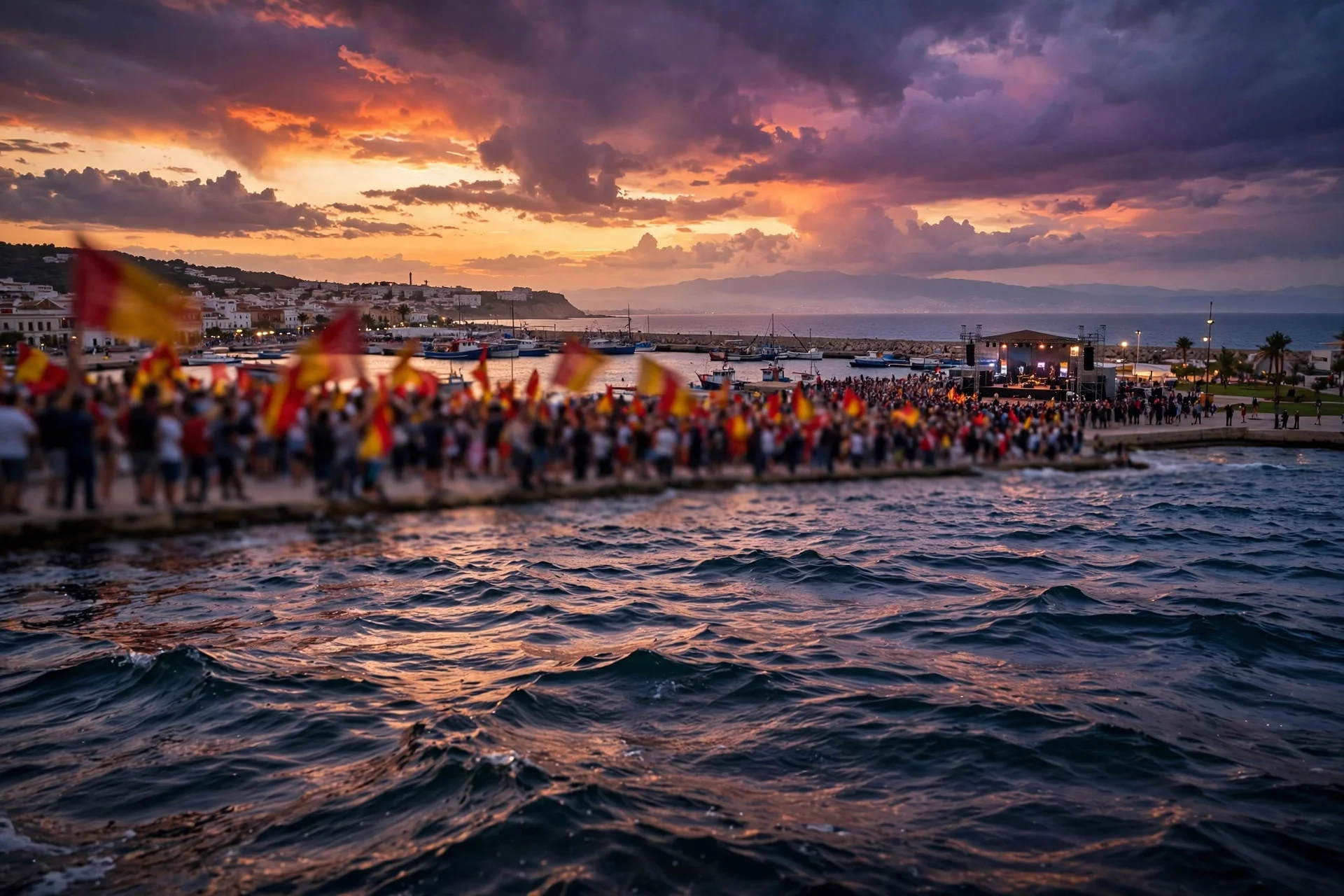
Ilustración alusiva al inicio de la precampaña electoral de Vox en Estepona.
Abascal opens Vox campaign in Estepona, heads to Ceuta the next day
Santiago Abascal opened Vox's campaign in Estepona and announced he will travel to Ceuta the next day.
Vox launches campaign in Estepona with Abascal's next-day trip to Ceuta
Santiago Abascal launched Vox's campaign in Estepona with a sovereignty message: he will travel to Ceuta the next day, denounced illegal immigration, blamed…
--- The context ---
Spain has entered the pre-campaign for the November 29 general election with three opening rallies. A day earlier, Pedro Sánchez headlined a rally in Dos Hermanas (Seville) —where in 2017 he announced his candidacy in the PSOE primaries— and Alberto Núñez Feijóo opened the PP pre-campaign in Madrid alongside Isabel Díaz Ayuso and José Luis Martínez-Almeida.
Vox leader Santiago Abascal chose another stage for his debut as a candidate: a rally in Estepona, Málaga, because his supporters are very close to Spanish lands in Africa and to their compatriots there. From Estepona he announced that the next day he will not be in Madrid for the military parade —where he said he would have liked to be as on so many other occasions— but in Ceuta.
--- The facts ---
Abascal announced he will spend the next day in Ceuta, where on July 30 and 31 some 70,000 migrants crossed the border illegally. He said he did not want to be part of the official stand in Madrid and preferred to be in Ceuta, which he described as Spanish territory for centuries and vowed would remain Spanish forever.
The Vox president harshly criticized the government of Pedro Sánchez and described the November 29 vote as probably the last chance for many Spaniards. He said the hour of truth had arrived, after what he presented as having stopped before the Supreme Court the mass naturalizations of people who had left 60, 70 or 150 years ago, along with their grandchildren and descendants, and he denounced the grandchildren's law as an attempt to alter the electoral roll to steal the election.
He urged his supporters not to trust favorable polls, which he called his main enemy for generating excessive confidence. He stressed that on November 29 there would be no family gathering, no football match and no excuse valid enough to keep anyone from the ballot box, and he asked voters to cast their ballots in person unless they had no alternative.
He said his distrust was not of the system but of Pedro Sánchez himself, whom he accused of having stolen the election within his own party, and he warned of lies, attempts at cheating, intimidation and provocations. He denied that Vox intends to privatize pensions —a rumor he attributed to a PSOE campaign—, guaranteed they would be paid at whatever cost without specifying a model, and promised to recover the future of young people and access to housing.
On housing, he said purchase prices rose 74 percent and rents 40 percent during the Sánchez legislature, which he called the dirtiest government in Spain's history. He added that over five years five million people arrived in Spain without equivalent housing being built and accused the chief executive of being directly responsible for evictions.
He defended remigration —the return of migrants to their countries of origin— as a campaign pillar, built out of love for those inside the country. He thanked those who come to Spain to work and respect the laws, and he was blunt: those who enter illegally must be repatriated, and those who commit crimes must serve their sentences in their own countries and be deported. He also defended national priority and deregulation.
--- The positions ---
Vox's position is clear: to link the housing crisis with the arrival of five million people in five years, to blame the prime minister directly for evictions, and to present November 29 as a decisive date. The strategy combines in-person voting mobilization with explicit distrust of the polls and of Pedro Sánchez.
From a progressive reading, the figures offered at the rally —a 74 percent rise in purchase prices and 40 percent in rents— are presented as proof of social deterioration, yet the speech offers no concrete model for housing or pensions beyond paying at whatever cost. The remigration proposal, even softened by gratitude toward migrants who work, keeps the hard line that has defined Vox on migration.
--- What remains unknown ---
It remains to be seen how the PSOE and the PP will respond to the start of the campaign from Estepona, whether the polls will confirm the anticipated upset, and what impact the next-day visit to Ceuta will have.
--- Unanswered questions ---
Will the polls confirm the anticipated electoral upset? What concrete model for pensions and housing will Vox propose? How will the PSOE and the PP respond to the challenge from Estepona? What effect will the Ceuta visit have?
--- EPM analysis ---
The Estepona launch confirms that Vox has chosen the ground where it feels most comfortable: immigration, housing and frontal criticism of the government. The next-day trip to Ceuta turns the national holiday into a gesture loaded with territorial symbolism, while the appeal to in-person voting reveals a strategy of maximum mobilization of its base.
📌 EPM Take:
In EPM's view, the Estepona rally shows a Vox betting everything on mobilizing its electorate around immigration and national sovereignty. The next-day trip to Ceuta is a calculated gesture to dominate the symbolic agenda of the national holiday, and in-person voting combines distrust of the prime minister with a strategy of mass participation. It remains to be seen whether the housing figures and the promises without a concrete model withstand campaign scrutiny, and whether the challenge to the polls translates into historic turnout among its voters.
--- The context ---
The pre-campaign for the November 29 general election began with three rallies that anticipate an intense race. A day earlier, Pedro Sánchez headlined a rally in Dos Hermanas (Seville) —where in 2017 he announced his candidacy in the PSOE primaries— and Alberto Núñez Feijóo opened the PP pre-campaign in Madrid alongside Isabel Díaz Ayuso and José Luis Martínez-Almeida.
Vox leader Santiago Abascal opted for a different start: a rally in Estepona, Málaga, because his supporters are very close to Spanish lands in Africa and to their compatriots there. From Estepona he announced that the next day he will not be in Madrid for the military parade —where he said he would have liked to be as on so many other occasions— but in Ceuta.
--- The facts ---
Abascal announced he will spend the next day in Ceuta, where on July 30 and 31 some 70,000 migrants crossed the border illegally. He said he did not want to be part of the official stand in Madrid and preferred to be in Ceuta, which he described as Spanish territory for centuries and vowed would remain Spanish forever.
The Vox president criticized the government of Pedro Sánchez and described November 29 as probably the last chance for many Spaniards. He said the hour of truth had arrived, after what he presented as having stopped before the Supreme Court the mass naturalizations of people who had left 60, 70 or 150 years ago, along with their grandchildren and descendants, and he denounced the grandchildren's law as an attempt to alter the electoral roll to steal the election.
Faced with favorable polls, he asked his supporters not to grow complacent and called the polls his main enemy for generating excessive confidence. He stressed that on November 29 there would be no family gathering, no football match and no excuse valid enough to keep anyone from the ballot box, and he asked voters to cast their ballots in person unless they had no alternative.
He said his distrust was not of the system but of Pedro Sánchez himself, whom he accused of having stolen the election within his own party, and he warned of lies, attempts at cheating, intimidation and provocations. He denied that Vox intends to privatize pensions —a rumor he attributed to a PSOE campaign—, guaranteed they would be paid at whatever cost without specifying a model, and promised to recover the future of young people and access to housing.
On housing, he said purchase prices rose 74 percent and rents 40 percent during the Sánchez legislature, which he called the dirtiest government in Spain's history. He noted that over five years five million people arrived in Spain without equivalent housing being built and accused the chief executive of being directly responsible for evictions.
He defended remigration —the return of migrants to their countries of origin— as a campaign pillar, built out of love for those inside the country. He thanked those who come to Spain to work and respect the laws, and he was blunt: those who enter illegally must be repatriated, and those who commit crimes must serve their sentences in their own countries and be deported. He also defended national priority and deregulation.
--- The positions ---
Vox's position is sharp: national sovereignty, control of illegal immigration and defense of Spaniards against a government it accuses of deteriorating housing, pensions and purchasing power. The next-day visit to Ceuta reinforces the territorial message, and the appeal to in-person voting seeks to secure the participation of its electorate.
From a conservative reading, the speech connects with a real concern: five million arrivals in five years without equivalent housing, a 74 percent rise in purchase prices and 40 percent in rents. The promise to pay pensions at whatever cost and to put Spaniards first in housing and employment answers demands that the current government, in Vox's view, has ignored throughout the legislature.
--- What remains unknown ---
It remains to be seen how the PSOE and the PP will respond to the start of the campaign from Estepona and to the next-day visit to Ceuta, whether the polls will keep anticipating the upset, and what model for pensions and housing the party will present.
--- Unanswered questions ---
Will the polls keep anticipating an electoral upset for November 29? What concrete model for pensions and housing will Vox present? How will the PSOE and the PP respond to the challenge from Estepona? What consequences will the Ceuta visit have?
--- EPM analysis ---
Vox opens its campaign where its message is strongest: the southern border and the defense of Ceuta as Spanish territory. The speech combines criticism of the government with broad social promises and an uncompromising line on migration. Distrusting the polls shows a party that takes nothing for granted.
📌 EPM Take:
In EPM's view, the Estepona launch is a statement of intent: the campaign will be fought on immigration, housing and national sovereignty. The next-day trip to Ceuta turns the national holiday into an act of territorial affirmation that will force the other parties to take a position. If the housing figures resonate with voters and in-person voting works, November 29 could deliver the anticipated upset, the same upset the polls anticipate and Abascal asks his supporters not to believe. The coming weeks will show whether the message holds.
Abascal abre la precampaña de Vox en Estepona y anuncia viaje a Ceuta
Santiago Abascal abrió la precampaña de Vox en Estepona y anunció que viajará a Ceuta al día siguiente.
Arranca la campaña en Estepona: Abascal elige Ceuta como gesto de soberanía
Santiago Abascal estrenó la campaña de Vox en Estepona con un mensaje de soberanía: viajará a Ceuta al día siguiente, denunció la inmigración ilegal, culpó al…
--- El contexto ---
España entró en la precampaña de las generales del 29 de noviembre con tres actos de apertura. Un día antes, Pedro Sánchez encabezó un mitin en Dos Hermanas (Sevilla) —donde en 2017 anunció su candidatura a las primarias del PSOE— y Alberto Núñez Feijóo abrió la precampaña del PP en Madrid junto a Isabel Díaz Ayuso y José Luis Martínez-Almeida.
El líder de Vox, Santiago Abascal, eligió otro escenario para su debut como candidato: un acto en Estepona, Málaga, "porque estáis muy cerca de nuestras tierras en África y de nuestros compatriotas". Desde allí anunció que al día siguiente no estará en Madrid para el desfile —donde dijo que le habría gustado estar "como en tantas otras ocasiones"— sino en Ceuta.
--- Los hechos ---
Abascal anunció que pasará al día siguiente en Ceuta, donde el pasado 30 y 31 de julio unos 70.000 migrantes cruzaron la frontera de forma ilegal. "En representación de todos vosotros, no quiero formar parte de esa tribuna y quiero estar en representación de todos en nuestro territorio invadido en Ceuta, en el norte de África, que es España desde hace siglos y que va a seguir siendo España por los siglos de los siglos", declaró.
El presidente de Vox criticó al Gobierno de Pedro Sánchez y definió el 29 de noviembre como "probablemente la última oportunidad para muchos españoles". Aseguró que ha llegado "la hora de la verdad", tras frenar ante el Tribunal Supremo las "nacionalizaciones masivas de personas que se habían ido hace 60, 70, 150 años, y sus nietos y sus descendientes", y denunció la ley de nietos como un intento de "alterar el censo electoral para robarnos las elecciones".
Pidió a sus simpatizantes no fiarse de las encuestas favorables, su "principal enemigo" por generar "confianza excesiva". "El 29 de noviembre no hay reunión familiar, no hay partido de fútbol, no hay afición, no hay excusa que valga para que acudamos todos a las urnas", enfatizó, y pidió el voto presencial salvo que no haya otra alternativa.
"No es una desconfianza del sistema, es una desconfianza de Pedro Sánchez", declaró, tras acusarlo de haber "robado las elecciones en su propio partido" y advertir de "mentiras, intentos de trampa, de amedrentamiento y de provocaciones". Negó que Vox pretenda privatizar las pensiones —rumor que atribuyó a una campaña del PSOE—, garantizó que se pagarán "al precio que sea y como sea" sin precisar modelo, y prometió recuperar "el futuro de los jóvenes" y el acceso a la vivienda.
Sobre la vivienda, afirmó que la compra subió un 74 % y el alquiler un 40 % durante la legislatura de Sánchez, al que calificó como "el gobierno más sucio de la historia de España". Añadió que en cinco años llegaron cinco millones de personas a España sin viviendas equivalentes y lo acusó de ser "el culpable directo de los desahucios".
Defendió la remigración —el retorno de migrantes a sus países de origen— como eje de campaña, "por amor a los de dentro". Agradeció a quienes llegan a trabajar y respetar las leyes, y fue tajante: "el que viene ilegalmente a España tiene que ser repatriado. El que viene a España a cometer delitos tiene que irse a su propio país a cumplir la pena. Fuera los delincuentes, han de ser deportados". También defendió la "prioridad nacional" y la desregulación.
--- Las posiciones ---
Vox vincula la crisis de vivienda con la llegada de cinco millones de personas en cinco años, culpa al presidente del Gobierno de los desahucios y presenta el 29 de noviembre como cita decisiva. La estrategia combina la movilización del voto presencial con la desconfianza en los sondeos y en Pedro Sánchez.
Desde una lectura progresista, las cifras del mitin —74 % en compra, 40 % en alquiler— se presentan como prueba del deterioro, pero no hay ningún modelo de vivienda o pensiones más allá de pagar "como sea". La remigración, aun matizada con el agradecimiento a quienes trabajan, mantiene la línea dura de la formación.
--- Lo que falta saber ---
Falta conocer la respuesta del PSOE y del PP al arranque desde Estepona, si los sondeos confirman el vuelco anticipado y qué impacto tendrá la visita a Ceuta al día siguiente.
--- Preguntas sin respuesta ---
¿Confirmarán las encuestas el vuelco anticipado? ¿Qué modelo de pensiones y vivienda propondrá Vox? ¿Cómo responderán el PSOE y el PP al desafío de Estepona? ¿Qué efecto tendrá la visita a Ceuta?
--- Análisis EPM ---
El arranque en Estepona confirma que Vox ha elegido el terreno donde se siente más fuerte: inmigración, vivienda y crítica frontal al Gobierno. El viaje a Ceuta al día siguiente convierte la fiesta nacional en un gesto de simbolismo territorial, y la apelación al voto presencial revela una estrategia de movilización máxima de su base.
📌 Conclusion EPM:
A juicio de EPM, el mitin de Estepona muestra a un Vox que apuesta todo a movilizar a su electorado en torno a la inmigración y la soberanía nacional. El viaje a Ceuta al día siguiente es un gesto calculado para dominar la agenda simbólica de la fiesta nacional, y el voto presencial combina la desconfianza en el presidente del Gobierno con una estrategia de participación masiva. Queda por ver si las cifras sobre vivienda y las promesas sin modelo resisten el escrutinio de la campaña.
--- El contexto ---
La precampaña de las generales del 29 de noviembre arrancó con tres actos que anticipan una contienda intensa. Un día antes, Pedro Sánchez encabezó un mitin en Dos Hermanas (Sevilla) —donde en 2017 anunció su candidatura a las primarias del PSOE— y Alberto Núñez Feijóo abrió la precampaña del PP en Madrid junto a Isabel Díaz Ayuso y José Luis Martínez-Almeida.
El líder de Vox, Santiago Abascal, optó por otro arranque: un acto en Estepona, Málaga, "porque estáis muy cerca de nuestras tierras en África y de nuestros compatriotas". Desde allí anunció que al día siguiente no estará en Madrid para el desfile sino en Ceuta.
--- Los hechos ---
Abascal anunció que pasará al día siguiente en Ceuta, donde el pasado 30 y 31 de julio unos 70.000 migrantes cruzaron la frontera de forma ilegal. "En representación de todos vosotros, no quiero formar parte de esa tribuna y quiero estar en representación de todos en nuestro territorio invadido en Ceuta, en el norte de África, que es España desde hace siglos y que va a seguir siendo España por los siglos de los siglos", declaró.
El presidente de Vox criticó al Gobierno de Pedro Sánchez y definió el 29 de noviembre como "probablemente la última oportunidad para muchos españoles". Aseguró que ha llegado "la hora de la verdad", tras frenar ante el Tribunal Supremo las "nacionalizaciones masivas de personas que se habían ido hace 60, 70, 150 años, y sus nietos y sus descendientes", y denunció la ley de nietos como un intento de "alterar el censo electoral para robarnos las elecciones".
Frente a las encuestas favorables, pidió no confiarse: son su "principal enemigo" por generar "confianza excesiva". "El 29 de noviembre no hay reunión familiar, no hay partido de fútbol, no hay afición, no hay excusa que valga para que acudamos todos a las urnas", enfatizó, y pidió el voto presencial salvo que no haya otra alternativa.
"No es una desconfianza del sistema, es una desconfianza de Pedro Sánchez", declaró, tras acusarlo de haber "robado las elecciones en su propio partido" y advertir de "mentiras, intentos de trampa, de amedrentamiento y de provocaciones". Negó que Vox pretenda privatizar las pensiones —rumor que atribuyó a una campaña del PSOE—, garantizó que se pagarán "al precio que sea y como sea" sin precisar modelo, y prometió recuperar "el futuro de los jóvenes" y el acceso a la vivienda.
Sobre la vivienda, afirmó que la compra subió un 74 % y el alquiler un 40 % durante la legislatura de Sánchez, al que calificó como "el gobierno más sucio de la historia de España". Señaló que en cinco años llegaron cinco millones de personas a España sin viviendas equivalentes y lo acusó de ser "el culpable directo de los desahucios".
Defendió la remigración —el retorno de migrantes a sus países de origen— como eje de campaña, "por amor a los de dentro". Agradeció a quienes llegan a trabajar y respetar las leyes, y fue tajante: "el que viene ilegalmente a España tiene que ser repatriado. El que viene a España a cometer delitos tiene que irse a su propio país a cumplir la pena. Fuera los delincuentes, han de ser deportados". También defendió la "prioridad nacional" y la desregulación.
--- Las posiciones ---
La posición de Vox es nítida: soberanía nacional, control de la inmigración ilegal y defensa de los españoles frente a un Gobierno al que acusa de deteriorar la vivienda, las pensiones y el poder adquisitivo. La visita a Ceuta refuerza el mensaje territorial y el voto presencial busca blindar a su electorado.
Desde una lectura conservadora, el discurso conecta con una preocupación real: cinco millones de llegadas en cinco años sin viviendas equivalentes, un 74 % de subida en la compra y un 40 % en el alquiler. La promesa de pagar las pensiones "al precio que sea" y de priorizar a los españoles responde a demandas que el Gobierno, a juicio de Vox, ha ignorado toda la legislatura.
--- Lo que falta saber ---
Falta conocer la respuesta del PSOE y del PP al arranque desde Estepona, si los sondeos mantienen el vuelco anticipado y qué modelo de pensiones y vivienda presentará la formación.
--- Preguntas sin respuesta ---
¿Mantendrán los sondeos el vuelco anticipado? ¿Qué modelo de pensiones y vivienda presentará Vox? ¿Cómo responderán el PSOE y el PP? ¿Qué consecuencias tendrá la visita a Ceuta?
--- Análisis EPM ---
Vox abre su campaña donde su mensaje tiene más fuerza: la frontera sur y la defensa de Ceuta como territorio español. El discurso combina la crítica al Gobierno con promesas sociales de amplio alcance y una línea migratoria sin matices. Desconfiar de las encuestas muestra una formación que no da nada por ganado.
📌 Conclusion EPM:
A juicio de EPM, el arranque de Vox en Estepona es una declaración de intenciones: la campaña se jugará en la inmigración, la vivienda y la soberanía nacional. El viaje a Ceuta al día siguiente convierte la fiesta nacional en un acto de afirmación territorial que obligará a los demás partidos a posicionarse. Si las cifras sobre vivienda calan en el electorado y el voto presencial funciona, el 29 de noviembre podría deparar el vuelco anticipado que anticipan los sondeos que el propio Abascal pide no creerse.