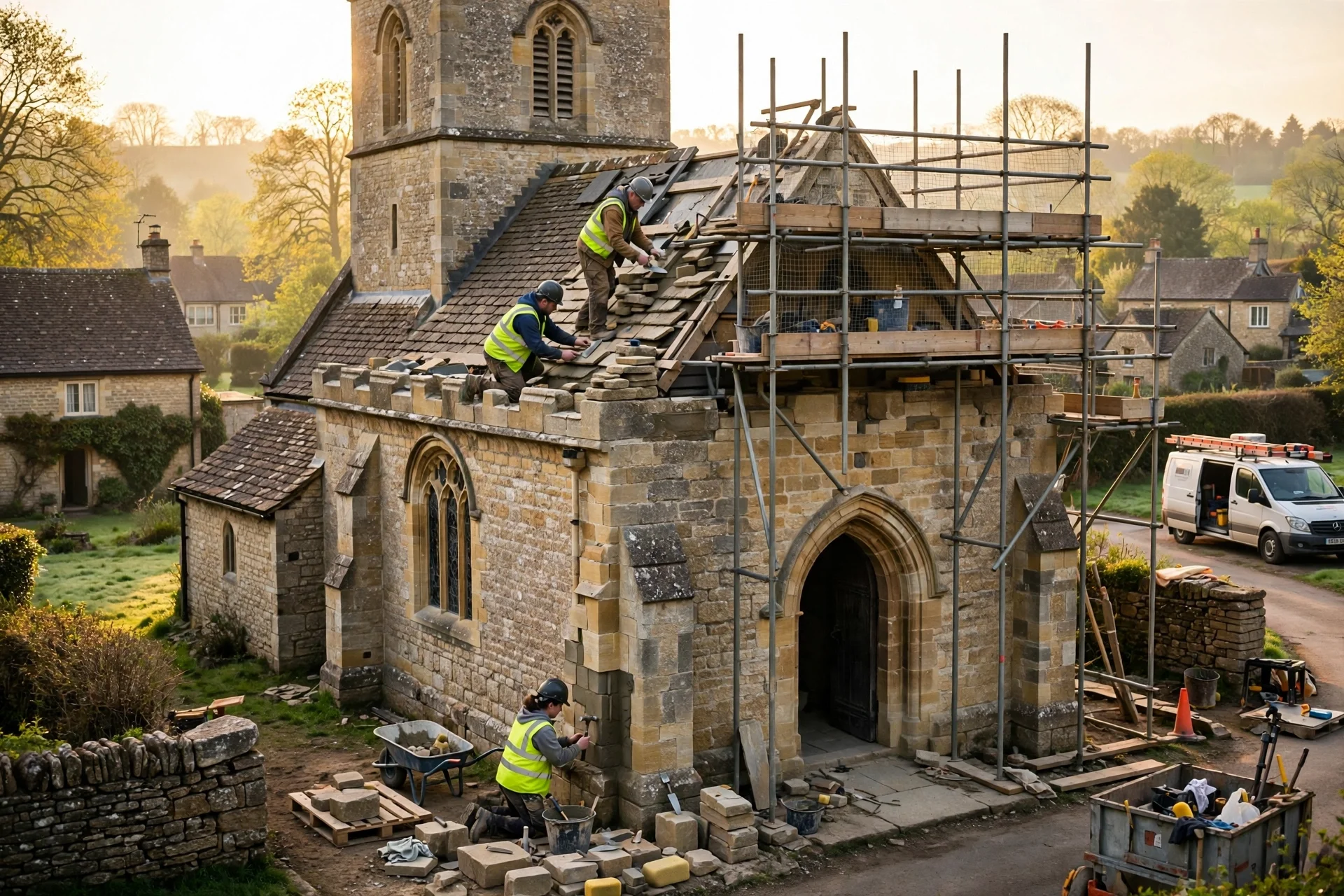
Imagen ilustrativa generada con IA: restauración de una iglesia histórica de piedra en Inglaterra. · Imagen generada con IA para Erick Prometeo Media
United Kingdom commits over £41 million to restore historic buildings
The British Government will invest over £41 million in 74 historic sites across England through two funds that prioritise areas of greatest need, covering…
Over £41 million to save England's churches and historic buildings
Over £41 million will fund repairs at 74 historic buildings across England, prioritising areas of greatest need and supporting churches, a synagogue, museums…
--- The context ---
Many of England's historic buildings are far from their former glory, with leaking roofs and crumbling stonework, as the Heritage Minister acknowledged when announcing the programme. Churches, synagogues, town halls and castles sit at the heart of local life, yet repairing them often costs more than congregations, volunteers and small communities can raise alone.
The initiative forms part of the wider £1.5 billion Arts Everywhere Fund and works through the Places of Worship Renewal Fund and the Heritage at Risk Capital Fund. Both prioritise areas in greatest need, where fundraising is most difficult, and both are delivered by Historic England.
--- The facts ---
Over £41 million will support 74 sites. The Places of Worship Renewal Fund will share over £18 million among 51 recipients. The Church of St Elwyn in Hayle will receive masonry repairs and new rainwater systems to prevent water penetration, with its interior restored using traditional conservation methods.
Birmingham Cathedral will halt the deterioration of its tower and dome, preserving its English-Baroque architecture. In Grimsby, the Sir Moses Montefiore Memorial Synagogue, the only remaining synagogue in Lincolnshire and South Humberside, will advance restoration focused on the structure of the ark. The fund is also facilitating urgent repairs at the Church of St George in Ramsgate.
The Heritage at Risk Capital Fund, in its second year, will provide nearly £13 million to 20 recipients. The Grade II listed Margate Museum and Old Town Hall will return to community use after structural repairs. Blackpool's former Post Office will secure its structure towards a community-led cultural hub. An additional £10 million will support Dover Castle, Brodsworth Hall and Osborne, covering fortifications and roof repairs.
--- The positions ---
Baroness Twycross said, as reported in the announcement, that nothing tells the nation's stories quite like its historic buildings and that the funding will keep them open for years. Emma Squire and Claudia Kenyatta, of Historic England, argued that historic places shape the character and identity of where people live, work and visit.
Kate Logan, of English Heritage, thanked the Government for vital support for three sites she described as among the country's most important. Bishop Andrew Rumsey welcomed grants to churches in areas of considerable need, saying they would fund repairs allowing worship and social action to continue while relieving local volunteers.
--- What remains unknown ---
The announcement does not break down each project's amount or set detailed timetables. It confirms the worship fund is worth £92 million across this parliament and the heritage at risk fund £75 million, with a second round for 2026/27 to be announced later.
--- Unanswered questions ---
How much exactly will each of the 74 sites receive? When will the urgent works in Hayle, Birmingham and Grimsby begin and finish? Which buildings may qualify for the second round in 2026/27? How will officials verify that repairs prevent further deterioration?
--- EPM analysis ---
The programme treats heritage as social infrastructure rather than decoration, reaching small temples, a coastal museum and a former post office, not only national monuments. Its needs-based priority recognises that local fundraising capacity is deeply unequal. Its breadth is its strength, but also its test: dozens of different projects must now be delivered well and on time.
📌 EPM Take:
In EPM's view, investing over £41 million in 74 buildings that anchor community life is the right choice because it tackles deterioration before damage becomes irreversible and directs money towards places least able to raise it themselves. Churches, synagogues, museums, town halls and castles are not ornaments from another age; they are working spaces for worship, culture and encounter. The Government should now publish clear figures for each project, firm timetables and evidence of completion, so that residents can see the promised rescue taking shape in stone, roofs and reopened doors rather than in announcements alone.
--- The context ---
England's built heritage is under steady strain: roofs leak, stonework crumbles and small communities spend years raising money for repairs that cannot wait. The Heritage Minister described that decline when presenting the investment and argued that buildings giving hometowns their character should keep serving the public. Behind each historic church stand volunteers and congregations preserving assets.
The plan belongs to the £1.5 billion Arts Everywhere Fund and is delivered through the Places of Worship Renewal Fund and the Heritage at Risk Capital Fund. Both prioritise areas in greatest need, where private fundraising is hardest. Historic England delivers the schemes on behalf of the Government.
--- The facts ---
The investment exceeds £41 million and covers 74 sites. The worship fund will share over £18 million among 51 recipients. In Hayle, the Victorian Church of St Elwyn will receive masonry repairs and new rainwater systems. Birmingham Cathedral will stop the deterioration of its tower and dome, preserving its English-Baroque fabric for future generations.
In Grimsby, the Sir Moses Montefiore Memorial Synagogue, the only remaining synagogue in Lincolnshire and South Humberside, will advance restoration centred on the structure of the ark. The worship fund is also facilitating urgent repairs at the Church of St George in Ramsgate. The announcement followed the minister's visit to Margate and Ramsgate.
The Heritage at Risk Capital Fund, in its second year, will provide nearly £13 million to 20 recipients. Margate Museum and the Grade II listed Old Town Hall will receive structural repairs so the hall can become a community asset. In Blackpool, the former Post Office will secure its structure towards a community-led cultural venue. A further £10 million will fund work at Dover Castle, Brodsworth Hall and Osborne.
--- The positions ---
Baroness Twycross said, according to the announcement, that historic buildings tell the nation's stories like nothing else and too many are far from their former glory. Emma Squire and Claudia Kenyatta, of Historic England, stressed that historic places lie at the heart of communities and offer spaces where people come together and connect.
Kate Logan, of English Heritage, called the support vital for Dover Castle, Osborne and Brodsworth Hall. Bishop Andrew Rumsey welcomed awards to churches in areas of considerable need, noting that the grants would fund fabric repairs enabling worship and social action to continue and relieve local volunteers who care for the country's built heritage.
--- What remains unknown ---
Project-by-project amounts and a single delivery timetable have not been published. The worship fund is worth £92 million across this parliament and the heritage at risk fund £75 million. A second round for 2026/27 will be announced later, following an initial round of 37 recipients announced in August 2025.
--- Unanswered questions ---
What exact sum will each church, museum and castle receive? What checks will ensure every grant is spent on the repairs announced? When will Margate's Old Town Hall reopen in its new community role? What will happen to at-risk buildings that missed out this time?
--- EPM analysis ---
The programme rightly treats heritage as a shared responsibility: some buildings carry a national story no single parish or neighbourhood could afford to preserve alone, and tradition is better defended with sound roofs than with speeches. Even so, public money demands discipline: transparent awards, verified works and honest reporting on costs and completion.
📌 EPM Take:
In EPM's view, spending over £41 million to protect 74 historic buildings is a defensible use of public money provided every project accounts openly for its grant, timetable and completed works. These churches, synagogues, museums and castles preserve the memory and character of their communities, and letting them decay would cost more, than repairing them now. Prioritising areas of greatest need also corrects an obvious inequality in local fundraising capacity. Ministers must now prove, through finished stonework and reopened doors, that the conservation promised in this announcement is delivered in full.
Reino Unido destina más de 41 millones a rescatar su patrimonio
El Gobierno británico destinará más de 41 millones de libras a 74 edificios históricos de Inglaterra mediante dos fondos que priorizan las zonas de mayor…
Más de 41 millones para salvar iglesias y edificios históricos ingleses
Más de 41 millones de libras financiarán reparaciones en 74 edificios históricos de Inglaterra, con prioridad para las zonas de mayor necesidad y ayudas a…
--- El contexto ---
Muchos edificios históricos de Inglaterra presentan tejados con filtraciones y mampostería deteriorada, según reconoció la ministra de Patrimonio al anunciar el programa. Iglesias, sinagogas, ayuntamientos y castillos forman parte de la vida cotidiana de pueblos y ciudades, pero su conservación exige obras costosas que las comunidades no siempre pueden financiar solas.
La iniciativa se inscribe en el Arts Everywhere Fund, dotado con 1,5 mil millones de libras, y combina el Places of Worship Renewal Fund y el Heritage at Risk Capital Fund. Ambos priorizan las zonas con mayor necesidad, donde recaudar fondos es más difícil, y son entregados por Historic England.
--- Los hechos ---
Más de 41 millones de libras apoyarán a 74 sitios. Del fondo para lugares de culto, 51 beneficiarios compartirán más de 18 millones de libras. La iglesia de St Elwyn, en Hayle, recibirá reparaciones de mampostería y nuevos sistemas de agua de lluvia para impedir filtraciones.
La catedral de Birmingham detendrá el deterioro de su torre y su cúpula, preservando su arquitectura barroca inglesa. En Grimsby, la sinagoga Sir Moses Montefiore, la única que queda en Lincolnshire y South Humberside, avanzará en la restauración de la estructura del arca. En Ramsgate, el fondo facilitará reparaciones urgentes en la iglesia de St George.
El Heritage at Risk Capital Fund, en su segundo año, destinará casi 13 millones de libras a 20 beneficiarios. El museo y el antiguo ayuntamiento de Margate, de grado II, volverán al uso comunitario tras reparaciones estructurales. La antigua oficina de correos de Blackpool iniciará su conversión en centro cultural comunitario. Otros 10 millones apoyarán a Dover Castle, Brodsworth Hall y Osborne, con obras en fortificaciones y tejados.
--- Las posiciones ---
Baroness Twycross sostuvo, en el anuncio, que ningún elemento cuenta las historias de la nación como los edificios históricos de sus comunidades y que la financiación mantendrá abiertas sus puertas. Emma Squire y Claudia Kenyatta, de Historic England, destacaron que estos lugares dan forma al carácter y la identidad de donde la gente vive, trabaja y visita.
Kate Logan, de English Heritage, agradeció el apoyo para tres sitios que describió como de gran importancia nacional y necesitados de reparación. El obispo Andrew Rumsey celebró las ayudas a iglesias de zonas de considerable necesidad y señaló que aliviarán la carga de recaudación de los voluntarios locales.
--- Lo que falta saber ---
El anuncio no detalla el importe de cada proyecto ni los plazos de cada obra. Sí confirma que el fondo de culto vale 92 millones de libras en este parlamento y el de patrimonio en riesgo, 75 millones, y que la segunda ronda para 2026/27 se anunciará más adelante.
--- Preguntas sin respuesta ---
¿Cuánto recibirá exactamente cada uno de los 74 sitios? ¿Cuándo comenzarán y terminarán las obras urgentes de Hayle, Birmingham y Grimsby? ¿Qué edificios podrán optar a la segunda ronda de 2026/27? ¿Cómo se comprobará que las reparaciones evitan nuevas filtraciones?
--- Análisis EPM ---
La apuesta combina patrimonio y cohesión local: alcanza templos pequeños, un museo costero y una antigua oficina de correos, no solo monumentos nacionales. Al priorizar las zonas con más dificultades para recaudar, reconoce que el voluntariado no basta para sostener bienes colectivos. Su éxito dependerá de la ejecución y de que la segunda ronda mantenga ese criterio territorial.
📌 Conclusion EPM:
A juicio de EPM, invertir más de 41 millones de libras en 74 edificios es acertado porque ataca el deterioro antes de que se vuelva irreversible y reparte los recursos hacia las zonas que menos pueden recaudar por sí mismas. La combinación de lugares de culto, museos, ayuntamientos y castillos muestra que el patrimonio no es un lujo decorativo, sino infraestructura social que acoge culto, cultura y encuentro. El reto ahora es la ejecución: importes claros por proyecto, plazos públicos decidirán si esta ronda se recuerda como un rescate real o solo como un anuncio bien intencionado.
--- El contexto ---
El patrimonio de Inglaterra envejece bajo presión constante: tejados que filtran, piedra que se desmorona y comunidades obligadas a recaudar durante años. La ministra describió ese deterioro al presentar la inversión y defendió que los edificios queridos por los vecinos mantengan sus puertas abiertas. Tras cada iglesia histórica hay voluntarios y fieles que sostienen bienes.
El plan forma parte del Arts Everywhere Fund, de 1,5 mil millones de libras, y se canaliza por el Places of Worship Renewal Fund y el Heritage at Risk Capital Fund. Ambos priorizan las áreas de mayor necesidad, donde la recaudación privada es más difícil. Historic England entrega los esquemas en nombre del Gobierno.
--- Los hechos ---
La inversión supera los 41 millones de libras y alcanza 74 sitios. El fondo de culto repartirá más de 18 millones entre 51 beneficiarios. En Hayle, la iglesia victoriana de St Elwyn recibirá reparaciones de mampostería y nuevos sistemas contra el agua de lluvia. La catedral de Birmingham frenará el deterioro de su torre y su cúpula, preservando su arquitectura barroca inglesa.
En Grimsby, la sinagoga Sir Moses Montefiore, la única restante en Lincolnshire y South Humberside, continuará su restauración centrada en la estructura del arca. El fondo también facilitará reparaciones urgentes en la iglesia de St George de Ramsgate. El anuncio siguió a la visita ministerial a Margate y Ramsgate.
El Heritage at Risk Capital Fund, en su segundo año, aportará casi 13 millones a 20 beneficiarios. El museo y el antiguo ayuntamiento de Margate, de grado II, recibirán reparaciones estructurales para volver al uso comunitario. En Blackpool, la antigua oficina de correos asegurará su estructura hacia un centro cultural liderado por la comunidad. Otros 10 millones financiarán obras en Dover Castle, Brodsworth Hall y Osborne.
--- Las posiciones ---
Baroness Twycross afirmó, según el anuncio, que los edificios históricos cuentan las historias de la nación y que demasiados están lejos de su antiguo esplendor. Emma Squire y Claudia Kenyatta, de Historic England, subrayaron que estos lugares ocupan el corazón de las comunidades y ofrecen espacios de reunión y participación local.
Kate Logan, de English Heritage, calificó la ayuda de vital para que el público siga disfrutando de Dover Castle, Osborne y Brodsworth Hall. El obispo Andrew Rumsey valoró que las ayudas paguen reparaciones que permiten continuar el culto y la acción social, aliviando a los voluntarios que cuidan el patrimonio construido.
--- Lo que falta saber ---
No se han publicado los importes proyecto a proyecto ni un calendario único de ejecución. El fondo de culto vale 92 millones de libras en este parlamento y el de patrimonio en riesgo, 75 millones. La segunda ronda de cada fondo, para el ejercicio 2026/27, se anunciará en fecha posterior.
--- Preguntas sin respuesta ---
¿Qué cantidad exacta corresponde a cada iglesia, museo o castillo? ¿Qué controles garantizarán que el dinero se gasta en las reparaciones anunciadas? ¿Cuándo reabrirá el antiguo ayuntamiento de Margate en su nuevo uso comunitario? ¿Qué ocurrirá con los edificios en riesgo que no entraron en esta ronda?
--- Análisis EPM ---
El programa trata el patrimonio como responsabilidad compartida: hay edificios cuya pérdida empobrecería al país y cuya factura supera lo que una parroquia o un barrio pueden reunir. La tradición se conserva mejor con tejados sólidos que con discursos. Aun así, la prudencia exige transparencia total y resultados medibles en cada subvención.
📌 Conclusion EPM:
A juicio de EPM, destinar más de 41 millones de libras a proteger 74 edificios históricos es un uso defendible del dinero público siempre que cada proyecto rinda cuentas con importes, plazos y obras verificables. Estos templos, museos y castillos guardan la memoria y el carácter de sus comunidades, y dejarlos caer saldría más caro, que repararlos ahora. La prioridad dada a las zonas de mayor necesidad corrige además una desigualdad evidente en la capacidad local de recaudación. El Gobierno deberá demostrar con hechos, y no solo con visitas ministeriales, que la conservación prometida llega completa.