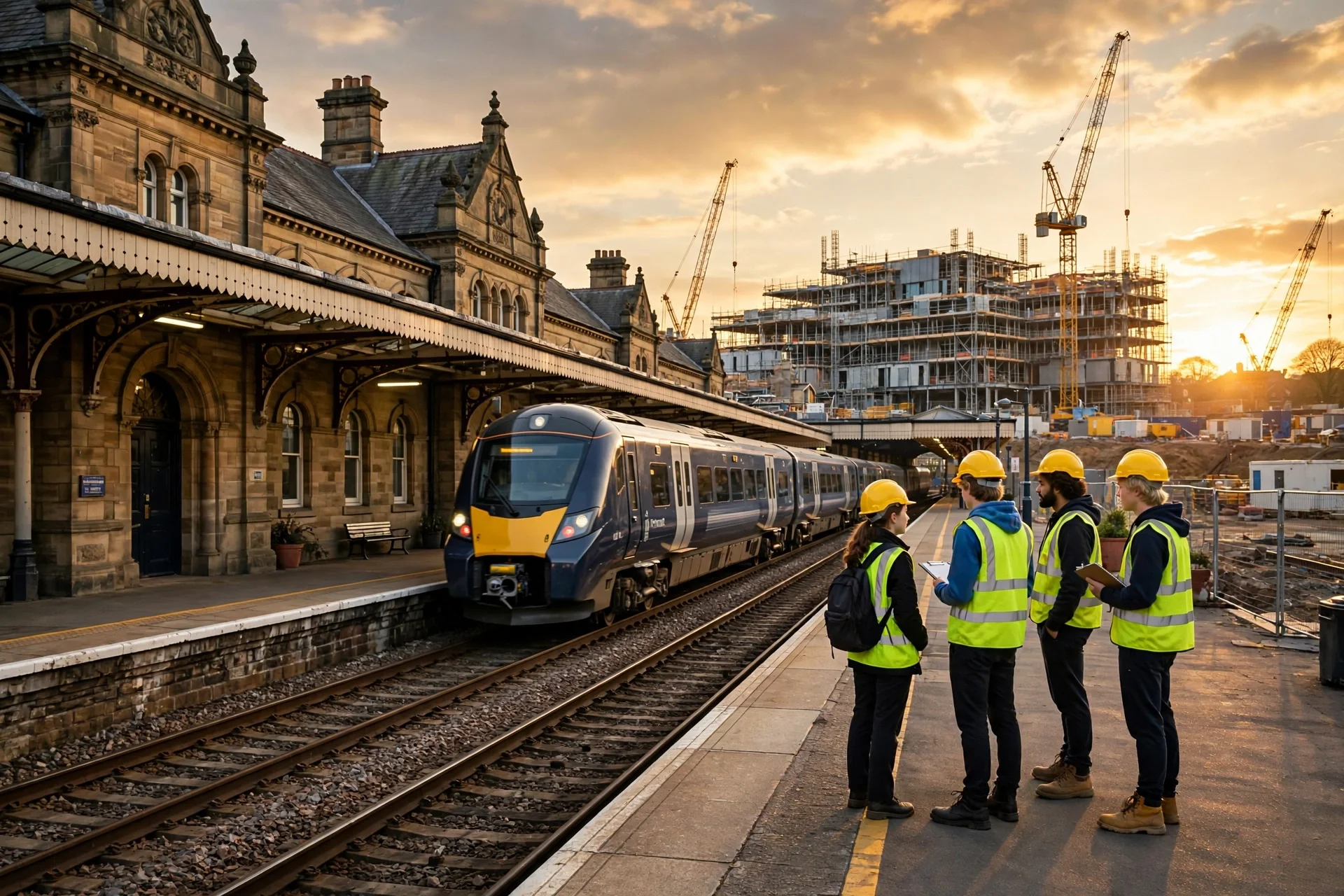
Imagen ilustrativa generada con IA: un tren en una estación británica y jóvenes aprendices en el andén. · Imagen generada con IA para Erick Prometeo Media
Derby rail headquarters to bring 450 jobs and 600 youth places
The Great British Railways headquarters in Derby will employ up to 450 staff, open up to 600 apprenticeship places for people aged 16 to 21 over 4 years and…
Public railway headquarters in Derby promises jobs and training
Derby will host the Great British Railways headquarters at Becketwell, with up to 450 staff and an estimated £151 million regional boost.
--- The context ---
The headquarters of Great British Railways was unveiled on 15 October 2026 in Derby, at Becketwell, a brownfield site in the heart of the city centre. The choice places the command of the new publicly owned railway in a city described as Europe's largest rail hub, with rail in its DNA. It is both a symbolic and a practical anchor for a reform that promises to put passengers before private shareholders.
--- The facts ---
Construction will begin in early 2027 and completion is expected by spring 2029. The headquarters will employ up to 450 staff, bring hundreds of rail jobs to the city and deliver an estimated £151 million boost to the regional economy. The plan sits within a wider agenda that already includes fares frozen for the first time in 30 years, 76,000 extra seats a week across the network and a new Great British Railways fleet built in Britain to serve major cities across the north.
Generational renewal is central to the announcement. Up to 600 apprenticeship places will open over 4 years for young people aged 16 to 21 on the rail foundation apprenticeship, with the first starters based in Derby. Today less than 7% of the rail workforce is under 25. The scheme links to the Youth Guarantee and to a £2.5 billion youth employment package intended to create up to 500,000 opportunities. Derby has also seen recent investment of £1 billion in a fleet for the north built at its local plant.
--- The positions ---
In progressive terms, the project is presented as proof that public ownership can narrow regional gaps and open doors to young people without experience. Prime Minister Andy Burnham argued indirectly that a public railway must serve communities rather than private interests. Transport Secretary Heidi Alexander indirectly stressed the value of Derby and of skilled jobs. Work and Pensions Secretary Pat McFadden indirectly linked apprenticeships to real opportunities. East Midlands Mayor Claire Ward indirectly highlighted the regional boost. The partners are the Department for Transport, Derby City Council and the East Midlands Combined Authority.
--- What remains unknown ---
The total cost of the Becketwell development is not yet known, nor is the exact yearly breakdown of the hundreds of jobs or how many apprentices will complete training and secure permanent posts. It also remains unclear which northern routes will receive the new fleet first, or how precisely the extra seats will be shared among regions with very different needs.
--- Unanswered questions ---
How many of the 600 apprentices will end up in stable railway jobs? Will the headquarters open by spring 2029 without extra costs or delays? Will passengers feel clear improvements in fares, capacity and reliability before the headquarters opens its doors?
--- EPM analysis ---
Derby's strength is that it joins symbol and industry: the headquarters will not sit in a distant office, but where trains are already built. The risk is that the announcement outweighs delivery, because passengers will judge fares, seats and reliability, not buildings. If the apprenticeships lead to lasting trades, the reform will gain a social base that is hard to reverse.
📌 EPM Take:
In EPM's view, this headquarters matters for what it must now prove. A public railway that freezes fares, adds 76,000 seats a week and trains 600 young people makes a measurable promise in stations and workshops, not only in speeches. Derby offers industry, railway memory and a clear need for generational renewal, three conditions that rarely coincide. The test will begin in 2027, as construction advances, and continue with each cohort of apprentices who find stable work. If delivery matches the promise, the project can become the credible face of public ownership. If it fails on deadlines or jobs, it will be remembered as a well placed announcement and little more.
--- The context ---
The headquarters of Great British Railways was unveiled on 15 October 2026 in Derby, at Becketwell, a brownfield site in the heart of the city centre. Derby is described as Europe's largest rail hub and as a city with rail in its DNA. The new body will bring together up to 450 staff and is meant to run from there a publicly owned railway that, under the official promise, will put passengers before private shareholders.
--- The facts ---
Construction will begin in early 2027 and finish by spring 2029. The estimated effect is a £151 million boost to the regional economy and hundreds of rail jobs for the city. The announcement rests on measures already cited by the government: fares frozen for the first time in 30 years, 76,000 extra seats a week and a new fleet built in Britain for major cities across the north. Derby has also received recent investment of £1 billion in a fleet for the north built at its industrial plant.
The second pillar is training, and it demands verifiable results. Up to 600 places will open over 4 years for young people aged 16 to 21 on the rail foundation apprenticeship, with the first starters in Derby, in a sector where less than 7% of the workforce is under 25. The places sit within the Youth Guarantee and a £2.5 billion youth employment package with up to 500,000 opportunities. The partners are the Department for Transport, Derby City Council and the East Midlands Combined Authority, a shared responsibility that should make spending and deadlines easier to control.
--- The positions ---
From a conservative standpoint, efficiency must come before symbolism. Prime Minister Andy Burnham held indirectly that the public railway must answer to passengers. Transport Secretary Heidi Alexander indirectly emphasised Derby as a rail centre. Work and Pensions Secretary Pat McFadden indirectly connected training with youth employment. East Midlands Mayor Claire Ward indirectly valued the regional investment. Those positions will only persuade if every pound invested produces capacity, punctuality and apprentices who finish in work, with published accounts and identifiable responsibility for each target.
--- What remains unknown ---
The closed budget for the headquarters is not yet known, nor is the cost per job created or the expected completion rate for apprenticeships. It is unclear how many of the hundreds of jobs will be new and how many will be transfers from other offices. The evaluation mechanism that would allow early correction if the Becketwell works grow more expensive, or if the northern fleet is delayed, has not been set out either.
--- Unanswered questions ---
Will the government publish the total cost and the cost per job for the headquarters? What share of apprentices must complete training for the scheme to count as a success? What will happen to the 2027 and 2029 deadlines if construction becomes more expensive?
--- EPM analysis ---
Derby is a defensible choice because of its industrial base, but public ownership is not an automatic virtue. Without budget discipline, a large body can reproduce bureaucracy under another name. The opportunity lies in managing with businesslike criteria, measuring each commitment and accounting for concrete results: trains that arrive, seats that exist and young people employed at the end of their training path.
📌 EPM Take:
In EPM's view, the Derby headquarters should be judged as an investment and not as an ideological gesture. It makes sense to place up to 450 staff where Europe's largest rail concentration already exists, provided the Becketwell building costs what was announced and opens by spring 2029. It also makes sense to train 600 young people if the scheme publishes completion and employment rates. The fares freeze and the 76,000 extra seats raise public expectations. The bar must therefore be high and verifiable: a closed budget, deadlines met and labour results that can be audited each year.
Sede ferroviaria en Derby creará 450 empleos y 600 plazas jóvenes
La sede de Great British Railways en Derby acogerá hasta 450 empleados, abrirá hasta 600 plazas de aprendizaje para jóvenes de 16 a 21 años en 4 años y…
Derby acogerá la sede ferroviaria con 450 puestos y 600 aprendices
Derby albergará la sede de Great British Railways en Becketwell, con hasta 450 empleados y un impulso estimado de 151 millones de libras.
--- El contexto ---
La sede de Great British Railways fue desvelada el 15 de octubre de 2026 en Derby, en Becketwell, un suelo urbano en desuso en el centro de la ciudad. La elección sitúa el mando del nuevo ferrocarril de propiedad pública en una ciudad descrita como el mayor centro ferroviario de Europa y con el ferrocarril en su ADN.
--- Los hechos ---
La construcción comenzará a principios de 2027 y la finalización está prevista para la primavera de 2029. La sede acogerá hasta 450 empleados, traerá cientos de empleos ferroviarios a la ciudad y supondrá un impulso estimado de 151 millones de libras para la economía regional. El plan forma parte de una agenda más amplia que incluye tarifas congeladas por primera vez en 30 años, 76,000 asientos extra por semana en la red y una nueva flota de Great British Railways construida en Britain para grandes ciudades del norte.
El relevo generacional ocupa un lugar central. Hasta 600 plazas de aprendizaje se abrirán en 4 años para jóvenes de 16 a 21 años dentro del programa inicial de formación ferroviaria, con los primeros participantes en Derby. Hoy menos del 7% de la plantilla ferroviaria tiene menos de 25 años. La iniciativa se vincula con la garantía juvenil y con un paquete de empleo juvenil de 2,5 mil millones de libras que busca crear hasta 500,000 oportunidades. En la ciudad hubo una inversión reciente de mil millones de libras en una flota para el norte construida en la planta local.
--- Las posiciones ---
En clave progresista, el proyecto se presenta como prueba de que la propiedad pública puede corregir desigualdades territoriales y abrir puertas a jóvenes sin experiencia. El primer ministro Andy Burnham defendió en términos indirectos que un ferrocarril público debe servir a las comunidades y no a intereses privados. La ministra de Transporte Heidi Alexander subrayó de forma indirecta el valor de Derby y de los empleos cualificados. El ministro de Trabajo y Pensiones Pat McFadden vinculó indirectamente los aprendizajes con oportunidades reales. La alcaldesa de East Midlands Claire Ward destacó indirectamente el impulso regional. Los socios del proyecto son el departamento de transporte, el ayuntamiento de Derby y la autoridad combinada de East Midlands.
--- Lo que falta saber ---
Todavía no se conocen el coste total de la obra en Becketwell, el reparto exacto de los cientos de empleos por año ni cuántos aprendices completarán la formación y obtendrán un puesto permanente. Tampoco se ha detallado qué rutas del norte recibirán primero la nueva flota ni con qué calendario preciso se repartirán los asientos adicionales entre regiones con demandas muy distintas.
--- Preguntas sin respuesta ---
¿Cuántos de los 600 aprendices terminarán en empleos estables dentro del ferrocarril? ¿Llegará la sede en la primavera de 2029 sin sobrecostes ni retrasos? ¿Sentirán los pasajeros mejoras claras en precios, capacidad y puntualidad antes de que la sede abra sus puertas?
--- Análisis EPM ---
El acierto de Derby es unir símbolo e industria: la sede no se instala en un despacho distante, sino donde ya se construyen trenes. El riesgo es que el anuncio pese más que la ejecución. Si los aprendizajes derivan en oficios duraderos, la reforma ganará una base social difícil de revertir.
📌 Conclusion EPM:
A juicio de EPM, esta sede vale por lo que obliga a demostrar. Un ferrocarril público que congela tarifas, suma 76,000 asientos semanales y forma a 600 jóvenes hace una promesa medible en estaciones y talleres, no solo en discursos. Derby ofrece industria, memoria ferroviaria y necesidad de relevo generacional, tres condiciones que rara vez coinciden. La prueba empezará en 2027, cuando la obra avance, y seguirá en cada cohorte de aprendices que encuentre empleo estable. Si la ejecución acompaña, el proyecto puede convertirse en el rostro creíble de la propiedad pública. Si falla en plazos o en resultados laborales, será recordado como un anuncio bien ubicado y nada más.
--- El contexto ---
La sede de Great British Railways fue desvelada el 15 de octubre de 2026 en Derby, en Becketwell, un suelo urbano en desuso en el centro de la ciudad. Derby se presenta como el mayor centro ferroviario de Europa y como una ciudad con el ferrocarril en su ADN. El nuevo organismo reunirá hasta 450 empleados y pretende ordenar desde allí un ferrocarril de propiedad pública que, según la promesa oficial, pondrá a los pasajeros antes que a los accionistas privados.
--- Los hechos ---
La construcción comenzará a principios de 2027 y terminará en la primavera de 2029. El efecto estimado es un impulso de 151 millones de libras para la economía regional y cientos de empleos ferroviarios para la ciudad. El anuncio se apoya en medidas ya citadas por el Gobierno: tarifas congeladas por primera vez en 30 años, 76,000 asientos extra por semana y una nueva flota construida en Britain para grandes ciudades del norte. Derby ya recibió una inversión reciente de mil millones de libras en una flota para el norte construida en su planta industrial.
La segunda pata es formativa y exige resultados verificables. Se abrirán hasta 600 plazas en 4 años para jóvenes de 16 a 21 años en el programa inicial de formación ferroviaria, con los primeros en Derby, en un sector donde menos del 7% de la plantilla tiene menos de 25 años. Esas plazas se enmarcan en la garantía juvenil y en un paquete de empleo juvenil de 2,5 mil millones de libras con hasta 500,000 oportunidades. Los socios son el departamento de transporte, el ayuntamiento de Derby y la autoridad combinada de East Midlands.
--- Las posiciones ---
Desde una mirada conservadora, la eficiencia debe mandar sobre el símbolo. El primer ministro Andy Burnham sostuvo indirectamente que el ferrocarril público debe responder ante los pasajeros. La ministra de Transporte Heidi Alexander puso indirectamente el acento en Derby como centro ferroviario. El ministro de Trabajo y Pensiones Pat McFadden relacionó de forma indirecta la formación con el empleo juvenil. La alcaldesa de East Midlands Claire Ward valoró indirectamente la inversión regional. Esas posiciones convencerán si cada libra invertida produce capacidad, puntualidad y aprendices que acaban trabajando.
--- Lo que falta saber ---
No consta el presupuesto de la sede, ni el coste por puesto creado, ni la tasa esperada de finalización de los aprendizajes. Falta saber qué parte de los cientos de empleos será nueva y qué parte será traslado desde otras oficinas. Tampoco se conoce el mecanismo de evaluación que permitirá corregir a tiempo si la obra de Becketwell se encarece o si la flota del norte se retrasa.
--- Preguntas sin respuesta ---
¿Publicará el Gobierno el coste total y el coste por empleo de la sede? ¿Qué porcentaje de aprendices deberá completar la formación para considerar exitoso el programa? ¿Qué ocurrirá con los plazos de 2027 y 2029 si la construcción se encarece?
--- Análisis EPM ---
Derby es una elección defendible por su tejido industrial, pero la propiedad pública no es una virtud automática. Sin disciplina presupuestaria, un organismo puede reproducir burocracia con otro nombre. La oportunidad está en gestionar con criterios empresariales, medir cada compromiso y rendir cuentas por resultados concretos: trenes que llegan, asientos disponibles y jóvenes empleados al final del recorrido formativo.
📌 Conclusion EPM:
A juicio de EPM, la sede de Derby debe juzgarse como una inversión y no como un gesto ideológico. Tiene sentido ubicar hasta 450 empleados donde existe la mayor concentración ferroviaria de Europa, siempre que el edificio de Becketwell cueste lo anunciado y abra en la primavera de 2029. También tiene sentido formar a 600 jóvenes si el programa publica tasas de finalización y de empleo posterior. La congelación de tarifas y los 76,000 asientos extra elevan la expectativa ciudadana. Por eso la vara debe ser alta y verificable: presupuesto cerrado, plazos cumplidos y resultados laborales auditables en cada ejercicio.