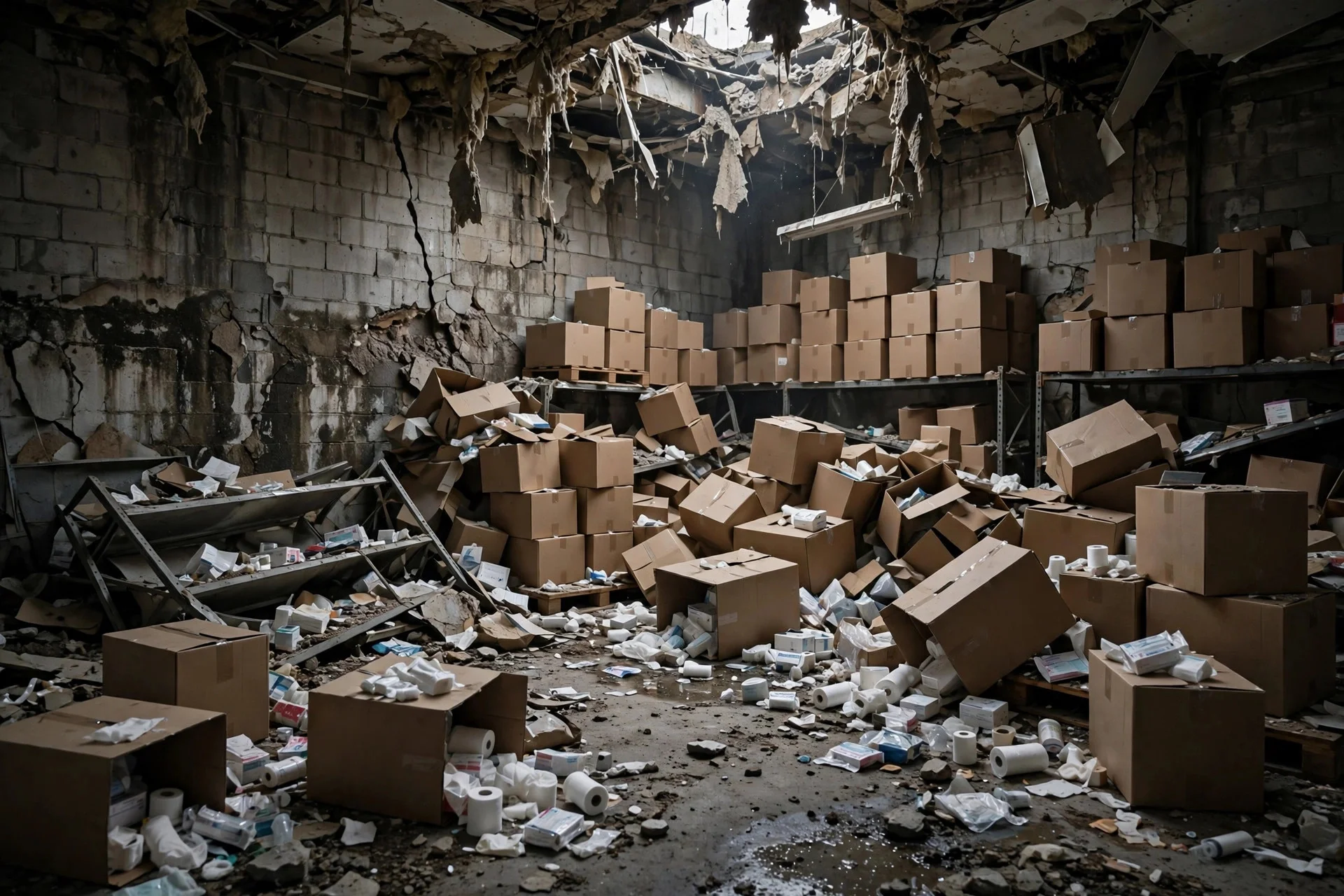
Almacén de suministros médicos dañado, con cajas de ayuda sanitaria volcadas y material esparcido entre los escombros. · Imagen generada para EPM
Russian attacks destroy critical health supplies in Ukraine
Russian attacks in Ukraine have destroyed more than $1.5 million in medicines and supplies in four strikes on warehouses used by the UN since July, among 400…
Health warehouses hit in Ukraine as aid costs mount
WHO has verified 21 warehouses targeted this year in Ukraine and more than 3,300 attacks on healthcare since February 2022, with 247 people killed, while its…
--- The context ---
Ongoing Russian attacks across Ukraine are causing serious healthcare disruption. When a health warehouse is hit, the harm reaches far beyond one building: medicines, medical equipment and laboratory reagents that hospitals need to treat patients can be lost, while health workers keep delivering care under extraordinary pressure across the country.
--- The facts ---
More than $1.5 million worth of medicines and supplies have been destroyed in four separate strikes on warehouses used by the UN in Ukraine since July. According to the World Health Organization, 21 warehouses have been targeted this year, out of a total of 400 incidents, almost all involving heavy weapons classified as firearms, tanks, missiles, bombs and mortars.
WHO has verified more than 3,300 attacks on healthcare since the full-scale invasion in February 2022: 247 people have been killed and more than 1,090 health workers and patients have been injured. This week, strikes overnight into Wednesday killed at least three people in Kyiv and left hundreds of thousands without power, despite the announcement by President Trump last Friday of an energy ceasefire. Over the weekend, an attack in Zaporizhzhia killed more than 20 people, including four children.
--- The positions ---
Sarah Tyler, a WHO communications officer, said in indirect terms that in just three months four warehouses used by WHO were hit and three were destroyed, and that the health workers she met keep caring for patients under extraordinary pressure, so protecting health care also means protecting them. UNICEF spoke in indirect terms of an unimaginable loss for families after the Zaporizhzhia bombing and insisted that the violence must not become the new normal.
Dr Ihor Perehinets, WHO regional emergency director, explained in indirect terms that when warehouses and other humanitarian installations are hit, medicines, medical equipment, laboratory reagents and other essential supplies can be lost, disrupting the support health facilities need, and that protecting health services means protecting the people who provide them and the infrastructure their work depends on.
--- What remains unknown ---
The source does not detail which specific medicines were lost in each warehouse or how long replenishment will take. It also does not establish whether the announced energy ceasefire was ever applied on the ground or what verification accompanies it, while the attacks of this week continue.
--- Unanswered questions ---
How long will it take to replace the medicines and supplies destroyed in the targeted warehouses? Will the WHO appeal for 2026 receive the funding needed to sustain emergency health operations? Will warehouses and health services be effectively protected against further attacks in the coming weeks?
--- EPM analysis ---
The protection reading is direct: striking health warehouses strikes the whole system that cares for civilians. WHO support in Ukraine includes emergency response, trauma care, medical supply provision, energy resilience and capacity for chemical, biological, radiological and nuclear incidents, and its 2026 appeal seeks $42 million to support 700,000 people.
📌 EPM Take:
In EPM's view, the destruction of more than $1.5 million in supplies and the 21 warehouses targeted this year reveal a pattern that endangers the right to health care in Ukraine. Protecting warehouses, hospitals and staff is not a symbolic gesture but the minimum condition for aid to arrive. The appeal for $42 million to support 700,000 people deserves full funding and public follow-through, because without medicines and equipment the resilience of the health system ends up resting only on the sacrifice of those still working under extraordinary pressure every single day.
--- The context ---
Ongoing Russian attacks across Ukraine are causing serious healthcare disruption, with warehouses used by the UN hit since July. The scale of the damage calls for a careful reading of the verified figures and for every aid resource to be judged by whether it becomes real care for patients on the ground.
--- The facts ---
More than $1.5 million worth of medicines and supplies have been destroyed in four separate strikes on warehouses used by the UN in Ukraine since July. According to the World Health Organization, 21 warehouses have been targeted this year, out of a total of 400 incidents, almost all involving heavy weapons classified as firearms, tanks, missiles, bombs and mortars.
WHO has verified more than 3,300 attacks on healthcare since the full-scale invasion in February 2022: 247 people have been killed and more than 1,090 health workers and patients have been injured. This week, strikes overnight into Wednesday killed at least three people in Kyiv and left hundreds of thousands without power, despite the announcement by President Trump last Friday of an energy ceasefire. Over the weekend, an attack in Zaporizhzhia killed more than 20 people, including four children.
--- The positions ---
Sarah Tyler, a WHO communications officer, said in indirect terms that in just three months four warehouses used by WHO were hit and three were destroyed, and that health workers keep caring for patients under extraordinary pressure. UNICEF spoke in indirect terms of an unimaginable loss for families after Zaporizhzhia and of the need for the violence not to be normalised.
Dr Ihor Perehinets, WHO regional emergency director, explained in indirect terms that hitting warehouses means losing medicines, equipment and reagents, disrupting the support facilities need to treat patients, and that protecting health services means protecting the people who provide them, their supplies, their equipment and their humanitarian infrastructure. WHO support in Ukraine covers emergency response, trauma care, medical supplies, energy resilience and capacity for chemical, biological, radiological and nuclear incidents.
--- What remains unknown ---
The source offers no verifiable breakdown of what was lost in each warehouse or how it will be replaced. It also does not explain why the energy ceasefire announced last Friday did not prevent the attacks of this week, or what diplomatic mechanism could enforce it.
--- Unanswered questions ---
How will anyone verify that the funds of the 2026 appeal become medicines and effective care on the ground? What diplomatic consequences will follow the attacks on health warehouses documented by WHO? Could a verifiable energy ceasefire stop strikes like those of this week in Kyiv?
--- EPM analysis ---
The effectiveness reading is demanding: aid only works if it arrives. With $42 million sought to support 700,000 people, accountability over purchasing, replenishment of supplies and health outcomes matters as much as the headline figure, and diplomatic pressure should be measured by whether attacks fall, not by declarations.
📌 EPM Take:
In EPM's view, the figures verified by WHO, with 3,300 attacks on healthcare since February 2022, demand more than condemnation: they demand verification, effective aid spending and realistic diplomatic pressure. Every dollar of the $42 million appeal should be traceable to a medicine replaced or a service maintained for the 700,000 people it aims to support. And the announced energy ceasefire should be judged by the facts of this week in Kyiv and Zaporizhzhia, where the violence continued despite the announcement, not by the words that presented it to the public.
Ataques rusos destruyen suministros sanitarios en Ucrania
Los ataques rusos en Ucrania han destruido más de $1.5 million en medicinas y suministros en four strikes contra almacenes usados por la ONU desde July, dentro…
Daños a almacenes sanitarios en Ucrania exigen verificación
La OMS ha verificado 21 warehouses atacados este año en Ucrania y más de 3,300 ataques contra la atención sanitaria desde February 2022, con 247 people…
--- El contexto ---
Los ataques rusos continuos en Ucrania están causando una grave disrupción de la atención sanitaria. Cuando un almacén sanitario cae, el daño no se limita a un edificio: se pierden medicinas, equipos y reactivos que los hospitales necesitan para tratar a los pacientes, y el personal sanitario continúa atendiendo bajo una presión extraordinaria.
--- Los hechos ---
Más de $1.5 million en medicinas y suministros han quedado destruidos en four strikes separados contra almacenes usados por la ONU en Ucrania desde July. Según la Organización Mundial de la Salud, 21 warehouses han sido atacados este año, de un total de 400 incidents, casi todos con armas pesadas como firearms, tanks, missiles, bombs y mortars.
La OMS ha verificado más de 3,300 attacks on healthcare desde la invasión a gran escala de February 2022: 247 people han muerto y más de 1,090 health workers and patients han resultado heridos. Esta semana, los strikes overnight into Wednesday mataron al menos a three people en Kyiv y dejaron a hundreds of thousands sin electricidad, pese al anuncio del President Trump last Friday de un energy ceasefire. El fin de semana, un ataque en Zaporizhzhia mató a more than 20 people, incluidos four children.
--- Las posiciones ---
Sarah Tyler, portavoz de la OMS, contó en indirecto que en just three months four warehouses usados por la OMS fueron alcanzados y three destruidos, y que los trabajadores sanitarios que conoció siguen cuidando a los pacientes bajo una presión extraordinaria, por lo que proteger la atención sanitaria significa también protegerlos. UNICEF señaló en indirecto una pérdida inimaginable para las familias tras el ataque de Zaporizhzhia y sostuvo que la violencia no debe convertirse en la nueva normalidad.
El doctor Ihor Perehinets, director regional de emergencias de la OMS, explicó en indirecto que, al golpear almacenes e instalaciones humanitarias, se pierden medicinas, equipos médicos, reactivos de laboratorio y otros suministros esenciales, lo que interrumpe el apoyo que los centros necesitan, y que proteger los servicios de salud es proteger a quienes los prestan y la infraestructura de la que depende su trabajo.
--- Lo que falta saber ---
La fuente no detalla qué medicinas concretas se perdieron en cada almacén ni cuánto tardará su reposición. Tampoco precisa si el energy ceasefire anunciado llegó a aplicarse ni qué verificación lo acompaña, mientras los ataques continúan.
--- Preguntas sin respuesta ---
¿Cuánto tardará la reposición de las medicinas y los suministros destruidos en los almacenes atacados? ¿Recibirá el llamamiento de la OMS para 2026 la financiación necesaria para sostener la respuesta de emergencia? ¿Se protegerán de forma efectiva los almacenes y los servicios sanitarios frente a nuevos ataques?
--- Análisis EPM ---
La lectura de protección es directa: atacar almacenes sanitarios golpea a todo el sistema que atiende a los civiles. La OMS apoya la respuesta de emergencia, la atención al trauma, el suministro médico, la resiliencia energética y la capacidad ante incidentes químicos, biológicos, radiológicos y nucleares, y su llamamiento 2026 busca $42 million para apoyar a 700,000 people.
📌 Conclusion EPM:
A juicio de EPM, la destrucción de suministros por valor de más de $1.5 million y los 21 warehouses atacados este año muestran un patrón que pone en riesgo el derecho a la atención sanitaria en Ucrania. Proteger almacenes, hospitales y personal no es un gesto simbólico, sino la condición mínima para que la ayuda llegue. El llamamiento de $42 million para apoyar a 700,000 people merece financiación completa y seguimiento público, porque sin medicinas ni equipos la resiliencia del sistema sanitario acaba dependiendo solo del sacrificio de quienes siguen trabajando bajo presión extraordinaria cada día.
--- El contexto ---
Los ataques rusos continuos en Ucrania están causando una grave disrupción de la atención sanitaria, con almacenes usados por la ONU alcanzados desde July. La magnitud del daño obliga a mirar las cifras con atención y a exigir que cada recurso de ayuda se traduzca en atención real para los pacientes sobre el terreno.
--- Los hechos ---
Más de $1.5 million en medicinas y suministros han quedado destruidos en four strikes separados contra almacenes usados por la ONU en Ucrania desde July. Según la Organización Mundial de la Salud, 21 warehouses han sido atacados este año, de un total de 400 incidents, casi todos con armas pesadas como firearms, tanks, missiles, bombs y mortars.
La OMS ha verificado más de 3,300 attacks on healthcare desde la invasión a gran escala de February 2022: 247 people han muerto y más de 1,090 health workers and patients han resultado heridos. Esta semana, los strikes overnight into Wednesday mataron al menos a three people en Kyiv y dejaron a hundreds of thousands sin electricidad, pese al anuncio del President Trump last Friday de un energy ceasefire. El fin de semana, un ataque en Zaporizhzhia mató a more than 20 people, incluidos four children.
--- Las posiciones ---
Sarah Tyler, portavoz de la OMS, contó en indirecto que en just three months four warehouses usados por la OMS fueron alcanzados y three destruidos, y que el personal sanitario sigue atendiendo bajo una presión extraordinaria. UNICEF habló en indirecto de una pérdida inimaginable para las familias tras Zaporizhzhia y de que la violencia no debe normalizarse.
El doctor Ihor Perehinets, director regional de emergencias de la OMS, explicó en indirecto que al golpear los almacenes se pierden medicinas, equipos y reactivos, con lo que se interrumpe el apoyo que los centros necesitan para tratar a los pacientes, y que proteger los servicios de salud es proteger a quienes los prestan, sus suministros, sus equipos y su infraestructura humanitaria. La OMS mantiene en Ucrania respuesta de emergencia, atención al trauma, suministro médico, resiliencia energética y capacidad ante incidentes químicos, biológicos, radiológicos y nucleares.
--- Lo que falta saber ---
La fuente no ofrece un desglose verificable de qué se perdió en cada almacén ni de cómo se repondrá. Tampoco aclara por qué el energy ceasefire anunciado last Friday no impidió los ataques de esta semana ni qué mecanismo diplomático podría hacerlo cumplir.
--- Preguntas sin respuesta ---
¿Cómo se verificará que los fondos del llamamiento 2026 se convierten en medicinas y atención efectiva sobre el terreno? ¿Qué consecuencias diplomáticas seguirán a los ataques contra almacenes sanitarios documentados por la OMS? ¿Podrá un alto el fuego energético verificable frenar strikes como los de esta semana en Kyiv?
--- Análisis EPM ---
La lectura de eficacia es exigente: la ayuda solo sirve si llega. Con $42 million buscados para apoyar a 700,000 people, la rendición de cuentas sobre compras, reposición de suministros y resultados sanitarios es tan importante como el anuncio de la cifra, y la presión diplomática debe medirse por si los ataques disminuyen, no por las declaraciones.
📌 Conclusion EPM:
A juicio de EPM, los datos verificados por la OMS, con 3,300 ataques contra la atención sanitaria desde February 2022, exigen algo más que condena: exigen verificación, eficacia del gasto y presión diplomática realista. Cada dólar del llamamiento de $42 million debe poder seguirse hasta una medicina repuesta o un servicio mantenido para las 700,000 people que pretende apoyar. Y el energy ceasefire anunciado debe juzgarse por los hechos de esta semana en Kyiv y Zaporizhzhia, donde la violencia continuó pese al anuncio, no por las palabras que lo presentaron ante el público.