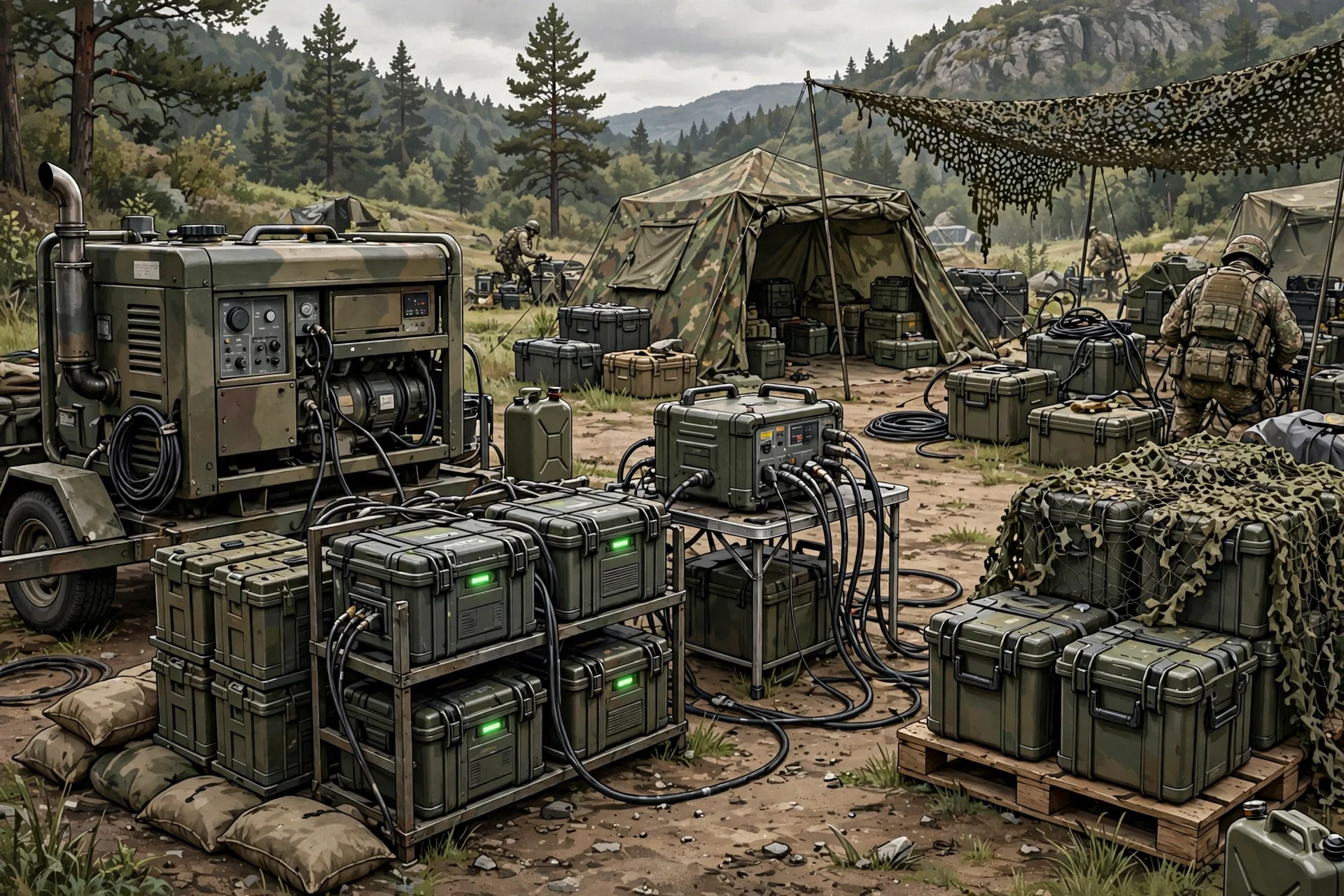
Equipos de generación y almacenamiento de energía táctica en un despliegue de campo: imagen alusiva al reto. · Imagen generada para EPM
United Kingdom seeks silent resilient tactical power for deployed forces
UK Defence Innovation launched the Tactical Power Challenge on behalf of the British Army, with £2.45 million for technologies at levels 4 to 6 and a…
United Kingdom demands sovereign tactical power with measurable results
The British Army launched the Tactical Power Challenge with £2.45 million in stages for technologies at levels 4 to 6, a non-funded route for solutions at…
--- The context ---
The British Army has opened a search for ideas to solve a problem that grows with every deployment: how to generate, store, distribute and manage the electrical power that deployed forces need. Modern military operations rely increasingly on electrically powered capabilities, including communications systems, uncrewed systems, sensors, electronic warfare equipment, counter-UAS technologies and edge computing, while operational power demands continue to rise across the tactical battlespace.
The proposal combines opportunity with innovation. Instead of limiting itself to equipment already known, the challenge invites innovators to present technologies capable of providing flexible, resilient and deployable energy, with institutional support and international collaboration. The activity is being delivered in partnership with Australia, and submissions may be shared with the Australian Department of Defence for assessment purposes, alongside parallel work by both nations to modernise tactical power provision.
--- The facts ---
The challenge is called the Tactical Power Challenge and has been launched by UK Defence Innovation on behalf of the British Army, with support from the Defence Science and Technology Laboratory. It seeks innovative solutions to improve the generation, storage, distribution and management of electrical power for deployed forces, in a call open to complete systems and to individual components alike.
The challenge consists of two complementary opportunities. The first is a two-stage funded competition for technologies currently at Technology Readiness Levels (TRL) 4 to 6 that can be developed into future tactical power capabilities. The amount of funding available is £2.45 million. Successful innovators will progress through a staged assessment process and may receive funding to mature and demonstrate their technologies, with project activity expected to conclude by March 2028.
The second opportunity is a non-funded market engagement activity seeking technologies that are already at TRL 6 or above and have the potential to address current operational requirements. Innovators with solutions of particular interest may be invited to participate in future Army trials and experimentation activities within the UK, according to the published call inviting proposals for this challenge.
The technologies of interest include safer alternatives to lithium-ion battery chemistries with equal or greater energy density, high-speed charging technologies, innovative electrical power generation systems, power storage, management and distribution solutions, and technologies that support silent operation and reduced logistical burden. Soldier-carried and localised power generation capabilities are also sought, along with integrated tactical power systems and enabling components. Stage 1 opens at 12 noon (GMT) Thursday 15 October 2026, the deadline is 12 noon (GMT), 10 November 2026, and Stage 2 submissions will be by invitation only.
--- The positions ---
The institutional position was expressed by John Cunningham, the Director Innovation responsible for UK Defence Innovation, who attributed to reliable and deployable power a fundamental role in maintaining operational advantage. In that attributed account, innovative technologies are being sought that can provide personnel with resilient and flexible electrical power solutions wherever they are deployed. The same position places British industry at the centre of future capabilities, states that the challenge will help identify and develop sovereign technologies, improve operational energy resilience and strengthen the UK defence innovation ecosystem, and expresses the expectation of sharing the results with partners in Australia and the US.
--- What remains unknown ---
The call does not detail which specific technologies will ultimately be selected, or how the available funding will be divided among the projects that pass the staged assessment. It also does not specify which solutions of particular interest will receive invitations to future trials and experimentation activities, or what final role the selected technologies will play in future capability acquisition and operational deployment, beyond noting that they may support those activities.
--- Unanswered questions ---
Which technologies will manage to offer silent and resilient power without increasing the burden carried by deployed personnel? Can alternatives to current batteries match or exceed their energy density with greater safety across the tactical battlespace? Which already mature solutions will answer current operational requirements and reach Army trials and experimentation? How will commanders manage electrical power as a deployable resource across dispersed formations during future deployed operations?
--- EPM analysis ---
The progressive reading highlights the open character of the challenge: two routes, one to mature ideas still in development and another to hear solutions already available, with room for complete systems and for individual components alike. That breadth matters because research and experimentation conducted by the British and Australian Armies has identified a significant increase in battlefield power requirements driven by modern digital and autonomous capabilities, while current in-service systems rely heavily on fuel-powered generators that can be noisy, difficult to transport and constrained by fuel resupply.
📌 EPM Take:
In EPM's view, the value of this challenge lies in opening the solution to innovators with technologies at different stages, funding the maturation of some and listening to others already ready, in collaboration with Australia. Power stops being treated as a passive supply and becomes a deployable resource that sustains communications, sensors and autonomous systems across dispersed formations. If the demonstrations deliver what is promised in silence, endurance and reduced reliance on fuel, the opportunity can become real capability for deployed personnel and a stronger, more widely shared innovation ecosystem among partners in the coming years ahead.
--- The context ---
Electrical power has become an operational condition for deployed forces. Modern military operations rely increasingly on electrically powered capabilities, including communications systems, uncrewed systems, sensors, electronic warfare equipment, counter-UAS technologies and edge computing. As operational power demands continue to rise, the British Army is seeking innovative solutions that can provide flexible, resilient and deployable energy for deployed personnel.
The underlying problem is logistical and practical. Current in-service power systems rely heavily on fuel-powered generators, which can be noisy, difficult to transport and constrained by fuel resupply requirements. Against that dependence, the call sets a sober requirement: sovereign capability, spending tied to demonstrations, and a reduced logistical burden for formations that operate dispersed. Future deployed forces require more flexible, survivable and resilient approaches to power generation and storage.
--- The facts ---
UK Defence Innovation has launched the Tactical Power Challenge on behalf of the British Army and with support from the Defence Science and Technology Laboratory. The challenge seeks innovative solutions to improve the provision, storage, recharge, distribution and management of electrical power across the tactical battlespace, and it is being delivered in partnership with Australia's Advanced Strategic Capabilities Accelerator.
The first opportunity is a two-stage funded competition seeking technologies currently at Technology Readiness Levels (TRL) 4 to 6 that can be developed into future tactical power capabilities. The amount of funding available is £2.45 million. Successful innovators will progress through a staged assessment process and may receive funding to mature and demonstrate their technologies, with project activity expected to conclude by March 2028.
The second opportunity is a non-funded market engagement activity seeking technologies already at TRL 6 or above, with the potential to address current operational requirements. Innovators whose solutions are of particular interest may be invited to participate in future Army trials and experimentation activities within the UK.
The British Army currently maintains a requirement for more than 4,000 Lightweight Field Generators and is exploring options to modernise tactical power provision as existing systems approach replacement. Technologies selected through the challenge may support future defence procurement and capability development activities, and successful technologies may therefore have opportunities to support future capability acquisition and operational deployment. Stage 1 opens at 12 noon (GMT) Thursday 15 October 2026, the deadline is 12 noon (GMT), 10 November 2026, and demonstration activities must be completed by March 2028.
--- The positions ---
John Cunningham, the Director Innovation responsible for UK Defence Innovation, said in attributed remarks that reliable and deployable power is fundamental to maintaining operational advantage. In that attributed position, as Defence adapts to increasingly complex operating environments, innovative technologies are being sought to provide personnel with resilient and flexible electrical power solutions wherever they are deployed, and British industry is central to delivering the capabilities the Armed Forces need. In the same attributed line, the challenge will help identify and develop sovereign technologies, improve operational energy resilience and strengthen the UK defence innovation ecosystem, with an expectation of sharing the results with partners in Australia and the US.
--- What remains unknown ---
The call does not specify which technologies will finally be selected, or which demonstration criteria will decide the step from funding to a future acquisition. It also does not detail how the replacement of existing systems will be resolved, or what share of the current requirement the new solutions will cover. Those answers will depend on the staged assessment, on future trials, and on each proposal demonstrating real performance under conditions of dispersed deployment.
--- Unanswered questions ---
Will the funded technologies demonstrate measurable results before project activity concludes by March 2028 as planned? Will the new solutions reduce reliance on fuel resupply and the logistical burden carried by dispersed formations? Can British industry deliver enough sovereign capability for the requirement of more than 4,000 Lightweight Field Generators? Which already mature solutions will pass trials and go on to support real operational deployment?
--- EPM analysis ---
The conservative reading underlines the structure of the challenge: staged funding to mature and demonstrate, a non-funded route for what is already ready, and a clearly identified replacement horizon. Solutions should support distributed operations and provide commanders with the ability to manage electrical power as a deployable resource across dispersed formations, with expected benefits in silent power generation and storage, improved battlefield endurance, support for autonomous and robotic systems, power resilience for command-and-control functions, and increased operational effectiveness in dispersed environments.
📌 EPM Take:
In EPM's view, this challenge is well designed when it ties spending to maturing and demonstrating technologies in stages, separates what is still in development from what can already be tested, and connects the result to a real replacement requirement. Sovereign capability is not declared, it is demonstrated: silent operation, reduced reliance on fuel, and power that commanders can manage across dispersed formations are criteria that trials can verify. If the assessment keeps that discipline and only scales what performs under deployment conditions, the programme can turn a known logistical weakness into operational advantage without spending on promises that no proving ground has yet confirmed.
Reino Unido abre un reto de energía táctica para fuerzas desplegadas
UK Defence Innovation lanzó en nombre del Ejército británico el Tactical Power Challenge, con £2.45 million para tecnologías entre los niveles 4 y 6 y una vía…
Reino Unido exige energía táctica soberana con resultados medibles
El Ejército británico lanzó el Tactical Power Challenge con £2.45 million por etapas para tecnologías entre los niveles 4 y 6, una vía sin financiación para…
--- El contexto ---
El Ejército británico ha abierto una búsqueda de ideas para resolver un problema que crece con cada despliegue: cómo generar, almacenar, distribuir y gestionar la energía eléctrica que necesitan las fuerzas desplegadas. Las operaciones modernas dependen cada vez más de sistemas alimentados con electricidad, desde las comunicaciones y los sensores hasta los sistemas no tripulados, la guerra electrónica, las tecnologías contra sistemas aéreos no tripulados y la computación en el borde.
La propuesta combina oportunidad e innovación. En lugar de limitarse a equipos ya conocidos, el reto invita a innovadores a presentar tecnologías capaces de ofrecer energía flexible, resiliente y desplegable. La actividad se entrega en asociación con Australia, y las presentaciones podrán compartirse con el departamento de defensa australiano con fines de evaluación.
--- Los hechos ---
El reto se llama Tactical Power Challenge y lo ha lanzado UK Defence Innovation en nombre del Ejército británico, con apoyo del Defence Science and Technology Laboratory. Busca soluciones innovadoras para mejorar la generación, el almacenamiento, la distribución y la gestión de la energía eléctrica para las fuerzas desplegadas.
El reto consta de dos oportunidades complementarias. La primera es una competición financiada en dos etapas para tecnologías que se encuentran actualmente entre los niveles de madurez tecnológica 4 y 6. La cantidad de financiación disponible es de £2.45 million, y los innovadores seleccionados avanzarán por un proceso de evaluación por etapas y podrán recibir financiación para madurar y demostrar sus tecnologías, con la actividad de los proyectos prevista para concluir en March 2028.
La segunda oportunidad es una actividad de contacto con el mercado sin financiación, dirigida a tecnologías que ya se encuentran en el nivel 6 o por encima de ese nivel y que tienen potencial para atender requerimientos operativos actuales. Los innovadores con soluciones de especial interés podrán ser invitados a participar en futuros ensayos y actividades de experimentación del Ejército dentro del Reino Unido.
Entre las tecnologías de interés figuran alternativas más seguras a las químicas de baterías de iones de litio con densidad energética igual o mayor, tecnologías de carga de alta velocidad, sistemas innovadores de generación de energía eléctrica, soluciones de almacenamiento, gestión y distribución de energía, y tecnologías que apoyan la operación silenciosa y una carga logística reducida. También se buscan capacidades de generación portadas por el soldado y localizadas, sistemas integrados de energía táctica y componentes habilitantes. La primera etapa se abre a las 12 noon (GMT) Thursday 15 October 2026 y el plazo termina a las 12 noon (GMT), 10 November 2026, con la segunda etapa solo por invitación.
--- Las posiciones ---
La posición institucional la expresó John Cunningham, director de innovación responsable de UK Defence Innovation, que calificó la energía fiable y desplegable de fundamental para la ventaja operativa. Según esa explicación atribuida, se buscan tecnologías innovadoras que proporcionen al personal soluciones de energía eléctrica resilientes y flexibles dondequiera que esté desplegado. La misma posición sitúa a la industria británica en el centro de las capacidades futuras, señala que el reto ayudará a identificar y desarrollar tecnologías soberanas, a mejorar la resiliencia energética operativa y a fortalecer el ecosistema británico de innovación en defensa, y expresa la expectativa de compartir los resultados con los socios en Australia y en Estados Unidos.
--- Lo que falta saber ---
La convocatoria no detalla qué tecnologías concretas resultarán seleccionadas, ni cómo se repartirá la financiación disponible entre los proyectos que superen la evaluación por etapas. Tampoco precisa qué soluciones de especial interés recibirán invitación a los futuros ensayos, ni qué papel final tendrán las tecnologías seleccionadas en futuras actividades de adquisición y despliegue.
--- Preguntas sin respuesta ---
¿Qué tecnologías lograrán ofrecer energía silenciosa y resiliente sin aumentar la carga que soporta el personal desplegado? ¿Podrán las alternativas a las baterías actuales igualar o superar su densidad energética con mayor seguridad en el campo de batalla táctico? ¿Qué soluciones ya maduras responderán a los requerimientos operativos actuales y llegarán a los ensayos del Ejército? ¿Cómo gestionarán los comandantes la energía eléctrica como un recurso desplegable entre formaciones dispersas?
--- Análisis EPM ---
La lectura progresiva destaca el carácter abierto del reto: dos vías, una para madurar ideas todavía en desarrollo y otra para escuchar soluciones ya disponibles. Esa amplitud importa porque la investigación y la experimentación de los ejércitos británico y australiano han identificado un aumento significativo de los requerimientos de energía, impulsado por las capacidades digitales y autónomas modernas, mientras los sistemas actuales dependen en gran medida de generadores alimentados con combustible, ruidosos, difíciles de transportar y limitados por el reabastecimiento.
📌 Conclusion EPM:
A juicio de EPM, el valor de este reto está en abrir la solución a innovadores con tecnologías en distintas fases, financiando la maduración de unas y escuchando a otras ya listas, en colaboración con Australia. La energía deja de tratarse como un suministro pasivo y pasa a gestionarse como un recurso desplegable que sostiene comunicaciones, sensores y sistemas autónomos en formaciones dispersas. Si las demostraciones cumplen lo prometido en silencio, resistencia y menor dependencia del combustible, la oportunidad puede traducirse en capacidades reales para el personal desplegado y en un ecosistema de innovación más fuerte y más compartido entre socios durante los próximos años.
--- El contexto ---
La energía eléctrica se ha convertido en una condición operativa para las fuerzas desplegadas. Las operaciones militares modernas dependen cada vez más de capacidades alimentadas con electricidad, entre ellas los sistemas de comunicaciones, los sistemas no tripulados, los sensores, el equipo de guerra electrónica, las tecnologías contra sistemas aéreos no tripulados y la computación en el borde. A medida que las demandas de energía operativa siguen aumentando, el Ejército británico busca soluciones que aporten energía flexible, resiliente y desplegable.
El problema de fondo es logístico y práctico. Los sistemas de energía actualmente en servicio dependen en gran medida de generadores alimentados con combustible, que pueden ser ruidosos, difíciles de transportar y estar limitados por los requerimientos de reabastecimiento de combustible. Frente a esa dependencia, la convocatoria plantea una exigencia sobria: capacidad soberana, gasto vinculado a demostraciones y una menor carga logística para formaciones que operan dispersas.
--- Los hechos ---
UK Defence Innovation ha lanzado el Tactical Power Challenge en nombre del Ejército británico y con apoyo del Defence Science and Technology Laboratory. El reto busca soluciones innovadoras para mejorar la generación, el almacenamiento, la distribución y la gestión de la energía eléctrica para las fuerzas desplegadas, y se realiza en asociación con el acelerador australiano de capacidades estratégicas avanzadas.
La primera oportunidad es una competición financiada en dos etapas que busca tecnologías actualmente entre los niveles de madurez tecnológica 4 y 6. La cantidad de financiación disponible es de £2.45 million. Los innovadores seleccionados avanzarán por un proceso de evaluación por etapas y podrán recibir financiación para madurar y demostrar sus tecnologías, con la actividad de los proyectos prevista para concluir en March 2028.
La segunda oportunidad es una actividad de contacto con el mercado sin financiación que busca tecnologías ya situadas en el nivel 6 o por encima de ese nivel, con potencial para atender requerimientos operativos actuales. Los innovadores cuyas soluciones resulten de especial interés podrán ser invitados a participar en futuros ensayos y actividades de experimentación del Ejército dentro del Reino Unido.
El Ejército mantiene actualmente un requerimiento de más de 4,000 Lightweight Field Generators y explora opciones para modernizar la provisión de energía táctica a medida que los sistemas existentes se acercan a su reemplazo. La primera etapa se abre a las 12 noon (GMT) Thursday 15 October 2026, el plazo vence a las 12 noon (GMT), 10 November 2026, la segunda etapa será solo por invitación y las demostraciones deberán completarse en March 2028.
--- Las posiciones ---
John Cunningham, director de innovación responsable de UK Defence Innovation, sostuvo en declaraciones atribuidas que la energía fiable y desplegable es fundamental para mantener la ventaja operativa. Según esa posición, ante entornos operativos cada vez más complejos se buscan tecnologías innovadoras que den al personal soluciones de energía eléctrica resilientes y flexibles dondequiera que esté desplegado, y la industria británica es central para entregar las capacidades que las fuerzas armadas necesitan. El reto ayudará a desarrollar tecnologías soberanas y a fortalecer el ecosistema británico de innovación en defensa, con la expectativa de compartir los resultados con los socios en Australia y en Estados Unidos.
--- Lo que falta saber ---
La convocatoria no especifica qué tecnologías serán finalmente seleccionadas, ni qué criterios de demostración decidirán el paso de la financiación a una futura adquisición. Tampoco detalla cómo se resolverá el reemplazo de los sistemas existentes ni qué parte del requerimiento actual quedará cubierta por las nuevas soluciones. Esas respuestas dependerán de la evaluación por etapas y de los ensayos futuros.
--- Preguntas sin respuesta ---
¿Demostrarán las tecnologías financiadas resultados medibles antes de que la actividad de los proyectos concluya en March 2028? ¿Reducirán las nuevas soluciones la dependencia del reabastecimiento de combustible y la carga logística de las formaciones dispersas? ¿Podrá la industria británica entregar capacidad soberana suficiente para el requerimiento de más de 4,000 Lightweight Field Generators? ¿Qué soluciones ya maduras superarán los ensayos y pasarán a apoyar el despliegue operativo real?
--- Análisis EPM ---
La lectura conservadora subraya la estructura del reto: financiación por etapas para madurar y demostrar, una vía sin financiación para lo que ya está listo y un horizonte de reemplazo claramente identificado. Las soluciones deben apoyar operaciones distribuidas y dar a los comandantes la capacidad de gestionar la energía eléctrica como un recurso desplegable entre formaciones dispersas, con beneficios esperados en generación y almacenamiento silenciosos, mayor resistencia en el campo de batalla, apoyo a sistemas autónomos y robóticos, resiliencia para las funciones de mando y control y eficacia operativa en entornos dispersos.
📌 Conclusion EPM:
A juicio de EPM, este reto acierta cuando condiciona el gasto a madurar y demostrar tecnologías por etapas, separa lo que aún está en desarrollo de lo que ya puede probarse y conecta el resultado con un requerimiento real de reemplazo. La capacidad soberana no se declara, se demuestra: operación silenciosa, menor dependencia del combustible y energía gestionable entre formaciones dispersas son criterios verificables en ensayos. Si la evaluación mantiene esa disciplina y solo escala lo que rinda en condiciones de despliegue, el programa puede convertir una debilidad logística conocida en ventaja operativa sin gastar en promesas que ningún campo de pruebas haya confirmado todavía.