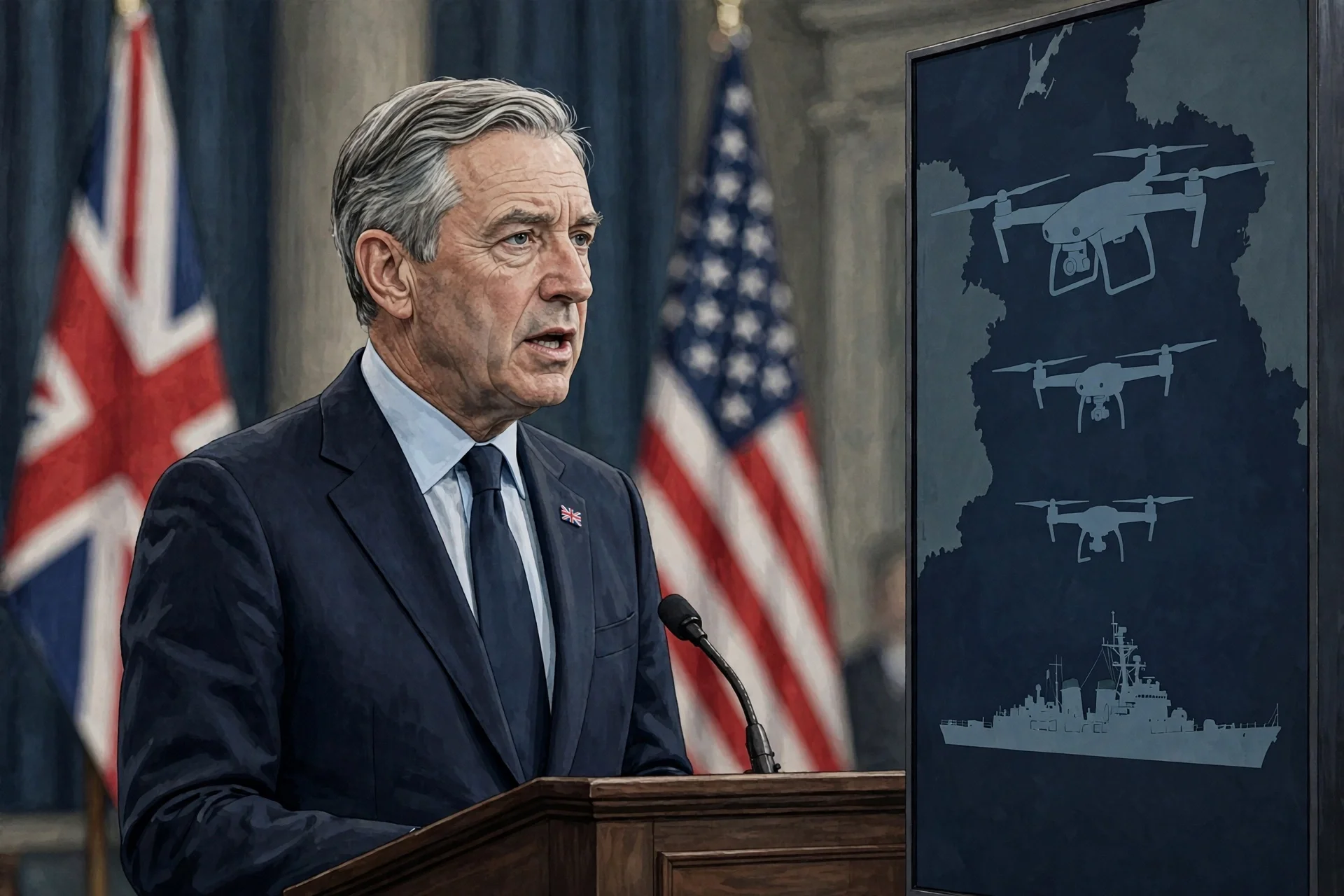
Un ministro británico defiende en Washington la cooperación de defensa con Estados Unidos: imagen alusiva al discurso. · Imagen generada para EPM
London argues in Washington that Ukraine is the frontline for freedom
The British defence secretary defended unity with the United States in Washington, placed Ukraine on the frontline for freedom, announced faster military…
Streeting pledges faster British defence contracts and production at scale
The British defence secretary warned in Washington that last century's dangers are returning, rejected appeasement towards Russia, announced much shorter…
--- The context ---
Speaking at a Washington think tank, the British defence secretary, Wes Streeting, argued that there has rarely been a more important time for Britain and America to think boldly and act decisively together. He said the gravest dangers of the last century are returning with this century's technologies, Russia is waging war in Europe, and warfare itself is being transformed. In his framing, the frontline for freedom today is in Ukraine, a country that did not ask for this war, and standing with it unites values with self-interest.
--- The facts ---
Streeting recalled visiting Kyiv this summer and seeing bombed-out shopping centres, make-do shelters in underground car parks and children's toys lying in the rubble of destroyed homes. He argued that appeasement fails, a lesson drawn from experience with the Russian president since 2014, and that a free people have the right to determine their own destiny without living at the mercy of a more powerful neighbour. He added that defending peace today can cost far less than restoring it tomorrow, and that rewarded aggression would not stay confined to Ukraine or Europe.
The secretary said Ukraine has changed the character of conflict forever: a $650 drone can destroy a $4 million tank, and uncrewed boats costing a quarter of a million dollars sink warships worth $65 million. His lesson was that military power is no longer measured by the biggest platforms, but by who innovates fastest, produces at scale and turns cheap technology to devastating effect. Competitors, he warned, are advancing fast in autonomy, artificial intelligence, drones, cyber and electronic warfare, so modernisation means getting affordable weaponry into the military's hands quickly.
On procurement, he announced British targets: cutting the time from concept to contract for new platforms from six years to two, adapting existing ones from three years to one, and handling everything else in under three months. As evidence he cited the RAVEN ground-launched missile system, designed, developed and delivered in four months, with the first eight systems costing less than $25 million, and one-way attack drones that went from paper to flight in three months and reached the frontline within a year. He also cited British access to combat data from a Ukrainian military artificial intelligence platform.
Streeting argued that invention alone is not enough: allies must also out-produce their adversaries, replenish stockpiles and sustain forces through a prolonged conflict, and he presented the biggest sustained increase in British defence spending since the Cold War as a chance to reindustrialise Britain. He put the active British foreign military sales portfolio with the United States at more than $11 billion, and said British industry produces around 15 per cent of each F-35 through more than 100 first-tier suppliers supporting over 20,000 jobs. He noted that the United Kingdom is the only European ally to commit its nuclear deterrent in full to NATO, has over 1,000 personnel in NATO command posts, took command of joint forces in Norfolk, and committed to spend 3.5% of GDP on defence by 2035.
--- The positions ---
The position he set out pairs firm support for Ukraine with a renewed transatlantic partnership with scientists, engineers and businesses working side by side. Streeting rejected framing national purchasing as an exclusive choice between buying British, European or American, and urged allies to aggregate demand, open defence systems to innovators historically kept out, and ease technology flows across the Atlantic. He accepted that much of the frustration voiced in Washington about Europe's reliance on American military power is justified, while insisting Britain is stepping up because its own security demands it.
--- What remains unknown ---
The speech does not set out how each procurement target will be financed, nor what guarantees exist that the announced timelines will be met in practice. It also leaves open how much more British factories will produce, and when that output becomes capability for the armed forces and Ukraine.
--- Unanswered questions ---
Will the United Kingdom meet its target of cutting concept-to-contract time for new platforms from six years to two? Will the commitment to spend 3.5% of GDP on defence by 2035 translate into real and sustained capability? Can Britain and America produce at the scale the speech itself treats as essential? Will Ukrainian combat data change allied military artificial intelligence?
--- EPM analysis ---
The progressive reading stresses the framing: Ukraine's cause as that of a free people determining their own destiny, and transatlantic cooperation as a shared undertaking of values and interests at once. It also highlights the social dimension, linking higher spending to reindustrialisation and jobs, and the push to open innovation to smaller firms previously shut out of major contracts. The contrast between a $650 drone and a $4 million tank captures that shift towards defence that is cheaper, more adaptable and far faster to field.
📌 EPM Take:
In EPM's view, the speech is strongest where it presents support for Ukraine as a defence of freedom that coincides with self-interest, rather than as an act of generosity towards a distant country. Its credibility rests on verifiable targets: shorter procurement timelines, examples such as the RAVEN system delivered in four months, and a dated spending commitment. Its weakness is the one the secretary himself acknowledges indirectly: innovation counts for little without production at scale sustained over time. London will be judged on contracts signed, factories running and capability actually delivered to the frontline, not on the eloquence of one morning in Washington at all.
--- The context ---
Speaking at a Washington think tank, the British defence secretary, Wes Streeting, warned that the gravest dangers of the last century are returning armed with the technologies of this one, with Russia waging war in Europe and adversaries probing the West daily. He said there has rarely been a more important time for Britain and America to act decisively together, and placed the frontline for freedom in Ukraine. His central message was one of realism: defending freedom is not simply a matter of principle but of national self-interest.
--- The facts ---
The secretary recalled visiting Kyiv this summer, where he saw bombed-out shopping centres, make-do shelters in underground car parks and children's toys in the rubble of destroyed homes. He stated that Ukraine did not ask for this war, that the Russian president invaded the country, and that experience since 2014 shows appeasement fails. He defended a free people's right to determine their own destiny, warning that rewarded aggression and borders redrawn by force would not stay confined to Ukraine or Europe.
Streeting argued that Ukraine has changed the character of conflict forever: a $650 drone can destroy a $4 million tank, and uncrewed boats costing a quarter of a million dollars sink warships worth $65 million. He concluded that military power is no longer measured simply by the biggest and most expensive platforms, but by who innovates fastest, produces at scale and turns relatively cheap technology to devastating effect. He declared the old procurement model, of lengthy specifications and tortuous compliance, obsolete, and warned that nations which do not adapt will be left at risk.
To fix that model, he announced British targets: cutting concept-to-contract time for new platforms from six years to two, adapting existing ones from three years to one, and handling everything else in under three months. As proof he cited the RAVEN ground-launched missile system, designed, developed and delivered in four months in response to an urgent Ukrainian air-defence requirement, with the first eight systems costing less than $25 million, and one-way attack drones that went from paper to flight in three months and reached the frontline within a year. He added British access to combat data from a Ukrainian military artificial intelligence platform.
The secretary insisted that inventing the most sophisticated weapon means little without manufacturing it in sufficient quantities, replenishing stockpiles and sustaining forces through a prolonged conflict, and he linked the biggest sustained increase in British defence spending since the Cold War to reindustrialisation. He put the active British foreign military sales portfolio with the United States at more than $11 billion, and highlighted that British industry produces around 15 per cent of each F-35 through more than 100 first-tier suppliers supporting over 20,000 jobs. He recalled that the United Kingdom is the only European ally to commit its nuclear deterrent in full to NATO, has over 1,000 personnel in NATO command posts, took command of joint forces in Norfolk, and committed to spend 3.5% of GDP on defence by 2035.
--- The positions ---
The position set out was one of deterrence and demanding burden-sharing: NATO remains the cornerstone of Western security, but Europe must take greater responsibility for its own defence. Streeting accepted that much of the frustration expressed in Washington about that reliance is justified, and said Britain is stepping up because its security demands it, not because it was told to. He argued that the strongest allies bring the most to the alliance, that interoperability cannot be retrofitted, and that British and American integration can model NATO's modernisation.
--- What remains unknown ---
The speech does not explain what happens if the procurement deadlines are missed, nor does it name consequences for the delays it condemns. It also does not quantify the extra production needed or specify how the industrial effort divides between the United Kingdom, Europe and the United States.
--- Unanswered questions ---
Can the procurement bureaucracy actually meet deadlines of two years, one year and under three months as announced? Will other European allies match the British effort within NATO? Will the commitment to spend 3.5% of GDP on defence by 2035 survive if fiscal pressures change? Can the allied industrial base produce at scale for as long as a prolonged conflict requires?
--- EPM analysis ---
The conservative reading highlights the speech's backbone: no appeasement, credible deterrence, and capability, rather than spending figures alone, as the true measure of credibility. The secretary captured it by calling investment without modernisation irresponsible, and by demanding production at scale rather than ingenious prototypes alone. His frankness about European reliance also carries weight, as does leading by example: full nuclear deterrent, alliance command posts and an industry supporting over 20,000 jobs linked to the F-35.
📌 EPM Take:
In EPM's view, the speech earns its force through realism: it names the Russian threat without euphemism, buries appeasement using the experience since 2014, and treats deterrence as an industrial obligation, not only a military one for generals. The procurement targets and the examples of the RAVEN system and the attack drones point to a concrete path against the bureaucracy the secretary himself declares obsolete. The test will be execution: deadlines met, production sustained and European allies contributing as much as they demand. If London delivers on what it announced, its claim to remain among the strongest allies will rest on evidence rather than rhetoric.
Londres defiende en Washington que Ucrania es la primera línea de la libertad
El secretario de Defensa británico defendió en Washington la unidad con Estados Unidos, situó a Ucrania como primera línea de la libertad, anunció metas para…
Streeting promete acelerar la defensa británica y producir a escala
El secretario de Defensa británico advirtió en Washington del regreso de los peligros del siglo pasado, rechazó el apaciguamiento frente a Rusia, anunció…
--- El contexto ---
En un centro de estudios de Washington, el secretario de Defensa británico, Wes Streeting, defendió que rara vez ha sido tan importante que Londres y Washington actúen juntos. Según expuso, los peligros más graves del siglo pasado regresan con las tecnologías de este siglo, Rusia libra una guerra en Europa y la guerra misma se transforma. Para el ministro, la primera línea de la libertad está hoy en Ucrania, un país que no pidió esta guerra y cuya defensa une valores compartidos e interés propio.
--- Los hechos ---
Streeting recordó que visitó Kiev el pasado verano y vio centros comerciales bombardeados, refugios improvisados en aparcamientos subterráneos y juguetes de niños entre los escombros. Sostuvo que el apaciguamiento no funciona, lección que también deja la experiencia con el presidente ruso desde 2014, y que un pueblo libre tiene derecho a determinar su destino sin vivir a merced de un vecino más poderoso. Defendió que respaldar a Ucrania no obliga a elegir entre valores e interés propio, y que defender la paz hoy cuesta mucho menos que restaurarla mañana.
El ministro afirmó que Ucrania ha cambiado para siempre el carácter del conflicto: un dron de 650 dólares puede destruir un tanque de 4 millones de dólares, y embarcaciones no tripuladas de un cuarto de millón de dólares hunden buques de guerra de 65 millones de dólares. La lección es que el poder militar ya no se mide solo por las plataformas más grandes y caras, sino por innovar más rápido, producir a escala y convertir tecnología barata en efecto devastador, frente a competidores que avanzan en autonomía, inteligencia artificial, drones, ciberdefensa y guerra electrónica.
En contratación, anunció recortar el plazo de concepto a contrato de las plataformas nuevas de seis años a dos, el de las existentes de tres años a uno y el resto a menos de tres meses. Citó el sistema de misiles RAVEN, diseñado, desarrollado y entregado en cuatro meses, con las primeras ocho unidades por menos de 25 millones de dólares, y drones de ataque unidireccionales que pasaron del papel al vuelo en tres meses y llegaron al frente en un año. También mencionó el acceso británico a datos de combate de una plataforma ucraniana de inteligencia artificial militar.
Streeting defendió que no basta con innovar: hay que producir a escala y sostener a las fuerzas en un conflicto prolongado, y presentó el mayor aumento sostenido del gasto británico de defensa desde el fin de la Guerra Fría como oportunidad de reindustrializar el país. Cifró la cartera activa de ventas militares a Estados Unidos en más de 11 mil millones de dólares, y señaló que la industria británica produce alrededor del 15 por ciento de cada F-35, con más de 100 proveedores de primer nivel y más de 20,000 empleos. Recordó que Reino Unido es el único aliado europeo que compromete toda su disuasión nuclear con la OTAN, mantiene a más de 1,000 militares en puestos de mando, asumió el mando de fuerzas conjuntas en Norfolk y se comprometió a llegar al 3.5% del PIB en defensa en 2035.
--- Las posiciones ---
La posición británica combina respaldo firme a Ucrania, modernización acelerada y una alianza renovada entre científicos, ingenieros y empresas de ambos países. Streeting rechazó plantear la compra nacional como elección excluyente frente a Europa o Estados Unidos, y defendió agregar demanda, abrir el sistema a innovadores históricamente excluidos y facilitar que la tecnología cruce el Atlántico. Reconoció además que parte de la frustración de Washington por la dependencia europea del poder militar estadounidense está justificada, y subrayó que Reino Unido avanza porque su seguridad lo exige, no porque se lo ordenen.
--- Lo que falta saber ---
El discurso no detalla cómo se financiará cada meta de contratación ni qué garantías existen de que los plazos anunciados se cumplan. Tampoco precisa cuánta producción adicional saldrá de las fábricas británicas ni cuándo se convertirá en capacidad entregada.
--- Preguntas sin respuesta ---
¿Cumplirá Reino Unido su meta de reducir de seis años a dos el plazo de concepto a contrato? ¿Se traducirá el compromiso de llegar al 3.5% del PIB en defensa en 2035 en capacidad real y sostenida? ¿Lograrán británicos y estadounidenses producir a la escala que el discurso considera imprescindible? ¿Cambiará el acceso a datos de combate ucranianos la inteligencia artificial militar aliada?
--- Análisis EPM ---
La lectura progresiva subraya el encuadre: la defensa de Ucrania como causa de un pueblo libre, y la cooperación transatlántica como tarea compartida de valores e intereses. Destaca también su dimensión social, al vincular el gasto con la reindustrialización y el empleo, y su apuesta por abrir la innovación a empresas pequeñas antes excluidas de los grandes contratos. El contraste entre un dron de 650 dólares y un tanque de 4 millones resume ese giro hacia una defensa más accesible y rápida.
📌 Conclusion EPM:
A juicio de EPM, el discurso acierta al presentar el respaldo a Ucrania como una defensa de la libertad que coincide con el interés propio, y no como un gesto de generosidad. Su fuerza está en las metas verificables que anuncia: plazos de contratación recortados, ejemplos como el RAVEN entregado en cuatro meses y un compromiso de gasto con fecha. Su debilidad es la que el propio ministro reconoce de forma indirecta: innovar no basta si no se produce a escala y de forma sostenida. La credibilidad de Londres se medirá en contratos firmados, fábricas en marcha y capacidad entregada, no en la elocuencia de una mañana en Washington.
--- El contexto ---
En un centro de estudios de Washington, el secretario de Defensa británico, Wes Streeting, advirtió que los peligros más graves del siglo pasado regresan armados con las tecnologías de este siglo, con Rusia librando una guerra en Europa y adversarios que ponen a prueba a Occidente a diario. Sostuvo que rara vez ha sido tan importante que ambos países actúen juntos, y que la primera línea de la libertad está hoy en Ucrania. Su mensaje fue de realismo: defender la libertad es también interés nacional.
--- Los hechos ---
El ministro recordó su visita a Kiev el pasado verano, donde vio centros comerciales bombardeados, refugios improvisados en aparcamientos subterráneos y juguetes de niños entre los escombros. Afirmó que Ucrania no pidió esta guerra, que el presidente ruso invadió el país, y que la experiencia desde 2014 demuestra que el apaciguamiento fracasa. Defendió el derecho de un pueblo libre a determinar su destino sin vivir a merced de un vecino más poderoso, y advirtió que si la agresión es recompensada, las consecuencias no quedarán confinadas a Ucrania ni a Europa.
Streeting sostuvo que Ucrania ha cambiado para siempre el carácter del conflicto: un dron de 650 dólares puede destruir un tanque de 4 millones de dólares, y embarcaciones no tripuladas de un cuarto de millón de dólares hunden buques de guerra de 65 millones de dólares. Concluyó que el poder militar ya no se mide por las plataformas más caras, sino por quién innova más rápido, produce a escala y convierte tecnología barata en efecto devastador. Denunció que el viejo modelo de contratación, de especificaciones interminables y cumplimiento tortuoso, quedó obsoleto, y que quien no se adapte quedará en riesgo.
Anunció metas para corregirlo: recortar el plazo de concepto a contrato de las plataformas nuevas de seis años a dos, el de las existentes de tres años a uno y el resto a menos de tres meses. Citó como prueba el sistema de misiles RAVEN, diseñado, desarrollado y entregado en cuatro meses, con las primeras ocho unidades por menos de 25 millones de dólares, y drones de ataque unidireccionales que pasaron del papel al vuelo en tres meses y llegaron al frente en un año. Añadió el acceso británico a datos de combate de una plataforma ucraniana de inteligencia artificial militar.
Insistió en que inventar el arma más sofisticada sirve de poco sin fabricarla en cantidad y sostener un conflicto prolongado, y vinculó el mayor aumento sostenido del gasto británico de defensa desde la Guerra Fría con la reindustrialización. Cifró la cartera activa de ventas militares británicas a Estados Unidos en más de 11 mil millones de dólares, y destacó que la industria británica produce alrededor del 15 por ciento de cada F-35, con más de 100 proveedores de primer nivel y más de 20,000 empleos. Recordó que Reino Unido es el único aliado europeo que compromete toda su disuasión nuclear con la OTAN, cuenta con más de 1,000 militares en puestos de mando, asumió el mando de fuerzas conjuntas en Norfolk y se comprometió a llegar al 3.5% del PIB en defensa en 2035.
--- Las posiciones ---
La posición expuesta es de disuasión y carga compartida: la OTAN sigue siendo la piedra angular de la seguridad occidental, pero Europa debe asumir mayor responsabilidad por su defensa. Streeting reconoció que gran parte de la frustración expresada en Washington por esa dependencia está justificada, y aseguró que Reino Unido da un paso adelante porque su seguridad lo exige, no porque se lo pidan. Defendió que los aliados más fuertes son los que más aportan, que la interoperabilidad no puede añadirse a posteriori y que la integración británica y estadounidense puede modelar la modernización de la OTAN.
--- Lo que falta saber ---
El discurso no explica qué ocurrirá si los plazos de contratación no se cumplen, ni detalla responsabilidades ante los retrasos que denuncia. Tampoco cuantifica la producción adicional necesaria ni precisa cómo se repartirá el esfuerzo industrial entre Reino Unido, Europa y Estados Unidos.
--- Preguntas sin respuesta ---
¿Podrá la burocracia cumplir los plazos de dos años, un año y menos de tres meses anunciados? ¿Aportarán los demás aliados europeos un esfuerzo comparable al británico dentro de la OTAN? ¿Se mantendrá el compromiso de llegar al 3.5% del PIB en defensa en 2035 si cambian las presiones fiscales? ¿Podrá la base industrial aliada producir a escala durante un conflicto prolongado?
--- Análisis EPM ---
La lectura conservadora destaca la columna vertebral del discurso: nada de apaciguamiento, disuasión creíble y capacidad como medida de la credibilidad, por encima del gasto como simple cifra. El ministro lo resumió al afirmar que la inversión sin modernización es irresponsable, y al exigir producción a escala, no solo prototipos ingeniosos. También pesa su franqueza sobre la dependencia europea y su defensa de liderar con el ejemplo: disuasión nuclear completa, mandos aliados y una industria que sostiene más de 20,000 empleos ligados al F-35.
📌 Conclusion EPM:
A juicio de EPM, el valor del discurso está en su realismo: nombra la amenaza rusa sin eufemismos, entierra el apaciguamiento con la experiencia desde 2014 y convierte la disuasión en una obligación industrial, no solo militar. Las metas de contratación y los ejemplos del RAVEN y de los drones muestran un camino concreto contra la burocracia que el propio ministro declara obsoleta. La prueba de fuego será de ejecución: plazos cumplidos, producción sostenida y aliados europeos que aporten tanto como exigen. Si Londres cumple lo anunciado, su pretensión de seguir entre los aliados más fuertes tendrá fundamento; si no, quedará como otro discurso bien construido.