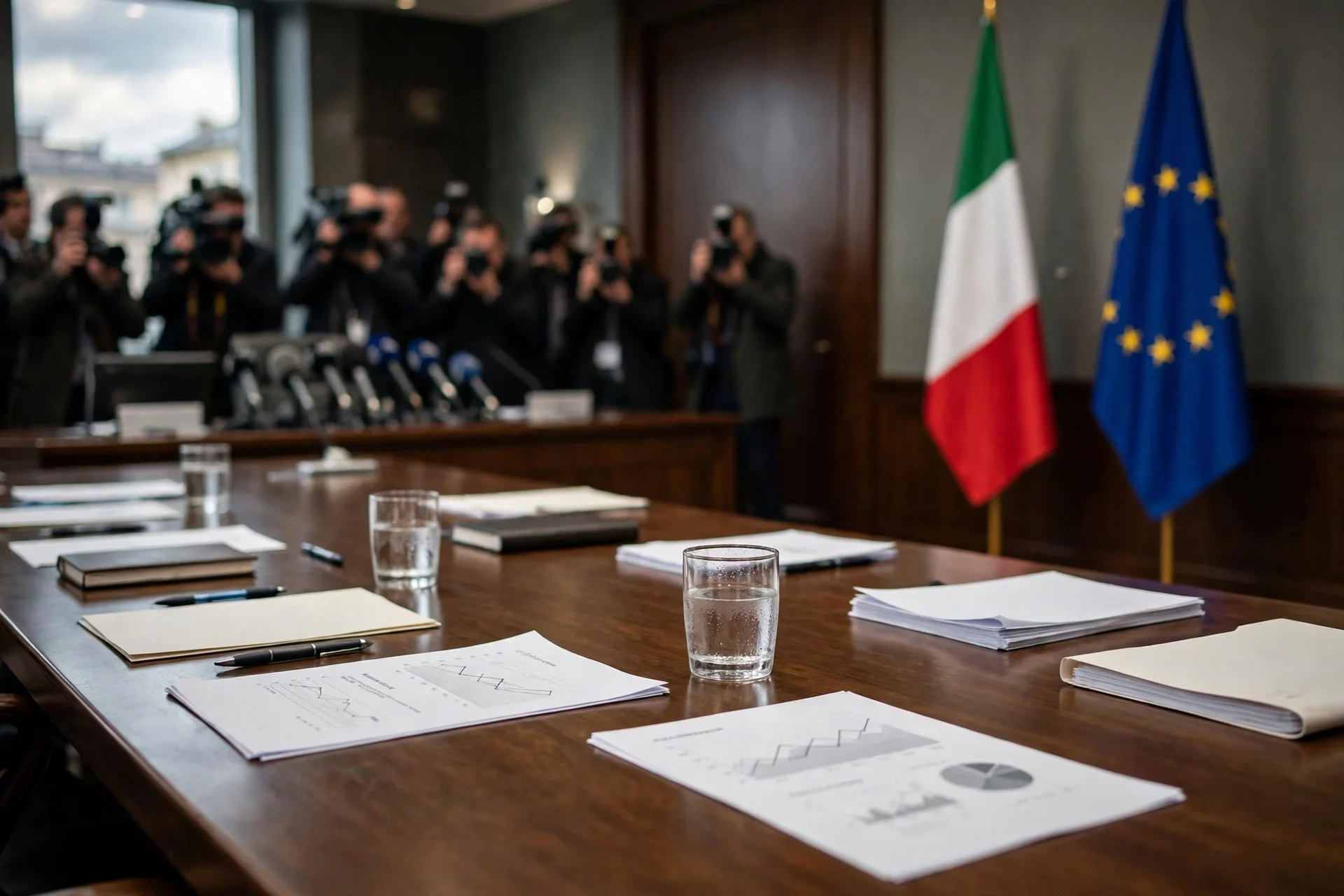
Rueda de prensa tras un Consejo Europeo, en alusión a las negociaciones sobre energía, migración y presupuesto. · Imagen ilustrativa generada para EPM
Meloni puts energy prices and migration at the European Council
After the October European Council, Meloni highlighted the ETS and ETS2 references, the closing of the bills decree to lower electricity costs, a migration…
Meloni defends borders, cohesion and sanctions at the Council
Meloni presented the October European Council with progress on energy and the bills decree, a defense of borders and of Cohesion and agriculture funds, an open…
--- The context ---
The October European Council was intense, with several items on the agenda, and Italian Prime Minister Giorgia Meloni focused her assessment on the issues of greatest importance for her country. Competitiveness and, in particular, energy prices stood at the center of her remarks, alongside migration, the multiannual European budget and support for Ukraine.
--- The facts ---
Meloni said she was pleased that the Council conclusions include several issues raised by Italy in previous weeks, also in a document drafted together with Czechia on the emissions trading system. According to her account, the text includes the reference to the Reserve Stability Market, the reference to ETS2 and the need to assess timing and safeguards, and the reference to an urgent review of the ETS. In parallel, Italy closed with the European Commission the negotiation of the so-called bills decree, which makes it possible to intervene in how the electricity price is generated and in the impact of gas costs in order to lower bills.
On migration, the Council opened a debate that will conclude at the next meeting, and the Commission announced new measures and an assessment with member states to create an emergency framework allowing immediate responses in a crisis, citing what happened in Ceuta at the start of August. On the multiannual budget, Italy for now defended the Cohesion funds and those of the Common Agricultural Policy, although the debate remains open and long. On Ukraine, with President Zelensky present, leaders discussed how to keep supporting the attacked nation.
--- The positions ---
Meloni said she spoke with President von der Leyen about Italian requests for greater flexibility within the current rules, including for energy investment, and expressed optimism after seeing significant progress. On migration, she said she spoke with Prime Minister Sanchez and that they agreed their interior ministers will work next week to replace the reciprocal measures currently in place with other forms of cooperation, while maintaining monitoring of how Schengen works and the defense of borders. At home, she recalled that close to 5 billion has been invested since her government began in the Ilva case, between direct funds and Invitalia, and she condemned violence at student protests, with 17-18 officers injured according to her account.
--- What remains unknown ---
It remains to be seen how the references on the ETS become effective decisions, what scope the migration emergency framework will have once the Commission defines it with member states, and whether the defense of Cohesion and agriculture withstands a budget debate that Meloni herself described as still long. The content of the new forms of migration cooperation that interior ministers must design next week was not detailed either.
--- Unanswered questions ---
Will the references to the ETS and ETS2 translate into concrete changes on timing and safeguards? Will electricity bills fall noticeably after the agreement on the bills decree? What immediate responses will the migration emergency framework actually allow when a crisis like the one in Ceuta occurs?
--- EPM analysis ---
Meloni's assessment combines closed results, such as the bills decree negotiation after talks she described as long but constructive, with processes that are only beginning, such as the migration debate that will conclude at the next Council. On energy, Italy argues that certain rigidities in the use of some instruments worsen the situation and that rules producing distortions must be corrected, a position that, according to the prime minister, other countries also share.
📌 EPM Take: In EPM's view, the Council leaves Italy with real progress on energy and with the migration and budget agendas still to be defined in the coming weeks of European negotiation ahead. The bills agreement can ease pressure on households and businesses if its implementation truly reduces the weight of gas in the electricity price. The test will come with concrete decisions on emissions, migration emergencies and funds, where every promise should be measured by its practical effect and not by its mention in general conclusions. The speed with which those decisions reach the territories and sectors now bearing the highest energy costs in Europe will also matter for judging whether this Council changed anything real.
--- The context ---
Italian Prime Minister Giorgia Meloni described the October European Council as intense and presented its results by putting national interests first: lowering energy prices, protecting borders, preserving Cohesion and agriculture funds, and maintaining firmness toward Russia with continued support for Ukraine, the attacked nation.
--- The facts ---
On energy, the conclusions included issues raised by Italy, also together with Czechia, on the emissions trading system: the reference to the Reserve Stability Market, the reference to ETS2 and the need to assess timing and safeguards, and the reference to an urgent review of the ETS. In parallel, Italy closed with the European Commission the negotiation of the so-called bills decree, which makes it possible to intervene in how the electricity price is generated and in the impact of gas costs on that price, with the stated aim of lowering bills in the current context.
On migration, the Council opened a debate that will conclude at the next meeting and the Commission announced new measures and an emergency framework so that states can give immediate responses in crises such as the one seen in Ceuta at the start of August. Meloni explained that she spoke with Prime Minister Sanchez and that they agreed their interior ministers will work next week to replace the reciprocal measures currently in place with other forms of cooperation, without giving up monitoring of Schengen or the defense of borders. On Ukraine, with President Zelensky present, there was a broad and complex debate on frozen assets.
--- The positions ---
Meloni argued that at this Council it was essential to have very clear language on sanctions against Russia, which she described as one of the best deterrence instruments, with no steps backward. She also said she spoke with President von der Leyen and sees room for greater flexibility within the current rules, including for energy investment. On the domestic front, she recalled the close to 5 billion invested since her government began in the Ilva case, between direct funds and Invitalia, and asked all political forces to condemn violence at student protests, with 17-18 officers injured according to her count.
--- What remains unknown ---
What remains unknown includes how the emissions references will be applied, what concrete instruments the migration emergency framework will contain, and how far the defense of Cohesion funds and the Common Agricultural Policy will go in a budget debate that remains open. The legal and practical detail of the frozen assets debate, which the prime minister herself called extremely complex, is also still missing.
--- Unanswered questions ---
Will Europe keep clear language with no retreat on sanctions against Russia? Will Italy manage to preserve Cohesion and agriculture funds intact at the close of the multiannual budget? Will states be able to respond immediately to a new migration crisis like the one in Ceuta at the start of August?
--- EPM analysis ---
The Italian position, according to its prime minister, does not stand alone on energy: other countries share the view that a certain rigidity in some instruments worsens the situation and that rules generating distortions must be corrected, because they have raised energy costs for companies and pushed part of Europe's deindustrialization. Meloni said she explained that evolution to her colleagues with graphic aids during the negotiation.
📌 EPM Take: In EPM's view, firmness on borders and sanctions coexists in this assessment with patient negotiation on energy and the budget that must still demonstrate measurable results for families and businesses in the coming months ahead. Replacing reciprocal measures with cooperation with Spain without weakening border defense will be a demanding test of balance. If the emissions references remain only on paper, energy costs will keep punishing the industry that Europe says it wants to protect against competitors operating under different environmental standards elsewhere. The Italian government has linked those costs to the continent's deindustrialization, and that warning will deserve close follow-up when the technical details and implementation calendars of each measure are negotiated in the coming months.
Meloni lleva la energía y la migración al Consejo Europeo
Tras el Consejo Europeo de octubre, Meloni destacó las referencias sobre ETS y ETS2, el cierre del decreto de las facturas para bajar la luz, un marco…
Meloni defiende fronteras, cohesión y sanciones en el Consejo
Meloni presentó el Consejo Europeo de octubre con avances en energía y el decreto de las facturas, defensa de fronteras y de los fondos de Cohesión y…
--- El contexto ---
El Consejo Europeo de octubre fue intenso, con varios puntos en el orden del día, y la primera ministra italiana, Giorgia Meloni, concentró su balance en las cuestiones de mayor importancia para su país. La competitividad y, en particular, los precios de la energía ocuparon el centro de su intervención, junto con la migración, el presupuesto plurianual europeo y el apoyo a Ucrania.
--- Los hechos ---
Meloni se declaró contenta de que las conclusiones del Consejo incorporen varias cuestiones planteadas por Italia en las semanas previas, también en un documento elaborado junto con Chequia sobre el sistema de comercio de emisiones. Según explicó, entraron la referencia a la Reserve Stability Market, la referencia a los ETS2 con la necesidad de evaluar tiempos y salvaguardas, y la referencia a la revisión urgente del ETS. En paralelo, Italia cerró con la Comisión Europea la negociación del llamado decreto bollette, que permite intervenir en la generación del precio de la electricidad y en el impacto del coste del gas para bajar las facturas.
En migración, el Consejo abrió un debate que concluirá en la próxima cita, y la Comisión anunció nuevas medidas y una evaluación con los Estados miembros para crear un marco de emergencia que permita respuestas inmediatas ante crisis, con el ejemplo de lo ocurrido en Ceuta a inicios de agosto. Sobre el presupuesto plurianual, Italia defendió por ahora los fondos de Cohesión y los de la Política Agrícola Común, aunque el debate sigue abierto y será largo. En Ucrania, con la presencia del presidente Zelensky, se debatió cómo seguir apoyando a la nación agredida.
--- Las posiciones ---
Meloni afirmó que habló con la presidenta von der Leyen sobre las peticiones italianas de mayor flexibilidad dentro de las reglas actuales, también para las inversiones en energía, y se mostró optimista al ver progresos significativos. Sobre migración, contó que habló con el presidente Sánchez y que acordaron que los ministros del Interior de ambos países trabajen la próxima semana para sustituir las medidas recíprocas vigentes por otras formas de cooperación, manteniendo el monitoreo del funcionamiento de Schengen y la defensa de las fronteras. En el plano interno, recordó que desde el inicio de su Gobierno se invirtieron cerca de 5 mil millones entre fondos directos e Invitalia en el caso Ilva y condenó la violencia en las protestas estudiantiles, con 17-18 agentes heridos según su balance.
--- Lo que falta saber ---
Queda por ver cómo se concretan las referencias sobre los ETS en decisiones efectivas, qué alcance tendrá el marco migratorio de emergencia que la Comisión debe definir con los Estados y si la defensa de la Cohesión y de la agricultura resiste un debate presupuestario que la propia Meloni describió como todavía largo. Tampoco se detalló el contenido de las nuevas formas de cooperación migratoria que deben diseñar los ministros del Interior la próxima semana.
--- Preguntas sin respuesta ---
¿Se traducirán las referencias al ETS y a los ETS2 en cambios concretos sobre tiempos y salvaguardas? ¿Bajará de forma perceptible la factura de la luz tras el acuerdo sobre el decreto de las facturas? ¿Qué respuestas inmediatas permitirá exactamente el marco de emergencia migratorio cuando se produzca una crisis como la de Ceuta?
--- Análisis EPM ---
El balance de Meloni combina resultados cerrados, como la negociación del decreto de las facturas tras una negociación que calificó de larga pero constructiva, con procesos apenas abiertos, como el debate migratorio que concluirá en el próximo Consejo. En energía, Italia defiende que cierta rigidez en el uso de algunos instrumentos empeoran la situación y que las reglas que producen distorsiones deben corregirse, una posición que, según la primera ministra, comparten otros países.
📌 Conclusion EPM: A juicio de EPM, el Consejo deja a Italia con avances reales en energía y con la agenda migratoria y presupuestaria todavía por definir en las próximas semanas de negociación europea. El acuerdo sobre las facturas puede aliviar a hogares y empresas si su aplicación reduce de verdad el peso del gas en el precio eléctrico. La prueba llegará con las decisiones concretas sobre emisiones, emergencias migratorias y fondos, donde cada promesa deberá medirse por su efecto práctico y no por su mención en unas conclusiones generales del Consejo. También contará la rapidez con que esas decisiones lleguen a los territorios y a los sectores que hoy soportan los costes más altos de la energía en Europa.
--- El contexto ---
La primera ministra italiana, Giorgia Meloni, calificó de intenso el Consejo Europeo de octubre y presentó sus resultados poniendo por delante la defensa de los intereses nacionales: bajar los precios de la energía, proteger las fronteras, preservar los fondos de Cohesión y de la agricultura, y mantener la firmeza frente a Rusia con apoyo continuado a Ucrania, la nación agredida.
--- Los hechos ---
En energía, las conclusiones incorporaron cuestiones planteadas por Italia, también junto con Chequia, sobre el sistema de comercio de emisiones: la referencia a la Reserve Stability Market, la referencia a los ETS2 con la necesidad de evaluar tiempos y salvaguardas, y la referencia a la revisión urgente del ETS. En paralelo, Italia cerró con la Comisión Europea la negociación del llamado decreto bollette, que permite intervenir en la generación del precio de la electricidad y en el impacto del coste del gas sobre ese precio, con el objetivo declarado de bajar las facturas en el contexto actual.
En migración, el Consejo abrió un debate que concluirá en la próxima cita y la Comisión anunció nuevas medidas y un marco de emergencia para que los Estados puedan dar respuestas inmediatas ante crisis como la vivida en Ceuta a inicios de agosto. Meloni explicó que habló con el presidente Sánchez y que ambos acordaron que sus ministros del Interior trabajen la próxima semana para sustituir las medidas recíprocas vigentes por otras formas de cooperación, sin renunciar al monitoreo de Schengen ni a la defensa de las fronteras. Sobre Ucrania, con el presidente Zelensky presente, hubo un debate amplio y complejo sobre los bienes congelados.
--- Las posiciones ---
Meloni sostuvo que en este Consejo era fundamental un lenguaje muy claro sobre las sanciones a Rusia, a las que describió como uno de los mejores instrumentos de disuasión, sin pasos atrás. También afirmó que habló con la presidenta von der Leyen y que ve margen para mayor flexibilidad dentro de las reglas actuales, también para las inversiones en energía. En el frente interno, recordó los cerca de 5 mil millones invertidos desde el inicio de su Gobierno en el caso Ilva, entre fondos directos e Invitalia, y pidió a todas las fuerzas políticas condenar la violencia en las protestas estudiantiles, con 17-18 agentes heridos según su recuento.
--- Lo que falta saber ---
Falta saber cómo se aplicarán las referencias sobre emisiones, qué instrumentos concretos incluirá el marco migratorio de emergencia y hasta dónde llegará la defensa de los fondos de Cohesión y de la Política Agrícola Común en un debate presupuestario que sigue abierto. También falta el detalle jurídico y práctico del debate sobre los bienes congelados, que la propia primera ministra calificó de extremadamente complejo.
--- Preguntas sin respuesta ---
¿Mantendrá Europa un lenguaje claro y sin retrocesos sobre las sanciones a Rusia? ¿Conseguirá Italia preservar intactos los fondos de Cohesión y de la agricultura al cierre del presupuesto plurianual? ¿Podrán los Estados responder de inmediato ante una nueva crisis migratoria como la de Ceuta a inicios de agosto?
--- Análisis EPM ---
La posición italiana, según su primera ministra, no está sola en energía: otros países comparten que cierta rigidez en algunos instrumentos empeora la situación y que las reglas que generan distorsiones deben corregirse, porque han encarecido la energía de las empresas y empujado parte de la desindustrialización europea. Meloni dijo haber explicado esa evolución a sus colegas con apoyos gráficos durante la negociación.
📌 Conclusion EPM: A juicio de EPM, la firmeza en fronteras y sanciones convive en este balance con una negociación paciente en energía y presupuesto que todavía debe demostrar resultados medibles para familias y empresas en los próximos meses. Sustituir medidas recíprocas por cooperación con España sin debilitar la defensa fronteriza será una prueba exigente de equilibrio. Si las referencias sobre emisiones se quedan en papel, el coste energético seguirá castigando a la industria que Europa dice querer proteger frente a competidores con otros estándares. El Gobierno italiano ha vinculado ese coste con la desindustrialización del continente, y esa advertencia merecerá seguimiento cuando se negocien los detalles técnicos y los calendarios de aplicación de cada medida durante los próximos meses.