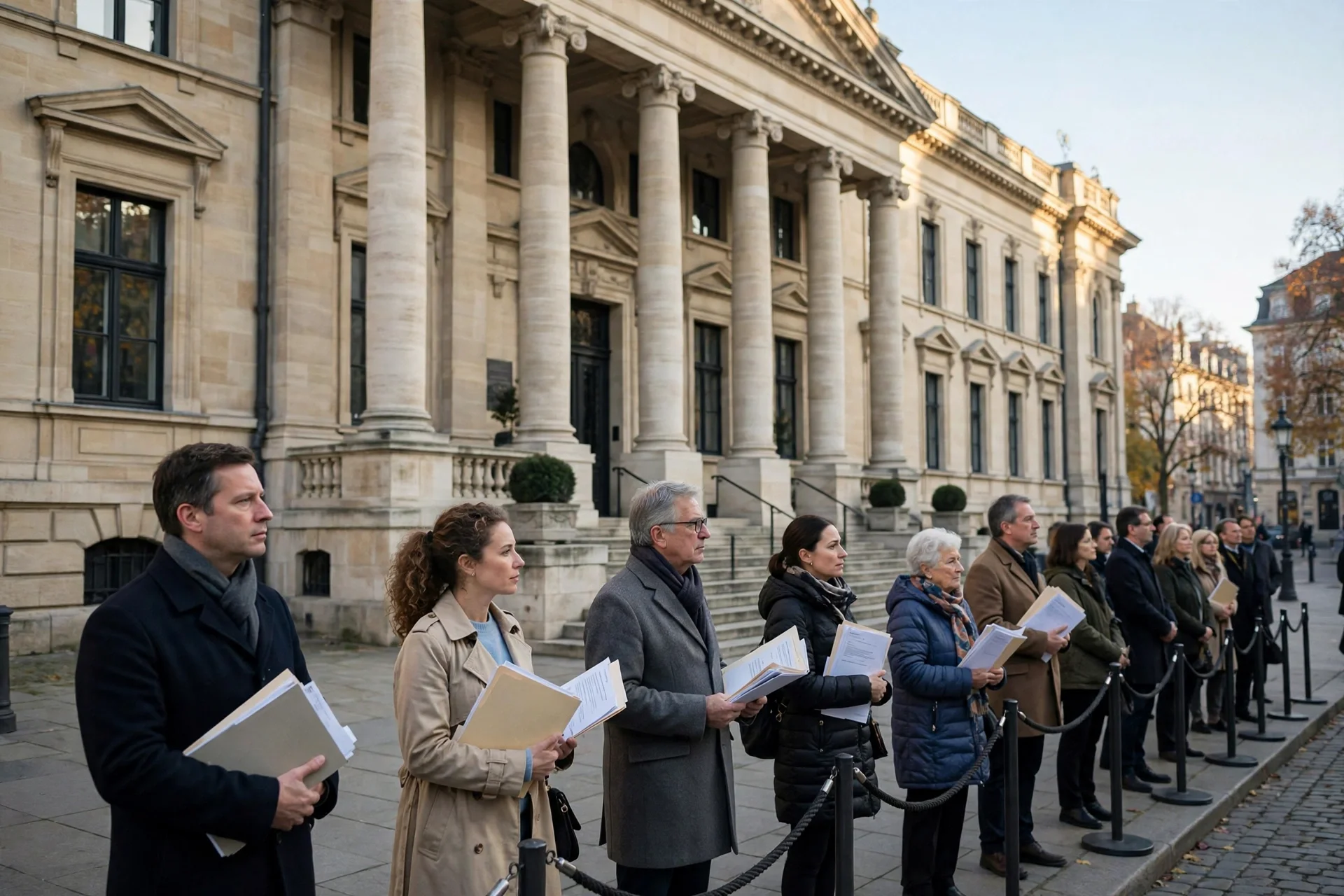
Ciudadanos con documentación en mano ante un edificio institucional, a la espera de una decisión que afecta su voto. · Imagen generada EPM
Court to decide if 163.020 affected voters can vote on November 29
The Constitutional Court must decide on admission of the Ombudsman appeal for protection and on the extremely urgent measures sought so that the 163.020 people…
Overseas vote on hold pending Constitutional Court decision
The Constitutional Court is processing the Ombudsman appeal against the suspension affecting 163.020 voters linked to the grandchildren law, while the Central…
--- The context ---
The Constitutional Court faces a race against the electoral calendar to decide whether the 163.020 Spaniards affected by the suspension of voting linked to the grandchildren law will be able to take part in the general election on November 29. What the court resolves, and above all when it resolves it, will determine whether those people can vote in this election or are left out of a specific contest even if their right is recognised later.
The dispute concerns the requirements for access to the electoral roll and whether maintaining the precautionary measure adopted in the prior judicial proceedings violates fundamental rights.
--- The facts ---
The Ombudsman, Ángel Gabilondo, filed an appeal for constitutional protection on Friday against the Supreme Court rulings that keep the precautionary measure in place and asked the court of guarantees to suspend its effects immediately. The appeal has been assigned to the fourth section of the Constitutional Court, whose rapporteur is Judge Enrique Arnaldo. The court has begun processing the claim, but it must rule on its admission and on the request for extremely urgent precautionary measures, and admitting the appeal does not by itself mean that those affected recover the right to vote.
The urgency comes from the overseas vote timetable. The Electoral Census Office plans to send the first documentation to those registered in the Census of Resident Absent Voters between October 24 and October 30. The second dispatch of ballot papers will take place between November 4 and November 14, depending on whether there are challenges to candidacies. Voters may send their vote to consulates until November 24 and cast it at the ballot box between November 21 and November 26.
--- The positions ---
The Ombudsman argues in his challenge that the Supreme Court orders keeping the suspension in place may violate the right to participate in public affairs through suffrage recognised in Article 23.1 of the Constitution, the principle of equality before the law set out in Article 14, and the right to effective judicial protection in Article 24. From that position, keeping the suspension until a judgment is delivered could deprive those affected of voting in a specific election, a harm that a later ruling could no longer repair.
By contrast, the Central Electoral Board has warned that it does not have the time or the means to identify the 163.020 affected people individually and review all their files before the election. A favourable ruling from the Constitutional Court could open the door to provisionally restoring the vote, but its execution would also depend on the scope of the decision and on the instructions received by the electoral administration.
--- What remains unknown ---
It is still not known whether the court will admit the appeal, whether it will grant the extremely urgent precautionary measures requested, or on what conditions those affected could provisionally recover the vote if the decision were favourable.
--- Unanswered questions ---
Decisive questions remain open for those affected and for the organisation of the election. Will the Constitutional Court admit the appeal and immediately suspend the effects of the suspension? Will the electoral administration be able to apply an eventual favourable decision in time for the 163.020 affected voters? What will happen to their vote if the court grants protection after November 29?
--- EPM analysis ---
The legal core requires more than alleging a violation. To admit an appeal for constitutional protection, the claim must meet the procedural requirements and justify special constitutional significance, that is, a relevance that goes beyond the particular interest of the appellant and merits a ruling to interpret, apply or guarantee the effectiveness of the Constitution.
As for suspension, the Organic Law of the Constitutional Court provides that filing an appeal does not, as a general rule, suspend the effects of the challenged ruling. The court may order total or partial suspension when enforcement could cause harm that would make the appeal lose its purpose, provided the measure does not cause serious disruption to a constitutionally protected interest or to the fundamental rights or freedoms of another person.
📌 EPM Take: In EPM's view, the value of this decision will be measured as much by its reasoning as by its timing, because a right recognised after November 29 does not restore the lost opportunity to vote on that day. Effective protection of suffrage requires an urgent ruling with clear criteria, without turning a provisional measure into a definitive exclusion. At the same time, any provisional restoration must come with precise and workable instructions for the electoral administration, so that equality before the law does not depend on the material capacity to review each file in a few days or on improvised decisions.
--- The context ---
The Constitutional Court faces a race against the electoral calendar to decide whether the 163.020 Spaniards affected by the suspension of voting linked to the grandchildren law will be able to take part in the general election on November 29. The issue is not only whether intervention is appropriate, but also how an eventual favourable decision could be applied without compromising the security of the electoral roll or the organisation of the vote.
The debate sets the protection of the rights invoked against the need for the electoral roll to offer guarantees.
--- The facts ---
The Ombudsman, Ángel Gabilondo, filed an appeal for constitutional protection on Friday against the Supreme Court rulings that keep the precautionary measure in place and asked the court of guarantees to suspend its effects immediately. The appeal has been assigned to the fourth section of the Constitutional Court, whose rapporteur is Judge Enrique Arnaldo. The court has begun processing the claim, but it must rule on admission and on the request for extremely urgent precautionary measures, two distinct questions, because admitting the appeal does not by itself mean that those affected recover the right to vote.
The pressure from the calendar is objective. The Electoral Census Office plans to send the first documentation to those registered in the Census of Resident Absent Voters between October 24 and October 30. The second dispatch of ballot papers will take place between November 4 and November 14, depending on whether there are challenges to candidacies. Voters may send their vote to consulates until November 24 and cast it at the ballot box between November 21 and November 26.
--- The positions ---
The Ombudsman challenges the Supreme Court orders that keep the electoral suspension in place and argues that they may violate the right to participate in public affairs through suffrage recognised in Article 23.1 of the Constitution, the principle of equality before the law set out in Article 14, and the right to effective judicial protection in Article 24. His request is not limited to a judgment declaring the rights violated, but also seeks extremely urgent precautionary measures to prevent the suspension from producing irreversible effects before the election.
The Central Electoral Board, for its part, has warned that it does not have the time or the means to identify the 163.020 affected people individually and review all their files before the election. That warning defines the practical problem: even if the Constitutional Court issued a favourable ruling, its execution would depend on the scope of the decision and on the instructions received by the electoral administration.
--- What remains unknown ---
It is not yet known whether the court will admit the appeal, whether it will find the required special constitutional significance justified, or whether it will accept the urgency to adopt measures without first hearing the parties.
--- Unanswered questions ---
The process leaves questions that affect the certainty of the electoral system. Does the claim meet the procedural requirements and the special constitutional significance needed for admission? Does the urgency justify an immediate suspension without seriously disrupting a constitutionally protected interest? Would the electoral administration have an orderly and verifiable channel to apply the decision before November 29?
--- EPM analysis ---
The different levels should be distinguished. An appeal for constitutional protection allows a claim for the protection of fundamental rights when they are considered to have been violated by a public action or a judicial ruling, provided the legal requirements are met and the corresponding judicial route has first been exhausted.
On suspension, the general rule in the Organic Law of the Constitutional Court is that filing the appeal does not suspend the effects of the challenged ruling. Suspension, total or partial, may only be ordered when enforcement could cause harm that would make the appeal lose its purpose and provided it does not cause serious disruption to a constitutionally protected interest or to the rights or freedoms of another person. If the court admits the appeal but rejects suspension, the Supreme Court orders will continue to produce effects, and if it does not admit it, the suspension will remain in force on its terms.
📌 EPM Take: In EPM's view, institutional prudence requires a swift decision, but not at any price or in any way, because confidence in an election depends as much on protecting suffrage as on preserving a verified roll and equal rules for everyone. The court must rigorously weigh the irreversible harm alleged by the Ombudsman and the disruption that a rushed application could cause to the process. A reasoned decision, with delimited effects and clear instructions for the electoral administration, is the only way for the solution to strengthen legal certainty rather than weaken it.
El Constitucional decide si 163.020 afectados votarán el 29 de noviembre
El Tribunal Constitucional debe decidir sobre la admisión del recurso de amparo del Defensor del Pueblo y sobre las medidas cautelarísimas pedidas para que los…
Voto exterior en suspenso a la espera del Tribunal Constitucional
El Constitucional tramita el recurso de amparo del Defensor del Pueblo contra la suspensión que afecta a 163.020 electores vinculados a la ley de nietos…
--- El contexto ---
El Tribunal Constitucional afronta una decisión contrarreloj sobre el voto de 163.020 españoles afectados por la suspensión vinculada a la ley de nietos. No se trata de un trámite más: lo que resuelva, y sobre todo cuándo lo resuelva, determinará si esas personas podrán participar en las elecciones generales del 29 de noviembre o si quedarán fuera de unos comicios concretos aunque más adelante se les reconozca el derecho.
La controversia gira en torno a los requisitos para acceder al censo electoral y a si el mantenimiento de la medida cautelar adoptada en la vía judicial previa vulnera derechos fundamentales.
--- Los hechos ---
El Defensor del Pueblo, Ángel Gabilondo, presentó el viernes un recurso de amparo contra las resoluciones del Tribunal Supremo que mantienen la medida cautelar y pidió al tribunal de garantías que suspenda sus efectos de forma inmediata. El recurso ha recaído en la sección cuarta del Constitucional, cuyo ponente es el magistrado Enrique Arnaldo. El tribunal ya ha comenzado a tramitar la demanda, pero debe pronunciarse sobre su admisión y sobre la petición de medidas cautelarísimas, y admitir el recurso no implica por sí solo que los afectados recuperen el derecho al sufragio.
La urgencia la marca el voto exterior. La Oficina del Censo Electoral tiene previsto enviar la primera documentación a los inscritos en el Censo Electoral de Residentes Ausentes entre el 24 y el 30 de octubre. El segundo envío de papeletas se realizará entre el 4 y el 14 de noviembre, dependiendo de si existen impugnaciones de candidaturas. Los electores podrán remitir su voto a los consulados hasta el 24 de noviembre y depositarlo en urna entre el 21 y el 26 de ese mes.
--- Las posiciones ---
El Defensor del Pueblo sostiene en su impugnación que los autos del Supremo que mantienen la suspensión pueden vulnerar el derecho a participar en los asuntos públicos mediante el sufragio reconocido en el artículo 23.1 de la Constitución, el principio de igualdad ante la ley recogido en el artículo 14 y el derecho a la tutela judicial efectiva del artículo 24. Desde esa posición, mantener la suspensión hasta que haya sentencia podría privar a los afectados de ejercer el voto en unas elecciones concretas, un perjuicio que una resolución posterior ya no podría reparar.
Frente a ello, la Junta Electoral Central ha advertido de que no dispone de tiempo ni medios para identificar individualmente a los 163.020 afectados y revisar todos sus expedientes antes de los comicios. Una resolución favorable del Constitucional podría abrir la puerta a restituir provisionalmente el voto, pero su ejecución dependería también del alcance de la decisión y de las instrucciones que recibiese la Administración electoral.
--- Lo que falta saber ---
Todavía no se sabe si el tribunal admitirá el recurso, ni si acordará las medidas cautelarísimas solicitadas, ni en qué condiciones podrían recuperar provisionalmente el voto los afectados si la decisión fuera favorable.
--- Preguntas sin respuesta ---
Quedan abiertas cuestiones decisivas para los afectados y para la organización de los comicios. ¿Admitirá el Constitucional el recurso y acordará suspender de inmediato los efectos de la suspensión? ¿Podrá la Administración electoral aplicar a tiempo una eventual decisión favorable para los 163.020 afectados? ¿Qué ocurrirá con su voto si el tribunal concede el amparo después del 29 de noviembre?
--- Análisis EPM ---
El núcleo jurídico exige más que alegar una vulneración. Para admitir un recurso de amparo la demanda debe cumplir los requisitos procesales y justificar una especial trascendencia constitucional, es decir, una relevancia que vaya más allá del interés particular del recurrente y merezca un pronunciamiento para interpretar, aplicar o garantizar la eficacia de la Constitución.
En cuanto a la suspensión, la Ley Orgánica del Tribunal Constitucional establece que presentar un amparo no suspende como regla general los efectos de la resolución impugnada. El tribunal puede acordar la suspensión total o parcial cuando la ejecución pueda ocasionar un perjuicio que haga perder al recurso su finalidad, siempre que la medida no provoque una perturbación grave de un interés constitucionalmente protegido ni de los derechos fundamentales o libertades de otra persona.
📌 Conclusion EPM: A juicio de EPM, el valor de esta decisión se medirá tanto por su fundamento como por su momento, porque un derecho reconocido después del 29 de noviembre no devuelve la oportunidad perdida de votar ese día. La protección efectiva del sufragio exige resolver con urgencia y con criterios claros, sin convertir una medida provisional en una exclusión definitiva. Al mismo tiempo, cualquier restitución provisional debe venir acompañada de instrucciones precisas y ejecutables para la Administración electoral, de modo que la igualdad ante la ley no dependa de la capacidad material de revisar cada expediente en pocos días ni de decisiones improvisadas.
--- El contexto ---
El Tribunal Constitucional tiene por delante una carrera contra el calendario electoral para decidir si los 163.020 españoles afectados por la suspensión del voto vinculada a la ley de nietos podrán participar en las elecciones generales del próximo 29 de noviembre. La cuestión no es solo si procede intervenir, sino también cómo podría aplicarse una eventual decisión favorable sin comprometer la seguridad del censo ni la organización de los comicios.
El debate enfrenta la protección de los derechos invocados con la necesidad de que el censo electoral ofrezca garantías.
--- Los hechos ---
El Defensor del Pueblo, Ángel Gabilondo, presentó el viernes un recurso de amparo contra las resoluciones del Tribunal Supremo que mantienen la medida cautelar y solicitó que el tribunal de garantías suspenda sus efectos de forma inmediata. El recurso ha recaído en la sección cuarta del Constitucional, cuyo ponente es el magistrado Enrique Arnaldo. El tribunal ha comenzado a tramitar la demanda, pero debe pronunciarse sobre su admisión y sobre la petición de medidas cautelarísimas, dos cuestiones distintas, porque admitir el recurso no implica por sí solo que los afectados recuperen el derecho al sufragio.
La presión del calendario es objetiva. La Oficina del Censo Electoral tiene previsto enviar la primera documentación a los inscritos en el Censo Electoral de Residentes Ausentes entre el 24 y el 30 de octubre. El segundo envío de papeletas se realizará entre el 4 y el 14 de noviembre, dependiendo de si existen impugnaciones de candidaturas. Los electores podrán remitir su voto a los consulados hasta el 24 de noviembre y depositarlo en urna entre el 21 y el 26 de ese mes.
--- Las posiciones ---
El Defensor del Pueblo impugna los autos del Supremo que mantienen la suspensión electoral y sostiene que pueden vulnerar el derecho a participar en los asuntos públicos mediante el sufragio reconocido en el artículo 23.1 de la Constitución, el principio de igualdad ante la ley recogido en el artículo 14 y el derecho a la tutela judicial efectiva del artículo 24. Su petición no se limita a una sentencia que declare vulnerados los derechos, sino que reclama medidas cautelarísimas para evitar que la suspensión produzca efectos irreversibles antes de las elecciones.
La Junta Electoral Central, por su parte, ha advertido de que no dispone de tiempo ni medios para identificar individualmente a los 163.020 afectados y revisar todos sus expedientes antes de los comicios. Ese aviso delimita el problema práctico: aunque el Constitucional dictara una resolución favorable, su ejecución dependería del alcance de la decisión y de las instrucciones que recibiese la Administración electoral.
--- Lo que falta saber ---
Aún no se conoce si el tribunal admitirá el recurso, si justificará la especial trascendencia constitucional exigida, ni si estimará la urgencia para adoptar medidas sin oír previamente a las partes.
--- Preguntas sin respuesta ---
El proceso deja interrogantes que afectan a la certeza del conjunto del sistema electoral. ¿Reúne la demanda los requisitos procesales y la especial trascendencia constitucional necesarios para su admisión? ¿Justifica la urgencia una suspensión inmediata sin perturbar gravemente un interés constitucionalmente protegido? ¿Dispondría la Administración electoral de un cauce ordenado y verificable para aplicar la decisión antes del 29 de noviembre?
--- Análisis EPM ---
Conviene distinguir los planos. El recurso de amparo permite reclamar la protección de los derechos fundamentales cuando se considera que han sido vulnerados por una actuación pública o una resolución judicial, siempre que se cumplan los requisitos legales y se haya agotado previamente la vía judicial correspondiente.
Sobre la suspensión, la regla general prevista en la Ley Orgánica del Tribunal Constitucional es que la presentación del amparo no suspende los efectos de la resolución impugnada. Solo cabe acordar la suspensión total o parcial cuando la ejecución pueda ocasionar un perjuicio que haga perder al recurso su finalidad y siempre que no provoque una perturbación grave de un interés constitucionalmente protegido ni de los derechos o libertades de otra persona. Si el tribunal admite pero rechaza la suspensión, los autos del Supremo seguirán produciendo efectos, y si no admite, la suspensión seguirá vigente en sus términos.
📌 Conclusion EPM: A juicio de EPM, la prudencia institucional obliga a decidir rápido, pero no a cualquier precio ni de cualquier manera, porque la confianza en unas elecciones depende tanto de proteger el sufragio como de preservar un censo verificado y unas reglas iguales para todos. El tribunal debe ponderar con rigor el perjuicio irreversible que alega el Defensor del Pueblo y la perturbación que una aplicación precipitada podría causar al proceso. Una decisión motivada, con efectos delimitados y con instrucciones claras para la Administración electoral, es la única vía para que la solución refuerce la seguridad jurídica en lugar de debilitarla.