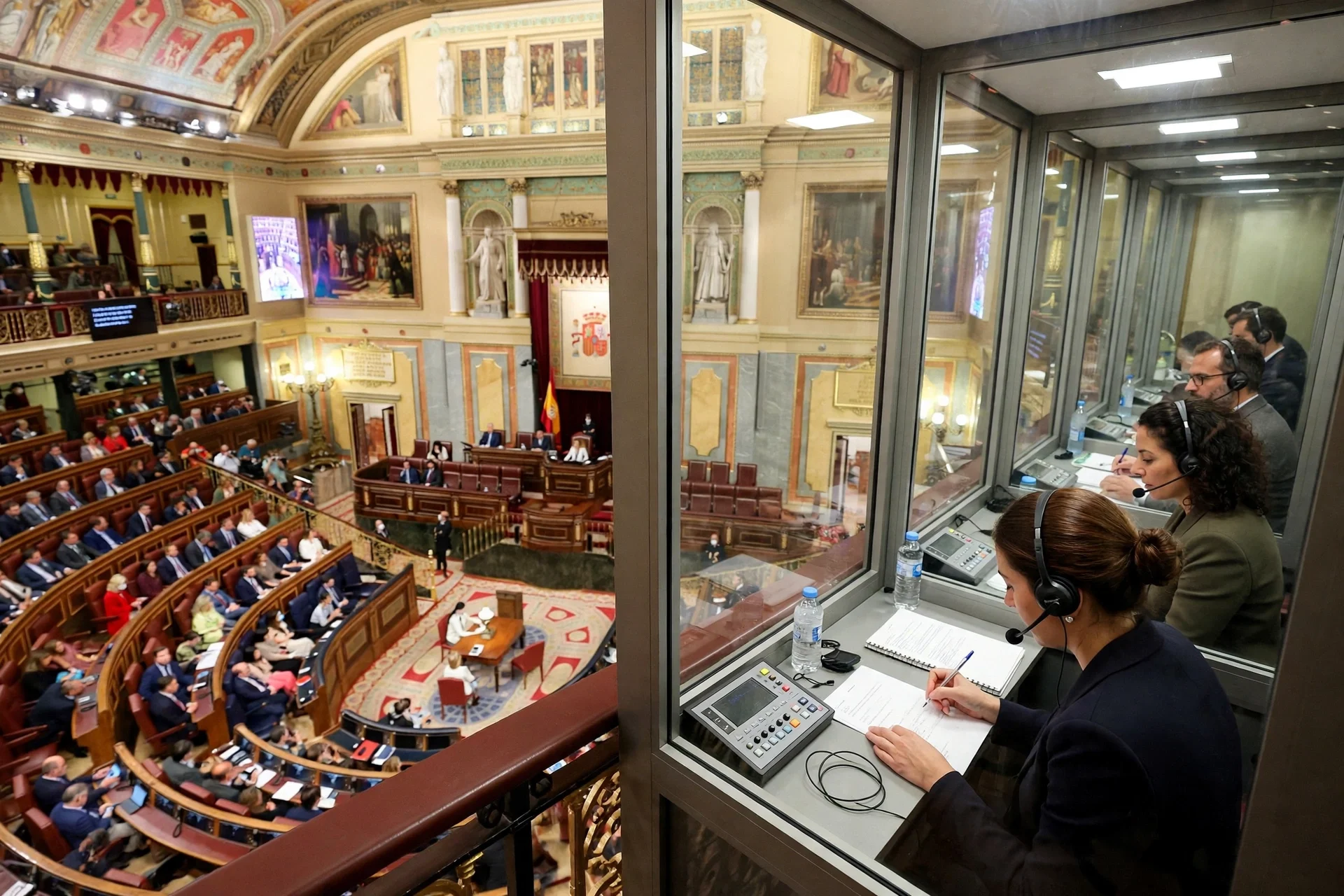
Interior de una cámara parlamentaria durante una sesión con interpretación simultánea. · Imagen generada EPM
New Senate to debate co-official languages and AI translation
The Senate emerging from the 29 November elections will debate whether to extend the co-official languages to all debates, while the institution considers…
Senate weighs co-official languages, service cost and AI option
The new Senate will have to rule on the limited use of the co-official languages, with the PP in favour of keeping it, Vox of cutting it and the left of…
--- The context ---
The Senate that emerges from the general elections on 29 November will inherit an open debate over the place of the co-official languages in the upper house. Their use today is limited to debates on plenary motions, the General Committee of the Autonomous Communities and the submission of certain documents.
That presence began in 2005, when the co-official languages were introduced through the General Committee of the Autonomous Communities. In 2010 they were extended to debates on plenary motions, and the Senate Bureau agreed that the same interpreters would also work in that setting.
--- The facts ---
The institution is considering using artificial intelligence for the automatic translation of the co-official languages and other languages. The Senate has stressed, in statements reported, that this is a political decision, at a time when the chamber is increasing its use of this technology and has become the first Spanish parliament to approve guidelines for its use.
The chamber has also acquired several Gemini Enterprise licences and has several projects under way to expand its use of this tool.
--- The positions ---
The left and pro-independence parties want to extend the co-official languages to all debates. During this legislature they tried on several occasions to amend the Senate rules to extend their use to all debates and texts, but the PP's absolute majority blocked the change.
Vox has proposed on several occasions ending their use, even though it is already limited, so that only Spanish is spoken, a path the PP did not accept either. The PP wants to leave things as they are and opposes extending the languages to all debates, as it made clear when Galician, Basque and Catalan were made universal in Congress.
Senate President Pedro Rollán said in reported statements that he had no plans to expand their use and argued indirectly that Spanish unites everyone. In the previous legislature, the PSOE supported taking up a Junts proposal to make their use universal, but repeatedly extended the amendment period, delaying the process until it was never carried out, and the 2023 early election left that proposal without effect.
--- What remains unknown ---
It is not defined whether automatic translation will apply to the co-official languages, in which debates, or which majority will control the Bureau. The current service depends on a 2024 interpretation and translation contract that could reach 1.6 million euros if the planned extensions are completed, with a base tender budget of 402,325 euros and up to four extensions for the same amount.
--- Unanswered questions ---
Will the new Senate decide to extend the co-official languages to all debates? Will artificial intelligence be used to translate them automatically? Will the interpreting service be kept at its current scope? What will happen to the 16 interpreters who remain from the initial 25?
--- EPM analysis ---
The issue is not only technical. Of the 25 interpreters selected at the start, seven for Catalan and six for each of the other languages, only 16 remain on the list today, a figure showing the strain on a model that has operated for two decades with very limited scope.
📌 EPM Take:
In EPM's view, the new Senate should settle this debate with a clear rule that protects linguistic plurality without keeping it confined to a handful of debates, and automatic translation can be an ally if it is used to widen understanding among senators rather than to cut rights or replace without safeguards the interpreters who currently sustain the service in the upper house, with public quality criteria and human review of every relevant translation.
--- The context ---
The Senate that emerges from the general elections on 29 November will have to rule on the use of the co-official languages, an issue that for years has been handled through a limited balance. Today they may only be used in debates on plenary motions, in the General Committee of the Autonomous Communities and in the submission of certain documents.
In 2005 they were introduced through the General Committee of the Autonomous Communities, and in 2010 they reached debates on plenary motions, where the Bureau agreed that the same interpreters would also work.
--- The facts ---
The institution is assessing using artificial intelligence for the automatic translation of the co-official languages and other languages, although the Senate has stressed, in statements reported, that this is a political decision. The chamber is increasing its use of this technology, has approved guidelines and has acquired several Gemini Enterprise licences, with several projects under way.
The current system is not cheap: the 2024 interpretation and translation contract could reach 1.6 million euros if the planned extensions are completed, on a base tender budget of 402,325 euros and up to four extensions for the same amount.
--- The positions ---
The PP, which holds an absolute majority in this legislature, proposes leaving the use as it currently stands. It has blocked on several occasions the rule changes promoted by pro-independence parties to extend them to all debates and texts, and opposes that extension, as it made clear when Galician, Basque and Catalan were made universal in Congress.
Senate President Pedro Rollán said in reported statements that he had no plans to expand their use, arguing indirectly that Spanish unites everyone. Vox has proposed on several occasions ending their use even though it is limited, but the PP has not agreed either to Spanish being the only language spoken.
In the previous legislature, the PSOE, with several government allies, supported taking up a Junts proposal to make their use universal. However, it repeatedly extended the amendment period, delaying the process until it was never carried out, and the 2023 early election left the proposal without effect.
--- What remains unknown ---
It remains to be seen whether automatic translation would lower the cost of the service or add to it, and in which debates it would apply. The final composition of the chamber is also unknown, as is whether any reform will gather enough support.
--- Unanswered questions ---
Will the new Senate keep the current limited use of the co-official languages? Will automatic translation reduce the cost of the interpreting service? Will any majority back a reform of the rules in one direction or the other? How will posts be covered if the list keeps shrinking?
--- EPM analysis ---
The starting point calls for prudence. Of the 25 interpreters selected at the beginning, seven for Catalan and six for each of the other co-official languages, only 16 remain on the list today. Any expansion of use would multiply demand on an already reduced service backed by a contract worth millions.
📌 EPM Take:
In EPM's view, before expanding obligations it is worth ensuring that the current service works with controlled costs and sufficient coverage, because extending the co-official languages to all debates without resolving the shortage of interpreters or the expense of up to 1.6 million euros would create a right on paper that the chamber could not deliver with the quality and continuity that an institution of this level must always guarantee in every session it holds.
El nuevo Senado debatirá las lenguas cooficiales y la traducción con IA
El Senado que salga de las elecciones del 29 de noviembre debatirá si extiende las lenguas cooficiales a todos los debates, mientras la institución valora usar…
Senado: lenguas cooficiales, coste del servicio y traducción con IA
El nuevo Senado deberá pronunciarse sobre el uso limitado de las lenguas cooficiales, con el PP partidario de mantenerlo, Vox de recortarlo y la izquierda de…
--- El contexto ---
El Senado que salga de las elecciones generales del próximo 29 de noviembre heredará un debate abierto sobre el lugar de las lenguas cooficiales en la Cámara Alta. Hoy su uso está acotado a los debates de las mociones del Pleno, a la Comisión General de las Comunidades Autónomas y a la presentación de algunos escritos.
Esa presencia comenzó en 2005, cuando se incorporaron a través de la Comisión General de las Comunidades Autónomas. En 2010 se extendieron al debate de las mociones del Pleno y la Mesa acordó que los mismos intérpretes actuaran también allí.
--- Los hechos ---
La institución valora utilizar la inteligencia artificial para la traducción automática de las lenguas cooficiales y de otros idiomas. Desde el Senado se precisa, en declaraciones recogidas, que es una decisión política, en un momento en que la Cámara incrementa esta tecnología y es el primer parlamento español en aprobar directrices para su uso.
La Cámara ha adquirido además varias licencias de Gemini Enterprise y mantiene varios proyectos para elevar su apuesta por esta herramienta.
--- Las posiciones ---
La izquierda y las formaciones independentistas apuestan por extender las lenguas cooficiales a todos los debates. Durante esta legislatura intentaron en varias ocasiones modificar el Reglamento para extender su uso a todos los debates y textos, pero la mayoría absoluta del PP lo impidió.
Vox ha propuesto en varias ocasiones acabar con su uso, pese a estar limitado, y que solo se hable castellano, vía que el PP tampoco aceptó. El PP propone dejarlo como está y se opone a extenderlas, como dejó patente cuando se universalizaron el gallego, el euskera y el catalán en el Congreso.
El presidente del Senado, Pedro Rollán, aseguró en declaraciones recogidas que no preveía ampliar su uso y sostuvo en indirecto que el castellano une a todos. En la legislatura anterior, el PSOE apoyó admitir a trámite una propuesta de Junts para universalizarlas, pero amplió varias veces el período de enmiendas y la tramitación se dilató sin llevarse a cabo, y el adelanto electoral de 2023 dejó aquella propuesta sin efecto.
--- Lo que falta saber ---
No está definido si la traducción automática se aplicará a las lenguas cooficiales, en qué debates, ni qué mayoría controlará la Mesa. El servicio depende de un contrato de 2024 para interpretación y traducción que puede alcanzar 1,6 millones de euros si se completan las prórrogas previstas, con base de licitación de 402.325 euros y hasta cuatro prórrogas por el mismo importe.
--- Preguntas sin respuesta ---
¿Decidirá el nuevo Senado extender las lenguas cooficiales a todos los debates? ¿Se usará la inteligencia artificial para traducirlas de forma automática? ¿Se mantendrá el servicio de intérpretes con su alcance actual? ¿Qué pasará con los 16 intérpretes que permanecen de los 25 iniciales?
--- Análisis EPM ---
La cuestión no es solo técnica. De los 25 intérpretes seleccionados al inicio, siete para el catalán y seis para cada una del resto de lenguas, hoy quedan 16 en la lista, un dato que muestra el desgaste de un modelo que lleva dos décadas con un alcance muy limitado.
📌 Conclusion EPM:
A juicio de EPM, el nuevo Senado debería resolver este debate con una regla clara que proteja la pluralidad lingüística sin mantenerla confinada a unos pocos debates, y la traducción automática puede ser una aliada si se usa para ampliar la comprensión entre senadores y no para recortar derechos ni sustituir sin garantías el trabajo de los intérpretes que hoy sostienen el servicio en la Cámara Alta, con criterios públicos de calidad y con revisión humana de cada traducción relevante.
--- El contexto ---
El Senado que surja de las elecciones generales del próximo 29 de noviembre tendrá que pronunciarse sobre el uso de las lenguas cooficiales, un asunto resuelto desde hace años con un equilibrio limitado. Hoy solo pueden usarse en los debates de las mociones del Pleno, en la Comisión General de las Comunidades Autónomas y en la presentación de algunos escritos.
Ese modelo se construyó gradualmente. En 2005 se incorporaron a través de la Comisión General de las Comunidades Autónomas y en 2010 llegaron a los debates de las mociones del Pleno, donde la Mesa acordó que los mismos intérpretes actuaran también allí.
--- Los hechos ---
La institución valora utilizar la inteligencia artificial para la traducción automática de las lenguas cooficiales y de otros idiomas, aunque desde el Senado se precisa, en declaraciones recogidas, que es una decisión política. La Cámara incrementa el uso de esta tecnología, ha aprobado directrices para su empleo y ha adquirido varias licencias de Gemini Enterprise, con varios proyectos en marcha.
El coste actual no es menor: el contrato de interpretación y traducción suscrito en 2024 puede alcanzar 1,6 millones de euros si se completan las prórrogas previstas, sobre una base de licitación de 402.325 euros y hasta cuatro prórrogas por el mismo importe.
--- Las posiciones ---
El PP, con mayoría absoluta en esta legislatura, propone dejar el uso como está actualmente. Ha impedido en varias ocasiones las reformas del Reglamento impulsadas por las formaciones independentistas para extenderlas a todos los debates y textos, y se opone a esa extensión como dejó patente cuando se universalizaron el gallego, el euskera y el catalán en el Congreso.
El presidente del Senado, Pedro Rollán, aseguró en declaraciones recogidas que no preveía ampliar su uso, alegando en indirecto que el castellano une a todos. Vox ha propuesto en varias ocasiones acabar con su uso pese a estar limitado, pero el PP tampoco accedió a que solo se hable castellano.
En la legislatura anterior, el PSOE, con aliados del Gobierno, apoyó admitir a trámite una propuesta de Junts para universalizar su uso. Pero amplió varias veces el período de enmiendas, dilatando la tramitación sin que se llevara a cabo, y el adelanto electoral de 2023 dejó la propuesta sin efecto.
--- Lo que falta saber ---
Falta saber si la traducción automática abarataría el servicio o se sumaría a su coste, y en qué debates se aplicaría. También falta conocer la composición final de la Cámara y si alguna reforma reunirá apoyos suficientes.
--- Preguntas sin respuesta ---
¿Mantendrá el nuevo Senado el uso limitado actual de las lenguas cooficiales? ¿Reducirá la traducción automática el coste del servicio de interpretación? ¿Apostará alguna mayoría por reformar el Reglamento en un sentido o en otro? ¿Cómo se cubrirán las plazas si la lista sigue reduciéndose?
--- Análisis EPM ---
El dato de partida invita a la prudencia. De los 25 intérpretes seleccionados al inicio, siete para el catalán y seis para cada una del resto de lenguas cooficiales, hoy solo permanecen 16 en la lista. Cualquier ampliación multiplicaría la demanda sobre un servicio ya reducido y con un contrato millonario.
📌 Conclusion EPM:
A juicio de EPM, antes de ampliar obligaciones conviene garantizar que el servicio actual funciona con costes controlados y cobertura suficiente, porque extender las lenguas cooficiales a todos los debates sin resolver la falta de intérpretes ni el gasto de hasta 1,6 millones de euros sería crear un derecho en el papel que la Cámara no podría atender con la calidad y la continuidad que una institución de este nivel exige siempre.