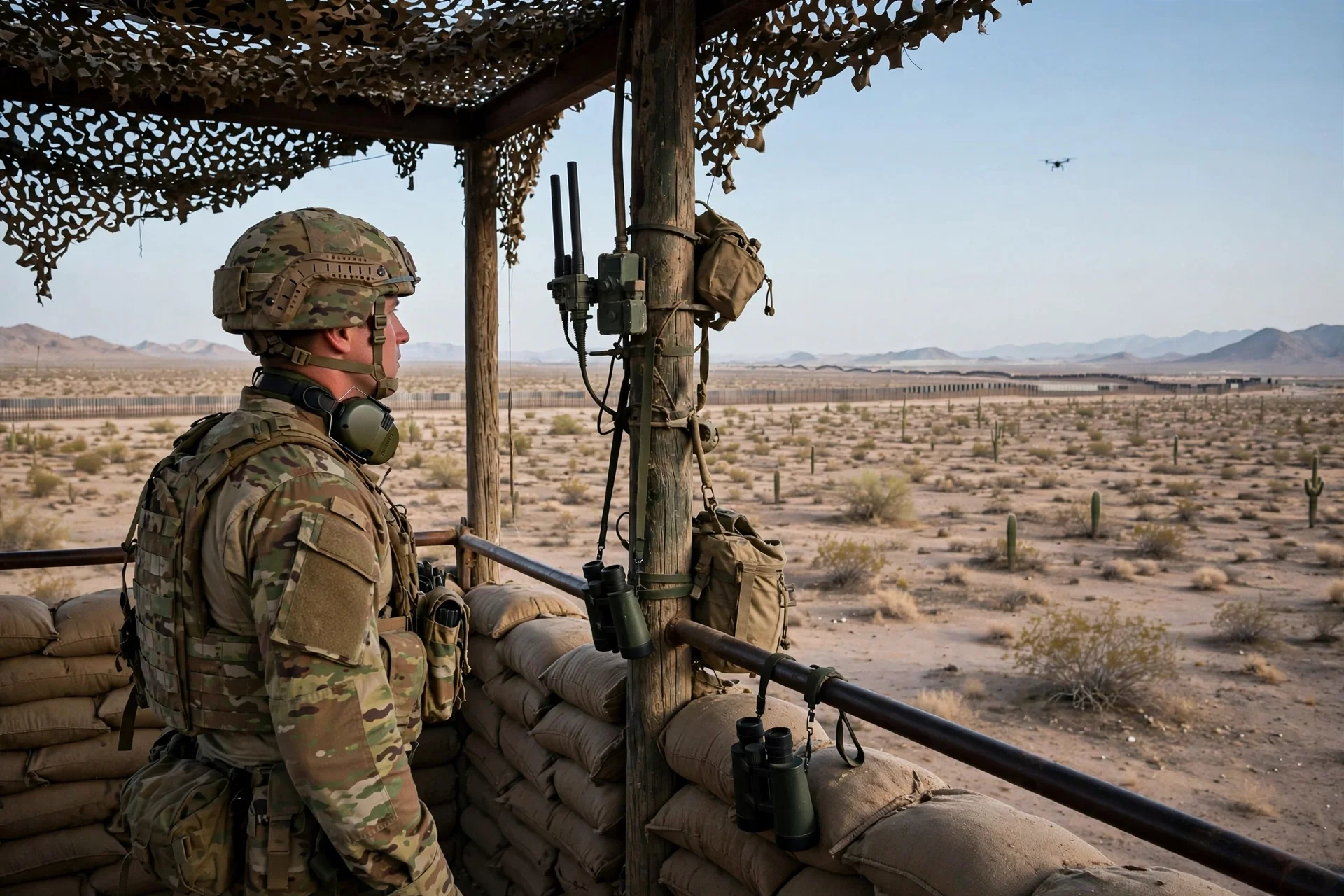
Puesto de vigilancia en la frontera sur de Estados Unidos, donde las autoridades restringieron los vuelos no autorizados de drones y mantienen la alerta por incursiones. · EPM
United States restricts drone flights along the Mexico border
The United States restricted unauthorized drone flights along the border with Mexico from October 16, from the surface up to 400 feet.
Washington closes border airspace amid repeated drone incursions
The Federal Aviation Administration banned unauthorized drone flights along the border with Mexico from October 16, from the surface to 400 feet.
--- The context ---
Since Friday, October 16, the United States has restricted unauthorized drone flights in a strip of airspace along its border with Mexico. The measure was adopted by the Federal Aviation Administration and announced in coordination with the Departments of Transportation, War and Homeland Security. It prohibits unauthorized operations from the surface up to 400 feet in altitude, across a strip extending one nautical mile north of the border line, in the middle of official concern over the use of these aircraft in drug trafficking and surveillance activities.
The decision does not come out of nowhere. It arrives while the Pentagon remains on alert over incursions by unmanned aircraft along the southern border. United States authorities have warned that drones are used to watch routes, observe the movements of border agents and move small packages of drugs, three uses that explain the pressure to control a low-altitude airspace that is increasingly contested.
--- The facts ---
The central numerical reference comes from March 2024, when the then head of United States Northern Command, General Gregory Guillot, estimated before lawmakers that incursions along the southern border probably exceeded a thousand a month. In that same appearance he acknowledged that he did not know the exact figure and that the estimate came from conversations with officials from Customs and Border Protection and the Department of Justice.
The most recent figure is of a different nature. On October 5, 2026, Brigadier General Brian Filler reported that United States forces had detected 378 incursions during the previous 30 days. It is a count of detections, not of distinct aircraft: the same drone can be detected more than once, as the Army itself has explained when describing the operational challenge at the border.
The operational response combines surveillance, detection and interception. The Army has tested radars, interceptor drones, autonomous armed systems and directed-energy technology. In September, according to journalistic reports, United States forces used a high-energy laser system to bring down drones at the border, and military officials said activity in the Rio Grande Valley fell by approximately 75% after the first interventions, carried out on August 25 and 26. During August, approximately 100 drones that authorities considered linked to cartels were shot down, according to a senior Department of War official.
The use of these weapons has also raised air safety concerns. In February, the Federal Aviation Administration temporarily suspended flights at the airport in El Paso, Texas, after Customs and Border Protection used the laser system before the corresponding aeronautical safety review had been completed. The restriction was lifted hours later, following intervention by the White House.
--- The positions ---
For Washington, the restriction is meant to give its authorities more room to identify and intervene against aircraft that represent a risk. The measure does not establish that all detected drones are operated by criminal organizations, and official information itself underlines the distinction: not every detected incursion belongs to a cartel or implies a crime.
On the Mexican side, the documented evidence shows a real expansion of the criminal use of these aircraft. Journalistic investigations have documented that criminal organizations use them to move synthetic drugs, watch routes and the movements of security forces, support irregular migrant crossings and carry out armed attacks, as well as adapting commercial aircraft to carry explosives. As of August 21, 2026, a specialized organization had recorded drone attack incidents in 17 Mexican states, with Michoacán, Guerrero and Sinaloa as the states with the most cases.
--- What remains unknown ---
There is no single updated public figure for confirmed incursions, nor a verified attribution aircraft by aircraft. It is also unknown what proportion of the recent 378 detections corresponded to authorized flights, navigation errors or criminal activity. In Sinaloa, seizures in October located components to assemble aircraft, rolls of fiber optics and batteries, but the Secretary of Defense, Ricardo Trevilla Trejo, clarified that the pieces were not complete drones and had no mechanisms to launch explosives, a nuance that separates the finding from any early conclusion.
--- Unanswered questions ---
Several questions remain unanswered by the authorities with complete data. How many of the incursions detected in the last 30 days were attributed with evidence to criminal organizations? What criteria separate an accidental incursion from a drug trafficking surveillance operation? How long will the temporary flight restriction along the border stay in force? What safeguards will prevent the use of laser systems from interfering again with civil aviation, as happened in El Paso? Without those answers, the exact dimension of the phenomenon will keep depending on partial estimates.
--- EPM analysis ---
Public discussion runs the risk of merging three different levels into a single figure. An estimate made in 2024 without an exact count, a recent detection of 378 incursions in 30 days and a verified criminal attribution are not equivalent, and treating them as interchangeable inflates or reduces the phenomenon depending on the narrative. The documented takedowns, around 100 in August, and the approximate 75% fall in activity in the Rio Grande Valley after the laser interventions indicate operational capacity, but they do not turn every detection into a drug trafficking flight.
The technological front is advancing in parallel. In a military exercise held in Arizona in September, defense companies presented radars, interceptor drones and automated systems designed to identify and neutralize small aircraft capable of flying at low altitude. The underlying issue is how precisely the threat can be measured and contained without eroding the safety of a shared airspace.
📌 EPM Take: In EPM's view, the restriction organizes the border sky, but its legitimacy will depend on how precisely Washington distinguishes between estimation, detection and criminal attribution. Closing an air strip is an administrative measure; turning every detected incursion into proof of a crime would be a mistake with costs for civil aviation, for lawful uses and for the bilateral relationship. The available evidence shows a real and documented risk, although still measured with partial figures from different moments. An effective response requires technology, yes, but also verifiable public data, air safety protocols without exceptions and effective coordination with Mexico.
--- The context ---
The United States has effectively closed the low sky along its border with Mexico. Since Friday, October 16, a restriction has been in force prohibiting unauthorized drone flights from the surface up to 400 feet in altitude, in a strip extending one nautical mile north of the border line. The measure, adopted by the Federal Aviation Administration in coordination with the Departments of Transportation, War and Homeland Security, responds to years of unmanned aircraft incursions that authorities have watched with growing concern and can no longer treat as isolated episodes.
The background is well established. United States authorities have repeatedly warned that drones are used to watch routes, observe the movements of border agents and move small packages of drugs. Faced with an instrument that is cheap, hard to track and already integrated into criminal logistics, Washington chose to reserve full control of that air strip for authorized operations only.
--- The facts ---
The Pentagon itself set out the estimated scale of the phenomenon. In March 2024, the then head of United States Northern Command, General Gregory Guillot, estimated before lawmakers that incursions along the southern border probably exceeded a thousand a month. The general acknowledged that he did not know the exact figure and that the estimate came from conversations with officials from Customs and Border Protection and the Department of Justice.
The pressure has not eased. On October 5, 2026, Brigadier General Brian Filler reported that United States forces had detected 378 incursions during the previous 30 days. The figure counts detections, and the same aircraft can be detected more than once, as the Army itself has explained, but even with that nuance the record confirms constant activity over the border.
The response is already kinetic as well. The Army has tested radars, interceptor drones, autonomous armed systems and directed-energy technology. During August, United States forces shot down approximately 100 drones they considered linked to cartels, according to a senior Department of War official. In September, according to journalistic reports, a high-energy laser system was used, and military officials said activity in the Rio Grande Valley fell by approximately 75% after the first interventions, carried out on August 25 and 26.
That capability carries an operational cost that has already become visible. In February, the Federal Aviation Administration temporarily suspended flights at the airport in El Paso, Texas, after Customs and Border Protection used the laser system before the corresponding aeronautical safety review had been completed. The restriction was lifted hours later, following intervention by the White House.
--- The positions ---
For the United States Government, the restriction is meant to give its authorities more room to identify and intervene against aircraft that represent a risk, without having to prove the affiliation of each device in every case. The measure does not establish that all detected drones are operated by criminal organizations, and official information acknowledges that not every detected incursion belongs to a cartel or implies a crime. Even so, the security logic is preventive: in a strip saturated with incursions, the burden of authorization falls on whoever flies, not on whoever watches.
In Mexico, the documented facts feed the concern. Journalistic investigations have recorded that criminal organizations expanded the use of drones to move synthetic drugs, watch security forces, support irregular migrant crossings and execute armed attacks. As of August 21, 2026, a specialized organization had recorded drone attack incidents in 17 states, with Michoacán, Guerrero and Sinaloa at the top. In October, the Army located in Sinaloa components to assemble aircraft, rolls of fiber optics and batteries, although the Secretary of Defense, Ricardo Trevilla Trejo, clarified that they were not complete drones and had no mechanisms to launch explosives.
--- What remains unknown ---
What remains unknown is the exact proportion of incursions attributable with evidence to criminal organizations, because the available figures mix estimates from 2024, recent detections and concrete takedowns. It has not been published how long the temporary restriction will last or what results the interception systems will produce beyond the Rio Grande Valley.
--- Unanswered questions ---
Will the prohibition reduce incursions in a sustained way or only displace flights to other stretches of the border? What volume of takedowns are United States forces prepared to assume as a routine operation? Will there be a bilateral mechanism to exchange detections with Mexico? How will civil aviation be protected from new episodes like the temporary closure of the El Paso airport? The answers will determine whether the restriction remains a deterrent gesture or becomes permanent doctrine.
--- EPM analysis ---
Precision still matters: the figure of more than a thousand monthly incursions is an official estimate from 2024 without an exact count, the 378 incursions are detections over a recent 30 days and the approximately 100 takedowns in August are aircraft that authorities considered linked to cartels. They are three different levels and none of them, alone, equals a census of drug trafficking flights. That said, the convergence of the three indicators points in a single direction: the low-altitude border airspace became an active front that can no longer be managed with passive surveillance.
The defense industry is already moving accordingly. In an exercise held in Arizona in September, sector companies presented radars, interceptor drones and automated systems to identify and neutralize small aircraft. The Federal Aviation Administration restriction fits that doctrine: deny the space, detect without pause and bring down aircraft when they represent a threat. The debate is no longer technological, but about scale, institutional coordination and continuity over time.
📌 EPM Take: In EPM's view, the restriction was inevitable: a State cannot tolerate hundreds of monthly air incursions over its border while criminal organizations turn drones into instruments of surveillance, smuggling and attack. The measure is right to reserve the entire strip and to sustain interception with measurable results, such as the fall in activity in the Rio Grande Valley. Its success, however, will require precision in attribution, impeccable coordination with civil aviation and sustained pressure, because closing the sky without dismantling the criminal capacity disputing it would only buy time, not lasting security for the border.
Estados Unidos restringe los vuelos de drones junto a México
Estados Unidos restringió desde el 16 de octubre los vuelos no autorizados de drones junto a la frontera con México, entre la superficie y 400 pies de altura.
Washington cierra el cielo fronterizo ante las incursiones de drones
La Administración Federal de Aviación prohibió desde el 16 de octubre los vuelos no autorizados de drones junto a la frontera con México, de la superficie a…
--- El contexto ---
Desde el pasado viernes 16 de octubre, Estados Unidos mantiene restringidos los vuelos no autorizados de drones en una franja del espacio aéreo junto a su frontera con México. La medida fue adoptada por la Administración Federal de Aviación y anunciada en coordinación con los departamentos de Transporte, Guerra y Seguridad Nacional. Prohíbe las operaciones no autorizadas desde la superficie hasta 400 pies de altura, en una franja que se extiende una milla náutica al norte de la línea fronteriza.
La decisión llega mientras el Pentágono mantiene la alerta por las incursiones de aeronaves no tripuladas en la frontera sur, en un contexto de preocupación oficial por el uso de estos aparatos en actividades de narcotráfico y vigilancia. Las autoridades han advertido que los drones sirven para vigilar rutas, observar movimientos de agentes fronterizos y trasladar pequeños paquetes de droga.
--- Los hechos ---
El antecedente numérico central procede de marzo de 2024, cuando el entonces titular del Comando Norte, el general Gregory Guillot, estimó ante legisladores que las incursiones en la frontera sur probablemente superaban las mil al mes. En esa comparecencia reconoció que desconocía la cifra exacta y que la estimación procedía de conversaciones con funcionarios de la Oficina de Aduanas y Protección Fronteriza y del Departamento de Justicia.
El dato más reciente es de otra naturaleza. El 5 de octubre de 2026, el general de brigada Brian Filler informó que las fuerzas estadounidenses habían detectado 378 incursiones durante los 30 días anteriores. Es una cifra de detecciones, no de aparatos distintos: un mismo dron puede ser detectado más de una vez, según ha explicado el propio Ejército.
La respuesta operativa combina vigilancia, detección e interceptación. El Ejército ha probado radares, drones interceptores, sistemas autónomos con armamento y tecnología de energía dirigida. En septiembre, según reportes periodísticos, fuerzas estadounidenses utilizaron un sistema láser de alta energía para derribar drones, y funcionarios militares señalaron que la actividad en el Valle del Río Grande disminuyó aproximadamente 75% tras las primeras intervenciones, realizadas el 25 y 26 de agosto. Durante agosto fueron derribados aproximadamente 100 drones que las autoridades consideraban vinculados con cárteles, según un alto funcionario del Departamento de Guerra.
El uso de estas armas también ha generado preocupaciones de seguridad aérea. En febrero, la Administración Federal de Aviación suspendió temporalmente los vuelos en el aeropuerto de El Paso, Texas, después de que la Oficina de Aduanas y Protección Fronteriza utilizara el sistema láser sin haberse completado la revisión de seguridad aeronáutica correspondiente. La restricción fue levantada horas después, tras la intervención de la Casa Blanca.
--- Las posiciones ---
Para Washington, la restricción busca dar a sus autoridades más margen para identificar e intervenir ante aeronaves que representen un riesgo. La medida no establece que todos los drones detectados sean operados por organizaciones criminales, y la propia información oficial subraya la distinción: no toda incursión detectada pertenece a un cártel ni implica la comisión de un delito.
Del lado mexicano, la evidencia documentada muestra una expansión real del uso criminal de estas aeronaves. Investigaciones periodísticas han documentado que organizaciones criminales las emplean para trasladar drogas sintéticas, vigilar rutas y movimientos de las fuerzas de seguridad, apoyar cruces irregulares de migrantes y realizar ataques armados, además de adaptar aeronaves comerciales para transportar explosivos. Hasta el 21 de agosto de 2026, una organización especializada había registrado incidentes de ataques con drones en 17 estados de México, con Michoacán, Guerrero y Sinaloa como las entidades con más casos.
--- Lo que falta saber ---
No existe una cifra pública única y actualizada de incursiones confirmadas, ni una atribución verificada aparato por aparato. Tampoco se conoce qué proporción de las 378 detecciones recientes correspondió a vuelos autorizados, a errores de navegación o a actividad delictiva. En Sinaloa, los aseguramientos de octubre localizaron componentes para ensamblar aeronaves, rollos de fibra óptica y baterías, pero el secretario de la Defensa, Ricardo Trevilla Trejo, aclaró que las piezas no eran drones completos ni tenían mecanismos para lanzar explosivos.
--- Preguntas sin respuesta ---
Quedan preguntas que las autoridades aún no responden con datos completos. ¿Cuántas de las incursiones detectadas en los últimos 30 días fueron atribuidas con evidencia a organizaciones criminales? ¿Qué criterios separan una incursión accidental de una operación de vigilancia del narcotráfico? ¿Cuánto tiempo se mantendrá vigente la restricción temporal de vuelos junto a la frontera? ¿Qué salvaguardas evitarán que el uso de sistemas láser vuelva a interferir con la aviación civil, como ocurrió en El Paso? Sin esas respuestas, la dimensión exacta del fenómeno seguirá dependiendo de estimaciones parciales.
--- Análisis EPM ---
La discusión pública corre el riesgo de fundir tres planos distintos en una sola cifra. Una estimación formulada en 2024 sin conteo exacto, una detección reciente de 378 incursiones en 30 días y una atribución criminal verificada no son equivalentes, y tratarlas como intercambiables infla o reduce el fenómeno según convenga al relato. Los derribos documentados, cerca de 100 en agosto, y la caída aproximada de 75% de la actividad en el Valle del Río Grande indican capacidad operativa, pero no convierten cada detección en un vuelo del narcotráfico.
El frente tecnológico avanza en paralelo. En un ejercicio militar realizado en Arizona en septiembre, empresas de defensa presentaron radares, drones interceptores y sistemas automatizados diseñados para identificar y neutralizar aeronaves pequeñas capaces de volar a baja altura. La cuestión de fondo es con qué precisión puede medirse y contenerse la amenaza sin erosionar la seguridad del espacio aéreo compartido.
📌 Conclusion EPM: A juicio de EPM, la restricción ordena el cielo fronterizo, pero su legitimidad dependerá de la precisión con que Washington distinga entre estimación, detección y atribución criminal. Cerrar una franja aérea es una medida administrativa; convertir cada incursión detectada en prueba de delito sería un error con costos para la aviación civil, para los usos lícitos y para la relación bilateral. La evidencia disponible muestra un riesgo real y documentado, aunque todavía medido con cifras parciales de momentos distintos. La respuesta eficaz exige tecnología, sí, pero también datos públicos verificables, protocolos de seguridad aérea sin excepciones y coordinación efectiva con México.
--- El contexto ---
Estados Unidos decidió cerrar de hecho el cielo bajo junto a su frontera con México. Desde el pasado viernes 16 de octubre rige una restricción que prohíbe los vuelos no autorizados de drones desde la superficie hasta 400 pies de altura, en una franja que se extiende una milla náutica al norte de la línea fronteriza. La medida, adoptada por la Administración Federal de Aviación en coordinación con los departamentos de Transporte, Guerra y Seguridad Nacional, responde a años de incursiones de aeronaves no tripuladas que las autoridades vigilan.
El trasfondo es conocido. Las autoridades estadounidenses han advertido de forma reiterada que los drones se utilizan para vigilar rutas, observar los movimientos de los agentes fronterizos y trasladar pequeños paquetes de droga. Frente a ese instrumento barato y difícil de rastrear, Washington optó por reservarse el control de esa franja.
--- Los hechos ---
La magnitud estimada del fenómeno la fijó el propio Pentágono. En marzo de 2024, el entonces titular del Comando Norte, el general Gregory Guillot, estimó ante legisladores que las incursiones en la frontera sur probablemente superaban las mil al mes. El general reconoció que desconocía la cifra exacta y que la estimación procedía de conversaciones con funcionarios de la Oficina de Aduanas y Protección Fronteriza y del Departamento de Justicia.
La presión no ha cedido. El 5 de octubre de 2026, el general de brigada Brian Filler informó que las fuerzas estadounidenses habían detectado 378 incursiones durante los 30 días anteriores. La cifra cuenta detecciones, y un mismo aparato puede ser detectado más de una vez, pero el registro confirma actividad constante sobre la frontera.
La respuesta ya es también cinética. El Ejército ha probado radares, drones interceptores, sistemas autónomos con armamento y tecnología de energía dirigida. Durante agosto, las fuerzas estadounidenses derribaron aproximadamente 100 drones que consideraban vinculados con cárteles, según información de un alto funcionario del Departamento de Guerra. En septiembre, según reportes periodísticos, se utilizó un sistema láser de alta energía, y funcionarios militares señalaron que la actividad en el Valle del Río Grande disminuyó aproximadamente 75% tras las primeras intervenciones, realizadas el 25 y 26 de agosto.
Esa capacidad tiene un costo operativo que ya se hizo visible. En febrero, la Administración Federal de Aviación suspendió temporalmente los vuelos en el aeropuerto de El Paso, Texas, después de que la Oficina de Aduanas y Protección Fronteriza utilizara el sistema láser sin haberse completado la revisión de seguridad aeronáutica correspondiente. La restricción fue levantada horas después, tras la intervención de la Casa Blanca.
--- Las posiciones ---
Para el Gobierno estadounidense, la restricción busca dar a sus autoridades más margen para identificar e intervenir ante aeronaves que representen un riesgo, sin necesidad de demostrar en cada caso la filiación del aparato. La medida no establece que todos los drones detectados sean operados por organizaciones criminales, y la información oficial reconoce que no toda incursión detectada pertenece a un cártel ni implica delito. Aun así, la lógica de seguridad es preventiva: en una franja saturada de incursiones, la carga de la autorización recae sobre quien vuela, no sobre quien vigila.
En México, los hechos documentados alimentan la preocupación. Investigaciones periodísticas han registrado que organizaciones criminales ampliaron el uso de drones para trasladar drogas sintéticas, vigilar a las fuerzas de seguridad, apoyar cruces irregulares de migrantes y ejecutar ataques armados. Hasta el 21 de agosto de 2026, una organización especializada había registrado incidentes de ataques con drones en 17 estados, con Michoacán, Guerrero y Sinaloa a la cabeza. En octubre, el Ejército localizó en Sinaloa componentes para ensamblar aeronaves, rollos de fibra óptica y baterías, aunque la Defensa aclaró que no eran drones completos.
--- Lo que falta saber ---
Falta conocer la proporción exacta de incursiones atribuibles con evidencia a organizaciones criminales, porque las cifras disponibles mezclan estimaciones de 2024, detecciones recientes y derribos concretos. Tampoco se ha publicado cuánto durará la restricción temporal ni qué resultados arrojarán los sistemas de interceptación fuera del Valle del Río Grande.
--- Preguntas sin respuesta ---
¿Servirá la prohibición para reducir de forma sostenida las incursiones o solo desplazará los vuelos a otros tramos de la frontera? ¿Qué volumen de derribos están dispuestas a asumir las fuerzas estadounidenses como operación rutinaria? ¿Habrá un mecanismo bilateral de intercambio de detecciones con México? ¿Cómo se protegerá a la aviación civil de nuevos episodios como el cierre temporal del aeropuerto de El Paso? Las respuestas marcarán si la restricción queda en gesto disuasorio o se convierte en doctrina permanente.
--- Análisis EPM ---
Conviene no perder la precisión: la cifra de más de mil incursiones mensuales es una estimación oficial de 2024 sin conteo exacto, las 378 incursiones son detecciones de 30 días recientes y los aproximadamente 100 derribos de agosto son aparatos que las autoridades consideraban vinculados con cárteles. Son tres planos distintos y ninguno, por sí solo, equivale a un censo de vuelos del narcotráfico. Dicho eso, la convergencia de los tres indicadores apunta en una sola dirección: la frontera aérea de baja altura se convirtió en un frente activo que ya no puede gestionarse con vigilancia pasiva.
La industria de defensa ya se mueve en consecuencia. En un ejercicio realizado en Arizona en septiembre, empresas del sector presentaron radares, drones interceptores y sistemas automatizados para identificar y neutralizar aeronaves pequeñas. La restricción de la Administración Federal de Aviación encaja en esa doctrina: negar el espacio, detectar sin pausa y derribar cuando el aparato represente una amenaza. El debate ya no es tecnológico, sino de escala, coordinación institucional y continuidad en el tiempo.
📌 Conclusion EPM: A juicio de EPM, la restricción era inevitable: un Estado no puede tolerar cientos de incursiones aéreas mensuales sobre su frontera mientras las organizaciones criminales convierten los drones en instrumentos de vigilancia, trasiego y ataque. La medida acierta al reservar la franja completa y al sostener la interceptación con resultados medibles, como la caída de actividad en el Valle del Río Grande. Su éxito, sin embargo, exigirá precisión en la atribución, coordinación impecable con la aviación civil y presión sostenida, porque cerrar el cielo sin desmantelar la capacidad criminal que lo disputa solo compraría tiempo, no seguridad duradera para la frontera.